Your new post is loading...

|
Scooped by
Jean-Michel Ané
October 3, 2019 2:55 PM
|
Mimosa caesalpiniifolia Benth. is a legume native to the semi-arid region of Brazil, in the Northeast. Its successful adaptation to other locations, such as the Atlantic Forest in the Southeast region, may be related to its ability to establish symbiosis with nitrogen-fixing bacteria, especially β-rhizobia of the genus Paraburkholderia. The objective of this work was to determine whether M. caesalpiniifolia adapted to bacterial symbionts in locals where it was introduced. Bacteria were recovered from nodules of M. caesalpiniifolia and characterized at the genetic level by BOX-PCR and sequencing of the 16S rRNA, recA, nifH, and nodC genes. Their symbiotic effectiveness was assessed under axenic conditions. M. caesalpiniifolia nodulated mainly with Paraburkholderia sabiae and a few strains of Rhizobium in the Southeast. On the other hand, the symbionts found in the Northeast were, predominantly, Paraburkholderia diazotrophica. Regardless of its origin, P. diazotrophica promoted a superior accumulation of plant biomass than other bacterial species. The results presented here demonstrate the ability of M. caesalpiniifolia to adapt to bacterial populations outside its location of origin, and indicate that, in this case, the symbiotic effectiveness was associated with the taxonomical classification of the strains.
|
|
Scooped by
Jean-Michel Ané
October 3, 2019 2:53 PM
|
Azorhizobium caulinodans can form root and stem nodules with the host plant Sesbania rostrata. The role of the CheZ phosphatase in the A. caulinodans chemotaxis pathway was previously explored using the nonchemotactic cheZ mutant strain (AC601). This mutant displayed stronger attachment to the root surface, enhancing early colonization; however, this did not result in increased nodulation efficiency. In this study, we further investigated the role of CheZ in the interaction between strain ORS571 and the roots of its host plant. By tracking long-term colonization dynamic of cheZ mutant marked with LacZ, we found a decrease of colonization of the cheZ mutant during this process. Furthermore, the cheZ mutant could not spread on the root surface freely and was gradually outcompeted by the wild type in original colonization sites. Quantitative reverse-transcription PCR analyses showed that exp genes encoding exopolysaccharides synthesis, including oac3, were highly expressed in the cheZ mutant. Construction of a strain carrying a deletion of both cheZ and oac3 resulted in a mutant strain defective in the colonization process to the same extent as found with the oac3 single-mutant strain. This result suggested that the enhanced colonization of the cheZ mutant may be achieved through regulating the formation of exopolysaccharides. This shows the importance of the chemotactic proteins in the interaction between rhizobia and host plants, and expands our understanding of the symbiosis interaction between rhizobium and host plant.
|
|
Scooped by
Jean-Michel Ané
October 3, 2019 1:55 PM
|
“A postdoc is just like a faculty position minus all the hassles of teaching,” a visiting professor told me and a handful of postdoctoral colleagues during an informal networking lunch earlier this year.
I disagree with this attitude towards education. Teaching at the university level is not and should not be considered a burden or chore that just needs to be done. It is a crucial part of academia, and it is essential that mentors portray it as such. We all want to do scientifically sound research, and, without question, we should all strive to be effective teachers. Through teaching, researchers are responsible for the education of the next generation of scientists, who will use their own unique ideas and skill sets to advance their fields.
|
|
Scooped by
Jean-Michel Ané
October 2, 2019 10:48 PM
|
The evolution of adaptive interactions with beneficial, neutral and detrimental microbes was one of the key features enabling plant terrestrialization. Extensive studies have revealed conserved and unique molecular mechanisms underlying plant-microbe interactions across different plant species; however, most insights gleaned to date have been limited to seed plants. The liverwort Marchantia polymorpha, a descendant of early diverging land plants, is gaining in popularity as an advantageous model system to understand land plant evolution. However, studying evolutionary molecular plant-microbe interactions (EvoMPMI) in this model is hampered by the small number of pathogens known to infect M. polymorpha. Here, we describe four pathogenic fungal strains, Irpex lacteus MI1, Phaeophlebiopsis peniophoroides MI2, Bjerkandera adusta MI3, and Bjerkandera adusta MI4, isolated from diseased M. polymorpha. We demonstrate that salicylic acid (SA) treatment of M. polymorpha promotes infection of the I. lacteus MI1 that likely to adopt a necrotrophic lifestyle, while this effect is suppressed by co-treatment with the bioactive jasmonate in M. polymorpha, dinor-cis-12-oxo-phytodienoic acid (dn-cis-OPDA), suggesting that antagonistic interactions between SA and oxylipin pathways during plant-fungus interactions are ancient and were established already in liverworts.
|
|
Scooped by
Jean-Michel Ané
October 2, 2019 10:42 PM
|
Multicellular organisms, including plants, are colonized by microorganisms, some of which are beneficial to growth and health. The assembly rules for establishing plant microbiota are not well understood, and neither is the extent to which their members interact. We conducted drop-out and late introduction experiments by inoculating Arabidopsis thaliana with synthetic communities from a resource of 62 native bacterial strains to test how arrival order shapes community structure. As a read-out we tracked the relative abundance of all strains in the phyllosphere of individual plants. Our results showed that community assembly is historically contingent and subject to priority effects. Missing strains could, to various degrees, invade an already established microbiota, which was itself resistant and remained largely unaffected by latecomers. Additionally, our results indicate that individual strains of Proteobacteria (Sphingomonas, Rhizobium) and Actinobacteria (Microbacterium, Rhodococcus) have the greatest potential to affect community structure as keystone species.
|
|
Scooped by
Jean-Michel Ané
October 1, 2019 2:16 PM
|
The root cap releases cells that produce massive amounts of mucilage containing polysaccharides, proteoglycans, extracellular DNA (exDNA) and a variety of antimicrobial compounds. The released cells – known as border cells or border‐like cells – and mucilage secretions form networks that are defined as root extracellular traps (RETs). RETs are important players in root immunity. In animals, phagocytes are some of the most abundant white blood cells in circulation and are very important for immunity. These cells combat pathogens through multiple defence mechanisms, including the release of exDNA‐containing extracellular traps (ETs). Traps of neutrophil origin are abbreviated herein as NETs. Similar to phagocytes, plant root cap‐originating cells actively contribute to frontline defence against pathogens. RETs and NETs are thus components of the plant and animal immune systems, respectively, that exhibit similar compositional and functional properties. Herein, we describe and discuss the formation, molecular composition and functional similarities of these similar but different extracellular traps.
|
|
Scooped by
Jean-Michel Ané
September 30, 2019 8:54 PM
|
Plants use volatile organic compounds (VOCs) to cue natural enemies to their herbivore prey on plants. Simultaneously, herbivores utilize volatile cues to identify appropriate hosts. Despite extensive efforts to understand sources of variation in plant communication by VOCs, we lack an understanding of how ubiquitous belowground mutualists, such as arbuscular mycorrhizal fungi (AMF), influence plant VOC emissions. In a full factorial experiment, we subjected plants of two milkweed (Asclepias) species under three levels of AMF availability to damage by aphids (Aphis nerii). We then measured plant headspace volatiles and chemical defenses (cardenolides) and compared these to VOCs emitted and cardenolides produced by plants without herbivores. We found that AMF have plant species-specific effects on constitutive and aphid-induced VOC emissions. High AMF availability increased emissions of total VOCs, two green leaf volatiles (3-hexenyl acetate and hexyl acetate), and methyl salicylate in A. curassavica, but did not affect emissions in A. incarnata. In contrast, aphids consistently increased emissions of 6-methyl-5-hepten-2-one and benzeneacetaldehyde in both species, independent of AMF availability. Both high AMF availability and aphids alone suppressed emissions of individual terpenes. However, aphid damage on plants under high AMF availability increased, or did not affect, emissions of those terpenes. Lastly, aphid feeding suppressed cardenolide concentrations only in A. curassavica, and AMF did not affect cardenolides in either plant species. Our findings suggest that by altering milkweed VOC profiles, AMF may affect both herbivore performance and natural enemy attraction.
|
|
Scooped by
Jean-Michel Ané
September 30, 2019 8:45 PM
|
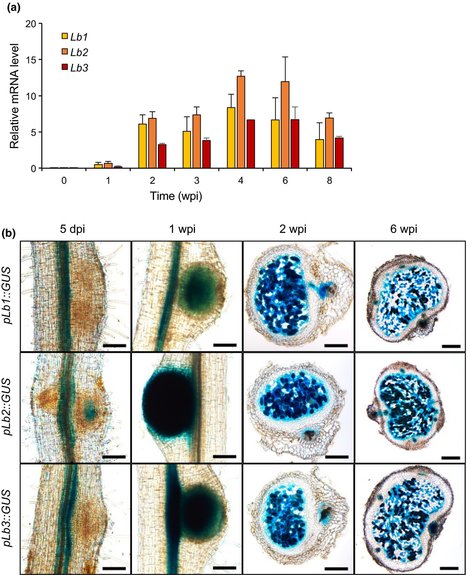
Legume nodules contain high concentrations of leghemoglobins (Lbs) encoded by several genes. The reason for this multiplicity is unknown.
CRISPR/Cas9 technology was used to generate stable mutants of the three Lbs of Lotus japonicus. The phenotypes were characterized at the physiological, biochemical and molecular levels. Nodules of the triple mutants were examined by electron microscopy and subjected to RNA‐sequencing (RNA‐seq) analysis.
Complementation studies revealed that Lbs function synergistically to maintain optimal N2 fixation. The nodules of the triple mutants overproduced superoxide radicals and hydrogen peroxide, which was probably linked to activation of NADPH oxidases and changes in superoxide dismutase isoforms expression. The mutant nodules showed major ultrastructural alterations, including vacuolization, accumulation of poly‐β‐hydroxybutyrate and disruption of mitochondria. RNA‐seq of c. 20 000 genes revealed significant changes in expression of carbon and nitrogen metabolism genes, transcription factors, and proteinases. Lb‐deficient nodules had c. 30–50‐fold less heme but similar transcript levels of heme biosynthetic genes, suggesting a post‐translational regulatory mechanism of heme synthesis.
We conclude that Lbs act additively in nodules and that the lack of Lbs results in early nodule senescence. Our observations also provide insight into the reprogramming of the gene expression network associated with Lb deficiency, probably as a result of uncontrolled intracellular free O2 concentration.
|
|
Scooped by
Jean-Michel Ané
September 30, 2019 5:49 PM
|
Primary infection of legumes by rhizobia involves the controlled localized enzymatic breakdown of cell walls at root hair tips. Previous studies determined the role of rhizobial CelC2 cellulase in different steps of the symbiotic interaction Rhizobium leguminosarum-Trifolium repens. Recent findings also showed that CelC2 influences early signalling events in the Ensifer meliloti-Medicago truncatula interaction. Here, we have monitored the root hair phenotypes of two legume plants, T. repens and M. sativa, upon inoculation with strains of their cognate and non-cognate rhizobial species, R. leguminosarum bv trifolii and E. meliloti, (over)expressing the CelC2 coding gene, celC. Regardless of the host, CelC2 specifically elicited ‘hole-on-the-tip’ events (Hot phenotype) in the root hair apex, consistent with the role of this endoglucanase in eroding the noncrystalline cellulose found in polarly growing cell walls. Overproduction of CelC2 also increased root hair tip redirections (RaT phenotype) events in both cognate and non-cognate hosts. Interestingly, heterologous celC expression also induced non-canonical alterations in ROS (Reactive Oxygen Species) homeostasis at root hair tips of Trifolium and Medicago. These results suggest the concurrence of shared unspecific and host-related plant responses to CelC2 during early steps of symbiotic rhizobial infection. Our data thus identify CelC2 cellulase as an important determinant of events underlying early infection of the legume host by rhizobia.
|
|
Scooped by
Jean-Michel Ané
September 29, 2019 11:04 PM
|
Over the past decades, crop yields have risen in parallel with increasing use of fossil-fuel derived nitrogen (N) fertilizers, but with concomitant negative impacts on climate and water resources. There is a need for more sustainable agricultural practices, and biological nitrogen fixation (BNF) could be part of the solution. A variety of nitrogen-fixing, epiphytic and endophytic plant growth promoting bacteria (PGPB) are known to stimulate plant growth. However, compared to the rhizobium-legume symbiosis, little mechanistic information is available as to how PGPB affect plant metabolism. Therefore, we investigated the metabolic changes in roots of the model grass species Setaria viridis upon endophytic colonization by Herbaspirillum seropedicae SmR1 (fix+) or a fix- mutant strain (SmR54), compared to uninoculated roots. Endophytic colonization of the root is highly localized and, hence, analysis of whole root segments dilutes the metabolic signature of those few cells impacted by the bacteria. Therefore, we utilized in situ laser ablation electrospray ionization mass spectrometry (LAESI-MS) to sample only those root segments at or adjacent to the sites of bacterial colonization. Metabolites involved in purine, zeatin, and riboflavin pathways were significantly more abundant in inoculated plants while metabolites indicative of nitrogen, starch, and sucrose metabolism were reduced in roots inoculated with the fix- strain or uninoculated, presumably due to N limitation. Interestingly, compounds, involved in indole-alkaloid biosynthesis were more abundant in the roots colonized by the fix- strain, perhaps reflecting a plant defense response.
|
|
Scooped by
Jean-Michel Ané
September 26, 2019 12:13 AM
|
Reporting of the actual data in graphs and plots increases transparency and enables independent evaluation. On the other hand, data summaries are often used in graphs because they aid interpretation. To democratize state-of-the-art data visualization of raw data with a selection of statistical summaries, a freely available, open-source web app was written using R/shiny that uses the ggplot2 package for generating plots. Users can to choose how to display the data and which of the data summaries to add. In addition, the 95% confidence intervals (95CIs) can be added for visual inferences. By adjusting the visibility of the layers, the visualization of the raw data and their summaries can be tuned for optimal presentation and interpretation. The app is dubbed PlotsOfData and is available at https://huygens.science.uva.nl/PlotsOfData/.
|
|
Scooped by
Jean-Michel Ané
September 25, 2019 11:34 PM
|
Recently, long noncoding RNAs (lncRNAs) have emerged as vital regulators of many biological processes in animals and plants. However, to our knowledge no investigations on plant lncRNAs which respond to arbuscular mycorrhizal (AM) fungi have been reported thus far. In this study, maize roots colonized with AM fungus were analyzed by strand-specific RNA-Seq to identify AM fungi-responsive lncRNAs and construct an associated regulatory network. A total of 1837 differentially expressed protein coding genes (DEGs) were identified from maize roots with Rhizophagus irregularis inoculation. Many AM fungi-responsive genes were homologs to MtPt4, STR, STR2, MtFatM, and enriched pathways such as fatty acid biosynthesis, response to phosphate starvation, and nitrogen metabolism are consistent with previous studies. In total, 5941 lncRNAs were identified, of which more than 3000 were new. Of those, 63 lncRNAs were differentially expressed. The putative target genes of differentially expressed lncRNAs (DELs) were mainly related to phosphate ion transmembrane transport, cellular response to potassium ion starvation, and lipid catabolic processes. Regulatory network analysis showed that DELs might be involved in the regulation of bidirectional nutrient exchange between plant and AM fungi as mimicry of microRNA targets. The results of this study can broaden our knowledge on the interaction between plant and AM fungi.
|
|
Scooped by
Jean-Michel Ané
September 25, 2019 11:31 PM
|
While mutualisms are widespread and essential in ecosystem functioning, the emergence of uncooperative cheaters threatens their stability, unless there are functional or evolutionary mechanisms limiting cheaters interactions.
Here, we evaluated the constraints upon mycoheterotrophic (MH) cheating plants in the mutualistic interaction network of autotrophic (AT) plants and arbuscular mycorrhizal fungi. For this purpose, we assembled a world-scale network of >25,000 interactions in order to investigate (i) the specialization and (ii) the phylogenetic distribution of MH or AT plants and their respective fungal partners.
We show that MH cheating repeatedly evolved in the vascular flora, suggesting low phylogenetic constraint for plants. However, MH cheaters are significantly more specialized than AT plants, and their fungi also appear more specialized and more closely related than fungi of AT plants, which suggest that cheaters are specifically isolated into modules by functional constraints
This unprecedented comparison of MH vs. AT plants thus reveals that MH cheating is most likely constrained by the specialization of phylogenetically conserved cheating-susceptible fungi, which suggests mechanisms for avoidance of these fungi. Beyond the mycorrhizal symbiosis, our approach highlights an empirical multiple-partners mutualistic system illustrating that the overall persistence of mutualism can be linked to functional constraints upon cheating emergences.
|
|
|
Scooped by
Jean-Michel Ané
October 3, 2019 2:54 PM
|
Aeschynomene indica is a semiaquatic legume that forms both stem and root nodules with rhizobia. Some A. indica rhizobia (AIRs) have been reported to nodulate the host using a Nod factor-independent pathway and possess photosynthetic abilities. To investigate the diversity and community structure of AIRs in China, a total of 300 rhizobial isolates were acquired from the root and stem nodules of A. indica grown at 4 sites in Shandong Peninsula, China. Nineteen representative strains were selected according to their recA phylogeny. With further classification in comparison with reference strains, 10 Bradyrhizobium genospecies were defined based on the 16S rRNA gene phylogeny and multilocus sequence analysis (MLSA) of housekeeping genes (HKGs) recA, atpD, glnII, dnaK, gyrB and rpoB. In addition, 6 genospecies were only found in China. No nodulation gene (nodA, nodB, nodC or nodZ) was detected in the AIRs isolates by PCR amplification and Southern blotting. Phylogenetic analysis of nifH and the photosynthesis-related gene pufLM revealed their common origins. All representative strains formed root nodules, but only 9 representative strains for 4 genospecies formed stem nodules on A. indica, indicating that the stem nodulation process of A. indica is limited to some strains. The nucleotide diversity and recombination events of the HKGs, as well as nifH and pufLM genes, showed that mutation contributes more than recombination in evolution. The distribution of dominant AIR genospecies was mainly affected by available nitrogen, organic carbon, total nitrogen and pH. Our study helps to characterize the diversity and evolution of AIRs.
|
|
Scooped by
Jean-Michel Ané
October 3, 2019 2:48 PM
|
Plants utilize hormones and other small molecules to trigger and coordinate their growth and developmental processes, adapt and respond to environmental cues, and communicate with surrounding organisms. Some of these molecules originate from carotenoids that act as universal precursors of bioactive metabolites arising through oxidation of the carotenoid backbone. This metabolic conversion produces a large set of compounds known as apocarotenoids, which includes the plant hormones abscisic acid (ABA) and strigolactones (SLs) and different signaling molecules. An increasing body of evidence suggests a crucial role of previously identified and recently discovered carotenoid-derived metabolites in the communication with arbuscular mycorrhizal (AM) fungi and the establishment of the corresponding symbiosis, which is one of the most relevant plant–fungus mutualistic interactions in nature. In this review, we provide an update on the function of apocarotenoid hormones and regulatory metabolites in AM symbiosis, highlighting their effect on both partners.
|
|
Scooped by
Jean-Michel Ané
October 3, 2019 1:40 PM
|
Fungi and plants have engaged in intimate symbioses that are globally widespread and have driven terrestrial biogeochemical processes since plant terrestrialization >500 million years ago. Recently, hitherto unknown nutritional mutualisms involving ancient lineages of fungi and nonvascular plants have been discovered, although their extent and functional significance in vascular plants remain uncertain. Here, we provide evidence of carbon-for-nitrogen exchange between an early-diverging vascular plant (Lycopodiella inundata) and Mucoromycotina (Endogonales) fine root endophyte fungi. Furthermore, we demonstrate that the same fungal symbionts colonize neighboring nonvascular and flowering plants. These findings fundamentally change our understanding of the physiology, interrelationships, and ecology of underground plant–fungal symbioses in modern terrestrial ecosystems by revealing the nutritional role of Mucoromycotina fungal symbionts in vascular plants.
|
|
Scooped by
Jean-Michel Ané
October 2, 2019 10:44 PM
|
Sulfur (S) containing molecules play an important role in symbiotic nitrogen fixation, and are critical components of nitrogenase and other iron-S proteins. S deficiency inhibits symbiotic nitrogen fixation by rhizobia. However, despite its importance, little is known about the sources of S that rhizobia utilize during symbiosis. We previously showed that Bradyrhizobium diazoefficiens USDA110T can assimilate both inorganic and organic S and that genes involved in organic S utilization are expressed during symbiosis. Here we show that a B. diazoefficiens USDA110 T insertion mutant in sulfonate monooxygenase (ssuD) is defective in nitrogen fixation. Microscopy analyses revealed that the ssuD- was defective in root hair infection and that bacteroids of the ssuD- showed degradation as compared to the wild type strain. Moreover, the ssuD- was significantly more sensitive to hydrogen peroxide-mediated oxidative stress than was the wild type strain. Taken together, these results show that the ability of rhizobia to utilize organic S plays an important role in symbiotic nitrogen fixation. Since nodules have been reported to be an important source of reduced S used during symbiosis and nitrogen fixation, further research will be needed to determine the mechanisms involved in regulation of S assimilation by rhizobia.
|
|
Scooped by
Jean-Michel Ané
October 1, 2019 2:57 PM
|
Mycorrhizas are mutually beneficial associations between soil-borne fungi and plant roots. Mycorrhizal fungi provide their host plant with essential nutrients in exchange for sugars and/or lipids. Traditionally, transport and translocation of macronutrients, including nitrogen and phosphorus, throughout the fungal mycelium and towards the host plant are well studied. However, the regulation of nutrient exchange and their contribution in the morphogenesis and development of mycorrhizas remains unclear. In this Opinion, we argue that adding micronutrients in the current models of symbiotic transport is essential to fully understand the establishment, maintenance, and functioning of mycorrhizal associations. Homeostatic mechanisms at the cellular level and the first transport proteins involved have been recently documented for zinc (Zn) in arbuscular mycorrhizal, ectomycorrhizal, and ericoid mycorrhizal fungi. Mycorrhizal plants benefit from an improved Zn status in control conditions and are better protected when environmental Zn availability fluctuates. These recent progresses are paving the way for a better understanding of micronutrient allocation in mycorrhizas. Revising our vision on the role of micronutrients, particularly of Zn, in these interactions will allow a better use of mycorrhizal fungi in sustainable agriculture and forestry, and will increase management practices in waste land, as well as in agricultural and natural ecosystems.
|
|
Scooped by
Jean-Michel Ané
September 30, 2019 8:58 PM
|
Arbuscular mycorrhizal fungi (AMF) establish symbiotic relationships with most land plants, mainly for the purpose of nutrient exchange. Many studies have revealed the regulation of processes in AMF, such as nutrient absorption from soil, metabolism and exchange with host plants, and the genes involved. However, the spatial regulation of the genes within the structures comprising each developmental stage is not well understood. Here, we demonstrate the structure-specific transcriptome of the model AMF species, Rhizophagus irregularis. We performed an ultra-low input RNA-seq analysis, SMART-seq2, comparing five extraradical structures, germ tubes, runner hyphae, branched absorbing structures (BAS), immature spores and mature spores. In addition, we reanalyzed the recently reported RNA-seq data comparing intraradical mycelium and arbuscule. Our analyses captured the distinct features of each structure and revealed the structure-specific expression patterns of genes related to nutrient transport and metabolism. Of note, the transcriptional profiles suggest distinct functions of BAS in nutrient absorption. These findings provide a comprehensive dataset to advance our understanding of the transcriptional dynamics of fungal nutrition in this symbiotic system.
|
|
Scooped by
Jean-Michel Ané
September 30, 2019 8:47 PM
|
Inferring gene trees is difficult because alignments are often too short, and thus contain insufficient signal, while substitution models inevitably fail to capture the complexity of the evolutionary processes. To overcome these challenges species tree-aware methods seek to use information from a putative species tree. However, there are few methods available that implement a full likelihood framework or account for horizontal gene transfers. Furthermore, these methods often require expensive data pre-processing (e.g., computing bootstrap trees), and rely on approximations and heuristics that limit the exploration of tree space. Here we present GeneRax, the first maximum likelihood species tree-aware gene tree inference software. It simultaneously accounts for substitutions at the sequence level and gene level events, such as duplication, transfer and loss and uses established maximum likelihood optimization algorithms. GeneRax can infer rooted gene trees for an arbitrary number of gene families, directly from the per-gene sequence alignments and a rooted, but undated, species tree. We show that compared to competing tools, on simulated data GeneRax infers trees that are the closest to the true tree in 90% of the simulations in terms relative Robinson-Foulds distance. While, on empirical datasets, GeneRax is the fastest among all tested methods when starting from aligned sequences, and that it infers trees with the highest likelihood score, based on our model. GeneRax completed tree inferences and reconciliations for 1099 Cyanobacteria families in eight minutes on 512 CPU cores. Thus, its advanced parallelization scheme enables large-scale analyses. GeneRax is available under GNU GPL at https://github.com/BenoitMorel/GeneRax.
|
|
Scooped by
Jean-Michel Ané
September 30, 2019 5:51 PM
|
Small guide RNA (sgRNA) is an important component of the CRISPR/Cas9 system. The gene editing efficiency of the CRISPR/Cas9 system could be enhanced by using highly active U6 promoters to drive the expression of sgRNA. Therefore, we constructed various expression vectors based on the 11 GmU6 promoters predicted and cloned in the whole soybean genome. The expression of truncated GUS driven by 11 GmU6 promoters was tested in hairy roots and by Arabidopsis thaliana transformation. The results indicated that higher transcriptional levels were driven by 5 GmU6 promoters (GmU6-4, GmU6-7, GmU6-8, GmU6-10 and GmU6-11) in both soybean hairy roots and Arabidopsis thaliana. In addition, three genes, Glyma03g36470, Glyma14g04180 and Glyma06g136900, were selected as targets to detect the transcriptional levels of multiple GmU6 promoters. Mutations in these three genes were detected in soybean hairy roots after Agrobacterium rhizogenes infection, indicating efficient target gene editing, including nucleotide insertion, deletion, and substitution. Mutation efficiencies differed among the 11 GmU6 promoters, ranging from 2.8% to 20.6%, and markedly higher efficiencies were obtained with all three genes using the GmU6-8 (20.3%) and GmU6-10 (20.6%) promoters. These two GmU6 promoters also showed higher ability to drive truncated GUS transcription in both soybean hairy roots and transformed Arabidopsis thaliana. These results will help to construct an efficient CRISPR-Cas9 gene editing system and promote the application of the CRISPR-Cas9 genome editing system in soybean molecular breeding.
|
|
Scooped by
Jean-Michel Ané
September 30, 2019 5:48 PM
|
Actinorhizal nodules are structurally different from legume nodules and show a greater similarity to lateral roots. Because of the important role of auxins in lateral root and nodule formation, auxin profiles were examined in roots and nodules of the actinorhizal species Datisca glomerata and the model legume Medicago truncatula. The auxin response in roots and nodules of both species was analyzed in transgenic root systems expressing a beta-glucuronidase gene under control of the synthetic auxin-responsive promoter DR5. The effects of two different auxin on root development were compared for both species. The auxin present in nodules at the highest levels was phenylacetic acid (PAA). No differences were found between the concentrations of active auxins of roots vs. nodules, while levels of the auxin conjugate indole-3-acetic acid-alanine were increased in nodules compared to roots of both species. Because auxins typically act in concert with cytokinins, cytokinins were also quantified. Concentrations of cis-zeatin and some glycosylated cytokinins were dramatically increased in nodules compared to roots of D. glomerata, but not of M. truncatula. The ratio of active auxins to cytokinins remained similar in nodules compared to roots in both species. The auxin response, as shown by the activation of the DR5 promoter, seemed significantly reduced in nodules compared to roots of both species, suggesting the accumulation of auxins in cell types that do not express the signal transduction pathway leading to DR5 activation. Effects on root development were analyzed for the synthetic auxin naphthaleneacetic acid (NAA) and PAA, the dominant auxin in nodules. Both auxins had similar effects, except that the sensitivity of roots to PAA was lower than to NAA. However, while the effects of both auxins on primary root growth were similar for both species, effects on root branching were different: both auxins had the classical positive effect on root branching in M. truncatula, but a negative effect in D. glomerata. Such a negative effect of exogenous auxin on root branching has previously been found for a cucurbit that forms lateral root primordia in the meristem of the parental root; however, root branching in D. glomerata does not follow that pattern.
|
|
Scooped by
Jean-Michel Ané
September 29, 2019 12:17 PM
|
I recently saw an old friend for the first time in many years. We had been Ph.D. students at the same time, both studying science, although in different areas. She later dropped out of graduate school, went to Harvard Law School and is now a senior lawyer for a major environmental organization. At some point, the conversation turned to why she had left graduate school. To my utter astonishment, she said it was because it made her feel stupid. After a couple of years of feeling stupid every day, she was ready to do something else.
|
|
Scooped by
Jean-Michel Ané
September 25, 2019 11:36 PM
|
Fusarium solani produces differential effects on two Lotus species. It shows growth promotion in Lotus japonicus while impairing it in L. tenuis.
•Net Photosynthesis is increased in L. japonicus upon F. solani inoculation, while PSII activity is not affected in both plant species.
•The amount of sugars in leaves and roots upon F. solani inoculation varies according to the plant species.
•The differential effects on plant growth are not correlated with nutrient uptake in both Lotus species.
|
|
Scooped by
Jean-Michel Ané
September 25, 2019 11:31 PM
|
Symbiotic nitrogen fixation carried out by the interaction between legumes and diazotrophic bacteria known as rhizobia requires of relatively large levels of transition metals. These elements act as cofactors of many key enzymes involved in this process. Metallic micronutrients are obtained from soil by the roots and directed to sink organs by the vasculature, in a process participated by a number of metal transporters and small organic molecules that mediate metal delivery in the plant fluids. Among the later, nicotianamine is one of the most important. Synthesized by nicotianamine synthases (NAS), this non-proteinogenic amino acid forms metal complexes participating in intracellular metal homeostasis and long-distance metal trafficking. Here we characterized the NAS2 gene from model legume Medicago truncatula. MtNAS2 is located in the root vasculature and in all nodule tissues in the infection and fixation zones. Symbiotic nitrogen fixation requires of MtNAS2 function, as indicated by the loss of nitrogenase activity in the insertional mutant nas2-1, a phenotype reverted by reintroduction of a wild-type copy of MtNAS2. This would be the result of the altered iron distribution in nas2-1 nodules, as indicated by X-ray fluorescence studies. Moreover, iron speciation is also affected in these nodules. These data suggest a role of nicotianamine in iron delivery for symbiotic nitrogen fixation.
|