Your new post is loading...

|
Scooped by
Jean-Michel Ané
September 25, 2019 11:27 PM
|
Nitric oxide (NO) is a crucial signaling molecule that conveys its bioactivity mainly through protein S-nitrosylation. This is a reversible post-translational modification (PTM) that may affect protein function. S-nitrosoglutathione (GSNO) is a cellular NO reservoir and NO donor in protein S-nitrosylation. The enzyme S-nitrosoglutathione reductase (GSNOR) degrades GSNO, thereby regulating indirectly signaling cascades associated to this PTM. Here the two GSNORs of the legume Lotus japonicus, LjGSNOR1 and LjGSNOR2, have been functionally characterized. The LjGSNOR1 gene is very active in leaves and roots, whereas LjGSNOR2 is highly expressed in nodules. The enzyme activities are regulated in vitro by redox-based PTMs. Reducing conditions and hydrogen sulfide-mediated cysteine persulfidation induced both activities, whereas cysteine oxidation or glutathionylation inhibited them. Ljgsnor1 knockout mutants contained higher levels of S-nitrosothiols. Affinity chromatography and subsequent shotgun proteomics allowed us to identify 19 proteins that are differentially S-nitrosylated in the mutant and the wild-type. These include proteins involved in biotic stress, protein degradation, antioxidant protection and photosynthesis. We propose that, in the mutant plants, deregulated protein S-nitrosylation contributes to developmental alterations, such as growth inhibition, impaired nodulation and delayed flowering and fruiting. Our results highlight the importance of GSNOR function in legume biology.
|
|
Scooped by
Jean-Michel Ané
September 21, 2019 6:51 PM
|
Medicago truncatula was proposed, about three decades ago, as a model legume to study the Rhizobium-legume symbiosis. It has now been adopted to study a wide range of biological questions, including various developmental processes (in particular root, symbiotic nodule and seed development), symbiotic (nitrogen-fixing and arbuscular mycorrhizal endosymbioses) and pathogenic interactions, as well as responses to abiotic stress. With a number of tools and resources set up in M. truncatula for omics, genetics, and reverse genetics approaches, massive amounts of data have been produced, as well as four genome sequence releases. Many of these data were generated with heterogeneous tools, notably for transcriptomics studies, and are consequently difficult to integrate. This issue is addressed by the LeGOO knowledge base (https://www.legoo.org), which finds the correspondence between the multiple identifiers of a same gene. Furthermore, an important goal of LeGOO is to collect and represent biological information from peer-reviewed publications, whatever the technical approaches used to obtain this information. The information is modelled in a graph-oriented database, which enables flexible representation, with currently over 200,000 relations retrieved from 298 publications. LeGOO also provides the user with mining tools, including links to the Mt5.0 genome browser and associated information (on gene functional annotation, expression, methylome, natural diversity and available insertion mutants), as well as tools to navigate through different model species. LeGOO is therefore an innovative database that will be useful to the Medicago and legume community to better exploit the wealth of data produced on this model species.
|
|
Scooped by
Jean-Michel Ané
September 20, 2019 3:00 PM
|
Dispersal of mycorrhizal fungi via animals and the importance for the interacting partners’ life history as well as for ecosystems is an understudied topic. In this review, we describe the available evidence and the most important knowledge gaps and finally suggest ways to gain the missing information. So far, 33 articles have been published proving a successful transfer of mycorrhizal propagules by animals. The vast majority of research on invertebrates was focused on arbuscular mycorrhizal (AM) fungi, whereas papers on vertebrates (mainly rodents and artiodactyls) equally addressed ectomycorrhizal (ECM) and AM fungi. Effective dispersal has been mostly shown by the successful inoculation of bait plants and less commonly by spore staining or germination tests. Based on the available data and general knowledge on animal lifestyles, collembolans and oribatid mites may be important in transporting ECM fungal propagules by ectozoochory, whereas earthworms, isopods, and millipedes could mainly transfer AM fungal spores in their gut systems. ECM fungal distribution may be affected by mycophagous dipterans and their hymenopteran parasitoids, while slugs, snails, and beetles could transport both mycorrhizal groups. Vertebrates feeding on fruit bodies were shown to disperse mainly ECM fungi, while AM fungi are transported mostly accidentally by herbivores. The important knowledge gaps include insufficient information on dispersal of fungal propagules other than spores, the role of invertebrates in the dispersal of mycorrhizal fungi, the way in which propagules pass through food webs, and the spatial distances reached by different dispersal mechanisms both horizontally and vertically.
|
|
Scooped by
Jean-Michel Ané
September 20, 2019 2:56 PM
|
Aims
We applied for the first time a high-throughput transcriptome approach to elucidate biochemical and physiological mechanisms controlling early events in the interaction between maize seedlings and different beneficial diazotrophic bacteria.
Methods
mRNA transcriptomes from maize (Zea mays L.) seedlings were characterized seven days after inoculation with Azospirillum brasilense sp245 and Herbaspirillum seropedicae HRC54. The expression profiles of selected genes were validated by quantitative reverse transcription–polymerase chain reaction analysis.
Results
Transcriptome profiling revealed a total of 764 and 3595 differentially expressed genes (DEGs) in maize when exclusively associated with A. brasilense and H. seropedicae, respectively, whereas 455 DEGs were shared by both treatments. Our results support the modulation of the host nitrogen metabolism and phytohormone responses by both diazotrophic bacteria as well as distinct activation of host immune responses.
Conclusions
Diazotrophic bacteria modulate maize metabolism, with some common responses to both beneficial bacteria, while others are specific to each bacterial species. This study provides a valuable contribution on how these beneficial bacteria might amend host metabolism to improve growth and fitness.
|
|
Scooped by
Jean-Michel Ané
September 20, 2019 2:47 PM
|
Assembling composite DNA modules from custom DNA parts has become routine due to recent technological breakthroughs such as Golden Gate modular cloning. Using Golden Gate, one can efficiently assemble custom transcription units and piece units together to generate higher-order assemblies. Although Golden Gate cloning systems have been developed to assemble DNA plasmids required for experimental work in model species, they are not typically applicable to organisms from other kingdoms. Consequently, a typical molecular biology laboratory working across kingdoms must use multiple cloning strategies to assemble DNA constructs for experimental assays. To simplify the DNA assembly process, we developed a multi-kingdom (MK) Golden Gate assembly platform for experimental work in species from the kingdoms Fungi, Eubacteria, Protista, Plantae, and Animalia. Plasmid backbone and part overhangs are consistent across the platform, saving both time and resources in the laboratory. We demonstrate the functionality of the system by performing a variety of experiments across kingdoms including genome editing, fluorescence microscopy, and protein interaction assays. The versatile MK system therefore streamlines the assembly of modular DNA constructs for biological assays across a range of model organisms.
|
|
Scooped by
Jean-Michel Ané
September 17, 2019 3:34 PM
|
The ability of photosynthetic algae to enter the hyphae of a soil fungus could tell us more about the evolution of these species and their potential for applications in the production of biofuel.
|
|
Scooped by
Jean-Michel Ané
September 17, 2019 3:16 PM
|
Background and Objective: Arbuscular mycorrhizal fungi (AMF) and rhizobia stimulated biological N-fixing in leguminous plants. This work was aimed to analyze the effects of single and dual inoculation with AMF and rhizobia on growth and mineral nutritional acquisition (especially N) in white clover (Trifolium repens L.). Materials and Methods: An arbuscular mycorrhizal fungus Rhizoglomus intraradices and a rhizobia Rhizobium trifolii were inoculated into rhizosphere of potted white clover and plant growth, soluble sugar, soluble protein, leghemoglobin, mineral nutrition and soil glomalin concentrations were analyzed after 100 days of inoculations. Results: Rhizobium trifolii inoculation positively promoted root mycorrhizal colonization. Single AMF or rhizobia treatment significantly increased the number of stolon joints and root biomass, which was related with symbiont-stimulated increases of soluble sugar and soluble protein. A higher root leghemoglobin concentration was found in -AMF+Rh plants than in non-inoculated plants. The AMF or rhizobia inoculation mainly promoted leaf nutrition acquisition including N. Conclusion: So, it was concluded that AMF and rhizobia jointly stimulated plant growth, root soluble sugar and soluble protein accumulation in white clover, while AMF did not show a cooperative effect on N fixation of rhizobia.
|
|
Scooped by
Jean-Michel Ané
September 15, 2019 9:30 PM
|
Protein phosphorylation is a post-translational modification with widespread regulatory roles in both eukaryotes and prokaryotes. Using mass spectrometry, we performed a genome wide investigation of protein phosphorylation in the non-model organism and biofuel producer Zymomonas mobilis under anaerobic, aerobic, and N2-fixing conditions. Our phosphoproteome analysis revealed 125 unique phosphorylated proteins, belonging to major pathways such as glycolysis, TCA cycle, electron transport, nitrogen metabolism, and protein synthesis. Quantitative analysis revealed significant and widespread changes in protein phosphorylation across growth conditions. For example, we observed increased phosphorylation of nearly all glycolytic enzymes and a large fraction of ribosomal proteins during aerobic and N2-fixing conditions. We also observed substantial changes in the phosphorylation status of enzymes and regulatory proteins involved in nitrogen fixation and ammonia assimilation during N2-fixing conditions, including nitrogenase, the Rnf electron transport complex, the transcription factor NifA, GS-GOGAT cycle enzymes, and the PII regulatory protein. This suggested that protein phosphorylation may play an important role at regulating all aspects of nitrogen metabolism in Z. mobilis. This study provides new knowledge regarding the specific pathways and cellular processes that may be regulated by protein phosphorylation in this important industrial organism and provides a useful road map for future experiments that investigate the physiological role of specific phosphorylation events in Z. mobilis.
|
|
Scooped by
Jean-Michel Ané
September 15, 2019 9:27 PM
|
Arbuscular mycorrhizal (AM) fungi are important symbionts to most of the terrestrial plants. Recent genome sequencing projects revealed that many AM fungi have repetitive genetic elements in their genomes and among these repetitive genetic elements, cut-and-paste DNA transposable elements were very prevalent. For example, in Rhizophagus irregularis, up to 21% of the genome assembly content was associated with cut-and-paste DNA transposable elements. In Diversispora epigaea, up to 23% of the genome content can also be attributed to cut-and-paste DNA transposable elements. While cut-and-paste DNA transposable elements are very abundant in AM fungi, detailed studies on these repetitive elements have been lacking. In this study, we revealed the diversity of cut-and-paste DNA transposable elements in Claroideoglomus claroideum and identified many potentially autonomous transposable elements in the genome assembly of C. claroideum. The evolutionary relationship between the DNA transposons we identified and the established sequences in public databases were also investigated.
|
|
Scooped by
Jean-Michel Ané
September 15, 2019 1:11 PM
|
Arbuscular mycorrhizal fungi (AMF) play a central role in rhizosphere functioning as they interact with both plants and soil microbial communities. The conditions in which AMF modify plant physiology and microbial communities in the rhizosphere are still poorly understood. In the present study, four different plant species, (clover, alfalfa, ryegrass, tall fescue) were cultivated in either sterilized (γ ray) or non-sterilized soil and either inoculated with a commercial AMF (Glomus LPA Val 1.) or not. After 20 weeks of cultivation, the mycorrhizal rate and shoot and root biomasses were measured. The abundance and composition of bacteria, archaea, and fungi were analyzed, respectively, by quantitative PCR (qPCR) and fingerprinting techniques. Whilst sterilization did not change the AMF capacity to modify plant biomass, significant changes in microbial communities were observed, depending on the taxon and the associated plant. AMF inoculation decreases both bacterial and archaeal abundance and diversity, with a greatest extent in sterilized samples. These results also show that AMF exert different selections on soil microbial communities according to the plant species they are associated with. This study suggests that the initial abundance and diversity of rhizosphere microbial communities should be considered when introducing AMF to cultures.
|
|
Scooped by
Jean-Michel Ané
September 15, 2019 1:09 PM
|
Nitrogen is the element that most often limits plant growth and development. Common agricultural practices rely on the application of large quantities of industrially-produced nitrogen fertilizer, which poses a worldwide environmental threat. Sustainable agriculture encourages the use of biologically fixed nitrogen. However, access to this is still limited to a restricted group of dicotyledonous plants that share among them the ability to form a root nodule symbiosis. After an intricate molecular dialogue, these plants accommodate in the cells of a newly root-derived organ - the nodule - a class of bacteria that produce the nitrogenase enzyme by which they are able to reduce di-nitrogen from air to bioavailable ammonia. This mutualism allows the plant access to nitrogen in exchange for carbon. This thesis focuses particularly on the actinorhizal symbioses established between the North American plant Datisca glomerata (Datiscaceae, Cucurbitales) and Frankia actinobacteria from cluster II (Frankiaceae, Frankiales).
|
|
Scooped by
Jean-Michel Ané
September 14, 2019 1:01 AM
|
Background
The LysM receptor-like kinases (LysM-RLKs) are important to both plant defense and symbiosis. Previous studies described three clades of LysM-RLKs: LysM-I/LYKs (10+ exons per gene and containing conserved kinase residues), LysM-II/LYRs (1–5 exons per gene, lacking conserved kinase residues), and LysM-III (two exons per gene, with a kinase unlike other LysM-RLK kinases and restricted to legumes). LysM-II gene products are presumably not functional as conventional receptor kinases, but several are known to operate in complexes with other LysM-RLKs. One aim of our study was to take advantage of recently mapped wild tomato transcriptomes to evaluate the evolutionary history of LysM-RLKs within and between species. The second aim was to place these results into a broader phylogenetic context by integrating them into a sequence analysis of LysM-RLKs from other functionally well-characterized model plant species. Furthermore, we sought to assess whether the Group III LysM-RLKs were restricted to the legumes or found more broadly across Angiosperms.
Results
Purifying selection was found to be the prevailing form of natural selection within species at LysM-RLKs. No signatures of balancing selection were found in species-wide samples of two wild tomato species. Most genes showed a greater extent of purifying selection in their intracellular domains, with the exception of SlLYK3 which showed strong purifying selection in both the extracellular and intracellular domains in wild tomato species. The phylogenetic analysis did not reveal a clustering of microbe/functional specificity to groups of closely related proteins. We also discovered new putative LysM-III genes in a range of Rosid species, including Eucalyptus grandis.
Conclusions
The LysM-III genes likely originated before the divergence of E. grandis from other Rosids via a fusion of a Group II LysM triplet and a kinase from another RLK family. SlLYK3 emerges as an especially interesting candidate for further study due to the high protein sequence conservation within species, its position in a clade of LysM-RLKs with distinct LysM domains, and its close evolutionary relationship with LYK3 from Arabidopsis thaliana.
|
|
Scooped by
Jean-Michel Ané
September 14, 2019 12:56 AM
|
Legumes engage in symbiosis with nitrogen-fixing soil bacteria, collectively called rhizobia, under nitrogen-limited conditions. In many legumes, the root invasion of rhizobia is mediated by infection threads (ITs), tubular invaginations of the host cell wall and plasma membrane, developed from infection foci of deformed root hairs. IT formation is regulated by a series of signal transduction in host root. Nodulation signals activate the host transcription factor (TF), CYCLOPS, which directly induces expression of two TF genes, ERF REQUIRED FOR NODULATION1 (ERN1) and NODULE INCEPTION (NIN), essential for IT development. Here, we explored the relationship among these three symbiotic TF genes in the model legume Lotus japonicus and examined how their interplay contributes to IT formation. qRT-PCR analysis showed that NIN expression induced by rhizobial infection was attenuated in ern1-1, and further declined in cyclops-3 ern1-1. ERN1 overexpression led to induction of NIN expression in cyclops-3 ern1-1 in the presence of rhizobia. Thus, in addition to CYCLOPS, ERN1 is able to increase the NIN expression level depending on infection. Furthermore, consistent with this transcriptional hierarchy, ectopic expression of ERN1 as well as NIN suppressed the IT-deficient cyclops-3 phenotype, but ERN1 failed to confer ITs in the nin-2 root. However, the ern1-1 symbiotic epidermal phenotype was not suppressed by the NIN ectopic expression. The cyclops-3 ern1-1 double mutant was less sensitive to rhizobial infection than the single mutants and defective in the symbiotic root hair response at earlier stages. This more severe phenotype of the double mutant suggests a role for ERN1 that independent of the CYCLOPS-mediated transcriptional regulation. We conclude that ERN1 is involved in regulating NIN expression in addition to CYCLOPS, and these TFs coordinately promote the symbiotic root hair response and IT development. Our data help to reveal the extensive role of ERN1 in root nodule symbiosis signaling.
|
|
|
Scooped by
Jean-Michel Ané
September 25, 2019 4:58 PM
|
Plants establish symbiotic relationships with soil bacteria or fungi, which colonize the plant root and provide the plant with inorganic nutrients, in exchange for photosynthesis products. Legume plants associate with both arbuscular mycorrhizal fungi (AMF) and the nitrogen-fixing soil bacteria called rhizobia. During the legume-rhizobium symbiosis, biological nitrogen fixation takes place in specific plants organs formed on the root, called nodules. Using the model legume Lotus japonicus, we studied the establishment of the legume-rhizobia-AMF tripartite symbiosis. We examined how the AM fungus Rhizophagus irregularis and the rhizobium Mesorhizobium loti affected one another during the colonization of the same legume roots, by performing co-inoculations. Moreover, we monitored the effect of the co-inoculation on the general plant performance. According to our results, the presence of M. loti had no effect on the root colonization by R. irregularis. However, root colonization by R. irregularis had a positive effect on the formation of root nodules. This study aims to enhance our understanding on how the plant selects, combines and controls its symbionts, towards to a more efficient use of legume plants in agroecosystems.
|
|
Scooped by
Jean-Michel Ané
September 21, 2019 6:47 PM
|
The phylogenetic depth at which arbuscular mycorrhizal (AM) fungi harbor a coherent ecological niche is unknown, which has consequences for operational taxonomic unit (OTU) delineation from sequence data and the study of their biogeography.
We tested how changes in AM fungi community composition across habitats (beta diversity) vary with OTU phylogenetic resolution. We inferred exact sequence variants (ESVs) to resolve phylotypes at resolutions finer than provided by traditional sequence clustering and analyzed beta diversity profiles up to order‐level sequence clusters.
At the ESV level, we detected the environmental predictors revealed with traditional OTUs or at higher genetic distances. However, the correlation between environmental predictors and community turnover steeply increased at a genetic distance of c. 0.03 substitutions per site. Furthermore, we observed a turnover of either closely or distantly related taxa (respectively at or above 0.03 substitutions per site) along different environmental gradients.
This study suggests that different axes of AM fungal ecological niche are conserved at different phylogenetic depths. Delineating AM fungal phylotypes using DNA sequences should screen different phylogenetic resolutions to better elucidate the factors that shape communities and predict the fate of AM symbioses in a changing environment.
|
|
Scooped by
Jean-Michel Ané
September 20, 2019 2:58 PM
|
The expansion of plants onto land necessitated the evolution of robust defense strategies to protect against a wide array of microbial invaders. Whereas host responses to microbial colonization are extensively explored in evolutionarily young land plant lineages such as angiosperms, we know relatively little about plant-pathogen interactions in early-diverging land plants thought to better represent the ancestral state. Here, we define the transcriptional and proteomic response of the early-divergent liverwort Marchantia polymorpha to infection with the oomycete pathogen Phytophthora palmivora. We uncover a robust molecular response to oomycete colonization in Marchantia that consists of conserved land plant gene families. Direct macroevolutionary comparisons of host infection responses in Marchantia and the model angiosperm Nicotiana benthamiana further reveal a shared set of orthologous microbe-responsive genes that include members of the phenylpropanoid metabolic pathway. In addition, we identify a role for the Marchantia R2R3-MYB transcription factor MpMyb14 in activating phenylpropanoid (flavonoid) biosynthesis during oomycete infection. Mpmyb14 mutants infected with P. palmivora fail to activate phenylpropanoid biosynthesis gene expression and display enhanced disease susceptibility compared to wild-type plants. Conversely, the ectopic induction of MpMyb14 led to the accumulation of anthocyanin-like pigments and dramatically enhanced liverwort resistance to P. palmivora infection. Collectively, our results demonstrate that the Marchantia response to oomycete infection displays evolutionarily conserved features indicative of an ancestral pathogen deterrence strategy centered on phenylpropanoid-mediated biochemical defenses.
|
|
Scooped by
Jean-Michel Ané
September 20, 2019 2:53 PM
|
Background and Aims
Arbuscular mycorrhizal (AM) symbiosis begins with molecular signal communication (MSC) between AM fungi and the roots of the host plant. We aimed to test the hypothesis that the transcriptional profiles of wheat roots can be changed significantly by AM symbiotic signals, without direct contact.
Methods
Non-mycorrhizal (NM) and MSC treatments involved burying filter membrane bags containing sterilized and un-sterilized inoculum of the AM fungus Rhizophagus irregularis, respectively. The bags physically separated roots and AM structures but allowed molecular signals to pass through. Extracted RNA from wheat roots was sequenced by high-throughput sequencing.
Results
Shoot total nitrogen and phosphorus content of wheat plants was decreased by the MSC treatment. A total of 2360 differentially expressed genes (DEGs), including 1888 up-regulated DEGs and 472 down-regulated DEGs, were found dominantly distributed on chromosomes 2A, 2B, 2D, 3B, 5B and 5D. The expression of 59 and 121 genes was greatly up- and down-regulated, respectively. Only a portion of DEGs could be enriched into known terms during gene ontology analysis, and were mostly annotated to ‘catalytic activity’, ‘protein metabolic process’ and ‘membrane’ in the molecular function, biological process and cellular component ontology categories, respectively. More than 120 genes that may be involved in key processes during AM symbiosis development were regulated at the pre-physical contact stages.
Conclusions
The transcriptional profiles of wheat roots can be changed dramatically by MSC. Much of the information provided by our study is of great importance for understanding the mechanisms underlying the development of AM symbiosis.
|
|
Scooped by
Jean-Michel Ané
September 19, 2019 11:29 PM
|
To overcome nitrogen deficiencies in the soil, legumes enter symbioses with rhizobial bacteria that convert atmospheric nitrogen into ammonium. Rhizobia are accommodated as endosymbionts within lateral root organs called nodules that initiate from the inner layers of Medicago truncatula roots in response to rhizobial perception. In contrast, lateral roots emerge from predefined founder cells as an adaptive response to environmental stimuli, including water and nutrient availability. CYTOKININ RESPONSE 1 (CRE1)-mediated signaling in the pericycle and in the cortex is necessary and sufficient for nodulation, whereas cytokinin is antagonistic to lateral root development, with cre1 showing increased lateral root emergence and decreased nodulation. To better understand the relatedness between nodule and lateral root development, we undertook a comparative analysis of these two root developmental programs. Here, we demonstrate that despite differential induction, lateral roots and nodules share overlapping developmental programs, with mutants in LOB-DOMAIN PROTEIN 16 (LBD16) showing equivalent defects in nodule and lateral root initiation. The cytokinin-inducible transcription factor NODULE INCEPTION (NIN) allows induction of this program during nodulation through activation of LBD16 that promotes auxin biosynthesis via transcriptional induction of STYLISH (STY) and YUCCAs (YUC). We conclude that cytokinin facilitates local auxin accumulation through NIN promotion of LBD16, which activates a nodule developmental program overlapping with that induced during lateral root initiation.
|
|
Scooped by
Jean-Michel Ané
September 17, 2019 3:25 PM
|
Legume plants have colonized almost all terrestrial biotopes. Their ecological success is partly due to the selective advantage provided by their symbiotic association with nitrogen-fixing bacteria called rhizobia, which allow legumes to thrive on marginal lands and nitrogen depleted soils where non-symbiotic plants cannot grow. Additionally, their symbiotic capacities result in a high protein content in their aerial parts and seeds. This interesting nutritional value has led to the domestication and agricultural exploitation of several legumes grown for seeds and/or fodder for human and domestic animal consumption. Several cultivated legume species are thus grown far beyond their natural geographic range. Other legume species have become invasives, spreading into new habitats. The cultivation and establishment of legume species outside of their original range requires either that they are introduced or cultivated along with their original symbiotic partner or that they find an efficient symbiotic partner in their introduced habitat. The peanut, Arachis hypogaea, a native of South America, is now cultivated throughout the world. This species forms root nodules with Bradyrhizobium, but it is unclear whether these came with the seeds from their native range or were acquired locally. Here we propose to investigate the phylogeography of Bradyrhizobium spp. associated with a number of different wild and cultivated legume species from a range of geographical areas, including numerous strains isolated from peanut roots across the areas of peanut cultivation. This will allow us to address the question of whether introduced/cultivated peanuts associate with bacteria from their original geographic range, i.e., were introduced together with their original bacterial symbionts, or whether they acquired their current associations de novo from the bacterial community within the area of introduction. We will base the phylogenetic analysis on sequence data from both housekeeping and core genes and a symbiotic gene (nif). Differences between the phylogenetic signal of symbiotic and non-symbiotic genes could result from horizontal transfer of symbiosis capacity. Thus this study will also allow us to elucidate the processes by which this symbiotic association has evolved within this group of Bradyrhizobium spp.
|
|
Scooped by
Jean-Michel Ané
September 17, 2019 3:16 PM
|
Cultivated soybean (Glycine max) carrying the Rj2 allele restricts nodulation with specific Bradyrhizobium strains via host immunity, mediated by rhizobial type III secretory protein NopP and the host resistance protein Rj2. Here we found that the single isoleucine residue I490 in Rj2 is required for induction of symbiotic incompatibility. Furthermore, we investigated the geographical distribution of the Rj2-genotype soybean in a large set of germplasm by single nucleotide polymorphism (SNP) genotyping using a SNP marker for I490. By allelic comparison of 79 accessions in the Japanese soybean mini-core collection, we suggest substitution of a single amino acid residue (R490 to I490) in Rj2 induces symbiotic incompatibility with Bradyrhizobium diazoefficiens USDA 122. The importance of I490 was verified by complementation of rj2-soybean by the dominant allele encoding the Rj2 protein containing I490 residue. The Rj2 allele was also found in Glycine soja, the wild progenitor of G. max, and their single amino acid polymorphisms were associated with the Rj2-nodulation phenotype. By SNP genotyping against 1583 soybean accessions, we detected the Rj2-genotype in 5.4% of G. max and 7.7% of G. soja accessions. Distribution of the Rj2-genotype soybean plants was relatively concentrated in the temperate Asian region. These results provide important information about the mechanism of host genotype-specific symbiotic incompatibility mediated by host immunity and suggest that the Rj2 gene has been maintained by environmental conditions during the process of soybean domestication.
|
|
Scooped by
Jean-Michel Ané
September 15, 2019 9:27 PM
|
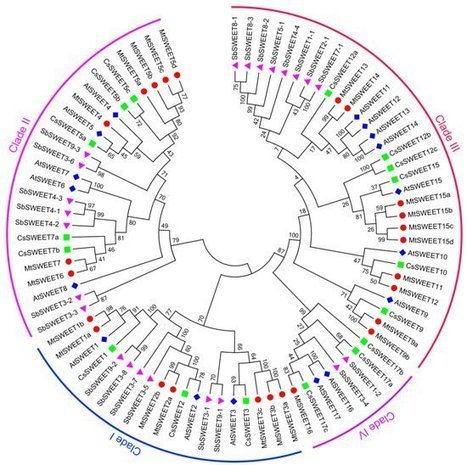
SWEET (Sugars Will Eventually be Exported Transporter) proteins mediate the translocation of sugars across cell membranes and play crucial roles in plant growth and development as well as stress responses. In this study, a total of 25 SWEET genes were identified from the Medicago truncatula genome and were divided into four clades based on the phylogenetic analysis. The MtSWEET genes are distributed unevenly on the M. truncatula chromosomes, and eight and 12 MtSWEET genes are segmentally and tandemly duplicated, respectively. Most MtSWEET genes contain five introns and encode proteins with seven transmembrane helices (TMHs). Besides, nearly all MtSWEET proteins have relatively conserved membrane domains, and contain conserved active sites. Analysis of microarray data showed that some MtSWEET genes are specifically expressed in disparate developmental stages or tissues, such as flowers, developing seeds and nodules. RNA-seq and qRT-PCR expression analysis indicated that many MtSWEET genes are responsive to various abiotic stresses such as cold, drought, and salt treatments. Functional analysis of six selected MtSWEETs in yeast revealed that they possess diverse transport activities for sucrose, fructose, glucose, galactose, and mannose. These results provide new insights into the characteristics of the MtSWEET genes, which lay a solid foundation for further investigating their functional roles in the developmental processes and stress responses of M. truncatula. View Full-Text
|
|
Scooped by
Jean-Michel Ané
September 15, 2019 1:13 PM
|
Arbuscular mycorrhiza (AM) is known to be a mutually beneficial plant-fungal symbiosis; however, the effect of mycorrhization is heavily dependent on multiple biotic and abiotic factors. Therefore, for the proper employment of such plant-fungal symbiotic systems in agriculture, a detailed understanding of the molecular basis of the plant developmental response to mycorrhization is needed. The aim of this work was to uncover the physiological and metabolic alterations in pea (Pisum sativum L.) leaves associated with mycorrhization at key plant developmental stages. Plants of pea cv. Finale were grown in constant environmental conditions under phosphate deficiency. The plants were analyzed at six distinct time points, which corresponded to certain developmental stages of the pea: I: 7 days post inoculation (DPI) when the second leaf is fully unfolded with one pair of leaflets and a simple tendril; II: 21 DPI at first leaf with two pairs of leaflets and a complex tendril; III: 32 DPI when the floral bud is enclosed; IV: 42 DPI at the first open flower; V: 56 DPI when the pod is filled with green seeds; and VI: 90–110 DPI at the dry harvest stage. Inoculation with Rhizophagus irregularis had no effect on the fresh or dry shoot weight, the leaf photochemical activity, accumulation of chlorophyll a, b or carotenoids. However, at stage III (corresponding to the most active phase of mycorrhiza development), the number of internodes between cotyledons and the youngest completely developed leaf was lower in the inoculated plants than in those without inoculation. Moreover, inoculation extended the vegetation period of the host plants, and resulted in increase of the average dry weight per seed at stage VI. The leaf metabolome, as analyzed with GC-MS, included about three hundred distinct metabolites and showed a strong correlation with plant age, and, to a lesser extent, was influenced by mycorrhization. Metabolic shifts influenced the levels of sugars, amino acids and other intermediates of nitrogen and phosphorus metabolism. The use of unsupervised dimension reduction methods showed that (i) at stage II, the metabolite spectra of inoculated plants were similar to those of the control, and (ii) at stages IV and V, the leaf metabolic profiles of inoculated plants shifted towards the profiles of the control plants at earlier developmental stages. At stage IV the inoculated plants exhibited a higher level of metabolism of nitrogen, organic acids, and lipophilic compounds in comparison to control plants. Thus, mycorrhization led to the retardation of plant development, which was also associated with higher seed biomass accumulation in plants with an extended vegetation period. The symbiotic crosstalk between host plant and AM fungi leads to alterations in several biochemical pathways the details of which need to be elucidated in further studies.
|
|
Scooped by
Jean-Michel Ané
September 15, 2019 1:11 PM
|
Rhizosphere and plant-associated microorganisms have been intensely studied for their beneficial effects on plant growth and health. These mainly include nitrogen-fixing bacteria (NFB) and plant-growth promoting rhizobacteria (PGPR). This beneficial fraction is involved in major functions such as plant nutrition and plant resistance to biotic and abiotic stresses, which include water deficiency and heavy-metal contamination. Consequently, crop yield emerges as the net result of the interactions between the plant genome and its associated microbiome. Here, we provide a review covering recent studies on PGP rhizobia as effective inoculants for agricultural practices in harsh soil, and we propose models for inoculant combinations and genomic manipulation strategies to improve crop yield.
|
|
Scooped by
Jean-Michel Ané
September 15, 2019 1:09 PM
|
A complex network of symbiotic events between plants and bacteria allows the biosphere to exploit the atmospheric reservoir of molecular nitrogen. In seeds, a series of presymbiotic steps are already identified during imbibition, while interactions between the host and its symbiont begin in the early stages of germination. In the present study, a detailed analysis of the substances' complex delivered by Cicer arietinum seeds during imbibition showed a relevant presence of proteins and amino acids, which, except for cysteine, occurred with the whole proteinogenic pool. The imbibing solution was found to provide essential probiotic properties able to sustain the growth of the specific chickpea symbiont Mesorhizobium ciceri. Moreover, the imbibing solution, behaving as a complete medium, was found to be critically important for the symbiont's attraction, a fact this that is strictly related to the presence of the amino acids glycine, serine, and threonine. Here, the presence of these amino acids is constantly supported by the presence of the enzymes serine hydroxymethyltransferase and formyltetrahydrofolate deformylase, which are both involved in their biosynthesis. The reported findings are discussed in the light of the pivotal role played by the imbibing solution in attracting and sustaining symbiosis between the host and its symbiont.
|
|
Scooped by
Jean-Michel Ané
September 14, 2019 12:58 AM
|
Azorhizobium caulinodans ORS571 can induce nodule formation on the roots and the stems of its host legume, Sesbania rostrata. Plant exudates are essential in the dialogue between microbes and their host plant and, in particular, amino acids can play an important role in the chemotactic response of bacteria. Histidine, arginine, and aspartate, which are the three most abundant amino acids present in S. rostrata seed exudates, behave as chemoattractants toward A. caulinodans. A position-specific-iterated BLAST analysis of the methyl-accepting chemotaxis proteins (MCPs) (chemoreceptors) in the genome of A. caulinodans was performed. Among the 43 MCP homologs, two MCPs harboring a dCache domain were selected as possible cognate amino acid MCPs. After analysis of relative gene expression levels and construction of a gene-deleted mutant strain, one of them, AZC_0821 designed as TlpH, was confirmed to be responsible for the chemotactic response to the three amino acids. In addition, it was found that these three amino acids can also influence chemotaxis of A. caulinodans independently of the chemosensory receptors, by being involved in the increase of the expression level of several che and fla genes involved in the chemotaxis pathway and flagella synthesis. Thus, the contribution of amino acids present in seed exudates is directly related to the role as chemoattractants and indirectly related to the role in the regulation of expression of key genes involved in chemotaxis and motility. This “dual role” is likely to influence the formation of biofilms by A. caulinodans and the host root colonization properties of this bacterium.
|


 Scoop.it!