

Shafer Trail-an iconic, unpaved road in the Island in the Sky district of Canyonlands National Park near Moab, Utah. Originally a cattle trail and the uranium mining. It plunges 1,500 fee


|
Scooped by
Gilbert C FAURE
onto Notebook or My Personal Learning Network November 26, 11:20 AM
|
 Scoop.it!
Shafer Trail-an iconic, unpaved road in the Island in the Sky district of Canyonlands National Park near Moab, Utah. Originally a cattle trail and the uranium mining. It plunges 1,500 fee


 Your new post is loading...
Scoop.it!
|
|
|
Scooped by
Gilbert C FAURE
November 26, 12:48 PM
|
Scoop.it!

🚨 BREAKING: Claude can now turn 45+ research papers into a structured research system.
Here are 13 powerful prompts to build literature reviews, map knowledge, identify research gaps, and synthesize evidence faster.
(Save this now. Research faster NOT longer)
Rules for every prompt: Use supplied sources unless I request a search. Cite paper IDs and verified PDF pages or sections. Never invent references or results. Mark missing information “not reported” and inaccessible text “unverified.” Separate reported findings from your interpretations.
1. Define your review
“Build a one-page review plan for [question], focusing on [population/context], [year range], and [purpose]. Include scope, inclusion/exclusion criteria, key terms, and three subquestions. Flag unclear boundaries before screening papers.”
2. Index your papers
“Assign permanent IDs to uploaded papers. Tabulate: ID, filename, title, year, study type, relevance, and include/exclude/uncertain with reasons. Flag duplicates, papers reporting the same study, and overlapping reviews. Identify full-text versus abstract-only access; count processed and pending files.”
3. Build an evidence table
“For [paper IDs], extract: population, sample size, design, intervention/exposure, comparator, outcome measure, follow-up, numerical findings, uncertainty, limitations, and source location. Use one row per study/outcome. Preserve units, distinguish adjusted results, and link papers reporting the same study.”
4. Assess study quality
“Evaluate [paper IDs] using design-appropriate checks for selection bias, measurement, missing data, confounding, and overstated conclusions. Return: strengths, concerns, supporting source locations, what each study can establish, and remaining uncertainty. Explain consequences plainly; avoid a single numerical quality score.”
5. Find the main themes
“Group included papers into up to six themes answering [question]. For each, provide a plain-language explanation, supporting IDs, conflicting IDs, and unresolved questions. Allow overlapping themes, label single-study themes tentative, and suggest a logical discussion order.”
6. Map the knowledge
“Map 8–12 core concepts in [topic]. Define each briefly, then tabulate: concept A, relationship, concept B, supporting IDs, and evidence type. Distinguish associations, tested causal relationships, and proposed explanations. Highlight three connections beginners should understand first.”
7. Resolve conflicting findings
“Compare [paper IDs] on [disputed claim]: populations, designs, measurements, comparators, follow-up, and results. Check whether they test the same question. Separate documented explanations from hypotheses, avoid incompatible numerical comparisons, and state the narrowest defensible conclusion plus evidence needed.”
More prompts in comment below 👇
|
|
Scooped by
Gilbert C FAURE
November 26, 12:16 PM
|
Scoop.it!

New research from Google Research demonstrates how evidence based clinical guidance improves the performance of medical AI.
To evaluate how AI handles real world clinical complexity, researchers generated thousands of scenarios from BMJ Best Practice monographs. The study assessed AI performance across varied clinical topics, regional guidelines, and changing recommendations over time.
Key findings include:
- Access to clinical guidance substantially improves AI performance
- Retrieving exact, current, local guidelines has the greatest impact on accuracy
For healthcare teams and technology developers, these findings highlight that AI recommendations are only as reliable as the clinical knowledge underpinning them. BMJ Best Practice delivers editorially maintained, evidence based content that supports both clinical decision making and the responsible evaluation of AI tools.
Since 1840, BMJ Group has worked to improve health outcomes worldwide through evidence based medical knowledge. As AI transforms healthcare, our clinical evidence and expertise ensure that clinical decisions remain grounded in reliable guidance.
BMJ Digital Health division creates evidence-based clinical decision support knowledge for clinical tools like BMJ Best Practice, and for direct integration into your platforms and systems. Get in touch with our team to find out how your organisation can use this clinical knowledge in your products. Derrick Leung Yvonne Ridge Helen Carson-Oliver Ashley McKimm
Read Google’s research and findings below.
|
|
Scooped by
Gilbert C FAURE
November 26, 11:18 AM
|
Scoop.it!

Lu You’s poems about his feline companion reveal a modern understanding of the bonds between humans and animals – and how caring for other species can expand our capacity for empathy.
|
|
Scooped by
Gilbert C FAURE
November 26, 5:53 AM
|
Scoop.it!

Edito CIFPSS 2027 : Rendez-vous au Luxembourg pour apprendre, échanger et inventer ensemble les formations en santé de demainCongrès international francophone de pédagogie en sciences pour la santé — du 3 au 5 mai 2027, Université du Luxembourg, campus de Belval (Esch-sur-Alzette)Du 3 au 5 mai...
|
|
Scooped by
Gilbert C FAURE
November 25, 9:01 AM
|
Scoop.it!

Apprendre à veiller n’a rien d’un acquis : c’est une compétence qui s’entretient, et qui se réapprend à mesure que l’environnement informationnel se transforme.
Cette transformation s’est accélère jour après jour. Les IA génératives se sont installées dans les pratiques quotidiennes. Elles produisent des synthèses rapides et souvent convaincantes, mais leur fiabilité dépend entièrement de la qualité des sources et du regard critique de celui qui les lit. Dans ce contexte, savoir construire un sourcing de confiance, distinguer un signal utile d’un bruit séduisant, structurer la collecte et l’analyse, puis faire parvenir la bonne information aux bonnes personnes au bon moment n’est plus l’affaire des seuls spécialistes.
C’est ce qui nous a conduits, chez Curebot à ouvrir la Curebot Academy il y a maintenant plus d’un an. Nous voulions un espace de formation en ligne accessible à toutes celles et ceux qui souhaitent renforcer leurs compétences en veille stratégique, qu’il s’agisse de prendre en main la plateforme, d’en approfondir les usages ou simplement de mieux structurer leur démarche. Les modules combinent vidéos, tutoriels et quiz, se suivent à son rythme, et restent gratuits, et ouverts à tous, utilisateurs de Curebot ou non.
Veiller, c’est d’abord décider de ce qui mérite d’être lu, et pourquoi. Face à des outils capables de produire bien plus de texte que nous ne pourrons jamais en vérifier, c’est sans doute la compétence la plus précieuse à cultiver.
Inscrivez-vous à la Curebot Academy 👉 https://lnkd.in/e-p3SV88
Ecole de Guerre Economique – EGE, IAE de Poitiers, Christian Marcon, Ophélie GARNIER, Audrey Knauf, EEIE - École Européenne d'Intelligence Économique, Master VSOC, Nicolas Dubuc, SYNFIE, Agnès Caron, Franck Mathot, Helene Madinier, Stéphane Chaudiron , Jordan Piednoir, EBD - Les formations de l'information
|
|
Scooped by
Gilbert C FAURE
November 25, 4:22 AM
|
Scoop.it!
once upon a time
|
|
Scooped by
Gilbert C FAURE
November 24, 10:43 AM
|
Scoop.it!

Open bibliographic database aims to support more granular research assessment and greater recognition of individual contributions
|
|
Scooped by
Gilbert C FAURE
November 24, 5:19 AM
|
Scoop.it!

🔺Une pyramide, quatre étages, avec personne dedans, hormis quelques momies.
La pyramide de la connaissance (DIKW pour les intimes) trône dans les supports de formation et, depuis peu, dans les présentations d'outils de KM assistés par IA. Les données au rez-de-chaussée, la sagesse au dernier étage, et entre les deux un ascenseur sensé vous transporter de l'un à l'autre.
Seulement, l'on n'y croise jamais personne dans cette pyramide, ni celui qui cherche, ni celui qui interprète, ni celui qui transmet, rien que du savoir embaumé, bien classé par étage, en attente de visiteurs.
💡 Dans ma thèse, j'ai proposé un autre schéma, moins monumental certes, mais qui place l'individu au coeur. Pas une momie donc, mais un humain bien vivant, qui régénère ce qu'il reçoit et le remet en circulation.
Vous le trouverez par ici ⬇️
Et dans votre organisation, la connaissance est-elle une momie dans une pyramide, ou circule-t-elle entre ceux qui la font vivre ?
Martin Roulleaux Dugage Marc de Fouchécour Sandrine VIGNER Patricia L'Esprit Richard Collin Céline Bodving Jannick Labatut-Pouyllau Chloé Hervy
#veille #gestiondesconnaissances #intelligenceéconomique| 13 commentaires sur LinkedIn
|
|
Scooped by
Gilbert C FAURE
November 24, 4:38 AM
|
Scoop.it!

“My father was a man who loved to wander. He had only one point of departure—our home—but so many destinations. I never knew where he’d be tomorrow. He said he didn’t know, either.”
This weekend, enjoy Chinese author Wang Yikun’s short story of the complicated bond between father and son, translated for the first time by The World of Chinese:
https://lnkd.in/eyHVEiQu
|
|
Scooped by
Gilbert C FAURE
November 26, 12:42 PM
|
Scoop.it!

1902 vs 2024 : ce que la carte des prénoms raconte vraiment de l’évolution de la société française.
Regardez ces deux cartes départementales à 122 ans d’écart.
En 1902, la France des prénoms masculins était ultra-homogène :
• « Jean » dominait ou partageait la tête dans 40 des 94 départements.
• Juste derrière : Louis, Marcel, Joseph, Georges, Henri, René ou André. Des prénoms longs, classiques et profondément ancrés dans la tradition catholique et familiale.
En 2024, le paysage a totalement basculé :
• « Gabriel » arrive en tête ou à égalité dans 56 des 100 départements.
• Les prénoms courts et doux explosent partout : Léo, Jules, Maël, Raphaël, Louis, Arthur.
• La carte reflète aussi une France beaucoup plus plurielle et ouverte sur le monde, avec l’émergence de prénoms bibliques, internationaux et issus de la diversité culturelle comme Adam, Noah, Eden, Mohamed, Ibrahim, Rayane ou Kaïs.
Au-delà des débats passionnés qu’elle suscite toujours, la data des prénoms est un formidable baromètre sociologique : elle raconte l’individualisation des choix parentaux, la mondialisation culturelle, les brassages démographiques et l’évolution de nos repères collectifs.
Un prénom n’est jamais qu’une mode : c’est la photographie d’une époque.
Selon vous, quel est le facteur n°1 derrière cette transformation en un siècle : la culture pop, l’ouverture internationale ou la quête de singularité des parents ?
#Sociologie #DataVisualization #Démographie #France #Culture #Tendances #Histoire #DataStorytelling #Société #Analyse| 20 commentaires sur LinkedIn
|
|
Scooped by
Gilbert C FAURE
November 26, 11:21 AM
|
Scoop.it!

Finding the right research tool shouldn't take as much time as doing the research itself.
We've mapped 12 research tools across 4 essential stages of the research process to help you build a practical research toolkit.
Here's what the guide covers:
1. FIND: Discover relevant papers and identify research directions.
2. MAP: Explore citation networks, related studies and emerging research.
3. READ & VERIFY: Read papers, compare findings and verify supporting evidence.
4. ORGANISE: Manage references, annotate papers and improve your academic writing.
Each stage includes one recommended starting tool, so you don't have to figure everything out at once.
We've also included the pricing category of every tool:
• Free
• Limited free tier
• Paid
OUR RECOMMENDED STARTING STACK
- Semantic Scholar
- ResearchRabbit
- Gemini NotebookLM
- Zotero
Start with a research question. Choose the right tools for each stage. Build your own research stack.
Save this guide for your next literature review.
Comment STACK if you want the complete guide.
#Research #HigherEducation #PhD #AcademicWriting #Researcher #ResearchTools #LiteratureReview #Zotero| 12 commentaires sur LinkedIn
|
|
Scooped by
Gilbert C FAURE
November 26, 11:20 AM
|
Scoop.it!
Shafer Trail-an iconic, unpaved road in the Island in the Sky district of Canyonlands National Park near Moab, Utah. Originally a cattle trail and the uranium mining. It plunges 1,500 fee
|
|
Scooped by
Gilbert C FAURE
November 26, 6:03 AM
|
Scoop.it!

On 7 December 2000, Nature quietly broke a convention.
A physics paper cited an arXiv preprint with no "submitted" or "in press" tag. That preprint had never been submitted anywhere. Mathematics has its own case: Perelman proved the Poincaré conjecture in preprint-only papers, which have accrued over 6,000 citations.
Physicists, geniuses, exceptions?
So what about the rest of us, for example, in famously cautious biology?
In our new paper in Quantitative Science Studies, we linked three million preprints from six servers to the world's largest bibliographic database and asked how often Cell, Nature and Science family journals cite preprints that never made it into any journal.
Short answer: more and more. Preprints are still cited 5–10 times less often than their share of the literature predicts, but the preference has risen steadily since 2013, and by 2019 never-published preprints had caught up with the ones that did get published. "They cite it because they knew journal version is coming" cannot explain it. Nor can faster publishing or a few superstar preprints; we checked.
One twist: COVID did not help. By 2022 the preference had fallen to half its 2021 level.
And the timing is awkward. Preprints are earning trust just as the servers overflow: arXiv took in 42,000 new papers last month despite its new author cap, and OpenAI posted more than 700 AI-generated maths preprints at once. So the last filter may be your reference list itself.
Our paper, which did make it into a journal:
https://lnkd.in/gBxX3pEQ
This is actually my first journal paper ever 🎉
This study began with a question from Alesia Zuccala after my ISSI 2025 talk on a different project comparing journal and preprint citations: "Well, Chiaki, are preprints really cited in real life?" I would also like to thank the reviewers for their generous and timely comments, the handling editor for the continued effort, and my supervisor.
Let me know your thoughts on preprints in the comments!
|
|
Scooped by
Gilbert C FAURE
November 26, 3:34 AM
|
Scoop.it!

Would you dare drive one of Utah’s most nerve-racking roads?! 😳🏜️
The Moki Dugway is an incredible stretch of Utah’s Highway 261 that winds down the side of a massive cliff, with jaw-droppin
|
|
Scooped by
Gilbert C FAURE
November 25, 9:54 AM
|
Scoop.it!

Back in 1979, Karl Popper was already worried about "the publication explosion." I dare not imagine his reaction if he had survived to witness what is happening on our feeds today...
On a more serious note, it makes me wonder if the current LLM-powered content crisis is really as unprecedented as it feels right now. Maybe we are just going through another classic "fear of new technology" phase, not so different from Socrates warning us in the Phaedrus about the dangers of writing. (Spoiler: humanity survived literacy.)
By the way, I’m halfway through Objective Knowledge and I strongly recommend it. As usual with Sir Popper, some passages are so deep they give you goosebumps.
#Philosophy #AI #KarlPopper #Reading #TechHistory #AI #LLM #ScientificWriting| 10 commentaires sur LinkedIn
|
|
Scooped by
Gilbert C FAURE
November 25, 4:28 AM
|
Scoop.it!

Apparently, publishing consistently is not enough. Your annual citation count must also grow forever.
Papers have different citation life cycles. Early numbers do not always reveal long-term influence...
But why understand the maths when we can set another performance target?| 21 commentaires sur LinkedIn
|
|
Scooped by
Gilbert C FAURE
November 25, 4:20 AM
|
Scoop.it!

In this issue, we feature a summary of discussions and issues raised at the 2026 International Open Access Week (OAW).
|
|
Scooped by
Gilbert C FAURE
November 24, 6:05 AM
|
Scoop.it!

Academic journals are struggling to cope with the accelerated submission of masses of AI-assisted autotexts.
At Learning, Media and Technology (Taylor & Francis) we've been measuring this increase in AI-supported manuscripts in rapid annual increases over the last few years, and observing it in manuscripts that are taking on unusual forms and exhibiting a number of alarming problems.
In this new editorial, Felicitas Macgilchrist, John Potter, Luci Pangrazio and I have tried to report on what we are observing as editors of a journal receiving hundreds of article submissions per year that we now believe to show strong signs of generative AI use. We wanted to put our first-hand observations into the context of emerging academic debates about "scholarslop", "Frankencitations", "drive-by" referencing, AI-generated translation, the purported "democratization" of publishing by LLMs, concerns over AI disclosures, and more.
One of our main observations recently is that we are seeing the production of a couple of distinctive kinds of submissions. One type looks highly automated in both substance and text production, and often appears as "integrative reviews", "conceptual synthesis" manuscripts, or other kinds of broadly meta-review and summary articles. Our suspicion is we are seeing so many of these because LLMs make them very easy to produce. Often these are very poor quality, but very high in quantity.
Another type of autotext appears to be underpinned by original research, but is so "polished" by AI that its meanings are often obscured or its contribution is erased by the naming of artificial conceptual constructs and over-complex expression. These AI-brushed manuscripts are perhaps the biggest challenge at first point of desk review and demand a lot of editor labour to discern if they make a genuine scholarly contribution.
We also look at what a couple of other journals are doing in response to this overproduction of academic autotexts. Increasingly, editorial teams are having to institute their own rules and produce fresh guidance to authors. Publishers haven't much helped because they are promoting AI in "responsible" academic practice, with the correct disclosures, at the same time as issuing warnings about its "irresponsible" use - leaving editors and reviewers to clear up the inevitable mess and confusion this has caused.
We're fully aware that academic publishing was a deeply problematic and "junkified" enterprise long before genAI arrived, and that the HE sector incentivizes many of the academic behaviours we talk about here - especially hyperproductive manuscript production. AI may be amplifying these existing problems, but it's also the basis of some very real and concerning new developments in academic writing that we try to get at here - and that we offer some final advice to authors to avoid.
https://lnkd.in/eqttXXkk| 46 commentaires sur LinkedIn
|
|
Scooped by
Gilbert C FAURE
November 24, 4:38 AM
|
Scoop.it!
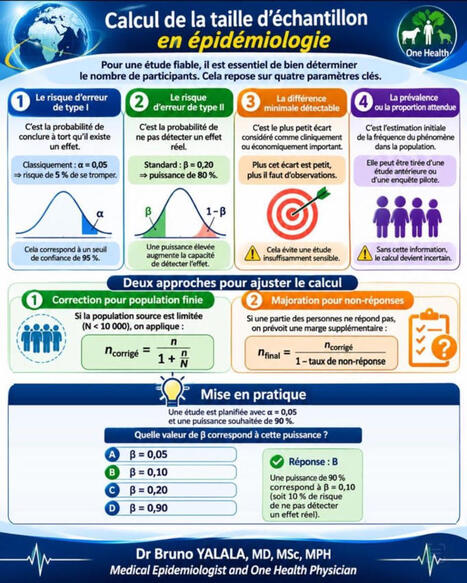
TAILLE DE L’ÉCHANTILLON EN ÉPIDÉMIOLOGIE
La rigueur d’une étude épidémiologique commence bien avant la collecte des données : elle commence par le choix judicieux de la taille de l’échantillon.
En épidémiologie, déterminer la taille d’un échantillon ne consiste pas simplement à choisir un nombre de participants. C’est une décision méthodologique fondamentale qui conditionne la précision des estimations, la puissance statistique et la crédibilité des résultats.
Quatre paramètres méritent une attention particulière : le risque d’erreur de type I (α), le risque d’erreur de type II (β), la différence minimale que l’étude souhaite détecter et la prévalence ou proportion attendue.
Il faut également tenir compte, lorsque cela s’applique, de la taille de la population source et du taux de non-réponse.
Mon expérience en surveillance épidémiologique aux frontières et dans la réponse aux épidémies, notamment Ebola en République démocratique du Congo, m’a conforté dans une conviction : une réponse de santé publique efficace repose aussi sur des données fiables, produites à partir de méthodes scientifiques rigoureuses.
Dans une perspective One Health, cette exigence méthodologique est essentielle pour mieux comprendre les risques sanitaires à l’interface entre la santé humaine, animale et environnementale.
La maîtrise des outils statistiques n’est donc pas une simple compétence technique : elle constitue un levier essentiel pour produire des connaissances solides et éclairer les décisions de santé publique.
~~~~~~~~~~~~~~~~~~~~~~~~~~~~~~~~~~~~
SAMPLE SIZE DETERMINATION IN EPIDEMIOLOGY
The scientific rigour of an epidemiological study begins long before data collection: it starts with an appropriate sample size determination.
In epidemiology, sample size calculation is not simply about choosing the number of participants. It is a fundamental methodological decision that influences the precision of estimates, statistical power and the credibility of study findings.
Four key parameters deserve particular attention: Type I error (α), Type II error (β), the minimum detectable difference, and the expected prevalence or proportion.
Finite population size and anticipated non-response rates must also be considered where applicable.
My professional experience in epidemiological surveillance at Points of Entry and in outbreak response, particularly during Ebola responses in the Democratic Republic of the Congo, has reinforced one conviction: effective public health action also depends on reliable data generated through rigorous scientific methods.
From a One Health perspective, methodological rigour is essential to better understand health risks at the human–animal–environment interface.
Statistical knowledge is therefore more than a technical skill; it is a fundamental tool for generating robust evidence and informing public health decisions.
Dr Bruno YALALA, MD, MSc, MPH.
Medical Epidemiologist and One Health Physician.
|
|
Scooped by
Gilbert C FAURE
November 24, 4:36 AM
|
Scoop.it!

La réflexion sur ce que recouvre la veille aujourd'hui continue de s’élargir. Une autre lecture riche publiée dans Veillemag en amont du Forum européen IES qui se tiendra cette semaine : celle d’ Aurélie Poquet, chercheure associée au CR451 de l’ Ecole de Guerre Economique – EGE, sur les affrontements informationnels qui entourent les décisions publiques.
Elle a comparé six dossiers industriels que tout semble séparer : les plastiques, les PFAS, le nucléaire, les gaz de schiste, les OGM et les nitrites. On y retrouve pourtant les mêmes stratégies, déployées sur les terrains médiatique, scientifique et institutionnel. Chaque camp cherche à asseoir sa légitimité en mobilisant ses propres sources d’autorité, tente d’imposer ses mots, à l’image de l’expression « polluants éternels » désormais installée pour les PFAS, et cherche à constituer des coalitions pour peser sur la décision.
Sa conclusion me semble la plus utile pour les praticiens : une qualification qui s’installe, une coalition qui se forme ou un procédé déjà observé ailleurs peuvent signaler une offensive bien avant l’examen d’un texte. La veille réglementaire commence donc bien en amont de la publication d’un projet, au moment où les mots, les alliances et les autorités se mettent en place.
Encore faut-il pouvoir lire ces signaux sur plusieurs terrains à la fois. Les équipes réglementaires, scientifiques et de communication en perçoivent chacune une partie, et c’est en croisant leurs lectures, comme nous le constatons dans les démarches de veille collaborative que nous accompagnons chez Esprits Collaboratifs avec Curebot, qu’une évolution de vocabulaire ou une alliance naissante prend tout son sens. Le travail d’Aurélie Poquet a l’intérêt de leur donner un référentiel commun pour nommer ce qu’elles observent.
Elle présentera ses résultats le 26 novembre à Angoulême, avec les ripostes des filières concernées et les enseignements pour les entreprises. Nous seront également présents avec Curebot dans le forum IES 2026 !
Pour lire la tribune 👉 https://lnkd.in/ejHskECt
CR451 - Centre de Recherche 451, Veillemag, Jacqueline Sala, Bernard CARAYON, Marie Noëlle Lienemann, Arnaud de Morgny, Ophélie GARNIER, Anne-Solène SPIDO, AEGE - Le réseau d'experts en intelligence économique, Portail de l'Intelligence Économique






