
From
www


|
Scooped by
Gilbert C FAURE
onto Notebook or My Personal Learning Network Today, 12:43 PM
|
 Scoop.it!


 Your new post is loading...
Scoop.it!
|
|
|
Scooped by
Gilbert C FAURE
Today, 9:54 AM
|
Scoop.it!

Back in 1979, Karl Popper was already worried about "the publication explosion." I dare not imagine his reaction if he had survived to witness what is happening on our feeds today...
On a more serious note, it makes me wonder if the current LLM-powered content crisis is really as unprecedented as it feels right now. Maybe we are just going through another classic "fear of new technology" phase, not so different from Socrates warning us in the Phaedrus about the dangers of writing. (Spoiler: humanity survived literacy.)
By the way, I’m halfway through Objective Knowledge and I strongly recommend it. As usual with Sir Popper, some passages are so deep they give you goosebumps.
#Philosophy #AI #KarlPopper #Reading #TechHistory #AI #LLM #ScientificWriting| 10 commentaires sur LinkedIn
|
|
Scooped by
Gilbert C FAURE
Today, 4:28 AM
|
Scoop.it!

Apparently, publishing consistently is not enough. Your annual citation count must also grow forever.
Papers have different citation life cycles. Early numbers do not always reveal long-term influence...
But why understand the maths when we can set another performance target?| 21 commentaires sur LinkedIn
|
|
Scooped by
Gilbert C FAURE
Today, 4:20 AM
|
Scoop.it!

In this issue, we feature a summary of discussions and issues raised at the 2026 International Open Access Week (OAW).
|
|
Scooped by
Gilbert C FAURE
November 24, 6:05 AM
|
Scoop.it!

Academic journals are struggling to cope with the accelerated submission of masses of AI-assisted autotexts.
At Learning, Media and Technology (Taylor & Francis) we've been measuring this increase in AI-supported manuscripts in rapid annual increases over the last few years, and observing it in manuscripts that are taking on unusual forms and exhibiting a number of alarming problems.
In this new editorial, Felicitas Macgilchrist, John Potter, Luci Pangrazio and I have tried to report on what we are observing as editors of a journal receiving hundreds of article submissions per year that we now believe to show strong signs of generative AI use. We wanted to put our first-hand observations into the context of emerging academic debates about "scholarslop", "Frankencitations", "drive-by" referencing, AI-generated translation, the purported "democratization" of publishing by LLMs, concerns over AI disclosures, and more.
One of our main observations recently is that we are seeing the production of a couple of distinctive kinds of submissions. One type looks highly automated in both substance and text production, and often appears as "integrative reviews", "conceptual synthesis" manuscripts, or other kinds of broadly meta-review and summary articles. Our suspicion is we are seeing so many of these because LLMs make them very easy to produce. Often these are very poor quality, but very high in quantity.
Another type of autotext appears to be underpinned by original research, but is so "polished" by AI that its meanings are often obscured or its contribution is erased by the naming of artificial conceptual constructs and over-complex expression. These AI-brushed manuscripts are perhaps the biggest challenge at first point of desk review and demand a lot of editor labour to discern if they make a genuine scholarly contribution.
We also look at what a couple of other journals are doing in response to this overproduction of academic autotexts. Increasingly, editorial teams are having to institute their own rules and produce fresh guidance to authors. Publishers haven't much helped because they are promoting AI in "responsible" academic practice, with the correct disclosures, at the same time as issuing warnings about its "irresponsible" use - leaving editors and reviewers to clear up the inevitable mess and confusion this has caused.
We're fully aware that academic publishing was a deeply problematic and "junkified" enterprise long before genAI arrived, and that the HE sector incentivizes many of the academic behaviours we talk about here - especially hyperproductive manuscript production. AI may be amplifying these existing problems, but it's also the basis of some very real and concerning new developments in academic writing that we try to get at here - and that we offer some final advice to authors to avoid.
https://lnkd.in/eqttXXkk| 46 commentaires sur LinkedIn
|
|
Scooped by
Gilbert C FAURE
November 24, 4:38 AM
|
Scoop.it!
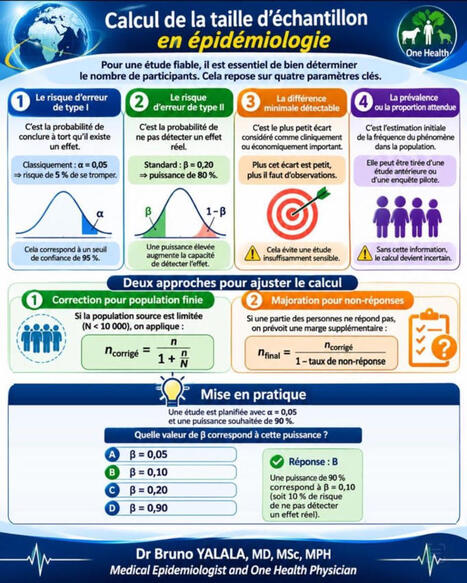
TAILLE DE L’ÉCHANTILLON EN ÉPIDÉMIOLOGIE
La rigueur d’une étude épidémiologique commence bien avant la collecte des données : elle commence par le choix judicieux de la taille de l’échantillon.
En épidémiologie, déterminer la taille d’un échantillon ne consiste pas simplement à choisir un nombre de participants. C’est une décision méthodologique fondamentale qui conditionne la précision des estimations, la puissance statistique et la crédibilité des résultats.
Quatre paramètres méritent une attention particulière : le risque d’erreur de type I (α), le risque d’erreur de type II (β), la différence minimale que l’étude souhaite détecter et la prévalence ou proportion attendue.
Il faut également tenir compte, lorsque cela s’applique, de la taille de la population source et du taux de non-réponse.
Mon expérience en surveillance épidémiologique aux frontières et dans la réponse aux épidémies, notamment Ebola en République démocratique du Congo, m’a conforté dans une conviction : une réponse de santé publique efficace repose aussi sur des données fiables, produites à partir de méthodes scientifiques rigoureuses.
Dans une perspective One Health, cette exigence méthodologique est essentielle pour mieux comprendre les risques sanitaires à l’interface entre la santé humaine, animale et environnementale.
La maîtrise des outils statistiques n’est donc pas une simple compétence technique : elle constitue un levier essentiel pour produire des connaissances solides et éclairer les décisions de santé publique.
~~~~~~~~~~~~~~~~~~~~~~~~~~~~~~~~~~~~
SAMPLE SIZE DETERMINATION IN EPIDEMIOLOGY
The scientific rigour of an epidemiological study begins long before data collection: it starts with an appropriate sample size determination.
In epidemiology, sample size calculation is not simply about choosing the number of participants. It is a fundamental methodological decision that influences the precision of estimates, statistical power and the credibility of study findings.
Four key parameters deserve particular attention: Type I error (α), Type II error (β), the minimum detectable difference, and the expected prevalence or proportion.
Finite population size and anticipated non-response rates must also be considered where applicable.
My professional experience in epidemiological surveillance at Points of Entry and in outbreak response, particularly during Ebola responses in the Democratic Republic of the Congo, has reinforced one conviction: effective public health action also depends on reliable data generated through rigorous scientific methods.
From a One Health perspective, methodological rigour is essential to better understand health risks at the human–animal–environment interface.
Statistical knowledge is therefore more than a technical skill; it is a fundamental tool for generating robust evidence and informing public health decisions.
Dr Bruno YALALA, MD, MSc, MPH.
Medical Epidemiologist and One Health Physician.
|
|
Scooped by
Gilbert C FAURE
November 24, 4:36 AM
|
Scoop.it!

La réflexion sur ce que recouvre la veille aujourd'hui continue de s’élargir. Une autre lecture riche publiée dans Veillemag en amont du Forum européen IES qui se tiendra cette semaine : celle d’ Aurélie Poquet, chercheure associée au CR451 de l’ Ecole de Guerre Economique – EGE, sur les affrontements informationnels qui entourent les décisions publiques.
Elle a comparé six dossiers industriels que tout semble séparer : les plastiques, les PFAS, le nucléaire, les gaz de schiste, les OGM et les nitrites. On y retrouve pourtant les mêmes stratégies, déployées sur les terrains médiatique, scientifique et institutionnel. Chaque camp cherche à asseoir sa légitimité en mobilisant ses propres sources d’autorité, tente d’imposer ses mots, à l’image de l’expression « polluants éternels » désormais installée pour les PFAS, et cherche à constituer des coalitions pour peser sur la décision.
Sa conclusion me semble la plus utile pour les praticiens : une qualification qui s’installe, une coalition qui se forme ou un procédé déjà observé ailleurs peuvent signaler une offensive bien avant l’examen d’un texte. La veille réglementaire commence donc bien en amont de la publication d’un projet, au moment où les mots, les alliances et les autorités se mettent en place.
Encore faut-il pouvoir lire ces signaux sur plusieurs terrains à la fois. Les équipes réglementaires, scientifiques et de communication en perçoivent chacune une partie, et c’est en croisant leurs lectures, comme nous le constatons dans les démarches de veille collaborative que nous accompagnons chez Esprits Collaboratifs avec Curebot, qu’une évolution de vocabulaire ou une alliance naissante prend tout son sens. Le travail d’Aurélie Poquet a l’intérêt de leur donner un référentiel commun pour nommer ce qu’elles observent.
Elle présentera ses résultats le 26 novembre à Angoulême, avec les ripostes des filières concernées et les enseignements pour les entreprises. Nous seront également présents avec Curebot dans le forum IES 2026 !
Pour lire la tribune 👉 https://lnkd.in/ejHskECt
CR451 - Centre de Recherche 451, Veillemag, Jacqueline Sala, Bernard CARAYON, Marie Noëlle Lienemann, Arnaud de Morgny, Ophélie GARNIER, Anne-Solène SPIDO, AEGE - Le réseau d'experts en intelligence économique, Portail de l'Intelligence Économique
|
|
Scooped by
Gilbert C FAURE
November 24, 4:32 AM
|
Scoop.it!

In 2000, PubMed indexed 836 meta-analyses. In 2025, it indexed 26,299.
I review and write meta-analyses, and many of the ones I see now answer questions that were already answered a few years ago.
Journals have noticed. More desk rejections, narrower scopes, and editors who are tired of the design before they read the abstract. The problem is that a careful review now hits the same wall as a redundant one.
Ioannidis wrote about the mass production of redundant meta-analyses in 2016. AI tools have made them even easier to produce since then.
When I decide whether a meta-analysis is worth doing, I ask:
• Is the question still open? I check existing reviews before writing the protocol.
• Was it registered beforehand, and did we stick to the protocol?
• Does it report certainty of evidence with GRADE, or only a pooled estimate?
• Could the evidence already be conclusive? If so, another meta-analysis adds little.
• Does the discussion say clearly what the data can't answer?
#EvidenceBasedMedicine #MetaAnalysis #SystematicReview #Anesthesiology #ResearchIntegrity
|
|
Scooped by
Gilbert C FAURE
November 23, 8:06 AM
|
Scoop.it!

🤖 How is generative AI changing the way medical students learn to conduct research?
As generative AI tools become increasingly integrated into education, they are also beginning to reshape how medical students approach research projects.
A recent article in Medical Teacher explores how students are using these tools, how supervisors are responding, and the opportunities and tensions emerging as AI becomes part of the research process.
📖 Read the full article - Use of generative Artificial Intelligence tools in medical student research projects: An activity system analysis https://ow.ly/4XYz51087vv
🗨️Share your experience: How is generative AI being used in research training at your institution, and what opportunities or challenges have you observed for students and supervisors?
#AMEE #Research #Journals #MedicalTeacher #AI #HealthProfessionsEducation
|
|
Scooped by
Gilbert C FAURE
November 23, 7:55 AM
|
Scoop.it!

🕵️ Avec seulement un pseudo, une photo ou quelques informations, il est parfois possible de retrouver énormément de choses sur une personne.
Aujourd’hui, on partage énormément d’informations sur Internet sans forcément s’en rendre compte. Une photo, un pseudo, une publication ou même quelques détails anodins peuvent parfois suffire à reconstituer une partie de la vie de quelqu’un.
Le problème, c’est qu’on sous-estime souvent la quantité de données que l’on laisse derrière nous sur Internet.
Dans cette vidéo, je vous montre comment fonctionne réellement l’OSINT, avec des techniques, des outils accessibles à tous, et des cas réels, pour comprendre jusqu’où une enquête numérique peut aller.
On va voir :
➣ comment retrouver des informations à partir d'un simple pseudo
➣ comment rechercher et analyser des photos publiées sur Internet
➣ comment géolocaliser un lieu à partir d'une image
➣ comment exploiter les métadonnées et les traces laissées en ligne
➣ comment utiliser l'intelligence artificielle dans une enquête OSINT
➣ les meilleurs outils et ressources pour mener ses propres recherches
➣ comment vérifier les informations et éviter les fausses pistes
➣ et surtout, comment protéger ses propres données personnelles
L'objectif n'est pas d'espionner les autres, mais de comprendre ce qu'il est possible de découvrir à partir de simples informations publiques, et surtout de prendre conscience de notre propre empreinte numérique.
Parce qu'aujourd'hui, mieux vaut savoir ce que l'on peut trouver sur vous avant que quelqu'un d'autre ne le découvre.
📺 La vidéo est disponible dès maintenant !
Le lien est juste ici : https://lnkd.in/eJuY3gMs
|
|
Scooped by
Gilbert C FAURE
November 23, 7:48 AM
|
Scoop.it!

À deux pas de la place de la République, j’ai rencontré l’artiste chinoise Deng Lihua (邓丽华) à l’occasion de son exposition Vacuité paisible (虚静), dont He Yuhong (何宇红) assure le commissariat.
Dans ses grands formats en noir et blanc, des masses sombres se heurtent. Une traînée claire les traverse. L’œil suit une courbe, la perd, la retrouve plus bas. La main s’est retirée depuis longtemps et pourtant, à suivre ces traces, on éprouve encore quelque chose de son geste. J’ai repensé à Merleau-Ponty et à cette part d’invisible que le visible rend présente.
Puis une autre question m’est venue. Qui regarde qui ? À Paris, face à une artiste chinoise qui travaille à l’encre, combien de temps regardons-nous son œuvre avant de lui demander de représenter une tradition, un pays, une identité ? Il y a peut-être une politique du regard qui s’attarde. Elle commence quand on laisse à une œuvre le temps de défaire l’idée qu’on s’en faisait.
En ressortant rue Meslay, le tumulte était toujours là. Je repensais à ce blanc très mince entre deux masses noires. Il avait suffi de m’y attarder pour que toute la feuille change. J’y vois le don de paix que Deng Lihua nous fait. Une paix intérieure, douce et ferme, qui peut tenir alors même que le monde gronde.
👏 Pour lire mon article « Deng Lihua, le mouvement invisible de l’encre » : https://lnkd.in/eB8529v5
#DengLihua #ArtContemporainChinois #PeintureÀLEncre #Philosophie #peinture #art
|
|
Scooped by
Gilbert C FAURE
Today, 9:01 AM
|
Scoop.it!

Apprendre à veiller n’a rien d’un acquis : c’est une compétence qui s’entretient, et qui se réapprend à mesure que l’environnement informationnel se transforme.
Cette transformation s’est accélère jour après jour. Les IA génératives se sont installées dans les pratiques quotidiennes. Elles produisent des synthèses rapides et souvent convaincantes, mais leur fiabilité dépend entièrement de la qualité des sources et du regard critique de celui qui les lit. Dans ce contexte, savoir construire un sourcing de confiance, distinguer un signal utile d’un bruit séduisant, structurer la collecte et l’analyse, puis faire parvenir la bonne information aux bonnes personnes au bon moment n’est plus l’affaire des seuls spécialistes.
C’est ce qui nous a conduits, chez Curebot à ouvrir la Curebot Academy il y a maintenant plus d’un an. Nous voulions un espace de formation en ligne accessible à toutes celles et ceux qui souhaitent renforcer leurs compétences en veille stratégique, qu’il s’agisse de prendre en main la plateforme, d’en approfondir les usages ou simplement de mieux structurer leur démarche. Les modules combinent vidéos, tutoriels et quiz, se suivent à son rythme, et restent gratuits, et ouverts à tous, utilisateurs de Curebot ou non.
Veiller, c’est d’abord décider de ce qui mérite d’être lu, et pourquoi. Face à des outils capables de produire bien plus de texte que nous ne pourrons jamais en vérifier, c’est sans doute la compétence la plus précieuse à cultiver.
Inscrivez-vous à la Curebot Academy 👉 https://lnkd.in/e-p3SV88
Ecole de Guerre Economique – EGE, IAE de Poitiers, Christian Marcon, Ophélie GARNIER, Audrey Knauf, EEIE - École Européenne d'Intelligence Économique, Master VSOC, Nicolas Dubuc, SYNFIE, Agnès Caron, Franck Mathot, Helene Madinier, Stéphane Chaudiron , Jordan Piednoir, EBD - Les formations de l'information
|
|
Scooped by
Gilbert C FAURE
November 24, 10:43 AM
|
Scoop.it!

Open bibliographic database aims to support more granular research assessment and greater recognition of individual contributions
|
|
Scooped by
Gilbert C FAURE
November 24, 5:19 AM
|
Scoop.it!

🔺Une pyramide, quatre étages, avec personne dedans, hormis quelques momies.
La pyramide de la connaissance (DIKW pour les intimes) trône dans les supports de formation et, depuis peu, dans les présentations d'outils de KM assistés par IA. Les données au rez-de-chaussée, la sagesse au dernier étage, et entre les deux un ascenseur sensé vous transporter de l'un à l'autre.
Seulement, l'on n'y croise jamais personne dans cette pyramide, ni celui qui cherche, ni celui qui interprète, ni celui qui transmet, rien que du savoir embaumé, bien classé par étage, en attente de visiteurs.
💡 Dans ma thèse, j'ai proposé un autre schéma, moins monumental certes, mais qui place l'individu au coeur. Pas une momie donc, mais un humain bien vivant, qui régénère ce qu'il reçoit et le remet en circulation.
Vous le trouverez par ici ⬇️
Et dans votre organisation, la connaissance est-elle une momie dans une pyramide, ou circule-t-elle entre ceux qui la font vivre ?
Martin Roulleaux Dugage Marc de Fouchécour Sandrine VIGNER Patricia L'Esprit Richard Collin Céline Bodving Jannick Labatut-Pouyllau Chloé Hervy
#veille #gestiondesconnaissances #intelligenceéconomique| 13 commentaires sur LinkedIn
|
|
Scooped by
Gilbert C FAURE
November 24, 4:38 AM
|
Scoop.it!

“My father was a man who loved to wander. He had only one point of departure—our home—but so many destinations. I never knew where he’d be tomorrow. He said he didn’t know, either.”
This weekend, enjoy Chinese author Wang Yikun’s short story of the complicated bond between father and son, translated for the first time by The World of Chinese:
https://lnkd.in/eyHVEiQu
|
|
Scooped by
Gilbert C FAURE
November 24, 4:35 AM
|
Scoop.it!

The infographic lists 25 AI and research tools (out of 30) grouped into five categories for academic research:
Literature Review
• 1. AnswerThis: Systematic literature reviews.
• 2. Gatsbi: Writing literature reviews.
• 3. ResearchCollab: Reading papers and identifying research gaps.
• 4. NOAH AI: Writing research papers and inserting citations.
• 5. Viktor: Discovering related papers, authors, and research networks.
Writing Research Paper
• 6. Trinka: Grammar, style, and language checks for technical writing.
• 7. Liner: Searching, summarizing, and organizing research and web info.
• 8. UPDF: Analyzing and summarizing research papers with AI.
• 9. Paperpal: Academic grammar, clarity, and manuscript language.
• 10. Rectoly: Analyzing academic research and finding key insights.
Finding Research Gap
• 11. PatSnap Eureka: AI agent turning patents and papers into tech solutions.
• 12. Moara: Screening papers for literature reviews.
• 13. Yomu AI: Paraphrasing text while keeping the original meaning.
• 14. Sourcely: Identifying papers for literature reviews.
• 15. ResearchRabbit: Finding research gaps and unexplored areas.
Review Research Papers
• 16. Thesify: Peer-style reviews of research papers.
• 17. Reviewer3: AI feedback on research manuscripts.
• 18. Review it: AI-assisted feedback to review and improve academic writing.
• 19. Mira: Exploring and understanding research faster.
• 20. ResearchScore: Evaluating research quality with AI.
Draw Scientific Figures
• 21. ResearchViz: Creating clear visualizations for research findings.
• 22. Gamma: Finding and organizing useful research designs.
• 23. MoClaw: Analyzing qualitative data such as interviews and surveys.
• 24. HumanizeThis: Making AI-generated writing sound more natural.
• 25. SciSpace: Reading, understanding, and analyzing academic papers faster.
For A + grades in your assignments just reach out via email or hmu for WhatsApp number ✍️ 📝 🥰 🎓
#essay #essays #essaywriting #essaydue #essaywritingtips #essayhelp #essayhelper #essaystructure #writingessays #dissertation #dissertationwriting #dissertationhelp #dissertationhelper #writingdissertation #thesis #thesishelp #thesishelper #thesishelpermalaysia #thesistips #thesisoutline #assignment #assignments #assignmentstruggles #assignmentdue #assignmentduetomorrow #assignmentduesoon #assignmenthelper #assignmenthelpermalaysia #assignmenthelpers #studytok #studywithme #studywithmee #studyabroad #studyincanada #studyincanada🇨🇦🇨🇦🇨🇦 #studyincanada🇨🇦 #studyinusa #studyinusa🇺🇸 #usastudent #studyinuk #studyinuk🇬🇧 #studyinuk🇬🇧🇬🇧🇬🇧 #studyingermany #studyingermany🇩🇪 #studyinaustralia #studyinaustralia🇦🇺 #studyinsingapore #studyinsingapore🇸🇬 #studyinmalaysia #studyinmalaysia🇲🇾 #studyindenmark #studyindenmark🇩🇰 #studyinfinland #studyinnorway #studyinnorway🇮🇸 #studyinsweden #studyinsweden🇸🇪 #fyp #fypシ゚ #fypp #fypppppppppppppp #fypppppppp #fypviral #fypviraltiktok🖤シ゚☆♡ #fypviralシ #fypviralシviral #fypviraltiktok
|
|
Scooped by
Gilbert C FAURE
November 23, 9:50 AM
|
Scoop.it!

Games won't fix clinical education on their own. But where they fit the learning, they can be powerful.
My new IntechOpen chapter, "Learning to Heal: Games as the Future Infrastructure of Clinical Competence," looks at where games actually earn their place in health professions education.
The pattern is fairly clear. Games help most where learning depends on:
• repetition, the chance to practise again and again without risk to a patient
• spatial reasoning, seeing and working with anatomy, devices and environments
• procedural skill, getting the steps right and in the right order
What I'd caution against is assuming that immersion equals learning. A beautiful, realistic environment can still teach very little if the design doesn't match what learners need to master, or if no one looks at what they do and gives feedback.
So the question I'd ask isn't "should we use games?" but "which competence are we building, and is a game the right tool for it?"
The chapter is open access: https://lnkd.in/dB8VcYDj
Where have you seen games genuinely improve clinical skills, and where have they fallen flat?
#MedEd #MedicalEducation #SeriousGames #HealthProfessionsEducation #Simulation
|
|
Scooped by
Gilbert C FAURE
November 23, 7:57 AM
|
Scoop.it!

Cross-sectional vs Cohort vs Case-Control Studies
Not all observational studies are designed in the same way. Understanding the difference between these three study designs is essential for selecting the right approach to answer a research question.
📌 1. Cross-sectional Study
A cross-sectional study measures exposure and outcome at a particular point in time or during a defined period.
• Provides a snapshot of a population.
• Commonly measures prevalence.
• Usually cannot establish whether exposure occurred before the outcome.
Example: Assessing the prevalence of hypertension and associated risk factors among adults in Nawabshah.
📌 2. Cohort Study
A cohort study identifies participants based on their exposure status and follows them over time to observe the development of an outcome. It can be prospective or retrospective.
• Can measure incidence.
• Helps establish the temporal relationship between exposure and outcome.
• Can assess multiple outcomes associated with an exposure.
Example: Following smokers and non-smokers over several years to compare the occurrence of lung disease.
📌 3. Case-Control Study
A case-control study starts by identifying people with a particular outcome (cases) and people without that outcome (controls). Their previous exposures are then compared.
• Particularly useful for rare diseases.
• Often quicker and less costly than a cohort study.
• Commonly uses the odds ratio to measure the association between exposure and outcome.
• Cannot directly calculate incidence from the usual case-control design.
Example: Comparing the previous smoking history of people with lung cancer (cases) and people without lung cancer (controls).
📊 KEY DIFFERENCES
🔹 Cross-sectional: Exposure and outcome assessed around the same time → Prevalence.
🔹 Cohort: Exposure first, outcome followed over time → Incidence and risk.
🔹 Case-control: Outcome first, previous exposure compared → Odds ratio.
💡 Which study design should you choose?
It depends on your research question, the frequency of the outcome or exposure, available time and resources, and whether you need to establish the temporal sequence.
Remember: These are observational study designs. An association identified through any of them does not automatically establish causation.
Good research begins with choosing the right study design for the right research question.
#ResearchMethods #StudyDesigns #CrossSectionalStudy #CohortStudy #CaseControlStudy #Epidemiology #PublicHealthResearch #ResearchEducation #HealthResearch #HealthScopeWithMaryam
|
|
Scooped by
Gilbert C FAURE
November 23, 7:51 AM
|
Scoop.it!

Sunday, journal editor mode: the abstract promised a beach, the manuscript delivered something else.
Michael Graham, you know the feeling | 12 comments on LinkedIn
|
|
Scooped by
Gilbert C FAURE
November 23, 4:43 AM
|
Scoop.it!

AI can already interpret medical images, draft diagnostic assessments, and converse with patients — fueling predictions that it will replace physicians.
Yet software cannot physically examine, biopsy, or operate on a patient, so the share of a specialty’s work that requires in-person physical interaction sets a ceiling on how much of it AI alone could replace.
Analyzing 2023 Medicare Part B claims — nearly US$45 billion in payments to 589,648 physicians across 56 specialties — Zeltzer and colleagues classify each billed service by whether it requires physical contact, setting aside evaluation and management (E&M) visits.
The share of non-E&M work that is physical, and thus protected at present from AI substitution, varies widely across specialties and increases in the length of postgraduate training: Procedural fields such as dermatology and orthopedic surgery are largely shielded.
Only about one fifth of all payments go to non-E&M services with no physical barrier to AI substitution. Physicians, however, concentrate in E&M-heavy specialties — family and internal medicine — where physical protection, as the authors measure it, is low.
The fields most accessible as career paths and most needed to relieve primary care shortages thus face the greatest uncertainty, because AI could impact their work as either a substitute or a complement — an outcome shaped as much by how AI is designed, deployed, and reimbursed as by the technology itself.
Read the Perspective “Physical Limits to AI Substitution across Physician Specialties — Implications for the Physician Workforce” by D. Zeltzer (Dan Zeltzer) et al.: https://nejm.ai/3UDkrIv
#ArtificialIntelligence #AIinMedicine | 23 comments on LinkedIn






