Your new post is loading...

|
Scooped by
Gilbert C FAURE
October 13, 2013 8:40 AM
|
is a personal Notebook Thanks John Dudley for the following tweet "If you like interesting snippets on all sorts of subjects relevant to academia, information, the world, highly recommended is @grip54 's collection:" La curation de contenus, la mémoire partagée d'une veille scientifique et sociétale
|
|
Scooped by
Gilbert C FAURE
June 16, 4:06 AM
|
Out of curiosity, I asked ChatGPT to create a visual representation of my professional life and daily routine based on everything it has learned about me over time.
To my surprise, it captured many aspects of my journey remarkably well medical educator, researcher, curriculum leader, mentor, reviewer, conference speaker, advocate for AI and immersive technologies in healthcare education, and most importantly, a lifelong learner.
While no AI-generated image can fully represent a person, this visual serves as an interesting reflection of how artificial intelligence can recognise patterns in our work, interests, values, and aspirations.
It is fascinating to see how AI not only supports our productivity but can also help us reflect on our professional identity and impact.
What do you think? How accurately would AI portray your professional journey?
#ArtificialIntelligence #MedicalEducation #DigitalHealth #Leadership #MedicalEducator #HigherEducation #AIinEducation #VirtualReality #MixedReality #AcademicLife
|
|
Scooped by
Gilbert C FAURE
June 15, 5:06 AM
|
Zhejiang University has officially surpassed Harvard in the 2026 Nature Index. However, keen observers will recognize Zhejiang isn't even the most prestigious university in China. It ranks behind Tsinghua, Peking, Shanghai Jiao Tong and Fudan in Gaokao admission scoring.
The explanation lies in Goodhart's law:
Goodhart's law states that the moment an index is used to allocate jobs, grants, or promotions, optimization pressure descends on it and its correlation with real quality begins to decay.
In 1998, four institutions — Zhejiang University, Zhejiang Medical University, Hangzhou University, and Zhejiang Agricultural University — merged to form the present-day comprehensive ZJU. Because volume-based bibliometrics reward size mechanically, if you fuse a flagship university with a medical school, an ag school, and a comprehensive university. you've created one of the largest research-producing bodies on eartH. ZJU now carries something like 314,000 academic publications and 6.8 million citations in aggregate indexes. A big chunk of "being good at bibliometrics" is simply that bibliometric volume rewards bigness, and ZJU was assembled to be big.
On top of that SZJU built the most aggressive cash-for-papers machine in the world. In the 90's China launched an incentive regime that turned publication into literal income.
The sums were staggering: across China, first authors averaged more than $43,000 for a paper in Science or Nature, with the top reward reaching $165,000, and scientists at top universities could earn in excess of $100,000 per paper. At ZJU specifically, a single high-impact paper's bonus could run up to 20 times a professor's average annual salary. The system behind it is called 唯论文 (Only papers). It generated a national "SCI supremacy" culture, where promotions, hiring, funding, and prestige all keyed off SCI publication counts and impact factors.
ZJU was a frontrunner. In a landmark survey of Chinese university reward policies, Zhejiang University had issued five separate cash-reward policies, more than any other institution. Make the metric the currency of every career, attach five-figure bonuses, and you get exactly what you'd expect. ZJU optimized the hardest because it had the size.
Beijing eventually recognized the perverse incentives. In February 2020, the central government told institutions to stop paying researchers bonuses for publishing, as part of a national policy to cut incentives that reward quantity over high-impact work. The cash-bonus era was officially curtailed, but the institutional muscle built during 20 years doesn't evaporate overnight. ZJU still churns out papers like there's no tomorrow, and its citation trading culture is still alive.
If you want to get a clear picture, the Shanghai ARWU ranking, designed to avoid metrics gaming by using difficult-to-fake data (like the number of Nobel Laureates) provides a less biased view of global University rankings.
|
|
Scooped by
Gilbert C FAURE
June 15, 4:46 AM
|
How do we communicate about -- or as journalists, cover -- 3.5 million scientific studies per year?
|
|
Scooped by
Gilbert C FAURE
June 12, 2:52 AM
|
A medical student presented a dizzy patient to me last week, and when I asked for them differential they told me they'd already run it past an LLM. Vestibular migraine. Reasonable answer, probably even right. So I asked them to name three other things it could be and talk me out of each one... things went silent.
A Wolters Kluwer survey out this week put a number on that silence. Three-quarters of clinicians now use AI at least weekly, and 74% call losing their own critical thinking one of the biggest risks of the whole thing. The fear isn't abstract. A prior Mass General Brigham study of 21 models found they nail the final diagnosis more than 90% of the time when you hand them the whole case, and miss the differential more than 80% of the time when the picture is still incomplete. Sharp at the end of the workup, lost at the start, which is the only part that was ever hard.
So the plan is to hand the front of every case to the one player at the table who goes all in on the first card it's dealt. | 60 comments on LinkedIn
|
|
Scooped by
Gilbert C FAURE
June 11, 1:47 PM
|
One of the biggest mistakes researchers make is claiming a research gap without knowing what type of gap they have actually identified.
Not every gap is a “lack of studies.”
Sometimes the gap is:
📌 A missing theory (Theoretical Gap)
📌 A different setting or country (Contextual Gap)
📌 Outdated evidence (Temporal Gap)
📌 An underrepresented population (Population Gap)
📌 Missing variables or concepts (Conceptual Gap)
📌 New technologies creating new opportunities (Technological Gap)
📌 Weak methods in previous studies (Methodological Gap)
📌 Findings that have not been translated into practice (Practical Gap)
The quality of your research is often determined by how clearly you identify and justify the gap it seeks to address.
Remember:
A strong research gap leads to a strong research question.
A strong research question leads to impactful research.
Before starting your next study, ask yourself:
“What specific gap am I trying to fill?”
Follow David Innocent for more research, evidence synthesis, and academic excellence insights.
|
|
Scooped by
Gilbert C FAURE
June 11, 1:11 PM
|
Nutritionally inadequate diets are among today’s greatest challenges to both public and planetary health. However, interventions aimed at changing eating behaviour in the long term have shown limited effectiveness, potentially because research has typically conceptualized eating behaviour as an individual activity despite its fundamentally social nature. In this Review, I argue for the importance of understanding eating within its natural social contexts to achieve effective, long-term change. I conceptualize eating as a social activity, review the current relevant theories, and synthesize the forms and dimensions of eating in its natural social context. Current and emerging methods for measurement and analysis are available that can capture eating in real-world settings. Empirical evidence shows that eating with others is more common than eating alone; eating takes place within specific social contexts and broad social systems; and eating serves central social functions. Researching eating behaviour in its natural social context could help to overcome the shortcomings of current theories and improve behaviour change interventions, to the benefit of health and well-being. Beyond meeting a basic need, eating behaviour shapes human health and environmental outcomes. In this Review, Mata highlights the fundamentally social nature of eating and describes how to integrate this evidence into current research on behaviour change.
|
|
Scooped by
Gilbert C FAURE
June 11, 10:15 AM
|
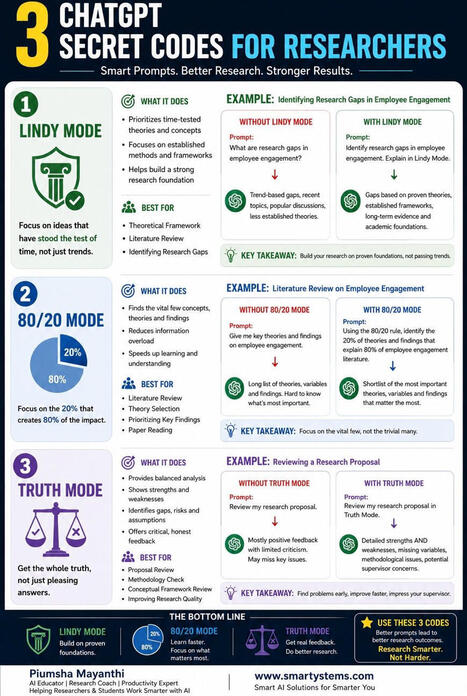
Most researchers are using ChatGPT like a search engine.
The problem?
The quality of the answer depends on the quality of the instruction.
In this infographic, I share 3 simple ChatGPT prompt techniques that can significantly improve your research workflow:
✅ Lindy Mode – Focus on proven theories, established frameworks, and long-standing academic foundations.
✅ 80/20 Mode – Identify the small number of concepts, theories, and findings that explain most of a research field.
✅ Truth Mode – Find weaknesses, missing variables, methodological issues, and potential supervisor concerns before submission.
Whether you’re working on a thesis, dissertation, literature review, journal article, or research proposal, these prompt techniques can help you think more critically and work more efficiently.
Remember:
📌 Lindy Mode = Strong Foundations
📌 80/20 Mode = Faster Learning
📌 Truth Mode = Better Critical Thinking
Which one would you use first?
Follow Piumsha Mayanthi for more AI, research, and academic productivity insights.
#Research #AcademicResearch #ResearchMethods #ThesisWriting #Dissertation #LiteratureReview #PhDLife #PhDStudent #GraduateSchool #Researcher #HigherEducation #Academia #ScientificResearch #ResearchTips #AcademicWriting #AI #ArtificialIntelligence #ChatGPT #GenerativeAI #AIForResearch #ResearchProductivity #DataAnalysis #EducationTechnology #MachineLearning #OpenAI
|
|
Scooped by
Gilbert C FAURE
June 11, 3:25 AM
|
Le verbe scroller désigne le geste de faire défiler un contenu sur un écran informatique. Longtemps utilisé de manière relativement neutre, il a pris avec l’essor des réseaux sociaux numériques une connotation de plus en plus négative, jusqu’à devenir le synonyme des dérives comportementales associées à leurs usages (fragmentation des capacités d’attention, perte de temps, passivité, dissociation morbide). Afin d’éclaircir les représentations associées à ce geste, nous proposons de le mettre en regard avec deux autres gestes emblématiques de leur époque et d’une forme de rapport aux flux de contenus numériques : « zapper » et « surfer ». On proposera à partir de cette comparaison des pistes de recherche ayant pour ambition de dépasser les formes profanes et savantes de stigmatisation dont ces gestes font l’objet. On verra qu’il est également possible de les envisager comme autant de modes d’appropriation actifs, voire d’éditorialisation des flux de contenus toujours plus massifs auxquels sont confrontés les usagers des réseaux sociaux et du web en général.
|
|
Scooped by
Gilbert C FAURE
June 10, 7:44 AM
|
Le référencement n'a pas disparu, il a changé de cible. Hier on truquait Google, aujourd'hui on truque les IA, et le terrain de jeu s'appelle Reddit. Voici comment des marques fabriquent un faux consensus pour s'inviter dans les réponses de ChatGPT, pourquoi un forum de biohackers vient de baisser le rideau, et ce que Wikipédia fait différemment. Attention : petit je
|
|
Scooped by
Gilbert C FAURE
June 10, 4:43 AM
|
It’s official (well this has been the case for 15 years), if you want to succeed in China, WeChat isn’t optional, it’s essential!
Weixin/WeChat is far more than a messaging app.
It's a way of life, an ecosystem, a culture.
It’s the backbone of communication, networking, marketing, payments, customer service, and B2B building in China.
Businesses use it to connect with clients, run advertising campaigns, manage communities, process transactions through WeChat Pay, and even operate mini-program stores and programs directly inside the app.
With over 1 billion active users, WeChat has become an all-in-one business ecosystem where relationships and trust are built digitally.
It's what Elon Musk wants to create in the west and the Chinese have been doing it for over a decade!
Whether you’re an international business, startup, university, hotel, retailer, B2B or B2C company.
Understanding how to leverage WeChat is critical for entering and growing in the Chinese market.
Companies that ignore WeChat risk missing the primary platform where Chinese consumers and businesses interact every day. | 31 comments on LinkedIn
|
|
Scooped by
Gilbert C FAURE
June 6, 9:45 AM
|
NotebookLM de Google fascine autant qu'il interroge. Cet outil d'IA ne travaille que sur VOS documents — pas l'internet entier — ce qui change radicalement le rapport aux hallucinations et à la traçabilité des sources.
Dans ce nouvel article, je propose un guide pratique ET une analyse critique : ce qui épate (résumé audio bluffant, quiz, cartes mentales en quelques minutes), mais aussi les vraies questions à se poser — confidentialité des données, droit d'auteur, dépendance cognitive, équité d'accès.
Mise en abyme assumée : l'article a été pensé pour être chargé dans NotebookLM et générer une dizaine de formats dérivés (podcast, présentation, infographie, flashcards…). On parle de l'outil, avec l'outil.
La règle d'or que je défends : l'IA est l'assistant, l'humain reste l'auteur.
À lire ici 👉 https://lnkd.in/eMBTVk_T
#NotebookLM #IA #IntelligenceArtificielle #Pédagogie #Formation #FabLab #IAResponsable #VeilleNumérique #Gemini
|
|
Scooped by
Gilbert C FAURE
June 5, 1:20 PM
|
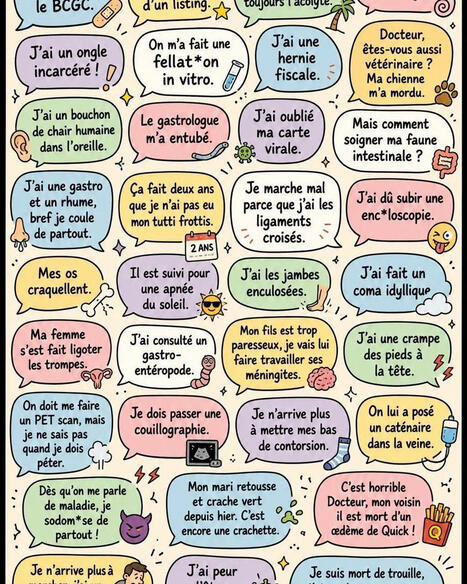
On vit quand même dans une époque où les gens arrivent chez le médecin comme dans une fête foraine possédée par Kafka après trois mojitos et une garde à vue émotionnelle. Plus personne ne connaît le nom de ses organes. Entre celui qui confond une radio avec un Pokémon rare et l’autre qui pense qu’un IRM est un boys band allemand des années 90, la médecine française ressemble désormais à un escape game administré par des mouettes sous cortisone.
Le pire, c’est l’assurance. Les gens balancent des énormités avec le calme d’un sommelier qui présente un grand cru. Tu peux annoncer une catastrophe biologique totalement inventée, il y aura toujours une vieille dame dans la salle d’attente pour répondre « Ma pauvre, mon cousin a eu pareil après une raclette. »
Et les moteurs de recherche ont terminé le travail. Avant, t’avais une angine. Maintenant, après deux minutes sur internet, tu t’auto-diagnostiques une maladie tropicale contractée probablement via un avocat bio ou une poignée de porte à Quimper.
Franchement, les médecins méritent une prime de survie psychologique. Pas un salaire. Une médaille. Une cellule de décompression. Un exorciste et deux chevaux tranquilles dans le Lubéron. | 73 comments on LinkedIn
|
|
|
Scooped by
Gilbert C FAURE
June 16, 8:42 AM
|
|
|
Scooped by
Gilbert C FAURE
June 16, 4:03 AM
|
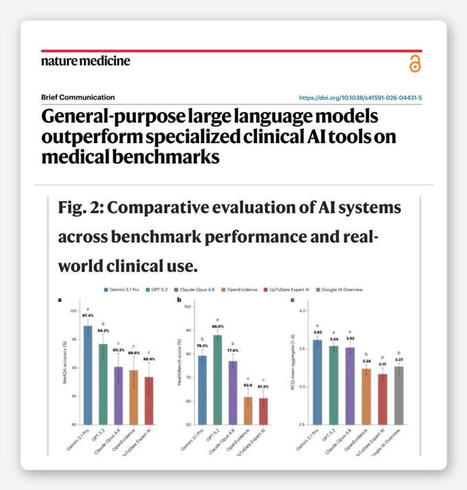
A new paper in Nature Medicine reported that general AI like ChatGPT and Gemini outperformed the specialized medical AI tools that hundreds of thousands of doctors use every day, including OpenEvidence and UpToDate. Over the weekend OpenEvidence, a company valued at $12 billion, fired back with a public post calling the study fatally flawed and conflicted. They turned the comments off. The authors are defending their headline. Thousands of people are resharing a screenshot of one bar chart and picking a side.
Set the ranking aside and look at safety.
All six systems hallucinated at the same low rate. The specialized clinical tools were no more likely to invent a fact than ChatGPT, and no less. On the one measure that should decide whether a tool is safe near a patient, there was no real difference.
But one of those clinical tools, UpToDate, refused to answer one in five physician questions, where the general models almost never refused. The study counts that refusal as a failure.
Here is what it never checks. When a real clinical question arrives without enough information to answer safely, refusing is the right move, not a defect. The paper does not tell us how many of those refusals were appropriate caution, or whether the models that answered every single time were confidently filling gaps they should have left open.
That is the study I want to read. This is not it.
Would you rather your clinical AI guess, or tell you when it cannot say? | 39 comments on LinkedIn
|
|
Scooped by
Gilbert C FAURE
June 15, 4:49 AM
|
|
|
Scooped by
Gilbert C FAURE
June 15, 4:35 AM
|
When does aging really accelerate?
This month's Editor's choice for the Journal of Gerontology, Series A: Medical Sciences is: "Finding the turning point in aging: a comparison of physical, cognitive, and psychological trajectories among centenarians and non-centenarians" by Erfei Zhao, Jennifer Ailshire, Jung Ki Kim, and Eileen Crimmins at USC Leonard Davis School of Gerontology.
Using nearly three decades of data from the Health and Retirement Study, the authors examine how health trajectories unfold among people who survive into their 70s, 80s, 90s, and beyond 100 years of age.
I enjoyed reading about their focus on identifying the tipping point at which decline begins to accelerate across multiple domains of health.
Their findings challenge the notion that exceptional longevity simply reflects slower aging. Authors suggest that many centenarians experience a prolonged period of relative resilience, followed by a compressed phase of decline late in life.
Understanding when these turning points occur has important implications for public health, clinical care, and the design of interventions aimed at extending not just lifespan, but healthspan.
Congratulations to the team on an important contribution to the science of healthy aging and longevity.
You can read the article here: https://lnkd.in/gzYZ8WZQ
This work was also featured in Trojan Talks: https://lnkd.in/gz-AQFdW
#HealthyAging #Longevity #Centenarians #Healthspan #Gerontology #AgingResearch #PopulationHealth #PublicHealth #CognitiveAging #SuccessfulAging #HealthTrajectories #ResearchHighlights
Gerontological Society of America (GSA), OUP Academic
Megan McCutcheon, Kathleen Jackson, Judie Lieu, Gustavo Duque
|
|
Scooped by
Gilbert C FAURE
June 12, 2:38 AM
|
A figure in the news last month stopped me short: Reuters reported that one in two young people in Europe have used an AI chatbot to discuss something intimate or personal. This is a remarkably high number of young people exposing their vulnerabilities to essentially unregulated technologies driven by commercial interests.
Yet the more I thought about the findings, the less interested I became in the technology, and the more I found myself drawn to understanding the behavior.
There is no doubt that the question of whether AI is helping or harming young people is important. But strikingly, the same surveys show that young people don't fully trust AI yet turn to it anyway. What is AI providing that so many are struggling to find elsewhere?
Behavioral science offers a useful lens here. A chatbot answers the instant a teenager reaches for it, skipping the long chain of steps that help-seeking in the real-world demands. There is no appointment, no waiting, no travel, no risk of judgment. People, especially adolescents, gravitate toward whatever asks the least of them in a difficult moment. And each time the chatbot responds, instantly, it rewards the reach, making the next turn to it more likely.
Why young people reach for AI, even while doubting it, is a question anyone building or funding mental health systems should be asking. Their behavior reveals the gaps in the systems surrounding them, and points to where the work urgently needs to begin. I make that argument here.
#MentalHealth #AdolescentHealth #BehavioralScience #AI #DigitalHealth #YouthMentalHealth #NCDs #HLM4
|
|
Scooped by
Gilbert C FAURE
June 11, 1:15 PM
|
Honestly, it's not that bad publication... | 45 comments on LinkedIn
|
|
Scooped by
Gilbert C FAURE
June 11, 10:30 AM
|
We do not let a doctor read an ultrasound without training and certification, yet a medical AI now used by about 65% of American doctors entered clinical practice with neither. I asked the tool about its own funding and conflicts of interest, and it refused to answer.
|
|
Rescooped by
Gilbert C FAURE
from Going social
June 11, 9:42 AM
|
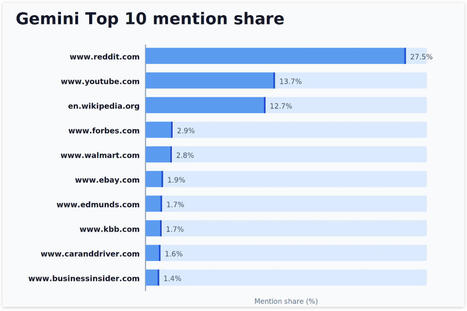
Chaque IA a ses sources de prédilection : Amazon chez Copilot, YouTube chez Perplexity, Reddit chez Gemini... Mais un trio s'impose presque partout.
Via Marco Bertolini
|
|
Scooped by
Gilbert C FAURE
June 10, 10:36 AM
|
Biliary tract cancers, encompassing intrahepatic, perihilar and distal cholangiocarcinoma and gallbladder cancer, are a heterogeneous group of highly aggressive malignancies. Most patients have unresectable disease at first presentation, and even those who undergo surgery are likely to have disease recurrence. Newer approaches have included liver transplantation for selected patients, and the integration of locoregional and systemic therapies has expanded the number of patients who can benefit from surgery. The advent of immune-checkpoint inhibitors and targeted therapies for patients with advanced-stage disease has prompted the exploration of these agents in earlier-stage disease settings. Despite this progress, treatment algorithms remain complex, necessitating a multidisciplinary and individualized approach to patient management. Future research should focus on optimizing patient selection through biomarker-driven strategies, including the integration of molecular profiles to guide the selection of systemic therapy, as well as refining the criteria for surgery and transplantation. These improvements will require global collaboration and novel clinical trial designs. In this Review, we describe evolving perioperative strategies for the management of patients with biliary tract cancers and highlight emerging directions in the field. Cholangiocarcinomas, comprising intrahepatic, extrahepatic and perihilar subtypes as well as gallbladder cancer, are a heterogeneous group of malignancies that necessitates a personalized approach to both surgery and systemic therapy. In this Review, the authors describe progress in the development of personalized perioperative therapy strategies as well as the most promising future research directions in this diverse and often difficult-to-treat group of cancers.
|
|
Scooped by
Gilbert C FAURE
June 10, 7:38 AM
|
ChatGPT vs Grok vs Gemini vs Claude vs Perplexity.
Vous ne savez pas laquelle utiliser ? Pas de panique, voici le breakdown rapide pour arrêter de tester chaque IA séparément 👇
1. ChatGPT
Le meilleur pour la productivité quotidienne : écriture, brainstorming, code, planification. En gros votre assistant tout-terrain.
2. Grok
Si votre travail tourne autour des tendances, des réseaux sociaux ou de ce qui se passe MAINTENANT, c'est l'IA à privilégier.
3. Gemini
Parfait si vous vivez dans Google Workspace (Docs, Sheets, Slides). Excellent pour la collaboration et le temps réel.
4. Claude
Vous bossez sur des rapports longs, des policies, du deep reading ? Claude est le plus fort pour comprendre et synthétiser des sujets complexes.
5. Perplexity
Besoin de sources fiables ? Solide pour la recherche, le fact-checking et les réponses sourcées rapidement.
Il n'y a pas de "meilleure IA"... seulement celle qui colle à votre poste et votre workflow.
Le bon move ? Le bon outil pour la bonne tâche.
___
Au-delà du choix d'outil, ce qui fait vraiment la différence c'est de continuer à monter en compétence sur l'IA.
J'ai compilé pour vous une sélection de 25 cours gratuits (Google AI Essentials, Google Prompt Engineering, DeepLearning AI Agent Developer, Generative AI Specialization, etc.) que vous n'avez plus aucune excuse pour ne pas suivre en 2026.
Pour vous faire gagner du temps, j'ai compilé tous ces liens dans un seul document.
👇
Pour recevoir ce GUIDE (gratuit) :
1) Likez ce post
2) Commentez "LIENS"
3) Connectez-vous avec moi (pour que je puisse vous l'envoyer)
♻️ Pensez à reposter pour en faire profiter votre réseau.
| 43 comments on LinkedIn
|
|
Scooped by
Gilbert C FAURE
June 8, 8:34 AM
|
Do presentations make you nervous? You're not alone!
The tips and tricks in this article are gold!
𝘙𝘦𝘱𝘰𝘴𝘵 𝘵𝘰 𝘩𝘦𝘭𝘱 𝘺𝘰𝘶𝘳 𝘯𝘦𝘵𝘸𝘰𝘳𝘬
- Keep it simple: 3 key points max. Don't overload.
- Practice, practice, practice: Time yourself.
- Use visuals wisely: 1 slide per minute is plenty.
- Be yourself: If you're not funny, don't force jokes.
- Record yourself: It's painful but reveals bad habits.
The real secret? Give lots of presentations.
You'll improve every time!
💬 What's your #1 presentation tip?
--------------------------------
𝐅𝐢𝐧𝐝 𝐢𝐭 𝐮𝐬𝐞𝐟𝐮𝐥?
🔄 Repost (& like)
Follow Razia to get more useful Research content (no clickbait stuff!) in your feed.
Want FREE tips on using AI in research?
↳ Join 17000+ researchers here ⬇️
https://lnkd.in/gV6-3UZk
--------------------------
🔗 to full article in comments | 14 comments on LinkedIn
|
|
Scooped by
Gilbert C FAURE
June 6, 9:44 AM
|
J’ai testé NotebookLM
https://notebooklm.google/ : notre cerveau secondé par une IA focalisée sur MES sources 👏🏼
Si vous jonglez entre PDF, docs Word, notes de réunion et articles, Notebooklm undefined vaut clairement le détour. L’idée est geniale vous chargez vos documents, vos écrits, idées etc … et l’IA ne répond qu’à partir des sources téléchargées Résultat: moins de blabla … plus de contenus structurés !
Ce que j’aime :
-focus sur mes contenus: fini les réponses “boîte noire”. Chaque insight est ancré dans les documents que j’ai fournis.
-Synthèses rapides: résumés clairs, plans, FAQ et fiches mémo générés en quelques secondes.
-Traçabilité: citations et passages surlignés pour vérifier d’où vient l’info 👏🏼
-Formats utiles: scripts audio, idées de présentations, quiz d’entraînement…
🎓Bonnes pratiques
👍 Qualité > Quantité
- Posez des prompts précis: “Compare les hypothèses A/B et cite les pages”.
- Vérifiez les références: suivez les liens/citations et faites votre choix.
Limites:
➡️ si vos sources sont incomplètes ou biaisées, les réponses le seront aussi.
➡️Données sensibles: évitez d’y placer des informations confidentielles sans politique claire de sécurité/partage.
➡️Contexte hors-sources: NotebookLM reste volontairement “myope” au-delà de ce que vous lui donnez.🙏
Merci Cédric du Bot @groupeetablieres - Formation Pour Adultes.
Pour transformer vos documents en connaissances actionnables grâce à son studio, NotebookLM est un un moteur d’intelligence focalisé sur vos propres contenus — et c’est précisément ce qui le rend utile !
François LE CLERE Groupe Etablières Cédric du Bot SUP SOCIAL - GROUPE ETABLIERES Damien SAVARY Sophie Maussion Marjorie Corboz Laura BOSSARD NotebookLMShare Community cyril Cyrilguillebaud Valdocco Formation Sandrine Lormeau Elodie Brugier Rivet …
|
|
Scooped by
Gilbert C FAURE
June 5, 1:20 PM
|
🔍 𝐃𝐞́𝐜𝐫𝐲𝐩𝐭𝐞𝐫 𝐥'𝐢𝐧𝐟𝐨 | 𝐃𝐞́𝐜𝐢𝐝𝐞𝐫 𝐝𝐮 𝐯𝐫𝐚𝐢 𝐞𝐬𝐭 𝐮𝐧 𝐦𝐞́𝐭𝐢𝐞𝐫. 𝐐𝐮𝐢 𝐥𝐞 𝐟𝐢𝐧𝐚𝐧𝐜𝐞 ?
Un journaliste économique du Handelsblatt, Norbert Häring, par ailleurs membre du parti de gauche BSW, a publié récemment un ouvrage intitulé « Le Complexe de la Vérité ».
Ce qu'il documente, c'est un maillage, largement financé sur fonds publics, d'organisations présentées comme relevant de la société civile, d'agences de vérification, de fondations et de relais médiatiques qui surveillent et orientent le débat. Häring en suit les traces concrètes, les flux financiers, les passerelles de personnel d'une structure à l'autre.
La question qu'il soulève est d'abord une question d'architecture. Lorsqu'un dispositif présenté comme une protection démocratique contre la désinformation est animé par des acteurs formés, financés et sélectionnés par les institutions qui en bénéficient, la régulation glisse vers la fabrique de la doxa autorisée.
Outre-Atlantique, un phénomène voisin a reçu un nom, forgé à droite, complexe industriel de la censure, apparu devant le Congrès américain dans le sillage des Twitter Files. Qu'une même inquiétude monte de la gauche allemande et de la droite américaine devrait suffire à la sortir des cases.
Le rôle du veilleur n'est pas de dire quel niveau de modération serait souhaitable. C'est de cartographier le dispositif comme on cartographierait n'importe quel appareil bureaucratique : acteurs, financements, canaux de décision, recours possibles.
Il y a d'ailleurs quelque chose d'instructif à voir les méthodes de l'OSINT, conçues pour les systèmes opaques et les États autoritaires, s'appliquer aux dispositifs de gouvernance informationnelle de l'Union européenne.
Et vous ? À qui déléguez-vous le soin de trier le vrai du faux à votre place ?
CR451 - Centre de Recherche 451 AEGE - Le réseau d'experts en intelligence économique Veillemag IAE de Poitiers ADBS - Secteur Veille Arnaud de Morgny Nicolas MOINET Bartol ZIVKOVIC François Soulard Antoine Violet-Surcouf Sébastien TERTRAIS
#veille #intelligenceéconomique #espritcritique #DSA #gouvernanceinformationnelle
|