NeuroImmunology
11.3K views | +0 today
Your new post is loading...
Scooped by Gilbert C FAURE
October 10, 2014 5:05 AM
Scoop.it!

CD98 is a potential target for ablating B cell clonal expansion and autoantibody in multiple sclerosis

This site is designed to inform and support those with Multiple Sclerosis. It is not a comprehensive medical guide to the disease. This information is taken from many different resources.
No comment yet.
Scooped by Gilbert C FAURE
October 5, 2014 1:19 PM
Scoop.it!

Good barriers make good neighbors

Good barriers make good neighbors - Aging-induced response at the choroid plexus negatively affects brain function http://t.co/9atwsf2I4N
No comment yet.
Scooped by Gilbert C FAURE from AUTOIMMUNITY
October 4, 2014 3:26 AM
Scoop.it!

Brain Antigen-Directed Autoantibodies Found Comparably Detec... : Neurology Today

An abstract is unavailable.
No comment yet.
Scooped by Gilbert C FAURE from Multiple sclerosis New Drugs Review
October 3, 2014 3:28 PM
Scoop.it!

Synthesis of novel therapeutic agents for the treatment of multiple sclerosis: A brief overview

Synthesis of novel therapeutic agents for the treatment of multiple sclerosis: A brief overview | NeuroImmunology | Scoop.it

Abstract

Multiple sclerosis (MS) often results in chronic inflammatory and autoimmune disorders, and recent developments in understanding the disease pathogenesis has lead to newer therapeutic options for the treatment of the disease. The development of small molecule drugs with improved efficacy, better tolerability, and oral administration has received a new impetus with the discovery of newer classes of drugs. In this review, we have summarized the hitherto known synthetic strategies of fingolimod, laquinimod, cladribine, and teriflunomide reported in the literature which are the key small molecules and the first oral drug candidates for MS in various stages of clinical development or have been launched in the market.


Via Krishan Maggon
Krishan Maggon 's curator insight, October 3, 2014 11:51 AM
Highlights

► Multiple sclerosis disease, pathogenesis, symptoms and types. ► Current treatment options for MS. ► Recent developments on small molecule therapeutics for the treatment of MS. ► Summary of the know literature routes for fingolimod, laquinimod, cladribine, teriflunomide and the synthetic highlights.

Scooped by Gilbert C FAURE
October 1, 2014 2:53 PM
Scoop.it!

Cognitive Decline Linked to Immune Crosstalk at Blood-Brain Interface - Genetic Engineering & Biotechnology News

Genetic Engineering & Biotechnology News
Cognitive Decline Linked to Immune Crosstalk at Blood-Brain Interface
Genetic Engineering & Biotechnology News
Immunofluorescence microscope image of the choroid plexus.
No comment yet.
Scooped by Gilbert C FAURE
October 1, 2014 3:05 AM
Scoop.it!

Unique 'signature' found in ageing brain - newkerala news #109062

Neuroscience #Health :: Blocking "Interferon alpha beta receptors" in Brain's "Choroid Plexus" may control aging :: http://t.co/OsrRXHS3vu
No comment yet.
Scooped by Gilbert C FAURE
September 28, 2014 2:47 PM
Scoop.it!

Frontiers | Cytomegalovirus as a novel target for immunotherapy of glioblastoma multiforme | Molecular and Cellular Oncology

Progress in the treatment of glioblastoma multiforme (GBM) over the last few decades has remained marginal and GBM is still universally fatal with short survival times after initial diagnosis. Much...
No comment yet.
Scooped by Gilbert C FAURE
September 28, 2014 2:39 PM
Scoop.it!

Vaccine Against MS Being Developed at Baylor Institute for Immunology Research

Vaccine Against MS Being Developed at Baylor Institute for Immunology Research | NeuroImmunology | Scoop.it
Read about the vaccine against MS developing at Baylor Institute for Immunology Research. (A vaccine for MS? Fingers (and toes and eyes and arms and legs) crossed!
No comment yet.
Scooped by Gilbert C FAURE
September 25, 2014 2:42 PM
Scoop.it!

Gene therapy enhances chemotherapy tolerance a... [J Clin Invest. 2014] - PubMed - NCBI

PubMed comprises more than 23 million citations for biomedical literature from MEDLINE, life science journals, and online books. Citations may include links to full-text content from PubMed Central and publisher web sites.
No comment yet.
Scooped by Gilbert C FAURE
September 24, 2014 2:56 PM
Scoop.it!

Baylor Research Institute Immunology Researchers Obtaining Promising Results with Multiple Sclerosis Vaccine

Thanks to new insights related to dendritic cell vaccines, researchers are investigating a potential vaccine for MS treatment and prevention at the Baylor Institute for Immunology Research (BIIR), a division of Baylor Research Institute.
No comment yet.
Scooped by Gilbert C FAURE from Multiple sclerosis New Drugs Review
September 24, 2014 1:55 PM
Scoop.it!

Exercise and your brain: Stanford research highlighted on NIH Director’s blog

Exercise and your brain: Stanford research highlighted on NIH Director’s blog | NeuroImmunology | Scoop.it
Thomas Rando, MD, PhD, who studies stem cells in muscle and longevity, and Tony Wyss-Coray, PhD, who studies the immune system’s impact on the brain, were awarded an NIH Director’s Transformative Research Award to study the slew of molecules that...

Via Krishan Maggon
No comment yet.
Scooped by Gilbert C FAURE from Alzheimer's Disease R&D Review
September 23, 2014 2:26 PM
Scoop.it!

Crystal structure reveals conservation of amyloid-ß conformation recognized by 3D6 following humanization to bapineuzumab

Crystal structure reveals conservation of amyloid-ß conformation recognized by 3D6 following humanization to bapineuzumab | NeuroImmunology | Scoop.it
Immunotherapy targeting amyloid-β peptide is under active clinical investigation for treatment of Alzheimer’s disease (AD). Among the hypotheses being investigated for impact on clinical outcome are the preferred epitope or conformation of amyloid-β to target for treatment, and the mechanism of action underlying immunotherapy. Bapineuzumab (humanized 3D6), a neo-epitope specific antibody recognizing amyloid-β1-5 with strong preference for an exposed Asp residue at the N-terminus of the peptide, has undergone advanced clinical testing for treatment of AD.


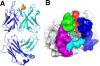
Here we report the crystal structure of a recombinant Fab fragment of 3D6 in complex with amyloid-β1-7 solved at 2.0 Å resolution. The N-terminus of amyloid-β is bound to 3D6 as a 310 helix. The amino-terminal Asp residue is buried deepest in the antibody binding pocket, with the Cβ atom of residue 6 visible at the entrance to the binding pocket near the surface of the antibody. We further evaluate homology model based predictions used to guide humanization of 3D6 to bapineuzumab, with actual structure of the Fab. The structure of the Fab:amyloid-β complex validates design of the humanized antibody, and confirms the amyloid-β epitope recognized by 3D6 as previously mapped by ELISA.

Conclusions

The conformation of amyloid-β antigen recognized by 3D6 is novel and distinct from other antibodies recognizing N-terminal epitopes. Our result provides the first report demonstrating structural conservation of antigen contact residues, and conformation of antigen recognized, between the parent murine antibody and its humanized version.


Figure 1. Overview of the structure of 3D6 fab with Aβ1-7 peptide (pdb identifier 4ONF). A) Side view showing alpha-carbon backbone traces of the molecules. Heavy chain is shown in cyan, light chain in blue and Aβ peptide in yellow/orange. B) 3D6 with Aβ1-7 view from above the molecule. Peptide is shown in stick representation with oxygens colored red, nitrogens in blue and carbons orange. Fab in surface representation colored white with the exception of CDRs contacting the peptide. CDR H1 is shown in red, H2 blue, H3 green, L1 magenta and L3 cyan. Only CDRs contacting the peptide are colored. CDRs, complementarity determining regions; pdb, protein data base.


Via Krishan Maggon
Krishan Maggon 's curator insight, September 20, 2014 4:47 PM

open access


Crystal structure reveals conservation of amyloid-β conformation recognized by 3D6 following humanization to bapineuzumab

Hadar Feinberg2, José W Saldanha5, Linnea Diep1, Amita Goel1, Angela Widom3,Geertruida M Veldman6, William I Weis2, Dale Schenk4 and Guriqbal S Basi1*

*Corresponding author: Guriqbal S Basi gur1balbasi@gmail.com

Author Affiliations

1Elan Pharmaceuticals, Inc. 300 Technology Sq., Cambridge, MA 02139, USA

2Departments of Structural Biology and of Molecular & Cellular Physiology, 299 Campus Drive, Stanford University School of Medicine, Stanford, CA 94305, USA

3Pfizer, Cambridge, MA, USA

4Prothena Biosciences, Inc., 650 Gateway Blvd., San Francisco, CA 94080, USA

5National Institute for Medical Research, The Ridgeway, Mill Hill, London NW7 1AA, UK

6Abbvie Bioresearch Center, Worcester, MA, USA

For all author emails, please log on.

Alzheimer's Research & Therapy 2014, 6:31  doi:10.1186/alzrt261


Scooped by Gilbert C FAURE
September 22, 2014 6:24 AM
Scoop.it!

BMC Neuroscience | Abstract | Microparticles in multiple sclerosis and clinically isolated syndrome: effect on endothelial barrier function

Cell-derived microparticles are secreted in response to cell damage or dysfunction. Endothelial and platelet dysfunction are thought to contribute to the development of multiple sclerosis (MS).
No comment yet.
Scooped by Gilbert C FAURE
October 6, 2014 11:29 AM
Scoop.it!

Promising results obtained with multiple sclerosis vaccine

Promising results obtained with multiple sclerosis vaccine | NeuroImmunology | Scoop.it
Thanks to new insights related to dendritic cell vaccines, researchers are investigating a potential vaccine for MS treatment and prevention.
No comment yet.
Scooped by Gilbert C FAURE
October 5, 2014 7:20 AM
Scoop.it!

The antibody genetics of multiple sclerosis: co... [Front Neurol. 2014] - PubMed - NCBI

PubMed comprises more than 23 million citations for biomedical literature from MEDLINE, life science journals, and online books. Citations may include links to full-text content from PubMed Central and publisher web sites.
No comment yet.
Scooped by Gilbert C FAURE
October 3, 2014 3:30 PM
Scoop.it!

Page SFN 2014 - V6

Page SFN 2014 - V6 | NeuroImmunology | Scoop.it
Agenda: French Society of Neurology International Congress - NeuroImmunology Clinical and Therapeutic Aspects ... http://t.co/Kky3v32Vrs
No comment yet.
Scooped by Gilbert C FAURE
October 3, 2014 3:08 PM
Scoop.it!

ALEMTUZUMAB: LONG TERM FOLLOW-UP IN A SINGLE CENTRE COHORT -- Willis et al. 85 (10): e4 -- Journal of Neurology, Neurosurgery & Psychiatry

Introduction

Alemtuzumab is an anti-CD52 monoclonal antibody, approved for the treatment of relapsing multiple... http://t.co/Ui3ylDftt7
No comment yet.
Scooped by Gilbert C FAURE
October 1, 2014 4:54 AM
Scoop.it!

Signature of aging in brain: Researchers suggest that the brain's 'immunological age' is what counts

Signature of aging in brain: Researchers suggest that the brain's 'immunological age' is what counts | NeuroImmunology | Scoop.it
Evidence of a unique 'signature' that may be the 'missing link' between cognitive decline and aging has been found by researchers.
No comment yet.
Scooped by Gilbert C FAURE
September 30, 2014 2:23 PM
Scoop.it!

Comparison of Antibodies Hydrolyzing Myelin Basic Protein from the Cerebrospinal Fluid and Serum of Patients with Multiple Sclerosis

Comparison of Antibodies Hydrolyzing Myelin Basic Protein from the Cerebrospinal Fluid and Serum of Patients with Multiple Sclerosis | NeuroImmunology | Scoop.it
by Visilii B. Doronin, Taisiya A. Parkhomenko, Massimiliano Castellazzi, Marina Padroni, Michela Pastore, Valentina N. Buneva, Enrico Granieri, Georgy A.
No comment yet.
Scooped by Gilbert C FAURE
September 28, 2014 2:47 PM
Scoop.it!

Neuro-Oncology: Bevacizumab and glioblastoma: Scientific review, newly reported updates, and ongoing controversies

Neuro-Oncology: Bevacizumab and glioblastoma: Scientific review, newly reported updates, and ongoing controversies | NeuroImmunology | Scoop.it
Bevacizumab and glioblastoma: Scientific review, newly reported updates, and ongoing controversies

Cancer... http://t.co/slw0ZElwwh
No comment yet.
Scooped by Gilbert C FAURE
September 26, 2014 3:38 PM
Scoop.it!

The role of cerebrospinal fluid b... [Recent Pat CNS Drug Discov. 2013] - PubMed - NCBI

PubMed comprises more than 23 million citations for biomedical literature from MEDLINE, life science journals, and online books. Citations may include links to full-text content from PubMed Central and publisher web sites.
No comment yet.
Scooped by Gilbert C FAURE from Multiple sclerosis New Drugs Review
September 25, 2014 2:40 PM
Scoop.it!

The Paradox of Daclizumab | Multiple Sclerosis Discovery Forum

The Paradox of Daclizumab | Multiple Sclerosis Discovery Forum | NeuroImmunology | Scoop.it
RT @MSDForum: Daclizumab did well in phase 3 trials for #MS. Here's the story behind the story http://t.co/PFzsfHqKs1


 an analysis of samples from blood and cerebrospinal fluid suggests that daclizumab nudges the abnormal numbers of innate and adaptive immune cells in RRMS back to more normal physiological levels found in people without MS (Lin et al., 2014).


the therapeutic efficacy of daclizumab paralleled the expansion of a key target cell population, called CD56bright natural killer cells (CD56bright NK). That raised hopes for a biomarker that could measure who was responding and predict who would do best.


Via Krishan Maggon
Krishan Maggon 's curator insight, September 25, 2014 4:29 AM

Great story about the discovery and development of daclizumab and its unexpected effects on activating the immune system. immunotherapy of MS.

Scooped by Gilbert C FAURE
September 24, 2014 1:58 PM
Scoop.it!

Emerging Therapies for Glioblastoma

Emerging Therapies for Glioblastoma | NeuroImmunology | Scoop.it
Review from JAMA Neurology — Emerging Therapies for Glioblastoma (RT @JAMA_current: MT @JAMANeuro Review of Emerging Therapies for #Glioblastoma http://t.co/8cJyS8V5EF #brain #braintumor #braincancer...
Krishan Maggon 's curator insight, September 24, 2014 2:10 PM

Thanks to Prof Gilbert Faure


Emerging Therapies for Glioblastoma ONLINE FIRSTAlissa A. Thomas, MD1; Cameron W. Brennan, MD2; Lisa M. DeAngelis, MD1; Antonio M. Omuro, MD1[+] Author AffiliationsJAMA Neurol. Published online September 22, 2014. doi:10.1001/jamaneurol.2014.1701
Scooped by Gilbert C FAURE
September 23, 2014 2:35 PM
Scoop.it!

Hu Antigen R (HuR) is a Positive Regulator of RN... [J Biol Chem. 2014] - PubMed - NCBI

PubMed comprises more than 23 million citations for biomedical literature from MEDLINE, life science journals, and online books. Citations may include links to full-text content from PubMed Central and publisher web sites.
No comment yet.
Scooped by Gilbert C FAURE from Multiple sclerosis New Drugs Review
September 23, 2014 2:20 PM
Scoop.it!

CD49d antisense drug ATL1102 reduces disease activity in patients with relapsing-remitting MS

CD49d antisense drug ATL1102 reduces disease activity in patients with relapsing-remitting MS | NeuroImmunology | Scoop.it

ABSTRACT

Objective: This study evaluated the efficacy and safety of ATL1102, an antisense oligonucleotide that selectively targets the RNA for human CD49d, the α subunit of very late antigen 4, in patients with relapsing-remitting multiple sclerosis (RRMS).

Methods: In a multicenter, double-blind, placebo-controlled randomized phase II trial, 77 patients with RRMS were treated with 200 mg of ATL1102 subcutaneously injected 3 times in the first week and twice weekly for 7 weeks or placebo and monitored for a further 8 weeks. MRI scans were taken at baseline and weeks 4, 8, 12, and 16. The primary endpoint was the cumulative number of new active lesions (either new gadolinium-enhancing T1 lesions or nonenhancing new or enlarging T2 lesions) at weeks 4, 8, and 12.

Results: A total of 72 patients completed the study and 74 intention-to-treat patients were assessed. ATL1102 significantly reduced the cumulative number of new active lesions by 54.4% compared to placebo (mean 3.0 [SD 6.12] vs 6.2 [9.89], p = 0.01). The cumulative number of new gadolinium-enhancing T1 lesions was reduced by 67.9% compared to placebo (p = 0.002). Treatment-emergent adverse events included mild to moderate injection site erythema and decrease in platelet counts that returned to within the normal range after dosing.

Conclusions: In patients with RRMS, ATL1102 significantly reduced disease activity after 8 weeks of treatment and was generally well-tolerated. This trial provides evidence for the first time that antisense oligonucleotides may be used as a therapeutic approach in neuroimmunologic disorders.

Classification: This study provides Class I evidence that for patients with RRMS, the antisense oligonucleotide ATL1102 reduces the number of new active head MRI lesions.


Via Krishan Maggon
Krishan Maggon 's curator insight, September 23, 2014 1:36 AM

Primary efficacy endpoint met with a statistically significant reduction of sIGF-I
levels of 26% at the 400mg/week dose (P<0.0001; highly significant)


• 36% average reduction in sIGF-I for lower body weight patients
• Positioned to move into Phase III stage of development
• Safe and well tolerated with no serious adverse events related to dosing reported


CD49d antisense drug ATL1102 reduces disease activity in patients with relapsing-remitting MSVolker Limmroth, MD, Frederik Barkhof, MD, PhD, Nuket Desem, MBA, Mark P. Diamond, MBA, George Tachas, PhD; For the ATL1102 Study Group


Correspondence to Dr. Tachas: george.tachas@antisense.com.auPublished online before print September 19, 2014, doi: 10.1212/WNL.0000000000000926Neurology 10.1212/WNL.0000000000000926