Your new post is loading...

|
Scooped by
Gilbert C FAURE
September 23, 2019 1:48 PM
|
We aimed to assess the relationship between levels of a cerebrospinal fluid (CSF) marker of pericyte damage, soluble platelet-derived growth factor receptor β (sPDGFRβ) and CSF markers of blood-brain barrier (BBB) integrity (CSF albumin and CSF/serum albumin ratio) and disease pathology (reduced...
|
|
Scooped by
Gilbert C FAURE
September 21, 2019 4:55 AM
|
A connection between glioma cells and neurons boosts cancer growth.
Credit: W. Jiao and Q.Zeng (EPFL) In 2018, breast cancer was the most common cancer in women worldwide, accounting...
Via Krishan Maggon
|
|
Scooped by
Gilbert C FAURE
September 16, 2019 1:12 PM
|
Multiple sclerosis (MS) is the most common demyelinating disease which mainly impacts
the integrity of central nervous system (CNS). MS etiology is not clearly known but
genetic, environmental factors and immune system are the most frequently explored
risk factors. Adaptive immune responses have a critical role in MS pathogenesis in
which auto-reactive T-cells and autoantibodies are main orchestrators. Immune responses
are modulated by inhibitory molecules which regulates adaptive system activation and
hemostasis interface.
|
|
Scooped by
Gilbert C FAURE
August 30, 2019 8:26 AM
|
Background There is increasing evidence that B lymphocytes are involved in the pathogenesis of multiple sclerosis, and they may be a therapeutic target. Rituximab, a monoclonal antibody, selectivel...
|
|
Scooped by
Gilbert C FAURE
August 18, 2019 2:08 PM
|
Multiple sclerosis is a chronic autoimmune disease of the central nervous system that results in varying degrees of disability. Progressive multiple sclerosis, characterized by a steady increase in neurological disability independently of relapses, can occur from onset (primary progressive) or...
|
|
Scooped by
Gilbert C FAURE
August 9, 2019 1:25 PM
|
Abstract Accumulating data on patients with autoimmune encephalitis have shed light on specificities concerning clinical presentation and outcomes, which are dependent on the antigen targeted by th...
|
|
Scooped by
Gilbert C FAURE
August 9, 2019 9:41 AM
|
For those of you now old enough to remember “Life on Mars”….yes it was a TV programme about a Cop who travelled back in time to the 1970s..sexism, bad haircuts, those platform sho…...
|
|
Scooped by
Gilbert C FAURE
August 8, 2019 8:44 AM
|
Several specialized macrophage populations reside in the structures that border the mammalian CNS, including the meninges, perivascular spaces and choroid plexus. Prinz and colleagues review the development and characteristics of these ‘CNS-associated macrophages’ and describe their proposed contributions to CNS function and disease.
|
|
Scooped by
Gilbert C FAURE
August 8, 2019 4:58 AM
|
KEY POINTS DN B cells are abnormally elevated in MS patients but have the same origin as in HC. DN B cells resemble CSM B cells but appear to be at an earlier maturation state. DN and CSM B cells undergo unique differentiation pathways. Abstract IgD−CD27− double negative (DN) B cells with proinflammatory characteristics are abnormally elevated in a proportion of multiple sclerosis (MS) patients. In this study, the origin and selection characteristics of DN B cells were studied in MS patients and healthy controls (HC). Expression of developmental markers on peripheral blood DN, IgD−CD27+ class-switched memory (CSM) and IgD+CD27− naive B cells of HC (n = 48) and MS patients (n = 96) was determined by flow cytometry. High-throughput adaptive immune receptor repertoire sequencing was performed on peripheral blood DN and CSM B cells of HC and MS patients (n = 3 each). DN B cells from HC and MS patients showed similar phenotypic and Ig repertoire characteristics. Phenotypic analysis indicated a mature state of DN B cells by low CD5, CD10, and CD38 expression. However, the frequency of CD95+ and IgA+ cells was lower in DN versus CSM B cells. DN B cells are Ag experienced, as shown by somatic hypermutation of their Ig genes in adaptive immune receptor repertoire sequencing, although they showed a lower mutation load than CSM B cells. Shared clones were found between DN and CSM B cells, although >95% of the clones were unique to each population, and differences in V(D)J usage and CDR3 physicochemical properties were found. Thus, DN B cells arise in HC and MS patients via a common developmental pathway that is probably linked to immune aging. However, DN and CSM B cells develop through unique differentiation pathways, with most DN B cells representing an earlier maturation state. Footnotes This work was supported by the National Multiple Sclerosis Society through a grant to K.C.O. (under Award PP-1509-06370) and the Belgian Charcot Foundation. J.F. is a postdoctoral fellow of the Fund for Scientific Research, Flanders. S.H.K. and S.M. were funded in part by the National Institutes of Health (Award R01AI104739). The sequencing data presented in this article have been submitted to the Sequence Read Archive (https://www.ncbi.nlm.nih.gov/sra) under BioProject accession number PRJNA429427. The online version of this article contains supplemental material. Received September 10, 2018. Accepted July 11, 2019. Copyright © 2019 by The American Association of Immunologists, Inc.
|
|
Scooped by
Gilbert C FAURE
July 30, 2019 1:15 PM
|
High-grade glioblastoma demonstrates exceedingly poor patient survival rates. In their Review, Lim and colleagues describe the immunological mechanisms involved in the control of glioblastoma and the outlook for immunotherapy.
Mosquito-borne virus infections, such as West Nile and Zika, have debilitating cognitive effects that persist despite recovery from encephalitis. Garber et al. identify mechanisms by which antiviral T cell persistence after recovery from infection leads to impairments in cognition via...
Via Krishan Maggon
|
|
Scooped by
Gilbert C FAURE
July 23, 2019 2:09 PM
|
A machine learning approach using high-dimensional phenotypic and functional profiling data identifies a multiple sclerosis-specific T cell population that is reduced following treatment.
|
|
|
Scooped by
Gilbert C FAURE
September 23, 2019 4:25 AM
|
Neuro-immune interactions
|
|
Scooped by
Gilbert C FAURE
September 20, 2019 2:31 PM
|
Immune cells mediate critical inflammatory and neurodegenerative processes in the CNS in individuals with multiple sclerosis (MS). In MS, activated microglia, border-associated macrophages and monocyte-derived macrophages in the CNS can encounter T cells that have infiltrated the brain parenchyma from the circulation. Although microglia and T cells both contribute to normal CNS development and homeostasis, evidence suggests that the meeting of activated microglia and macrophages with encephalitogenic T cells exacerbates their capacity to inflict injury. This crosstalk involves many cell-surface molecules, cytokines and neurotoxic factors. In this Review, we summarize the mechanisms and consequences of T cell–microglia interactions as identified with in vitro experiments and animal models, and discuss the challenges that arise when translating this preclinical knowledge to MS in humans. We also consider therapeutic approaches to MS of which the mechanisms involve prevention or modulation of T cell and microglia responses and their interactions. In this Review, Dong and Yong summarize the mechanisms and consequences of T cell–microglia interactions in multiple sclerosis, discuss therapeutic approaches that affect these interactions and consider the challenges of translating preclinical knowledge in this area to humans.
|
|
Scooped by
Gilbert C FAURE
September 18, 2019 2:27 PM
|
An analysis of T cell specificities sufficient to sustain a neutralizing anti-drug antibody response offers a potential approach for enhancing the clinical efficacy of a therapeutic humanized antibody.
|
|
Scooped by
Gilbert C FAURE
September 14, 2019 11:44 AM
|
|
|
Scooped by
Gilbert C FAURE
August 19, 2019 2:31 PM
|
In this Review, Matthews considers how advanced imaging techniques are enabling in vivo visualization of chronic CNS inflammation in multiple sclerosis that has previously been identified in histopathological studies.
|
|
Scooped by
Gilbert C FAURE
August 10, 2019 5:03 AM
|
But newly discovered “rosehip” neuron is missing in mice
|
|
Scooped by
Gilbert C FAURE
August 9, 2019 1:20 PM
|
The pathophysiological complexity of progressive multiple sclerosis (MS) challenges the development of effective treatments, despite the substantial unmet clinical need. In this Review, Faissner, Yong and colleagues highlight the need for therapies that target inflammation, neurodegeneration and...
|
|
Scooped by
Gilbert C FAURE
August 8, 2019 2:10 PM
|
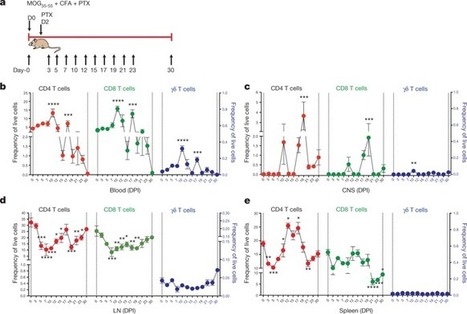
Activated clonally expanded CD4+ T cells display specificity to the myelin peptide MOG, whereas clonally expanded CD8+ T cells depend on T cell receptor recognition of unrelated surrogate peptides and have a regulatory function.
|
|
Scooped by
Gilbert C FAURE
August 8, 2019 5:01 AM
|
Multiple sclerosis (MS) is a central nervous system (CNS) autoimmune disease characterized by both inflammatory demyelination and impaired remyelination. Studies indicate that Toll-like receptor 2 (TLR2) signaling contributes to both the inflammatory component and the defective remyelination in MS.
|
|
Scooped by
Gilbert C FAURE
August 2, 2019 8:44 AM
|
US researchers say blood test can be 94% effective in spotting those at risk of the disease
|
|
Scooped by
Gilbert C FAURE
July 27, 2019 12:20 PM
|
Clearance of macromolecules from the cerebrospinal fluid in mice takes place via meningeal lymphatic vessels at the base of the skull; both drainage and the integrity of these vessels deteriorate with age.
|
|
Scooped by
Gilbert C FAURE
July 25, 2019 3:44 PM
|
Detailed imaging of the rodent central nervous system reveals new information about the route cerebrospinal fluid takes to leave the brain.
|