Your new post is loading...

|
Scooped by
Gilbert C FAURE
December 27, 2013 10:35 AM
|
|
|
Scooped by
Gilbert C FAURE
November 12, 4:39 AM
|
Interesting new paper in Nature this week identifying nectin-4 as a cellular receptor for rubella virus. What's particularly interesting is that nectin-4 is also a known receptor for measles virus, despite the two viruses belonging to entirely different viral families. The researchers show that nectin-4 facilitates rubella virus entry into respiratory epithelial cells and placental cells, providing new insights into both respiratory infection and the mechanisms underlying congenital rubella syndrome. While this is a mechanistic study, it has interesting implications for understanding viral pathogenesis and potentially developing therapeutics.
The timing is also notable, with PAHO meeting next week to review measles and rubella elimination in the Americas. A reminder that even for vaccine-preventable diseases we've studied for decades, there is still much to learn about how these viruses cause disease.
https://lnkd.in/g_wdXvMc
#InfectiousDiseases #Virology #Rubella
|
|
Scooped by
Gilbert C FAURE
November 7, 7:59 AM
|
In this Review, Lamont and Hajishengallis explore how the pathogenicity of Porphyromonas gingivalis is determined by microbial, metabolic and host context. They discuss how community interactions, nutrient-sensing and immune subversion regulate virulence and drive dysbiosis, inflammation and...
|
|
Scooped by
Gilbert C FAURE
November 6, 10:11 AM
|
🫁 Scientists have demonstrated that #antibodies against respiratory #viruses can be measured in exhaled breath, opening new possibilities for studying respiratory #immunity and developing better vaccines.
In a proof-of-concept study published in eBioMedicine – The Lancet Discovery Science, researchers used a non-invasive technology called Particles in Exhaled Air (PExA) to collect microscopic particles originating from deep inside the #lungs.
The study involved 28 participants and successfully detected IgA and IgG antibodies against #influenza, #SARSCoV2, and respiratory syncytial virus (#RSV).
Why is this important? Studying immune responses deep inside the lungs has traditionally required invasive procedures. This approach could make it easier to monitor respiratory immunity, understand responses to infections and vaccinations, and support the development of next-generation mucosal vaccines.
The research was conducted by Katherina Aguilera and colleagues, including Professor Charlotte Thålin and Associate Professor Mikael Åberg, through collaborations involving Karolinska Institutet, Danderyd Hospital, Uppsala University, and SciLifeLab in Sweden.
Although larger studies are needed, this represents an exciting step toward understanding how our lungs protect us from infections.
The future of respiratory #immunology may be as simple as taking a breath!
#RespiratoryHealth #InfectiousDiseases
🔗 See comments for reference.
|
|
Scooped by
Gilbert C FAURE
November 5, 10:46 AM
|
Perturbations of the multifaceted functions of the human intestine can manifest in an extraordinarily diverse range of disease pathologies that span developmental, infectious, inflammatory and neoplastic conditions. Accordingly, there is substantial interest in treating intestinal disorders by harnessing the promise of intestinal stem cells (ISCs). From 2009 to 2024, the National Institute of Diabetes and Digestive and Kidney Diseases sponsored a multi-institution collaborative, the Intestinal Stem Cell Consortium (ISCC), that sought to leverage advances in ISC biology for clinical translation to accelerate in vivo mucosal repair and eventually generate functioning intestinal tissue ex vivo. In this Roadmap, ISCC members summarize the latest advances and current knowledge gaps both from within the ISCC working group and across the field as a whole as relevant to understanding the human ISC niche, stem cell interactions with and in response to pathogens, and cellular and humoral regenerative strategies, towards realizing stem cell-based therapy for intestinal diseases. Major advances have deepened our understanding of intestinal stem (ISC) biology, yet the clinical translation remains limited, despite the promise of harnessing ISCs for both mucosal repair and regenerating functioning intestinal tissue. This Roadmap outlines progress, challenges and opportunities in the translation of ISC research to clinical therapy.
|
|
Scooped by
Gilbert C FAURE
November 5, 4:18 AM
|
The intestinal wall is a selectively permeable barrier between the content of the intestinal lumen and the internal environment of the body. Disturbances o
|
|
Scooped by
Gilbert C FAURE
October 21, 4:28 AM
|
The urinary bladder is a hollow, muscular organ that functions to store and void urine cyclically. The bladder has a dynamic mechanical environment owing to its cyclical expansion and contraction, along with the accumulation and outflow of urine. These complex mechanical stimuli, via diverse mechanosensors and downstream mechanotransduction, modulate bladder sensation, detrusor contraction in the bladder and remodelling of the bladder wall, thereby maintaining the functional homeostasis of the bladder. Mechanical homeostasis of the bladder can be disrupted by disease or injury, such as elevated stretch force and hydrostatic pressure in bladder outlet obstruction and increased matrix stiffness after bladder fibrosis. Abnormal mechanical environments are indicative of bladder diseases and also contribute to the progression of bladder injury and disease. Hence, understanding the effects of regulatory mechanisms of biomechanical cues on bladder function under both physiological and pathological conditions, clarifying the connections and distinctions between these states, and identifying the differential mechanical sensations and transduction pathways that drive bladder diseases and injuries are essential for developing novel therapeutic strategies targeting mechanotransduction pathways to promote the repair of injured or diseased bladders. Here, the biomechanical properties, mechanisms and regulation of the bladder are highlighted. The authors posit that biomechanics should not be viewed as a consequence of bladder pathology; instead, they could function as a primary upstream trigger that orchestrates the processes of bladder injury and repair.
|
|
Scooped by
Gilbert C FAURE
October 14, 8:36 AM
|
En tant que président du CNP EDN je souscris parfaitement aux constats du Pr Harry Sokol
Les demandes que l’on peut avoir dans les consultations sont nombreuses mais ne peuvent à ce jour, dans la très grande majorité des cas, que recevoir une réponse en partie empirique et pour le moins mal prédictible
CNP EDN
FHU PaCeMM
FHU GLIMMER "Gut, Liver & Microbiome Research"
SNFGE, Société Nationale Française de Gastro-Entérologie
Sabine Roman
|
|
Scooped by
Gilbert C FAURE
October 5, 9:46 AM
|
𝗛𝗼𝘄 𝗮 𝗦𝗰𝗶𝗲𝗻𝘁𝗶𝗳𝗶𝗰 𝗕𝗿𝗮𝗻𝗱 𝗞𝗲𝗲𝗽𝘀 𝗮 𝗩𝗮𝗰𝗰𝗶𝗻𝗲 𝗜𝗻𝗱𝘂𝘀𝘁𝗿𝘆 𝗔𝗹𝗶𝘃𝗲
✨ Innovation shines — even as time passes.
The global shift toward next‑generation mucosal vaccines has revealed a powerful truth:
𝗮 𝘀𝗰𝗶𝗲𝗻𝘁𝗶𝗳𝗶𝗰 𝗯𝗿𝗮𝗻𝗱 𝗶𝘀 𝗺𝗼𝗿𝗲 𝘁𝗵𝗮𝗻 𝗮 𝗽𝗿𝗼𝗱𝘂𝗰𝘁; 𝗶𝘁 𝗶𝘀 𝗮𝗻 𝗲𝗰𝗼𝘀𝘆𝘀𝘁𝗲𝗺.
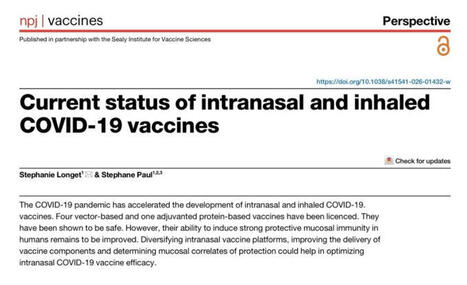
The recent npj Vaccines Perspective — “Current status of intranasal and inhaled COVID‑19 vaccines” — highlights a remarkable fact:
despite dozens of global attempts, only 𝗼𝗻𝗲 𝗮𝗱𝗷𝘂𝘃𝗮𝗻𝘁𝗲𝗱 𝗽𝗿𝗼𝘁𝗲𝗶𝗻‑𝗯𝗮𝘀𝗲𝗱 𝗶𝗻𝘁𝗿𝗮𝗻𝗮𝘀𝗮𝗹 𝘃𝗮𝗰𝗰𝗶𝗻𝗲 reached emergency authorization and entered high‑impact literature.
This single achievement proves something essential:
𝗮 𝘀𝘁𝗿𝗼𝗻𝗴 𝘀𝗰𝗶𝗲𝗻𝘁𝗶𝗳𝗶𝗰 𝗶𝗱𝗲𝗮, 𝘄𝗵𝗲𝗻 𝗯𝗿𝗮𝗻𝗱𝗲𝗱 𝗽𝗿𝗼𝗽𝗲𝗿𝗹𝘆, 𝗰𝗮𝗻 𝗸𝗲𝗲𝗽 𝗮𝗻 𝗲𝗻𝘁𝗶𝗿𝗲 𝗶𝗻𝗱𝘂𝘀𝘁𝗿𝘆 𝗮𝗹𝗶𝘃𝗲.
Across Nature Reviews Immunology, Signal Transduction and Targeted Therapy, and The Lancet Infectious Diseases, one message is clear:
𝗱𝗶𝘃𝗲𝗿𝘀𝗶𝗳𝗶𝗲𝗱 𝗽𝗹𝗮𝘁𝗳𝗼𝗿𝗺𝘀, 𝗺𝘂𝗰𝗼𝘀𝗮𝗹 𝗶𝗺𝗺𝘂𝗻𝗶𝘁𝘆, 𝗮𝗻𝗱 𝗶𝗻𝗻𝗼𝘃𝗮𝘁𝗶𝘃𝗲 𝗱𝗲𝗹𝗶𝘃𝗲𝗿𝘆 𝘀𝘆𝘀𝘁𝗲𝗺𝘀 𝗮𝗿𝗲 𝘁𝗵𝗲 𝗳𝘂𝘁𝘂𝗿𝗲.
This is exactly where 𝗥𝗮𝘇𝗶 𝗖𝗼𝘃 𝗣𝗮𝗿𝘀 stands as a compelling example.
🚀 Razi Cov Pars — When Innovation Becomes Legacy
🔹 𝗚𝗹𝗼𝗯𝗮𝗹 𝗿𝗲𝗰𝗼𝗴𝗻𝗶𝘁𝗶𝗼𝗻 𝗳𝗿𝗼𝗺 𝗮 𝗻𝗮𝘁𝗶𝗼𝗻𝗮𝗹 𝗶𝗻𝗻𝗼𝘃𝗮𝘁𝗶𝗼𝗻
Its presence in high‑impact literature transforms it from a domestic achievement into a scientific reference point.
🔹 𝗔 𝗽𝗿𝗼𝗽𝗿𝗶𝗲𝘁𝗮𝗿𝘆 𝗮𝗱𝗷𝘂𝘃𝗮𝗻𝘁 𝘁𝗵𝗮𝘁 𝘀𝗶𝗴𝗻𝗮𝗹𝘀 𝘁𝗲𝗰𝗵𝗻𝗼𝗹𝗼𝗴𝗶𝗰𝗮𝗹 𝗹𝗲𝗮𝗱𝗲𝗿𝘀𝗵𝗶𝗽
The RAS‑01 oil‑in‑water adjuvant has been repeatedly cited as a novel platform — proof that innovation can emerge anywhere.
🔹 𝗔 𝗯𝗿𝗮𝗻𝗱 𝘁𝗵𝗮𝘁 𝗱𝗼𝗲𝘀𝗻’𝘁 𝗳𝗮𝗱𝗲
When a scientific brand enters peer‑reviewed literature, it becomes part of the global narrative —
and science that enters the narrative never stops shining.
🌱 A Message to Young Scientists
𝗦𝗰𝗶𝗲𝗻𝗰𝗲 𝗶𝘀 𝗮 𝗹𝗼𝗻𝗴 𝗴𝗮𝗺𝗲.
Your work may take years to mature, but when it does, it becomes part of a legacy that outlives crises, trends, and headlines.
If one idea — born in a national institute — can reach global literature and influence future vaccine platforms,
then your idea can too.
Keep building.
Keep publishing.
Keep innovating.
✨ Because real science always finds its way to the light.
Stéphane Paul Stéphanie Longet
|
|
Scooped by
Gilbert C FAURE
October 2, 10:52 AM
|
🔬 New in Science Immunology from the Gaya lab at CIML!
Does our immune memory work the same way everywhere in the body? Not quite.
Mauro Gaya's team at CIML shows that after infection, B cell memory follows a different strategy depending on the mucosal tissue:
🫁 In the lungs, it favors memory B cells that stay on standby, ready to react quickly to new variants.
🦠 In the gut, it favors plasma cells that continuously produce large amounts of antibodies.
Strikingly, this choice is set by the tissue itself rather than by the pathogen. In the gut, microbiota-driven TGF-β promotes IgA class switching, and the IgA BCR pushes B cells toward plasma cell fate. Surprisingly, deleting the IgA BCR's short cytoplasmic tail enhanced this commitment by protecting cells from intracellular stress.
These findings could help design nasal and oral vaccines that trigger the most protective type of memory in each tissue. 💉
Congratulations to Pia HOLGADO, Samuel Origlio, Mauro Gaya and the whole team! 👏
📄 https://lnkd.in/evUZB3RN
Inserm PACA et Corse
INSERM
CNRS Provence et Corse
CNRS
Aix-Marseille University
|
|
Scooped by
Gilbert C FAURE
October 1, 4:01 AM
|
|
|
Scooped by
Gilbert C FAURE
September 18, 5:03 AM
|
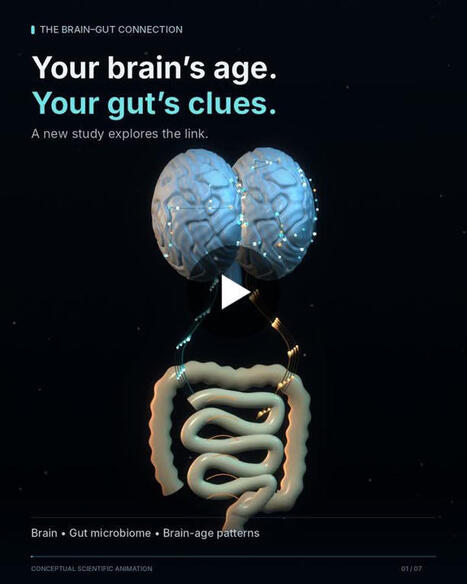
Your brain may appear older than it really is. And scientists at UCLA say that gap might have something to do with your gut. In a new paper published in eBioMedicine, researchers looked at brain images from about 1,500 men and women, both younger and middle aged.
Using a measure of how various areas of the brain talk to one another while resting, they calculated the brain’s age and then contrasted it with the individuals’ real ages.
Those whose brains appeared older than their years also scored lower on tests of memory and cognition, and exhibited more symptoms of depression.
This is when the gut enters the picture.
For a smaller group, researchers looked at fecal specimens. They discovered links between the brain-age gap, certain strains of gut bacteria, and metabolites in the stool.
Their results suggested mechanisms involving the immune system, blood vessels, neuronal communication, and energy metabolism.
I hope the dialogue around the microbiome can expand beyond a list of good and bad microbes. The presence of certain organisms is important. But linking them to a chemical landscape in the gut, as well as other parts of the body, seems like a far more intriguing topic.
This study was cross-sectional. It didn’t track patients into dementia. It can’t establish that a certain microbial composition leads to an older brain or that changing those bacteria would make the brain younger. Nor can it tell you if a colonoscopy would help identify someone at risk for dementia.
we should stop limiting the discussion of the gut to gas and defecation. Are we being too circumspect about the microbiome? Or are we jumping the gun? To me, that’s the conversation we should be having. | 12 comments on LinkedIn
|
|
Scooped by
Gilbert C FAURE
September 12, 11:11 AM
|
Airway epithelial cells as drivers of severe #asthma pathogenesis in this review from Bart Lambrecht, Gianni Marone and colleagues: https://lnkd.in/g9tZSgSV
|
|
|
Scooped by
Gilbert C FAURE
Today, 3:56 AM
|
Une nouvelle piste pour partager la contraception ?
Un « stérilet » masculin en développement à Lille.
📌 Ce qu’il faut savoir
Baptisé STEOM, ce dispositif mécanique, sans hormones et pensé pour être réversible, a remporté le Grand Prix i-Lab 2026. Le projet reçoit 500 000 € pour poursuivre son développement.
👉 Comment fonctionnerait-il ?
Deux petits implants seraient placés au niveau de chaque canal déférent, les conduits qui transportent les spermatozoïdes depuis les testicules vers l’urètre.
Le dispositif ne sectionnerait pas ces canaux. Il viserait à détourner le trajet des spermatozoïdes.
La pose est envisagée en ambulatoire, sous anesthésie locale, en une quinzaine de minutes.
➡️ Où en est le projet ?
Un prototype a été breveté en 2025 et les études précliniques ont débuté en 2026.
Le CIC-IT de Lille évoque de premiers essais cliniques en 2031, sous réserve des résultats des étapes précédentes.
Les concepteurs visent une durée d’action de trois ans et un délai d’environ trois mois avant que le dispositif soit efficace.
⚠️STEOM n’a pas encore été testé chez l’humain. Une potentielle commercialisation ne serait espérée que pour 2033. | 15 comments on LinkedIn
|
|
Scooped by
Gilbert C FAURE
November 9, 8:01 AM
|
The Human Gut Cell Atlas: Building a Shared Reference for Human Intestinal Biology
How do we make single-cell studies of the human gut more comparable and reproducible?
In this preprint, Kyle Kimler and Christopher Lance et al. present version 1.0 of the Human Gut Cell Atlas (HGCA), a community-built reference integrating 944,390 cells from 265 donors, 502 samples and 24 independent studies.
The authors developed a five-level consensus taxonomy defining 94 intestinal cell identities. By harmonizing cell annotations alongside anatomical, clinical and technical metadata, the authors address a major challenge in single-cell research: differences between studies can reflect not only biology, but also tissue sampling, processing and inconsistent cell-type definitions.
Importantly, the atlas reveals how strongly anatomical location and tissue depth shape intestinal cellular composition and transcriptional states. These findings were independently supported by spatial transcriptomic data.
The authors also demonstrate its practical value by mapping new datasets, identifying disease-associated signatures in a #Crohn’s disease cohort and assessing how intestinal organoids reproduce cell identities and regional characteristics of native tissue.
As a first version of an evolving resource, the #HGCA provides a standardized cellular, anatomical and metadata framework for reproducible analysis across healthy #intestinal tissue, disease-associated remodelling and experimental models. As the atlas grows to include more populations, age groups, anatomical regions and cellular states, it has the potential to become an increasingly valuable community reference, enabling researchers to integrate findings across studies and to deepen our understanding of human intestinal biology.
#HumanCellAtlas #GutCellAtlas #SingleCellRNAseq #GutBiology #Immunology #IBD #SpatialTranscriptomics
https://lnkd.in/ewU_s_pa
|
|
Scooped by
Gilbert C FAURE
November 6, 12:39 PM
|
IgAN arises through a multi-hit process, and each therapeutic class acts at a different step. Dr. Cheung maps mucosal B-cell priming, plasma cells, complement, and kidney-protective therapies onto the pathway.
|
|
Scooped by
Gilbert C FAURE
November 6, 9:59 AM
|
C'est l'heure du cas clinique 𝐁𝐈𝐎𝐫𝐞𝐜𝐨𝐬 !
Lundi, nous avons vu que le dépistage de la maladie cœliaque repose obligatoirement sur le duo 𝐈𝐠𝐀 𝐚𝐧𝐭𝐢-𝐭𝐫𝐚𝐧𝐬𝐠𝐥𝐮𝐭𝐚𝐦𝐢𝐧𝐚𝐬𝐞 + 𝐈𝐠𝐀 𝐭𝐨𝐭𝐚𝐥𝐞𝐬.
Passons à la pratique !
👤 𝐋𝐞 𝐜𝐚𝐬 : Un enfant de 5 ans consulte pour une diarrhée chronique et un infléchissement staturo-pondéral. Vous appliquez la recommandation et prescrivez le duo sérologique.
Les résultats tombent : les IgA totales sont normales, et les 𝐈𝐠𝐀 𝐚𝐧𝐭𝐢-𝐭𝐫𝐚𝐧𝐬𝐠𝐥𝐮𝐭𝐚𝐦𝐢𝐧𝐚𝐬𝐞 𝐬𝐨𝐧𝐭 𝐞𝐱𝐩𝐥𝐨𝐬𝐢𝐯𝐞𝐬, supérieures à 10 fois la limite supérieure de la normale.
Dans cette situation précise, la HAS autorise une démarche diagnostique allégée pour ce jeune patient.
❓ 𝐐𝐮𝐞𝐬𝐭𝐢𝐨𝐧 : Quel examen est indispensable à ce stade pour confirmer définitivement la maladie cœliaque sans avoir recours à la biopsie duodénale ?
|
|
Scooped by
Gilbert C FAURE
November 5, 7:45 AM
|
IFN-λ treatment inhibits tissue pathology and viral dissemination and promotes viral clearance. IFN-λ is a powerful player in antiviral defence on mucosal surfaces, but its broader immunomodulatory roles remain underexplored.
|
|
Scooped by
Gilbert C FAURE
October 22, 10:05 AM
|
|
|
Scooped by
Gilbert C FAURE
October 15, 11:49 AM
|
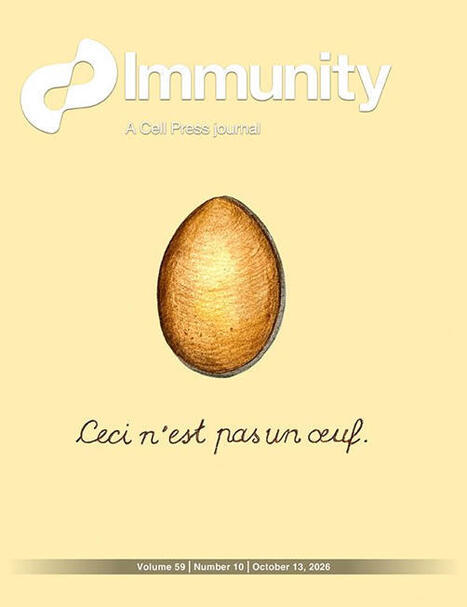
New issue online! Cover depicts work from Daria Esterházy, Yixuan D. Zhou & colleagues, who show that gut T cell responses to the same protein—chicken egg white ovalbumin (OVA)—differ depending on whether OVA is of dietary or epithelial origin, reflecting distinct antigen-presenting cell-subset dependencies. OVA, one of the most widely used model antigens, “is not (predictably) OVA”: its source and context can shape fundamentally different immune responses. This principle, which may extend to any antigen, is depicted as a version of Rene Magritte’s “The Treachery of Images.” Illustration by Daria Esterházy and Yixuan D. Zhou. https://lnkd.in/eveC4BT6
|
|
Scooped by
Gilbert C FAURE
October 8, 5:03 AM
|
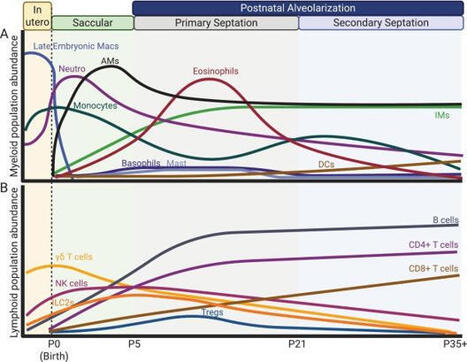
The immune system in postnatal lung development
|
|
Scooped by
Gilbert C FAURE
October 4, 11:38 AM
|
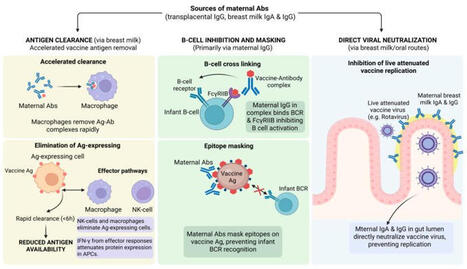
🧬 Title Story – A Double-Edged Sword: Breast Milk-Derived Maternal Antibodies and Infant Vaccine Responses: A Narrative Review
Authors: ALEXANDRA MPAKOSI, Rafaela Anna Moutsopoulou, Stamatios Cholevas, Alexandra Lianou, Andriana Samata, Foteini Tziraki, Ioannis Vogiatzis, Vasileios Cholevas, Zoi Iliodromiti, Theodora Boutsikou, Nicoletta Iacovidou, Andreas G. Tsantes and Rozeta Sokou
Neonatal defense relies on maternal antibodies transferred through the placenta (IgG) and breast milk (secretory IgA). While protective, these antibodies can also interfere with infant vaccine responses.
Key insights:
🧬 Placental transfer: Maternal IgG crosses via FcRn and can bind vaccine antigens (measles, tetanus, poliovirus), leading to rapid clearance through FcγRIIB-mediated inhibition and inadequate B cell activation
🍼 Breast milk antibodies: Vaccination during pregnancy or lactation induces protective IgA/IgG in breast milk, but these may accelerate vaccine antigen clearance and reduce plasma cell formation in breastfed infants
🌍 LMIC factors: Environmental enteric dysfunction, malnutrition, and co-infections may exacerbate interference
📊 Current evidence: Breastfeeding is associated with reduced immune response exclusively to the rotavirus vaccine
✅ Conclusion: Despite theoretical interference, the overall protective benefits of breastfeeding outweigh any potential reduction in vaccine responses
📖 Open access: 🔗 https://lnkd.in/dVRhpgGx
#MDPI #Vaccines #MaternalAntibodies #InfantVaccines #Immunology #TitleStory
|
|
Scooped by
Gilbert C FAURE
October 2, 4:07 AM
|
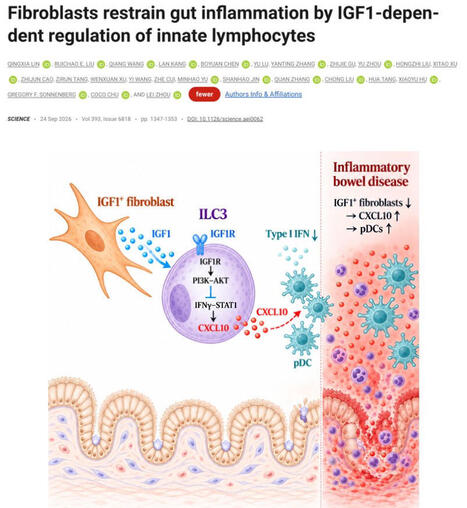
𝗙𝗶𝗯𝗿𝗼𝗯𝗹𝗮𝘀𝘁𝘀 𝗽𝘂𝘁 𝘁𝗵𝗲 𝗯𝗿𝗮𝗸𝗲𝘀 𝗼𝗻 𝗴𝘂𝘁 𝗶𝗻𝗳𝗹𝗮𝗺𝗺𝗮𝘁𝗶𝗼𝗻
𝘐𝘎𝘍1+ 𝘴𝘵𝘳𝘰𝘮𝘢𝘭 𝘤𝘦𝘭𝘭𝘴 𝘳𝘦𝘴𝘵𝘳𝘢𝘪𝘯 𝘢𝘯 𝘐𝘓𝘊3–𝘊𝘟𝘊𝘓10–𝘱𝘋𝘊 𝘪𝘯𝘧𝘭𝘢𝘮𝘮𝘢𝘵𝘰𝘳𝘺 𝘤𝘪𝘳𝘤𝘶𝘪𝘵
🧠 𝗔 𝗽𝗮𝗽𝗲𝗿 𝗮 𝗱𝗮𝘆 𝗸𝗲𝗲𝗽𝘀 𝗯𝗿𝗮𝗶𝗻 𝗱𝗲𝗰𝗮𝘆 𝗮𝘄𝗮𝘆 🧠
Wednesday, 30 September 2026
𝘐𝘯𝘧𝘭𝘢𝘮𝘮𝘢𝘵𝘰𝘳𝘺 𝘣𝘰𝘸𝘦𝘭 𝘥𝘪𝘴𝘦𝘢𝘴𝘦 𝘪𝘯𝘷𝘰𝘭𝘷𝘦𝘴 𝘮𝘢𝘫𝘰𝘳 𝘪𝘮𝘮𝘶𝘯𝘦–𝘮𝘦𝘴𝘦𝘯𝘤𝘩𝘺𝘮𝘢𝘭 𝘳𝘦𝘮𝘰𝘥𝘦𝘭𝘪𝘯𝘨, 𝘣𝘶𝘵 𝘩𝘰𝘸 𝘵𝘩𝘦 𝘭𝘰𝘴𝘴 𝘰𝘧 𝘴𝘱𝘦𝘤𝘪𝘧𝘪𝘤 𝘧𝘪𝘣𝘳𝘰𝘣𝘭𝘢𝘴𝘵 𝘴𝘵𝘢𝘵𝘦𝘴 𝘥𝘪𝘳𝘦𝘤𝘵𝘭𝘺 𝘢𝘭𝘵𝘦𝘳𝘴 𝘪𝘯𝘯𝘢𝘵𝘦 𝘮𝘶𝘤𝘰𝘴𝘢𝘭 𝘪𝘮𝘮𝘶𝘯𝘪𝘵𝘺 𝘳𝘦𝘮𝘢𝘪𝘯𝘴 𝘱𝘰𝘰𝘳𝘭𝘺 𝘶𝘯𝘥𝘦𝘳𝘴𝘵𝘰𝘰𝘥. 𝘓𝘪𝘯 𝘦𝘵 𝘢𝘭. 𝘪𝘥𝘦𝘯𝘵𝘪𝘧𝘺 𝘢 𝘱𝘳𝘰𝘵𝘦𝘤𝘵𝘪𝘷𝘦 𝘊3+ 𝘐𝘎𝘍1-𝘱𝘳𝘰𝘥𝘶𝘤𝘪𝘯𝘨 𝘧𝘪𝘣𝘳𝘰𝘣𝘭𝘢𝘴𝘵 𝘱𝘰𝘱𝘶𝘭𝘢𝘵𝘪𝘰𝘯 𝘵𝘩𝘢𝘵 𝘴𝘪𝘨𝘯𝘢𝘭𝘴 𝘵𝘩𝘳𝘰𝘶𝘨𝘩 𝘐𝘎𝘍1𝘙 𝘰𝘯 𝘨𝘳𝘰𝘶𝘱 3 𝘪𝘯𝘯𝘢𝘵𝘦 𝘭𝘺𝘮𝘱𝘩𝘰𝘪𝘥 𝘤𝘦𝘭𝘭𝘴 𝘵𝘰 𝘴𝘶𝘱𝘱𝘳𝘦𝘴𝘴 𝘪𝘯𝘵𝘦𝘳𝘧𝘦𝘳𝘰𝘯-γ-𝘥𝘳𝘪𝘷𝘦𝘯 𝘊𝘟𝘊𝘓10 𝘱𝘳𝘰𝘥𝘶𝘤𝘵𝘪𝘰𝘯 𝘢𝘯𝘥 𝘭𝘪𝘮𝘪𝘵 𝘱𝘭𝘢𝘴𝘮𝘢𝘤𝘺𝘵𝘰𝘪𝘥 𝘥𝘦𝘯𝘥𝘳𝘪𝘵𝘪𝘤-𝘤𝘦𝘭𝘭 𝘳𝘦𝘤𝘳𝘶𝘪𝘵𝘮𝘦𝘯𝘵.
💡 𝗧𝗮𝗸𝗲 𝗵𝗼𝗺𝗲 𝗺𝗲𝘀𝘀𝗮𝗴𝗲
• C3⁺ABCA8⁺ IGF1-producing fibroblasts are reduced in inflammatory bowel disease, while fibroblast-specific loss of Igf1 increases susceptibility to experimental intestinal inflammation.
• Stromal IGF1 signals through IGF1R on ILC3s, engaging PI3K–AKT and dampening interferon-γ–STAT1 signaling to suppress CXCL10 production.
• When this brake is lost, ILC3-derived CXCL10 recruits CXCR3⁺ plasmacytoid dendritic cells, promoting type I interferon-dependent intestinal inflammation.
🔥 𝗜𝗺𝗽𝗮𝗰𝘁
• The study shifts attention from pathogenic fibroblasts alone to the loss of protective stromal states, revealing a fibroblast–ILC3–pDC axis that could be explored therapeutically in inflammatory bowel disease.
❓ 𝗢𝗽𝗲𝗻 𝗾𝘂𝗲𝘀𝘁𝗶𝗼𝗻𝘀
• What signals drive the loss or reprogramming of protective C3⁺ IGF1-producing fibroblasts during chronic intestinal inflammation?
• Does systemic IGF1R blockade promote intestinal inflammation in susceptible patients through dysregulation of this ILC3–CXCL10 axis?
• Can this pathway be modulated locally without perturbing the broader physiological roles of IGF1–IGF1R signaling?
𝗙𝗶𝗯𝗿𝗼𝗯𝗹𝗮𝘀𝘁𝘀 𝗿𝗲𝘀𝘁𝗿𝗮𝗶𝗻 𝗴𝘂𝘁 𝗶𝗻𝗳𝗹𝗮𝗺𝗺𝗮𝘁𝗶𝗼𝗻 𝗯𝘆 𝗜𝗚𝗙𝟭-𝗱𝗲𝗽𝗲𝗻𝗱𝗲𝗻𝘁 𝗿𝗲𝗴𝘂𝗹𝗮𝘁𝗶𝗼𝗻 𝗼𝗳 𝗶𝗻𝗻𝗮𝘁𝗲 𝗹𝘆𝗺𝗽𝗵𝗼𝗰𝘆𝘁𝗲𝘀
Qingxia Lin, Ruichao E. Liu, Qiang Wang, Lan Kang et al.
Science, September 2026
Corresponding authors: Ruichao E. Liu, Gregory F. Sonnenberg, Coco Chu, Lei Zhou
🔗 𝘓𝘪𝘯𝘬 𝘵𝘰 𝘵𝘩𝘦 𝘱𝘶𝘣𝘭𝘪𝘤𝘢𝘵𝘪𝘰𝘯 𝘪𝘯 𝘤𝘰𝘮𝘮𝘦𝘯𝘵𝘴
𝘐𝘭𝘭𝘶𝘴𝘵𝘳𝘢𝘵𝘪𝘰𝘯 𝘨𝘦𝘯𝘦𝘳𝘢𝘵𝘦𝘥 𝘸𝘪𝘵𝘩 𝘊𝘩𝘢𝘵𝘎𝘗𝘛.
𝘛𝘩𝘦 𝘰𝘱𝘪𝘯𝘪𝘰𝘯𝘴 𝘴𝘩𝘢𝘳𝘦𝘥 𝘰𝘯 𝘓𝘪𝘯𝘬𝘦𝘥𝘐𝘯 𝘢𝘳𝘦 𝘮𝘺 𝘰𝘸𝘯.
|
|
Scooped by
Gilbert C FAURE
September 22, 8:06 AM
|
How durable is T cell memory in the human upper airway?
The nose and throat are major entry sites for respiratory viruses, yet surprisingly little is known about the longevity of antigen-specific memory T cells at these barrier tissues.
In our new preprint, we directly tracked virus-specific CD8 and CD4 T cells in the human upper airway for more than 18 months.
We collected nasal swabs monthly from healthy adults—nearly 900 samples in total—and used peptide–MHC multimers to track antigen-specific T cells with epitope-level specificity. We also followed corresponding T cell populations in blood for >12 months.
What did we find?
1. SARS-CoV-2- and influenza A-specific memory CD8 and CD4 T cells were remarkably common, detectable in nasal samples from >95% of individuals.
2. Upper-airway antigen-specific T cell memory was highly durable, persisting for 18+ months with no clear evidence of decline.
3. These virus-specific cells predominantly exhibited tissue-resident memory (TRM) phenotypes, consistent with long-term residence at this important barrier site.
4. During reported or suspected SARS-CoV-2 infections, SARS-CoV-2-specific T cell frequencies increased, providing evidence that these local memory populations can respond to renewed viral exposure.
Together, these data demonstrate remarkably durable antigen-specific CD8 and CD4 T cell memory in human upper-airway mucosal and lymphoid tissues.
The findings have implications for next-generation vaccines and T cell-based therapeutics designed to establish long-lived immunity directly at sites of pathogen entry.
Preprint: https://lnkd.in/dp43Nf2J
Huge congratulations to @Sydney Ramirez, Farhoud Faraji, La Jolla Institute for Immunology and the entire team!
|
|
Scooped by
Gilbert C FAURE
September 18, 4:46 AM
|
September issue online! Cover depicts work from Randy Longman, Wei Yang & colleagues identifying Bhlhe40 as a central regulator linking innate and adaptive intestinal immunity. Cover art designed by August Fireflies Studio. https://lnkd.in/e8g3cDqX
Maintaining tolerance at mucosal barrier surfaces, enabled by coordinated communication among immune cells, is critical for tissue health. Yang et al. report that the transcriptional regulator Bhlhe40 enables intestinal type 3 innate lymphoid cells and RORγt+ antigen-presenting cells to integrate inflammatory and microbial signals and promote regulatory T cell differentiation, thereby balancing tissue protection with tolerance in the intestine. This mechanism is relevant to inflammatory bowel disease. The impact of Bhlhe40 is depicted as the first light of dawn shining through a forest, illuminating a healthy landscape that symbolizes the activation of protective immune programs (blooming flowers) and the restoration of intestinal immune balance.
|
|
Scooped by
Gilbert C FAURE
September 12, 8:49 AM
|
In a new #SciencePerspective, researchers dig into the skin microbiome’s role in healthy skin aging and argue that microbial functions and metabolites may ultimately be more informative than microbial composition alone for understanding microbiome-linked skin aging.
Learn more: https://scim.ag/4xyajig
|