


You teach your self. Who ever you are, who ever that ‘self’ is will determine the words and deeds you perform in the classroom. It’s really difficult to change the teaching self from the outside…
Via Nik Peachey

 Your new post is loading...
 Scoop.it! You teach your self. Who ever you are, who ever that ‘self’ is will determine the words and deeds you perform in the classroom. It’s really difficult to change the teaching self from the outside… Via Nik Peachey
Scoop.it!

iLovePDF is an online service to work with PDF files completely free and easy to use. Merge PDF, split PDF, compress PDF, office to PDF, PDF to JPG and more! Via Nik Peachey 
Nik Peachey's curator insight,
April 10, 2019 4:25 AM
A huge collection of free tolls for working with PDF files. 
Kymberley Pelky's curator insight,
May 6, 2019 4:33 PM
I haven't explored this, but I wanted to Scoop.It right away!
Scoop.it!

‘Innovation’ is one of capitalism’s most popular buzzwords. Its function is to sustain the myth that business genius creates society’s wealth. Via LGA, juandoming
Scoop.it!

Scoop.it!

"For anyone involved in education, the importance of engagement is clear. And the need for both student engagement and buy-in cannot be overstated when it comes to device rollout." Via EDTECH@UTRGV
Scoop.it!

In the early years, I often spent hours many nights researching a topic of interest and sharing what I had learned, hoping for feedback from others. I spent even more time on the weekends, learning, exploring, and working to get better at writing, using WordPress, managing ad placements, and much more. It was often a lot of fun, and occasionally a bit burdensome. Over time all of that hard work paid off in numerous ways – new knowledge, connections, fun projects, and additional income. I developed and delivered training content, wrote a couple free ed tech books and then a complete “workshop in a book”. I developed a 4 week online flipped classroom workshop that I ran for many, teaching and connecting with hundreds of teachers all across the world. I began presenting at conferences and doing workshops at schools. I started teaching at the college where I work as CIO. Eventually, I took on additional part time jobs writing and managing online sites (shout out to my friends at the Flipped Learning Network and University Business). I was able to connect with and learn from so may informed and interesting colleagues while helping to pay for my kids' college costs, and I am very grateful for that. I also learned a lot of important things along the way, much of which ran somewhat contrary to what one might think an edtech guy would pick up over a decade. Allow me to share those insights. I hope you find some of them to be informative and useful. 10 Valuable Things I Learned While Writing and Running EmergingEdTech 1. Human relationships are so much more important than the technology This is so important. Technology has many benefits, but as a communications medium it has a certain way of distancing us (in comparison to face-to-face communication). We need to continuously strive to find the balance between sharing and connecting digitally versus in person. Sometimes that balance may be as simple as using video chat to connect. Human beings need other human beings – we need that connection, and we communicate far more effectively when we can see each other. Facts and concepts are an essential part of learning, but relationships change lives. 2. Technology alone will never revolutionize education Technology has made a huge difference in many ways, making online learning possible, providing opportunities to those who otherwise would not have them, capturing students' imaginations and giving them amazing tools to express themselves with. That's wonderful. But no matter how we apply technology, it is an evolution not a revolution. While technology may be necessary to bring about fundamental changes (such as competency based learning, or the dis-aggregation of the degree), it is ultimately always people who need to agree to make those things happen and sculpt policy and define a path forward. 3. Online learning has come a long way, but there is a still a good deal of room for improvement (particularly when it comes to keeping the experience social and human) In my experience and opinion, while online learning has expanded tremendously, I believe a lot of it is still done rather poorly. It can be done well and certainly is in some cases, but so many educators are still learning what that means and what it takes. Vital to online learning at its best is a sense of social presence and connection – one of the most glaringly missing elements from many of today's online classrooms. I believe that asynchronous video chat tools like FlipGrid can play an important role in bringing some of those missing elements back into the online classroom. Or perhaps we need to have more of an expectation for there to be some brief synchronous chats in our online courses. The bottom line is that the limited social interaction and instructor presence in the online classroom is a big shortcoming of too many online courses. 4. Far too many technology implementations are done with inadequate understanding of best practices This baffles me as a manager. There is no shortage of knowledge and experience available to us when it comes to how to manage change. I'm not saying it is easy – it isn't, but there are many best practices when it comes to implementation new tools and systems, yet they are so often overlooked. I wrote this extensive piece exploring this and if one person helps to make one project more of a success because of something I shared there, somehow that makes all 10 years of doing this feel that much more worth it. 5. Professional development, professional development, professional development I know some teachers tire of PD, although I think that is often because they get so discouraged by poorly designed and delivered PD. But the bottom line is that many educators need more hand holding and hands-on time to learn the tools we throw at them. And they need to be provided the time for it. If only their experiences would be more positive, more often. 6. Education is changing (albeit slowly) whether we agree with the changes or not, and you can either learn to change or gradually get pushed aside Change keeps coming. I know that significant changes in education occur at a snail's pace, but that may be a blessing. Yet things do change. For example, Western Governors University has been delivering Competency Based Education for decades. That's a big deal in the world of higher ed. We all know that online learning is more embraced year over year. Flipped Learning continues to spread and be embraced. Change is happening. Don't ignore it. We tell kids that they need to embrace life long learning. So do we. And administrators at all levels need to stay informed and be part of the conversation as we think about and plan for tomorrow. 7. Higher education needs to continue creating more flexible approaches to teaching, access, and credentialing I'm a big believer in efforts to make learning easier to grant credit for and making those credits more transportable. There has been a lot of great work done to move things in this direction. One of the larger scale efforts has been the Connecting Credentials work driven by the Lumina Foundation. In the meanwhile, digital badges continue to gain momentum as part of the overall microcredentials environment. I believe that the overlap of these ideas, combined with others like Competency Based Education, hold a great deal of promise when it comes to transforming higher education in a meaningful way that opens things up to a wider audience, at a lower cost, with a far more flexible, affordable, and powerful definition of the degree. 8. We should apply the science of learning to evolution of education technology When we leverage our growing understanding of the science and psychology of learning to help educators do a better job in their classrooms, we are putting to use an often overlooked form of “education technology”. I have written before about the importance of having our ed tech software developers do the same. 9. Technology should supplement and enhance teaching and learning but it should never replace human beings as guides of the learning process I think I've made this point above already, starting with point No. 1 above. The best education is driven by caring, properly trained educators, not machines. That should never change. 10. I love to help people learn new things At a conference earlier this month, an Australian gentleman by the name of Phil Nosworthy talked to attendees about Mindfulness and Mastery and how these are the things that can make our jobs and careers a wonderful experience. He asked us to list out things that bring meaning to our jobs. This was at the top of my list: I truly enjoy helping people learn things that can help them in their lives and jobs. I guess I've always had the heart of a teacher. Not surprising given that my Dad was a teacher. Thanks Pop (my dad passed 9 years ago this month, but here he is always here with me :). Via Yashy Tohsaku
Scoop.it!

"Digital distraction is a major source of frustration for professors. They're split, however, on whether to do anything about it. Some believe the onus is on students to change their habits, while others see an overreliance on lecturing as at least part of the problem ..." Via Leona Ungerer
Scoop.it!

Evaluations found that students participating in Technovation challenges display are more self-confident, better problem solvers, better entrepreneurs, more resilient and more self-reliant. Via John Evans
Scoop.it!
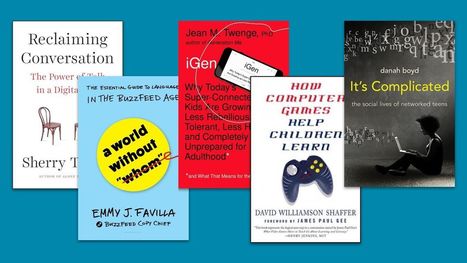
"Teachers don’t have to look far to see how changes in technology and social media are shaping students and influencing classrooms. We watch kids obsess over the latest apps as they chat before class. We marvel at the newest slang edging its way into student essays, and wonder at the ways constant smartphone communication is shaping students’ friendships, bullying, and even study habits. Via John Evans
Scoop.it!

Look no further. If you want to learn more about instructional design, eLearning and how people learn, here is an updated selection of books for you to browse. If you are already competent, there are a few books here that will expand your skills and understanding. In this updated article, there are a range of books, from the smaller less expensive ones to pricey graduate level texts.
Scoop.it!

"The smart speaker sits in a corner of the classroom, awaiting its next command. It’s also listening to – and possibly recording — every word you and your students say in the classroom. The voice assistant device that has dominated the residential industry is now making its way into classrooms." Via EDTECH@UTRGV
Scoop.it!
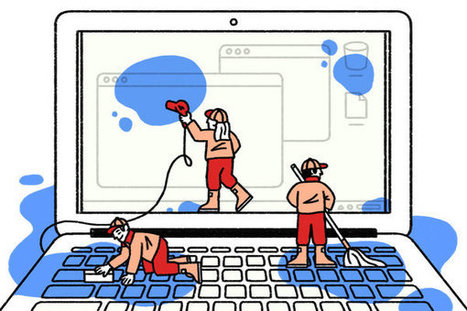
Like any tool we use every day, our laptops accumulate dust, grime, oils from our skin and who knows what else. Yours is probably due for a cleaning, and here’s how to do it right. Via John Evans |
Scoop.it!
Scoop.it!

"From marketing video to traffic studies, higher ed users find clever ways to put drones to work ..." Via Leona Ungerer
Scoop.it!
Scoop.it!

Rio Rancho (NM) Public Schools is the state’s third-largest school district; it has 18,000 students and more than 2,000 employees across 19 schools. Via EDTECH@UTRGV
Scoop.it!

From the article, “Why reading 100 books a year won’t make you successful.” Personal development books are only as helpful as the action we take after reading them. All the methodologie…
Via Felix Jacomino
Scoop.it!

Just a few years ago, educators were excited to use a robust learning management system (LMS) for online learning, but now an LMS may not be enough. Via Yashy Tohsaku
Scoop.it!

From
www

Durch eine kleine Änderung in den Standardeinstellungen macht Microsoft einen lästigen Zwischenschritt überflüssig: USB-Sticks können jetzt einfach herausgezogen werden. Vorher drohte ohne sicheres Entfernen ein Datenverlust.
Learn more / En savoir plus / Mehr erfahren:
https://www.scoop.it/t/free-tutorials-in-en-fr-de/?&tag=windows10
Via Gust MEES 
Gust MEES's curator insight,
April 9, 2019 9:54 AM
Durch eine kleine Änderung in den Standardeinstellungen macht Microsoft einen lästigen Zwischenschritt überflüssig: USB-Sticks können jetzt einfach herausgezogen werden. Vorher drohte ohne sicheres Entfernen ein Datenverlust.
Learn more / En savoir plus / Mehr erfahren:
https://www.scoop.it/t/free-tutorials-in-en-fr-de/?&tag=windows10
Scoop.it!

The new insert audio feature in Google Slides opens up the door to many new project ideas! Check out this list of 25 ways to use audio in Google Slides projects. Via Dr. Tom D'Amico (@TDOttawa) , Yashy Tohsaku
Scoop.it!

Set Your Settings to Reply I am seriously about to lose it over Reply All. “Thanks” does not need to be replied to a large group. The sender should have used BCC (Blind Carbon Copy) to prevent Reply All from happening in the first place. However, when BCC is not utilized (USE BCC MY FRIENDS!) …
Via Felix Jacomino
Scoop.it!

While it’s true that critical thinking is a foundation rather than a brick, how you build that foundation depends on the learning process itself: exposing students to new thinking and promoting interaction with that thinking in a gradual release of responsibility approach. Via John Evans
Scoop.it!

From
cblpro
Check all about the so-called essence of eLearning and discover 4 elements that are crucial for Building A Perfect eLearning Course for your audience. Via EDTECH@UTRGV
Scoop.it!

Check what you need to know to successfully make the switch from Web-Based Training To Blended Learning and increase the effectiveness of your training. Via EDTECH@UTRGV |








Some good points about reflective teaching, which of course we are all doing.