


By: Jessica Reed, MA,@KYgirlinAlabama When I think of how collaborative teaching has changed over the course of the last 10 years, one consistent idea for collaborative teaching is how teache…
Via Dr. Tom D'Amico (@TDOttawa)

 Your new post is loading...
 Scoop.it! By: Jessica Reed, MA,@KYgirlinAlabama When I think of how collaborative teaching has changed over the course of the last 10 years, one consistent idea for collaborative teaching is how teache… Via Dr. Tom D'Amico (@TDOttawa) No comment yet.
Sign up to comment
Scoop.it!

"Problem-based learning (PBL) is an exciting way to learn biology and is readily incorporated into large classes in a lecture hall environment. PBL engages students in solving authentic biological case problems, stimulating discussion among students and reinforcing learning. A problem-based learning environment emulates the workplace and develops self-directed learners. This is preferable to a mimetic learning environment in which students only watch, memorize, and repeat what they have been told.
"The examples given here are suitable for use in a first year college biology lecture theater, but the method is applicable to any class size and educational level."
Jim Lerman's insight:
This is a fascinating piece of work for at least three reasons. First, it was published in the mid-1990's, so it is interesting to see what problem-based learning looked like some 25 years ago. Second, despite its age, the procedures (particularly for problem-solving) are, by and large, quite as useful today as they were then. Third, most of the case examples are also, by and large, as useful today as they were then. Via Jim Lerman, Yashy Tohsaku 
Bradley Hokin's comment,
June 3, 2019 10:54 PM
Interesting insights Mitch! I liked how you aligned the thoughts of this article's real-life scenarios in a technology context since this article fails to discuss technology or ICT's. I enjoyed reading your insights. Cheers!

Jim Lerman's comment,
June 3, 2019 11:03 PM
I am very glad this article provoked such a positive response. I thought it was an excellent piece and worthy of wide dissemination. Author PETER OMMUNDSEN is to be commended for the abundant thoughtfulness of this piece and for the great amount of time it must have taken to develop these 20 case studies. The fact that is resonates so deeply with apparently early-career teachers, some 29 years after it was published is a remarkable accomplishment. And
Jim Lerman's comment,
June 3, 2019 11:04 PM
Mitch, you are absolutely correct in pointing out the further enhancement of these case studies to be gained by the careful integration of appropriate technological affordances.
Scoop.it!
Scoop.it!

"Cognitive computing is the end of one-size-fits-all education. The technology will make possible this declaration by Ignacio Estrada: If a child can’t learn the way we teach, maybe we should teach the way the child learns. This is exactly what will be possible in the near future with the help of cognitive computing ..." Via Leona Ungerer
Scoop.it!
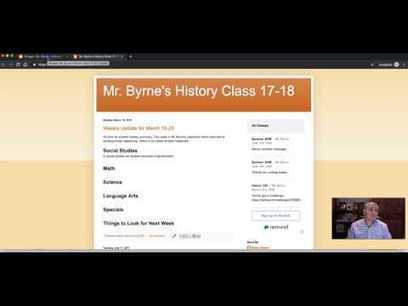
To remove the navigation bar from your Blogger blog follow these steps:
Via Gumersindo Fernández
Scoop.it!

What’s changing It’s now possible for users to work on Docs, Sheets, and Slides files when your device is offline or have a ba Via Dr. Tom D'Amico (@TDOttawa) 
Pamela Alaniz's curator insight,
May 13, 2019 5:49 PM
One of the fears I have using Google apps is that I will lose connectivity and lose work I was working on. This article explains how you can turn on the offline mode on your account so that it can automatically sync your work once you are connected to the internet. As an administrator you can set up these features to your Google classroom so that your students do not lose work or can work if they do not have internet connection but do have a device. Many students in your classrooms will not have internet if you are in low economic campus, so this is a great feature to update in your Google Classroom.

Jonathan Voltz's curator insight,
May 21, 2019 12:39 AM
Google classroom, docs, sheets etc. are a staple in every classroom these days from my recent experience with them in my classrooms. They offer a flexible and innovative way to create, manage and share various media forms with peers and teachers and also globally. having the flexibility to now work offline makes it even more impressive and valuable as a resource.
Thanks to Richard A. for the initial Scoop that prompted my to re-scoop about this initiate. 
Rachel Davey's curator insight,
May 23, 2019 10:23 AM
An interesting leap into the future, as Google Docs become more commonly used in the classroom. Opens up the potential for even more new and exciting technical initiatives in the modern classroom.
Scoop.it!
"It isn't often that forward-looking organizations take the time to look backwards too, but that's exactly what Educause has done in its latest Horizon Report. The association for IT professionals in higher education included a section in the report titled "Fail or Scale," which pulled out three..."
Via Leona Ungerer
Scoop.it!

A great device for enhancing STEAM education, a 3D printer for school can be a powerful tool. Here's a collection of the best, from safe and reliable machines to those backed with an arsenal of supplementary classroom resources. Via John Evans
Scoop.it!

Codelabs is a free online platform for learning, understanding and practicing programming. It provides a supervised tutorial on the working of a programming language works and enables the user to learn a new programming language easily and quickly. The user can execute their programs in the browser driven programming labs. It is useful for beginners as well as programmers with advanced knowledge. Tutorials are well-organized, one-page articles that help users to learn the basics of some of the most widely used programming languages across the world. Via John Evans
Scoop.it!

If you want to perform a quick edit on a photo, here are the best single-purpose online photo-editing apps you need to bookmark. Via Gumersindo Fernández
Scoop.it!

Scoop.it!

Learning is changing, and these online education trends are shedding light on a whole new crop of students--learn why online programs are evolving. Via EDTECH@UTRGV |
Scoop.it!

Whether we like it or not, the fourth industrial revolution is fundamentally changing the way the world works–and educators have to rise to the task of preparing students for 2030 and beyond.… Via Dr. Tom D'Amico (@TDOttawa)
Scoop.it!

Enable Offline Editing I use G Suite over other tools because collaboration is king. I do not want multiple versions floating around. Using G Suite I have full confidence that I am always looking at the current version. This is one reason for the paradigm shift that we do NOT make copies. Instead we name …
Via Felix Jacomino
Scoop.it!
Scoop.it!
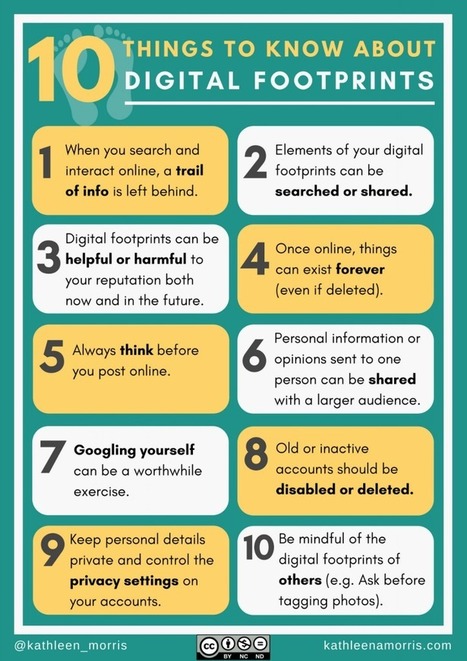
"Digital footprint, digital shadow, online reputation, digital tattoo — whatever you call it, it’s a term that’s too important to ignore yet often isn’t discussed in homes or classrooms. Via John Evans
Scoop.it!

"We have recently received a few requests from teachers asking about websites where they can search for and access educational documentaries ..."
Via Leona Ungerer
Scoop.it!
Scoop.it!

"Did you know that everything you do online leaves a trace? It’s true. It’s called a digital footprint, and while it may seem invisible to you right now, other people can see it, including ..." Via Leona Ungerer
Scoop.it!

Free resource of educational web tools, 21st century skills, tips and tutorials on how teachers and students integrate technology into education Via Dr. Tom D'Amico (@TDOttawa)
Scoop.it!

Puede que nunca hayas tenido problemas con Windows 10 tras instalar una actualización o incluso forzarla, pero no es algo que deberías hacer, y hay bastantes razones de peso para afirmarlo Via Wilmer Ramírez
Scoop.it!

From
t3n

Bei der organischen Suche auf Smartphones legte Duckduckgo im letzten Quartal um 78 Prozent zu. Via Guido Knaus
Scoop.it!

The 4th Industrial Revolution (4IR) is a way of describing the blurring of boundaries between the physical, digital, and biological worlds. It’s a fusion of advances in artificial intelligence (AI), robotics, the Internet of Things (IoT), 3D printing, genetic engineering, quantum computing, and other technologies. Via EDTECH@UTRGV, Yashy Tohsaku
Scoop.it!

Check some ways in which Artificial Intelligence Enhances the Learning process and figure out how to make use of this knowledge to improve your training. Via EDTECH@UTRGV |






