Clinical Pathology: The Importance of Laboratory Testing in Medical Diagnosis and Treatment, Wanda Smith*..
Get Started for FREE
Sign up with Facebook Sign up with X
I don't have a Facebook or a X account


|
Scooped by
Gilbert C FAURE
onto Laboratory Medicine July 30, 2023 4:55 AM
|
 Scoop.it!
Clinical Pathology: The Importance of Laboratory Testing in Medical Diagnosis and Treatment, Wanda Smith*..


 Your new post is loading...
 Your new post is loading...
Your new post is loading...
Scoop.it!
|
|
|
Scooped by
Gilbert C FAURE
March 31, 4:21 AM
|
Scoop.it!

Révélée par Ouest-France, une cyberattaque a touché le réseau de laboratoires Cerballiance. Des données sensibles, dont des comptes rendus d’analyses et des numéros de sécurité sociale, ont fait l’objet d’un accès non autorisé. Un nouvel incident pour un acteur déjà ciblé en 2025.
|
|
Scooped by
Gilbert C FAURE
March 30, 3:39 AM
|
Scoop.it!

In the intricate network of the human biliary system, the accurate diagnosis of bile duct strictures remains a formidable challenge for clinicians. These narrowings or blockages, connecting vital organs such as the liver, gallbladder, and intestines, can herald either malignant or benign processes.
|
|
Scooped by
Gilbert C FAURE
March 28, 3:13 AM
|
Scoop.it!

Labs Tests Online has launched a newly redesigned website.
Lab Tests Online helps patients and the public find trusted information about laboratory tests more easily and better understand what their results may mean. All content on the site is written, reviewed and updated by subject experts in laboratory medicine and is professionally peer reviewed.
The site’s design, structure and user experience has been transformed introducing a cleaner layout, simplified navigation and improved accessibility.
The College was pleased to support the redevelopment of the site which was made possible through a partnership between the College, LabMed, the Institute of Biomedical Science.
https://lnkd.in/etGUR66q
|
|
Rescooped by
Gilbert C FAURE
from Hésitations Vaccinales: Observatoire HESIVAXs
March 27, 4:52 AM
|
Scoop.it!

Thanks to The Guardian for covering our research and University of Sydney-backed social media campaign which aims to debunk misleading marketing of common, but typically unnecessary, medical tests being promoted to healthy people online.
We use full-body MRIs, the AMH and testosterone test as case studies to highlight this widespread issue and urge the public not to be conned by influencers with vested interests into taking a test you don’t really need - to look for evidence, not influence.
While we fully acknowledge that the social media landscape is extremely complex, that trust needs to rebuilt in health systems, and a single campaign won’t be the solution; we still believe getting evidence-based health messages to consumers to try and counter some of the misleading information is important. And we’ve had a lot of fun and learned a lot in the process.
Stayed tuned for more posts in the coming weeks, produced by the amazing USyd social media team Trish Tzannes Luke B. Winnie Liang!
https://lnkd.in/gBpdxB5i
|
|
Rescooped by
Gilbert C FAURE
from Mucosal Immunity
March 2, 4:11 AM
|
Scoop.it!
Un grand merci à Biologiste365 d’avoir permis un débat ouvert et utile autour de “Microbiote intestinal : de la recherche à la clinique”.
Les échanges (et le replay) sont ici : https://lnkd.in/ev3hj_HC
Pour la Société Française de Microbiologie et son GT MicMaC, le message reste constant, déjà porté dans notre tribune (Le Monde, 2023 – https://lnkd.in/ekh2EgXC) : oui à la recherche encadrée sur le microbiote, mais non aux raccourcis, potentiellement dangereux pour les patients.
L’étude portée par MicMaC (Pichon et al., Gut 2025 – https://lnkd.in/eYCweCfW) l’a objectivé : à partir d’un même échantillon de selles standardisé, des offres d’analyse du microbiote “en libre accès” auprès des particuliers produisent à l’heure actuelle des résultats et des interprétations très variables, donc non fiables, et d’aucune utilité. Quand le rendu dépend du laboratoire, ce n’est pas un biomarqueur clinique, et cela ne doit pas guider des décisions de santé.
Ce que nous défendons est simple et pragmatique :
· standardiser (pré-analytique, analytique, bioinformatique)
· valider (recherche clinique, cohortes, réplication, impact clinique)
· encadrer l’interprétation (s’appuyer sur des connaissances médicales et le dialogue clinico-biologique, pas de sur-promesses)
La SFM continuera à pousser une approche exigeante, transparente et centrée sur le patient, pour faire du microbiote un vrai progrès clinique.
Geneviève HÉRY-ARNAUD
#Microbiote #BiologieMédicale #Biomarqueurs #SFM #EBM #Métagénomique #MicMaC
|
|
Scooped by
Gilbert C FAURE
February 11, 4:53 AM
|
Scoop.it!
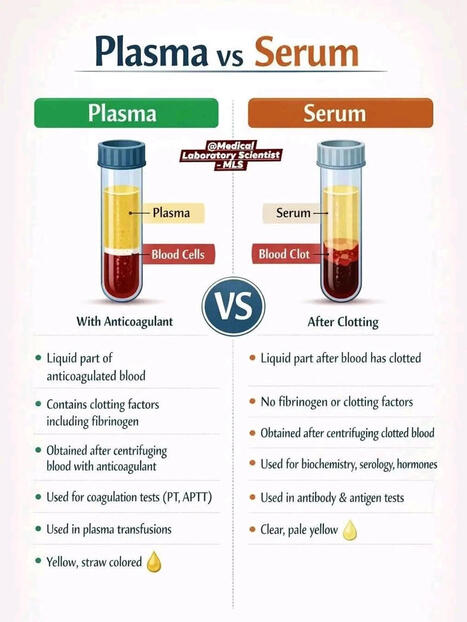
Plasma Serum Explained in One Simple Image
#fblifestyle #medicallaboratoryscientist #plasmavsserum #hematology #mls #medicallaboratory #serology
toujours difficile pour les médecins
|
|
Scooped by
Gilbert C FAURE
February 9, 4:20 AM
|
Scoop.it!
📺 Lundi, le journal télévisé de Groupe TF1 a diffusé un reportage consacré aux bilans sans ordonnance proposés dans les laboratoires français de biologie médicale, mettant en lumière l’activité de Cerballiance.
Cette évolution des parcours de santé illustre un changement profond :
👥 des patients de plus en plus acteurs de leur santé, qui peuvent aujourd’hui réaliser certains bilans biologiques sans ordonnance à leur demande, dans un cadre médical rigoureux, avec l’accompagnement d’un biologiste médical.
🥼 Dans ce reportage, de David de Araujo et Mignard Frédéric, Estelle Lamar, biologiste médicale Cerballiance, explique concrètement ce rôle central de la biologie médicale dans ces nouveaux parcours de prévention :
• apporter une réponse rapide et fiable à une question de santé ciblée,
• engager un suivi adapté si nécessaire, en lien avec les professionnels de santé.
• identifier les facteurs de risque notamment liés aux maladies cardiovasculaires et rénales, au travers du Score2.
🧬 Cet outil prédictif du risque d’accident cardiovasculaire à 10 ans, aujourd’hui proposé exclusivement par CERBA HEALTHCARE, apporte aux patients une lecture claire de leurs facteurs de risque et une base objective pour agir plus tôt.
Un exemple concret de la place croissante de la biologie médicale dans l’anticipation des risques toujours en lien étroit avec les professionnels de santé.
Bravo à l'ensemble des équipes mobilisées pour cette belle mise en lumière. 👏
#Prevention #BiologieMedicale #SantePublique #SansOrdonnance #TF1 | 13 comments on LinkedIn
|
|
Scooped by
Gilbert C FAURE
December 19, 2025 9:54 AM
|
Scoop.it!
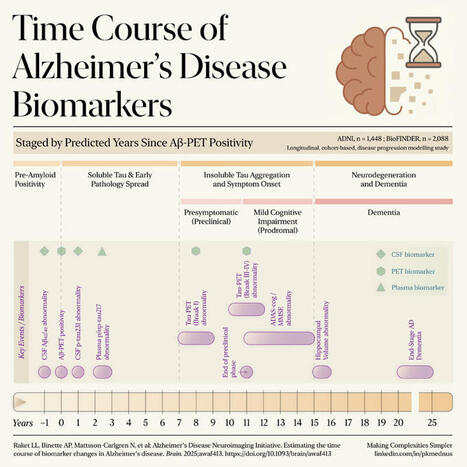
How long does Alzheimer's take to progress from its first biological sign to severe dementia? 🧠
Understanding this decades long biological timeline is crucial for managing the disease and evaluating new treatments.
A new analysis (https://lnkd.in/gY7igTAC) used longitudinal data from 1,448 subjects in the Alzheimer’s Disease Neuroimaging Initiative (ADNI) and 2,088 subjects in the BioFINDER study. The researchers created a continuous disease timeline by using a modelling technique that aligns patient observations based on amyloid-PET scans and cognitive scales, specifically the MMSE and ADAS-cog.
The timeline is centered at t = 0, which represents the predicted time a subject reaches Aβ-PET positivity.
The predicted disease time showed a significantly stronger pattern of correlation with unseen validation biomarkers (Aβ, tau, and neurodegeneration markers) compared to other staging methods, like existing biomarker clocks (all pairwise p values were less than 0.05).
The model revealed a precise sequence of biomarker abnormality, aligning with the disease progression. The total progression from Aβ-PET positivity to end stage AD dementia (MMSE = 0) was estimated to span 20 to 25 years.
The initial biological sign detectable by biofluid occurred first: CSF Aβ42/40 became abnormal approximately 1 year prior to Aβ-PET positivity. The earliest markers of soluble phosphorylated tau followed closely, with CSF p-tau231 and plasma p/np-tau217 becoming abnormal 1 to 3 years after Aβ-PET positivity.
This change in soluble p-tau happened many years before insoluble tau was detected by imaging, suggesting these soluble markers could reflect early changes caused by Aβ accumulation, not established neurofibrillary tangles.
Insoluble tau pathology, measured by Tau-PET, became clearly abnormal much later, with Braak I regions crossing the abnormality threshold 7 to 9 years after Aβ-PET positivity. The presymptomatic phase ended and cognitive measures (ADAS-cog/MMSE) become abnormal during the Mild Cognitive Impairment (MCI) stage, 11 to 15 years after Aβ-PET positivity.
Neurodegeneration, such as loss of hippocampal volume, became clearly abnormal during the dementia stages, 15 to 16 years after Aβ-PET positivity.
A key limitation of this work is the assumption that AD evolves around a single continuous trajectory; in reality, patient age and co-pathologies can influence the rate of decline and manifestation of symptoms. Also, data reliance on subjects who remain in the study may lead the model to estimate a longer disease duration in the later stages than is seen in typical patient populations.
These models provide continuous time disease staging that could improve prognosis and help in the evaluation of disease modifying treatments, by accurately highlighting the relative timing of pathological events across the AD continuum.
#neurology #dementia #alzheimers #biomarkers #prognosis
|
|
Scooped by
Gilbert C FAURE
December 15, 2025 3:55 AM
|
Scoop.it!

Noté /5. Retrouvez Textbook of Laboratory Medicine Clinical Procedures | Volume 1 et des millions de livres en stock sur Amazon.fr. Achetez neuf ou d'occasion
|
|
Scooped by
Gilbert C FAURE
March 30, 3:44 AM
|
Scoop.it!
Allied Med Academy is a professional educational YouTube channel dedicated to paramedical and allied health science students.
On this channel, you will find easy, clear, and exam-oriented lectures on MLT, DMLT, BMLT, Nursing, Radiology, DMRT, Lab Technology, and other allied medical subjects.
📚 What you will learn:
Pathology, Biochemistry, and Microbiology
Hematology and Blood Banking
Clinical Laboratory Procedures
MCQs and Exam Preparation
Practical and Concept-based Teaching
https://whatsapp.com/c
https://t.me/alliedmed123 #alliedhealth
|
|
Scooped by
Gilbert C FAURE
March 29, 1:01 PM
|
Scoop.it!
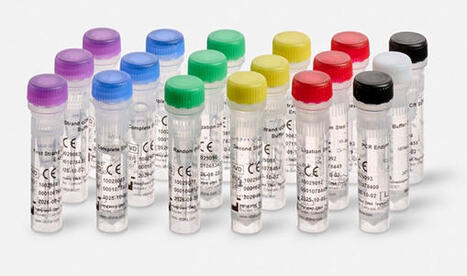
Integrated DNA Technologies Expands into Clinical Diagnostics...
|
|
Scooped by
Gilbert C FAURE
March 27, 11:48 AM
|
Scoop.it!
Founding members of the Santa Fe Project discuss the role of pathology in improving population-level health
|
|
Scooped by
Gilbert C FAURE
March 26, 11:24 AM
|
Scoop.it!
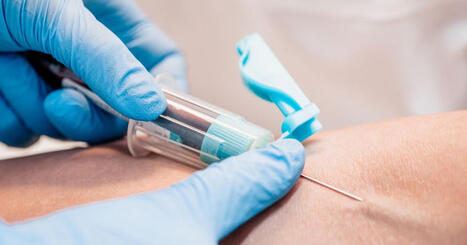
Clinical labs are exploring new business opportunities as consumers take more control of their healthcare and bypass their doctors to initiate testing.
|
|
Scooped by
Gilbert C FAURE
February 17, 4:14 AM
|
Scoop.it!

⭐PUBLIC HEALTH & ITS SUBTLE GROWTH⭐
💯Public health often advances quietly — not through headlines, but through small tools that change outcomes at scale.
💚A Multiplex is one of those tools: a rapid diagnostic test panel designed to screen for multiple infectious diseases in a single setting.
⚡While simple in appearance, devices like this sit at the intersection of Epidemiology, Maternal health, and child survival.
🤓From an epidemiological standpoint, integrated rapid testing panels are powerful because they support early detection, surveillance, and transmission interruption.
🏃When multiple infections can be screened simultaneously, health systems gain faster situational awareness.
🧎This is especially critical in low-resource or high-burden settings, where laboratory infrastructure may be limited but disease prevalence may be high.
🏂In maternal and child health, the stakes are even higher, as vertical transmission — from mother to child during pregnancy, delivery, or breastfeeding — remains a major driver of preventable illness and mortality worldwide.
🤼Conditions such as blood-borne and sexually transmitted infections can:
✅Increase risk of miscarriage or stillbirth
✅Cause congenital infections and birth defects
✅Lead to preterm birth and low birth weight
✅Contribute to neonatal and infant mortality
✅Affect long-term child development outcomes
🚸Early screening during antenatal care changes this trajectory. When infections are detected early, interventions can include:
✅Timely treatment for the mother
✅Preventive therapies during pregnancy
✅Safe delivery planning
✅Postnatal prophylaxis for newborns
✅Targeted breastfeeding guidance where applicable
💲From a systems perspective, multi-disease rapid tests also support equity in care delivery. They reduce the number of clinic visits required, lower logistical barriers, and improve coverage in rural and underserved populations. This aligns directly with global goals to strengthen primary healthcare and achieve universal health coverage.
🔄Aggregated screening data informs:
✅Regional disease prevalence trends
✅Program effectiveness evaluation
✅Resource allocation decisions
✅Outbreak early-warning systems
🧑🧒Ultimately, maternal and child health outcomes are one of the clearest indicators of population health.
✳️As public health professionals, clinicians, policymakers, and community leaders, our challenge is to ensure these tools are accessible, trusted, and integrated into routine care pathways.
🔐Because sometime, improving global health doesn’t start with a breakthrough drug or a new hospital — it starts with making sure a mother has access to a simple test at the right moment.
#PublicHealth #Epidemiology #MaternalHealth #ChildHealth #GlobalHealth #PreventiveCare #HealthEquity #PrimaryHealthcare #InfectiousDiseases #AntenatalCare
|
|
Scooped by
Gilbert C FAURE
February 11, 4:27 AM
|
Scoop.it!
Le travail paie !
🥵 Après 2 articles 51 dont l'un spécifiquement sur la biologie délocalisée🧪, voici l'arrêté du 4 février 2026 qui fixe les possibilités de biologie délocalisée (en dehors d'un établissement de santé) 🏥
Une satisfaction 🤗 pour le collectif CMSI France qui milite et oeuvre depuis plus de 5 ans sur ce sujet. L'attente fut longue mais çà valait le coup de se battre.
Celà peut vous paraitre peut-être anodin mais ce sont une vision et une avancée majeure pour l'organisation de l'offre de soins de premier recours.
Bienvenue dans le monde de la médecine moderne 🚀 et en route pour le désengorgement des urgences 🎯!
Le travail paie ! On ne lâche rien ! 🐊
Bravo à tous ceux qui ont contribué à cette évolution. C'est génial pour les patients !
Merci Direction générale de l'offre de soins (DGOS), Marie Daudé, Mickael BENZAQUI, Inspection générale des affaires sociales - Igas, Ministère de la Santé
JO - Arrêté du 4 février 2026
|
|
Scooped by
Gilbert C FAURE
February 8, 10:14 AM
|
Scoop.it!
Le site de référence en informations médicales et paramédicales - EM consulte
|
|
Scooped by
Gilbert C FAURE
January 14, 1:00 PM
|
Scoop.it!
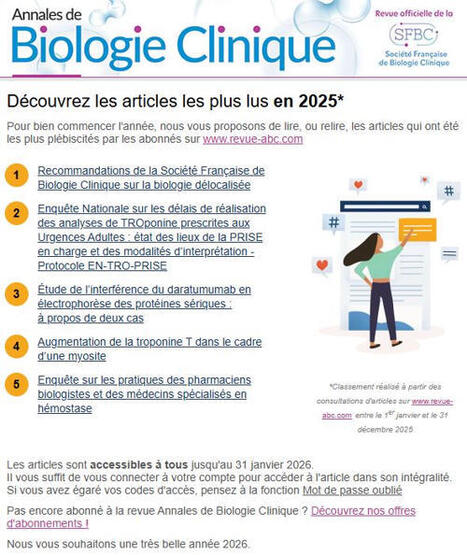
📍 Pour bien commencer l'année, nous vous proposons de lire, ou relire, les articles qui ont été les plus plébiscités par les abonnés dans les 𝐀𝐧𝐧𝐚𝐥𝐞𝐬 𝐝𝐞 𝐛𝐢𝐨𝐥𝐨𝐠𝐢𝐞 𝐜𝐥𝐢𝐧𝐢𝐪𝐮𝐞 🏆 https://lnkd.in/eK7DZW7D
📅 𝐋𝐞𝐬 𝐚𝐫𝐭𝐢𝐜𝐥𝐞𝐬 𝐬𝐨𝐧𝐭 𝐚𝐜𝐜𝐞𝐬𝐬𝐢𝐛𝐥𝐞𝐬 𝐚̀ 𝐭𝐨𝐮𝐬 𝐣𝐮𝐬𝐪𝐮'𝐚𝐮 𝟑𝟏 𝐣𝐚𝐧𝐯𝐢𝐞𝐫 𝟐𝟎𝟐𝟔.
Il vous suffit de vous connecter à votre compte pour accéder à l'article dans son intégralité.
Bonne lecture !
Michel Vaubourdolle Jean-Claude Alvarez Michel AROCK Jean-Louis Beaudeux @Marie-Christine Beauvieux @Élodie Boissier @Damien Bouvier Philippe Chatron @Agnès Mailloux Laurence Mouly @Pascal Pernet SAPIN Vincent Camille Gobeaux @Guillaume Lefevre Bruno Lehodey Mathieu Kuentz Bourbonneux Valery pecquet mathieu Pierre Hausfater Cedric Gil-Jardine @Christophe Choquet @Valérie Machie Valery Brunel Jeremy GUENEZAN Sandrine CHARPENTIER Yann-Erick Claessens @Alexandre Leonard @Benjamin Bonnet Carolyne Croizier Evrard Bertrand Anne Fogli @Sarah Diabate @Céline Bouchet-Seraphin @Sandrine Vuillaumier-Barrot Katell Peoc'h @Andréas Perrier-Cornet @Nicolas Gendron Céline Desconclois Hommais Virginie Planche Wentz @Caroline Vayne @Fabienne Nedelec Gac @Cécile Lavenu-Bombled Dominique Lasne Claire Flaujac @Myriam Hormi
SFBC Asso
#biologieclinique #ABC
|
|
Scooped by
Gilbert C FAURE
January 7, 8:10 AM
|
Scoop.it!

/PRNewswire/ -- A new study indicates that noninvasive prenatal screening (NIPS) performed using a low-cost form of whole genome sequencing can detec
|
|
Scooped by
Gilbert C FAURE
January 4, 4:41 AM
|
Scoop.it!
Arrêté du 28 octobre 2025 relatif à l'affectation des étudiants en médecine ayant satisfait aux épreuves nationales donnant accès au troisième cycle des études de médecine organisées
au titre de l'année universitaire 2025-2026
https://lnkd.in/dpXXaMtQ
En effectuant le top 200 de chaque spécialité et en le mixant on peut obtenir le classement national des 200 premiers
Voici une 1ere info :
🏥 1. Classement des CHU (attractivité dans le top 200)
(Nombre d’internes classés ≤ 200 affectés dans chaque CHU)
Voici le classement brut, basé sur votre échantillon :
Rang CHU / Institution Nombre d’internes ≤ 200
1 AP‑HP (Paris) ≈ 70
2 Marseille (AP‑HM) ≈ 20
3 Lyon (HCL) ≈ 18
4 Bordeaux ≈ 12
5 Toulouse ≈ 10
6 Grenoble ≈ 8
7 Montpellier ≈ 8
8 Rennes ≈ 7
9 Nice ≈ 6
10 Strasbourg ≈ 5
11 Nantes ≈ 4
12 Caen ≈ 3
13 Tours ≈ 2
14 Rouen ≈ 2
15 Poitiers ≈ 2
16 Lille ≈ 2
17 Angers ≈ 2
18 Saint‑Étienne 1
19 Nancy 1
20 Clermont‑Ferrand 1
21 Antilles (Martinique/Guadeloupe) 1
🔍 Interprétation rapide
• AP‑HP écrase tout : plus du tiers du top 200.
• Marseille et Lyon confirment leur attractivité, surtout en chirurgie et anesthésie.
• Bordeaux, Toulouse, Grenoble, Montpellier forment un bloc solide de CHU très attractifs.
• Les CHU plus petits (Caen, Poitiers, Tours…) captent quelques excellents profils, souvent dans des spécialités ciblées.
Et une 2ème:
2. Classement des spécialités (attractivité dans le top 200)
(Nombre d’internes ≤ 200 par spécialité)
Rang Spécialité Nombre d’internes ≤ 200
1 Anesthésie‑réanimation / Médecine intensive ≈ 45
2 Chirurgie (toutes disciplines) ≈ 35
3 Médecine cardiovasculaire ≈ 20
4 Dermatologie ≈ 15
5 Maladies infectieuses ≈ 10
6 Ophtalmologie ≈ 10
7 Pédiatrie ≈ 10
8 Oncologie / Hématologie ≈ 10
9 Néphrologie ≈ 10
10 Neurologie / Psychiatrie ≈ 8
11 Médecine générale ≈ 8
12 Radiologie ≈ 4
13 Gynécologie médicale / obstétrique ≈ 4
14 Rhumatologie ≈ 3
15 Médecine interne ≈ 3
16 Endocrinologie 2
17 Pneumologie 1
18 Santé publique 0
🔍 Interprétation rapide
• Médecine de l’aigu (anesthésie + réanimation + urgences) est de loin la spécialité la plus attractive du top 200.
• La chirurgie reste extrêmement attractive, surtout plastique, orthopédie, ORL, ophtalmo.
• Dermatologie confirme son statut de spécialité premium.
• Médecine générale attire quelques très bons rangs, mais reste minoritaire dans le top 200.
• Santé publique n’attire aucun top 200 dans votre échantillon.
(Avec l’aide de Copilot)




