 Your new post is loading...

|
Scooped by
Gilbert C FAURE
December 28, 2013 2:29 AM
|
Laboratory Medicine and Medical Biopathology
Laboratory Medicine is the name of a medical specialty where specialists are involved in medical diagnosis using laboratory assays to characterize molecular and cellular parameters in blood, biological fluids and tissues; It is called also clinical pathology.
|
|
Scooped by
Gilbert C FAURE
October 7, 5:36 AM
|
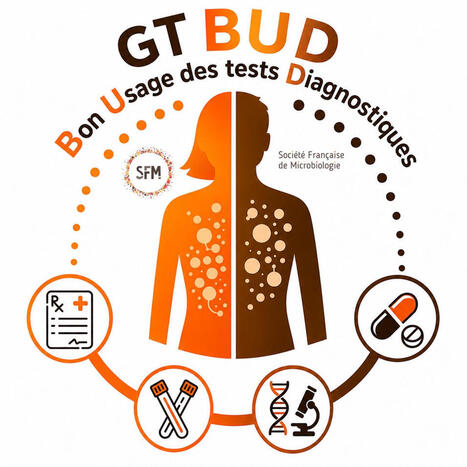
Très belle initiative de la SFM que ce nouveau GT pour le Bon Usage des tests Diagnostiques avec encore beaucoup de choses à faire et un appel à toutes les bonnes volonté
|
|
Scooped by
Gilbert C FAURE
September 24, 10:45 AM
|
📘 A Laboratory Guide to Clinical Hematology
🔬A valuable open educational resource by Michelle To and Valentin (Tino) Villatoro, developed through the Division of Medical Laboratory Science, University of Alberta. It provides an image-rich, practical approach to understanding blood cell morphology and hematological disorders.
🩸 A particularly useful feature: The guide makes extensive use of peripheral blood and bone marrow smear images, with descriptions that help learners correlate cellular morphology with hematological conditions. The eBook also provides access to an extensive University of Alberta hematology image collection. A useful resource for Medical Laboratory Science, Hematology, Medical Technology, Medical Microbiology, pathology students, postgraduate learners, and educators.
📖 Open Access: The eBook is licensed under a Creative Commons Attribution-NonCommercial 4.0 International (CC BY-NC 4.0) License, allowing sharing and adaptation for non-commercial purposes with appropriate attribution.
#ClinicalHematology #Hematology #MedicalLaboratoryScience #LaboratoryMedicine #MedicalEducation #HematologyEducation #PeripheralSmear #BloodMorphology #Anemia #Leukemia #MedicalLaboratory #OpenEducationalResources #OpenAccess | 13 comments on LinkedIn
💉 Vaccination : le potentiel des laboratoires de biologie médicale reste inexploité
Dans son nouveau rapport sur la politique vaccinale, la Cour des comptes pointe le rôle que pourraient jouer davantage les laboratoires de biologie médicale
📉 Avec seulement 54 % de couverture vaccinale contre la grippe chez les plus de 65 ans et 55 % des jeunes de 15 ans vaccinés contre les HPV, la France reste loin de ses objectifs
Pourtant, les laboratoires disposent de nombreux atouts :
🔬 500 000 patients accueillis chaque jour
📍 99 % des Français à moins de 20 minutes d’un laboratoire
👩⚕️ Des professionnels de santé qualifiés
🏥 Un réseau de proximité déjà pleinement opérationnel
L’expérience de « Mon test IST » montre que lorsque les laboratoires disposent des moyens nécessaires, ils peuvent contribuer concrètement à améliorer la prévention et l’accès aux soins
👉 La Fédération de la biologie médicale – FBM appelle donc à lever le dernier verrou réglementaire : permettre aux laboratoires de stocker, distribuer et approvisionner directement les vaccins
Les laboratoires sont prêts à prendre toute leur part dans la stratégie vaccinale nationale
urlr.me/rtkUYx
#Vaccination #BiologieMédicale #Prévention #SantéPublique #CourDesComptes
|
|
Scooped by
Gilbert C FAURE
August 24, 4:08 AM
|
I’m often asked how we find cancer-reactive T-cells.
Until now, I’ve usually been rather coy about the answer.
Well, the cat is finally out of the bag 😸
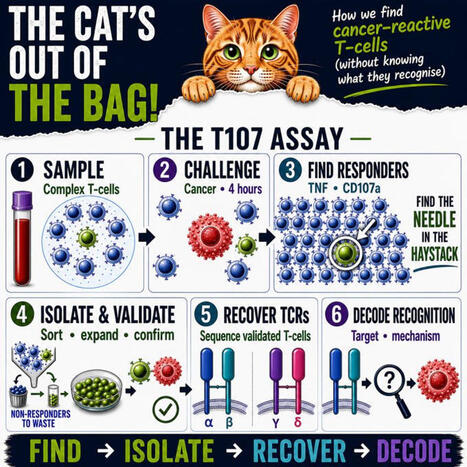
We’ve now published the method we use to fish viable cancer-reactive T-cells directly out of complex clinical samples, without needing to know what antigen they recognise.
We call it the T107 assay.
The principle is remarkably simple: expose T-cells to cancer cells for four hours and identify those that respond by detecting TNF and CD107a at the cell surface. Crucially, the responding cells remain alive.
That means we can isolate them, expand them, confirm that they really do recognise cancer, recover their T-cell receptors and then work out exactly what those receptors recognise.
Sometimes the cancer-reactive T-cell you want really is a needle in a haystack: less than one cell in a million. T107 lets us find it. 🪡
Finding interesting TCRs isn’t necessarily about finding the most abundant T-cell.
It’s about finding the right T-cell. ✅
We show that the approach works for αβ and γδ T-cells, CD4+ and CD8+ cells, and can recover receptors recognising patient-specific antigens, shared cancer antigens and even multiple different cancer types.
Some of the rather unusual cancer-reactive TCRs we’ve published over the years started life with experiments like these.
So, for everyone who has asked us:
“How do you find them?”
Here is the answer 👇
“Optimized procurement of cancer-reactive T-cell receptors from clinical samples”
Thanks especially to Marine Caillaud, Garry Dolton, Cristina Rius Rafael, Théo Morin and colleagues for making this possible.
Published open access in Immunotherapy Advances, the journal of the British Society for Immunology.
https://lnkd.in/e6RzhQfe
|
|
Scooped by
Gilbert C FAURE
August 16, 3:45 AM
|
Developing a UEMS Position on Direct-to-Consumer Testing (DTCT): Point of view Birgitte Rode Diness¹Truls Leegaard²Matthias Orth³ ORCID: 0000-0003-2881-8384¹ UEMS Section of Medical Genetics; Copenhagen University Hospital Rigshospitalet, Department of Clinical Genetics, Copenhagen, Denmark ² UEMS...
|
|
Scooped by
Gilbert C FAURE
August 8, 2:00 PM
|
|
|
Scooped by
Gilbert C FAURE
August 6, 10:02 AM
|
La DGOS vient de publier sa FAQ officielle sur la certification périodique.
17 pages qui clarifient enfin le dispositif.
Voici ce qu'il faut retenir, que vous soyez professionnel de santé ou employeur :
Pour les professionnels de santé :
→ 4 axes, 8 actions minimum sur un cycle de 6 ans (9 ans pour le cycle transitoire) → Vos actions réalisées depuis le 1er janvier 2023 comptent déjà — DPC, formations internes, engagements professionnels → Les formations hors DPC peuvent être prises en compte → La plateforme nationale « Ma Certif' Pro Santé » ouvrira en novembre 2026 → En attendant : conservez tous vos justificatifs
Pour les établissements et employeurs :
→ La certification reste une démarche individuelle du professionnel, y compris quand il est salarié → Mais la FAQ précise que le parcours « se construit en lien avec l'employeur » → Votre rôle : faciliter l'accès aux formations, soutenir l'organisation du parcours, mobiliser le plan de développement des compétences → Vous n'avez aucun rôle de contrôle — c'est l'Ordre qui vérifie
Ce que la FAQ ne dit pas (et c'est important) :
Aucun texte ne désigne explicitement qui finance la certification des salariés. Le mot « financer » n'apparaît pas une seule fois. Seuls les termes « organiser », « faciliter » et « mobiliser les dispositifs existants » sont utilisés.
Concrètement, les établissements qui anticipent maintenant — en intégrant la certification dans leur plan de développement des compétences — prendront une longueur d'avance.
Chez Biologie Elearning, nous accompagnons déjà les professionnels de santé avec des formations éligibles à la certification périodique, en e-learning et à leur rythme.
Découvrez nos programmes : https://lnkd.in/eXwrQrJa
Source : FAQ DGOS « La certification périodique : les clés pour s'y retrouver », juin 2026
#CertificationPériodique #SantéPublique #FormationContinue #DPC #ProfessionnelsDeSanté #Elearning #BiologieElearning #Pharmacien #Infirmière #IDEL #QualitéDesSoins
https://lnkd.in/eEZSDtVB
|
|
Scooped by
Gilbert C FAURE
July 30, 3:22 AM
|
From innovation to impact: bridging the Laboratory K-curve
Diagnostic innovation has never moved faster.
AI, multi-omics, digital health, liquid biopsy and decentralized testing are opening remarkable new possibilities.
But innovation alone is not enough.
If accessibility, affordability, acceptance, alignment and actionability are not addressed, even the best diagnostic solutions may never deliver their full clinical value.
This summarizes the key message of my recent article:
- the challenge in laboratory medicine is no longer only discovery
- it is translation, implementation and adoption
Bridging the Laboratory K-curve will require technology, evidence, education, policy and collaboration to move forward together.
#LaboratoryMedicine #Diagnostics #HealthcareInnovation #Implementation #DigitalHealth #ClinicalChemistry #ValueBasedHealthcare #CCLM
|
|
Scooped by
Gilbert C FAURE
July 27, 4:29 AM
|
Discover how pathologists diagnose diseases, analyze laboratory tests, and support accurate treatment decisions.
|
|
Scooped by
Gilbert C FAURE
July 23, 3:49 AM
|
In early June 2026, a quiet but powerful transformation began to take shape in Accra, Ghana.Experts from Africa CDC, the African Society for Laboratory Medicine (ASLM), Member States, and the UK Health Security Agency (UKHSA) came together with a shared mission to redefine how Africa strengthens ...
|
|
Scooped by
Gilbert C FAURE
July 21, 11:24 AM
|
Test de grossesse, bilan de ménopause ou de fatigue, check up, recherche d’infection urinaire ou bilan IST…
🔬 Au laboratoire, vous pouvez désormais réaliser ces bilans, conçus par des biologistes médicaux, sans ordonnance et sans rendez-vous.
Une démarche simple pour obtenir rapidement des informations utiles sur votre état de santé.
Ces examens sont payants et ne sont pas remboursés. Le dépistage des infections sexuellement transmissibles, quant à lui, bénéficie d'une prise en charge selon les dispositifs en vigueur.
👩⚕️ Renseignez-vous auprès de votre laboratoire. Nos professionnels de santé sont disponibles pour répondre à vos questions et vous accompagner.
Pour en savoir plus, rendez-vous sur notre site internet.
#unibio #monlabounibio #lbi #lesbiologistesindependants #bilansansordonnance #prevention
|
|
Scooped by
Gilbert C FAURE
July 20, 3:56 AM
|
Prenez votre santé en main et réalisez des tests sanguins sans ordonnance. Découvrez notre guide pour réaliser votre bilan biologique.
|
|
|
Scooped by
Gilbert C FAURE
October 14, 8:30 AM
|
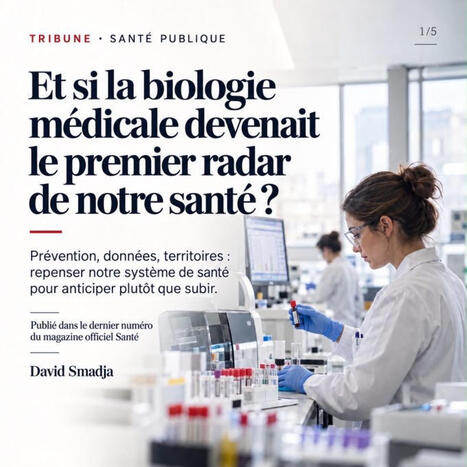
Dans le dernier numéro de la revue Officiel Santé Arik lellouche Alliance-hôpital SNAM-HP & CMH j'ai essayé de poser la question suivante: Et si la biologie médicale devenait l’un des premiers leviers de notre politique de prévention ?
Dans cet article consacré à la biologie médicale et aux territoires, je défends une conviction : les laboratoires ne doivent plus être considérés comme de simples producteurs de résultats, mais comme de véritables acteurs de la prévention et de la transformation de notre système de santé.
Chaque jour, les données biologiques nous offrent la possibilité de détecter plus tôt certaines maladies, d’identifier des facteurs de risque et de mieux comprendre les besoins sanitaires des populations.
Avec le développement de l’intelligence artificielle et une exploitation sécurisée des données de santé, nous pouvons aller plus loin : faire de la biologie médicale un véritable radar sanitaire au service des patients et des territoires.
Mais cette révolution doit aussi être organisationnelle.
Cela implique de mieux coordonner les laboratoires, de renforcer les coopérations entre centres hospitaliers et CHU, et surtout de mutualiser davantage sans centraliser systématiquement.
Car les besoins sanitaires ne sont pas identiques partout. L’État doit rester le garant de la solidarité nationale, tandis que les territoires doivent disposer de davantage de capacités pour adapter leurs politiques de prévention aux réalités locales.
Penser nationalement. Financer solidairement. Prévenir et agir territorialement.
C’est ainsi que nous pourrons progressivement construire cette République de la prévention.
#BiologieMédicale #Prévention #SantéPublique #SantéDesTerritoires #IntelligenceArtificielle #InnovationEnSanté #HôpitalPublic #Régionalisation #LaRépubliqueDeLaPrévention
|
|
Scooped by
Gilbert C FAURE
October 2, 10:41 AM
|
Basophil activation testing may allow clinicians to bypass the potentially dangerous oral food challenge in the diagnostic workup for food allergies. For an update on lab testing for the diagnosis of food allergies, refer to the new ARUP Consult Food Allergies topic: https://bit.ly/3VlK0xN
|
|
Scooped by
Gilbert C FAURE
September 14, 7:59 AM
|
« Ma spécialité, c'est de ne pas en avoir. »
Vous avez peut-être manqué cet épisode du Point de Bascule.
Il mérite une seconde écoute.
Augustin Abadie a 26 ans.
Il finit son internat de biologie médicale, et il mène déjà plusieurs projets en parallèle : une start-up sur la juste prescription, une série pédagogique, un réseau que beaucoup de biologistes installés lui envient.
Tout est parti d'un message LinkedIn envoyé à un inconnu.
On y parle de sa manière d'oser, de ce qu'on n'apprend pas pendant l'internat, de l'IA qui va bientôt valider à notre place, et de pourquoi il refuse, pour l'instant, de choisir un seul chemin.
Un épisode pour tous ceux qui aiment ce métier, et qui sentent qu'il est en train de changer.
🎧 À (ré)écouter 👇
---
Un mot pour la FNSIP -BM, partenaire du Point de Bascule.
Cet épisode s'adresse particulièrement aux internes.
Augustin y raconte comment il a profité de l'internat pour explorer, se former en dehors du cursus, et construire un parcours qui ne se réduit pas à la validation.
C'est exactement le genre de réflexion qui parle à celles et ceux qui font leur internat aujourd'hui.
Si vous êtes interne en pharmacie ou en biologie médicale, cet épisode vaut le détour.
Merci à la FNSIP -BM-BM de porter ces sujets auprès de ses adhérents.
|
|
Scooped by
Gilbert C FAURE
September 10, 4:49 AM
|
Le documentaire « You Can See Everything » sur Elizabeth Holmes, tenu secret jusqu’ici, a été dévoilé lors d’une projection dans un festival américain. La bande-annonce est glaçante.
Les cinéastes Nathan Fielder et Lance Oppenheim, ouvertement sceptiques à son égard, l’ont suivie pendant les 34 jours avant son incarcération en prison en mai 2023. Les documentaristes ont poursuivi ce projet pendant trois ans.
Elizabeth Holmes, fondatrice de l'entreprise de technologie de la santé Theranos, a été condamnée pour fraude à 11 ans de prison en 2022.
Elle a quitté l’université de Stanford à 19 ans pour diriger Theranos. Elle a attiré un conseil d’administration prestigieux comprenant d’anciens sénateurs américains et deux anciens secrétaires d’état.
Forbes l’a désignée en 2015 la plus jeune et la plus riche milliardaire self-made, sur la base d’une valorisation de son entreprise de 9 milliards de dollars.
Elizabeth Holmes a levé 945 millions de dollars auprès d’investisseurs comme Rupert Murdoch ou Larry Ellison (Oracle).
Il a ensuite été découvert que la méthode révolutionnaire de l’entreprise pour réaliser des analyses de sang n’avait en fait jamais existé.
https://lnkd.in/eDekXYKs
|
|
Scooped by
Gilbert C FAURE
August 23, 4:39 AM
|
Un robot qui te prend le sang tout seul.
Sans technicien qui cherche la veine. Sans deuxième ou troisième piqûre. Sans cette tension qui monte quand on te dit « restez bien immobile ».
La FDA vient d’autoriser Aletta, le premier robot autonome au monde capable de réaliser une prise de sang de A à Z. Il repère la veine avec de l’infrarouge et des ultrasons, distingue l’artère, pique, collecte, et pose même le pansement. Tout seul.
94,5 % de réussite du premier coup. 90 % des patients disent avoir ressenti autant ou moins de douleur qu’avec un humain.
On parle souvent de l’intelligence artificielle qui transforme la médecine. Voilà un exemple concret, presque discret, qui change déjà le quotidien de ceux qui passent des heures à enchaîner les prises de sang et de ceux qui les redoutent.
Ce n’est pas de la science-fiction. C’est un bras robotisé, un écran, et une promesse simple : moins d’échecs, moins de stress, plus de constance.
Imaginez les files d’attente qui s’allègent. Les patients à veines difficiles qui n’ont plus peur d’entrer dans la salle. Les soignants qui peuvent enfin se concentrer sur autre chose que la technique pure.
Est-ce que vous accepteriez qu’un robot vous prenne le sang demain matin ? Ou est-ce que le contact humain reste, pour vous, non négociable ?
|
|
Scooped by
Gilbert C FAURE
August 11, 8:57 AM
|
ChatGPT told me I have histamine intolerance.
I need testing for MCAS.
A patient said this to me today.
Her main symptom?
Bloating after eating certain “high histamine” foods.
I hear versions of this more and more.
“I need my histamine checked.”
“I need a DAO test.”
“I need testing for mast cell activation syndrome.”
Sometimes patients come in with a diagnosis already decided.
Sometimes they also have a specific list of labs they want ordered.
But medicine is rarely:
symptom → diagnosis → test
Bloating after certain foods does not automatically mean histamine intolerance.
And histamine intolerance is not the same thing as mast cell activation syndrome.
MCAS has specific clinical and laboratory criteria.
We look at the pattern of symptoms, whether multiple organ systems are involved, objective evidence of mast cell activation, and whether the entire clinical picture fits.
Mast cells can release histamine, tryptase, leukotrienes, prostaglandins, and other mediators.
This is also why people spend years studying medicine.
Knowing that a symptom can be linked to a diagnosis is the easy part.
The harder part is understanding:
↳ Which diagnosis actually fits
↳ Which diagnoses are more likely
↳ Which test is useful
↳ When that test should be drawn
↳ What can falsely raise or lower it
↳ And what the result actually means
Anyone can send a lab.
In many cases, you can even go directly to a commercial lab and order testing yourself.
The important part is interpreting that result in the context of your history.
That is where medicine lives.
So bring your questions to your physician.
Bring the symptoms.
Bring the timing.
Bring the foods, medications, photos, and patterns you have noticed.
But please try not to pressure your clinician into ordering a specific test simply because ChatGPT, Google, TikTok, or another source suggested it.
Testing should be guided by evidence and by your individual history.
AI can help you learn.
It can help you ask better questions.
But a symptom plus a search result is not the same as a diagnosis.
The nuance between the symptom, the test, and the person sitting in front of us still matters.
Have you noticed more people arriving at appointments with a diagnosis and laboratory list already generated by AI?
|
|
Scooped by
Gilbert C FAURE
August 8, 5:28 AM
|
Normal immune labs can miss poor immune function.
Vaccine titers can reveal it.
A “normal immune system” is not defined by one normal blood test.
Sometimes the real question is:
Can your immune system make the right antibodies when it is challenged?
That is one reason I may check pneumococcal antibody titers in patients with:
↳ Recurrent bacterial sinus infections
↳ Repeated bronchitis or pneumonia
↳ Frequent antibiotic use
↳ Infections that return soon after treatment
To understand the test, it helps to understand how vaccines work.
A vaccine introduces the immune system to a safe version or recognizable part of a germ.
Immune cells pick up that material and show it to B and T cells.
B cells can then develop into:
↳ Plasma cells that produce antibodies
↳ Memory B cells that remember the germ for later
If the real infection appears, the immune system can respond faster and more effectively.
Pneumococcus is a bacterium that can cause:
↳ Sinus infections
↳ Ear infections
↳ Pneumonia
↳ More serious invasive infections
It has many different outer sugar coatings, called serotypes.
Each serotype is slightly different.
That means we do not just ask:
“Does this patient have antibodies?”
We ask:
“Can this patient make antibodies against enough pneumococcal serotypes?”
This matters because some patients have normal total IgG, IgA, and IgM levels but still do not make effective antibodies against certain bacteria.
This pattern may be called specific antibody deficiency. It is commonly considered in people with recurrent infections involving the ears, sinuses, bronchi, or lungs.
But one low titer panel does not automatically diagnose an immune deficiency.
Low titers may mean:
↳ The person was never vaccinated against those serotypes
↳ Antibody levels have decreased with time
↳ The person produced an incomplete response
↳ The immune system may not respond normally to polysaccharide antigens
The clinical history matters.
The vaccine history matters.
The pattern of infections matters.
In selected patients, we may measure titers before vaccination, give an appropriate pneumococcal vaccine, and repeat the titers several weeks later.
That allows us to evaluate function:
Did the immune system recognize the challenge and produce an adequate response?
The interpretation is not based only on whether one number increased.
We consider the patient’s age, vaccine history, final antibody concentrations, number of serotypes protected, infection severity, and other immune testing.
Vaccines do more than prevent infection.
They can also help us understand how well the antibody side of the immune system is working.
A low titer is a clue.
The full immune response tells the story.
Have you ever wondered why your doctor ordered vaccine titers during an evaluation for recurrent infections?
|
|
Scooped by
Gilbert C FAURE
August 1, 2:10 AM
|
The proposed Enhancing CLIA Act is sparking important conversations about the future of lab-developed test oversight. In a new article series, ARUP's Jonathan Genzen, MD, PhD, MBA, explores key provisions of the act and what they could mean for patients and labs. Part 2 is linked below. #LDT #CLIA
|
|
Scooped by
Gilbert C FAURE
July 29, 4:04 AM
|
Understanding Blood Tests Simplified: A Patient's Complete Guide to Understanding CBC, Blood Sugar, Cholesterol, Liver Function, Kidney Function, ... & Common Laboratory (Doctor Clinical Series): 9798183856316: Medicine & Health Science Books @ Amazon.com
|
|
Scooped by
Gilbert C FAURE
July 24, 8:12 AM
|
Kids imagine futures based on what they see—but laboratory medicine is often left out of that picture.
A new effort is helping change that by introducing young audiences to lab environments, scientific concepts, and the people behind the scenes in healthcare. By making laboratories more visible to young eyes, it opens the door to future career possibilities while building understanding along the way. https://bit.ly/4vq9xmf
|
|
Scooped by
Gilbert C FAURE
July 23, 3:48 AM
|
Responding to real-world needs As countries expand access to testing by decentralizing services and task-shifting to trained lay providers, many testing sites face a critical gap: existing quality management systems (QMS) are too complex for non-laboratory settings.
|
|
Scooped by
Gilbert C FAURE
July 21, 11:00 AM
|
🔬 Biologistes médicaux : deux arrêtés du 26 juin 2026 modifient vos circuits de prescription.
Publiés au Journal officiel du 27 juin, l’arrêté « actes et soins » et l’arrêté « prescription » ouvrent à l’infirmier diplômé d’État un droit nouveau : prescrire certains examens de biologie médicale.
Concrètement, l’IDE pourra désormais vous adresser :
➡️ NFS, plaquettes et ionogramme sanguin (pathologie connue ou symptômes évocateurs)
➡️ ECBU avec antibiogramme
➡️ glycémie à jeun, créatininémie, albuminurie/créatininurie et HbA1c (diabétiques connus, espacement de 3 mois)
➡️ renouvellement de l’INR sous AVK
➡️ bêta-HCG et sérologies IST (VIH, hépatites B et C, syphilis, chlamydia, gonocoque)
Pour les laboratoires, c’est un nouveau prescripteur de première ligne : un flux d’entrée supplémentaire, mais aussi une vigilance accrue. Chaque prescription suppose une indication juste, des conditions d’espacement respectées et une traçabilité au dossier médical partagé.
L’IDEL, déjà partenaire pré-analytique du laboratoire, voit ainsi son rôle s’élargir dans le parcours de soins. Un sujet à suivre de près dans les prochains mois, à mesure que la pratique se déploiera.
#BiologieMédicale #LBM #Infirmier #Prescription #LoiInfirmière
|
|
Scooped by
Gilbert C FAURE
July 19, 2:23 AM
|
🧬 La mission de la biologie médicale est claire : prévenir, dépister, accompagner.
Vaccination, dépistage, accompagnement des maladies chroniques… Les biologistes médicaux sont des acteurs incontournables des parcours de santé et de la prévention.
Pour répondre aux défis de demain, la biologie médicale doit être pleinement reconnue comme un pilier des politiques de santé publique.
|












covering disciplines such as
(Biochemistry http://www.scoop.it/search?q=biochemistry)
Haematology
http://www.scoop.it/t/hematology
(Microbiology http://www.scoop.it/search?q=microbiology )
Immunology
http://www.scoop.it/t/immunology
(Genetics http://www.scoop.it/search?q=genetics)
some already covered by the curator of this topic
check also
http://www.scoop.it/t/autoimmunity
for autoimmune diseases diagnostic tools
CHECK for COVID-19
https://www.scoop.it/topic/medical-biopathology-and-laboratory-medicine/?&tag=covid-19
more than 100 relevant papers on tests, either serological, cellular...