


L’« Ever-Given », porte-conteneurs de 400 mètres, est échoué depuis presque trois jours à l’entrée sud du canal. Ce point de passage stratégique concentre à lui seul entre 10 % et 12 % du volume du commerce mondial.

 Your new post is loading...
 Scoop.it! L’« Ever-Given », porte-conteneurs de 400 mètres, est échoué depuis presque trois jours à l’entrée sud du canal. Ce point de passage stratégique concentre à lui seul entre 10 % et 12 % du volume du commerce mondial. 
No comment yet.
Sign up to comment
Scoop.it!

Avec l'approche du Ramadan, le ministère de l'Intérieur a tenu à rassurer les citoyens quant à l'abondance des produits de base et sur leur prix.
Scoop.it!
Scoop.it!
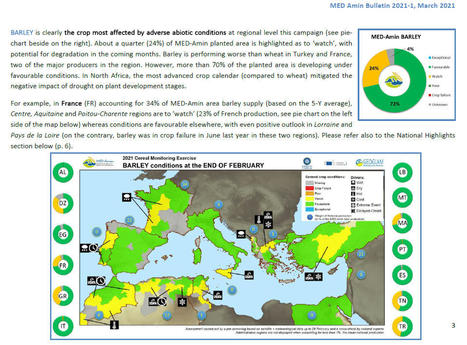
Bulletin MED-Amin 2021-1 sur les premières perspectives des cultures d'hiver à la fin du mois de février 2021. Nous avons pu donner un aperçu général de l'évolution des cultures céréalières dans la région méditerranéenne juste à temps. Le présent bulletin fournit des prévisions qualitatives préliminaires de la campagne 2020-2021, avec un accent particulier sur le blé tendre, le blé dur et l'orge. La période de suivi s'étend du semis à fin février 2021. Deux autres évaluations seront réalisées en mai et juin, pour continuer à suivre les conditions des cultures en Méditerranée jusqu'à la récolte. Télécharger les ici : https://www.med-amin.org/en/ressources-2/files/docs-communication/reports-rapport/408-med-amin-bulletin-2021-1-previsions-de-recolte/file
Scoop.it!
Plusieurs études récentes ont mis en lumière le fort impact environnemental de l’alimentation et ont montré qu’une évolution des habitudes alimentaires pourrait le réduire très significativement. Mais une alimentation de faible impact environnemental n’est pas automatiquement de bonne qualité nutritionnelle. Elle peut aussi entrer en conflit avec les normes sociales ou culturelles, ou se révéler économiquement inaccessible. Ces difficultés limitent la portée pratique des régimes alimentaires proposés dans les modèles d’ambition “planétaire”. Identifier des régimes qui assurent la compatibilité de toutes les dimensions de l’alimentation constitue aujourd’hui une question de recherche pertinente. L’idée est d’explorer les trajectoires vers l’atténuation des impacts en partant des comportements observés afin de proposer des chemins accessibles au plus grand nombre. Parallèlement, il importe de développer des systèmes d’information pour guider les consommateurs et inciter les producteurs à concevoir une offre alimentaire plus durable. C’est l’enjeu de l’affichage environnemental qui fait actuellement l’objet d’une expérimentation nationale.
Scoop.it!
La dépendance de l’élevage européen au soja américain date de la création du Marché Commun agricole, avec le libre accès du soja américain en contrepartie de la protection de notre marché céréalier. Depuis les accords de Blair House en 1992, l’Europe devait aussi limiter ses surfaces en oléagineux. Aussi les fabricants d’aliments du bétail et les éleveurs européens ont dû importer de plus en plus de soja en provenance des USA dans un premier temps, puis du Brésil, de l’Argentine. Ces pays disposent de grandes surfaces, parfois acquises par déforestation et de pratiques culturales à faible coût, notamment le paquet technologique «variétés OGM, glyphosate et semis direct». Face aux engagements politiques pris par l’Europe concernant la lutte contre le changement climatique et contre la déforestation, et aussi face à la demande croissante des consommateurs pour des produits animaux non OGM, dans quelles conditions l’élevage français et européen pourrait- il se passer du soja américain ?
Scoop.it!

Pulses are important components in sustainable diets and cropping systems. This study evaluated the environmental impact of cultivation of five Swedish pulses (yellow peas, grey peas, faba beans, common beans and lentils) in a life-cycle perspective. The impact of selected Swedish pulses (conventional or organic) was then compared with that of imported pulses in Sweden, including contributions from processing, packaging and transport. The influence of origin and transportation mode and differences between home cooking and canned pulses (Tetra Recart) were considered. The effect of Swedish cultivation methods is significant (figure below). The life cycle analysis shows that high-yielding varieties have a lower impact per kilogram produced, but it does point out that intercrop legumes (such as gray peas) have interesting potential, despite their low yield per hectare. above all shows that it is fundamental to include the stages following harvest in the life cycle analysis, because processing and transport have a major impact on the environment. Greenhouse gas emissions are thus eight times higher for canned beans coming from China or the United States and processed in Italy, than for lentils and dry gray peas produced in Sweden. Long-haul transport contributes significantly to energy consumption and climate change, the authors say, especially when pulses are processed and packaged far from their final point of consumption.
Scoop.it!

Futur : présentation du livre de Antoine Buéno publié aux Editions Flammarion. Notre civilisation va-t-elle s’effondrer ? La croissance peut-elle être durable ? Le travail va-t-il disparaître ? L’IA va-t-elle nous remplacer ? À quoi ressembleront l’art et le sexe de demain ? Serons-nous immortels ?Par-delà collapsologie et transhumanisme, Futur apporte des réponses concrètes à toutes les grandes questions. Au chapitre «agriculture et alimentation», l'auteur rappelle d'abord les défis des prochaines années: transitions énergétique et écologique, réforme agraire, innovations technologiques, fermes urbaines, entomophagie, etc...
Scoop.it!

Conservation agriculture (CA) has been promoted to mitigate climate change, reduce soil erosion, and provide a variety of ecosystem services. Yet, its impacts on crop yields remains controversial. To gain further insight, we mapped the probability of yield gain when switching from conventional tillage systems (CT) to CA worldwide. Relative yield changes were estimated with machine learning algorithms trained by 4403 paired yield observations on 8 crop species extracted from 413 publications. CA has better productive performance than no-till system (NT), and it stands a more than 50% chance to outperform CT in dryer regions of the world, especially with proper agricultural management practices. Residue retention has the largest positive impact on CA productivity comparing to other management practices. The variations in the productivity of CA and NT across geographical and climatical regions were illustrated on global maps. CA appears as a sustainable agricultural practice if targeted at specific climatic regions and crop species.
CIHEAM News's insight:
Scoop.it!
Concerns about market power and competition in the agri-food sector are widespread, with commentators regularly suggesting that farmers are in a structurally weaker position than other actors, who therefore benefit at their expense. The evidence reviewed in this paper indicates that downstream segments of agri-food chains are indeed typically more concentrated than farm-level production. Nevertheless, while competition problems were found in some instances, the current evidence does not support the claim that stronger actors in the chain systematically abuse their stronger position at the expense of farmers. An in-depth understanding of how value chains are organised is essential, as many widely used indicators provide little relevant information. In many areas, further research would be welcome, as current evidence does not cover all countries and sectors equally well.
Scoop.it!

International wheat prices were generally stable in recent weeks but those of coarse grains continued to increase amid strong import demand. International rice prices also firmed, driven by demand for lower quality Indica and Japonica varieties. In East Africa, prices of coarse grains generally followed mixed trends in February. In most countries, prices were around or below their year-earlier levels, except in the Sudan and South Sudan, where they were at near-record to record levels, underpinned by insufficient supplies and severe macro‑economic difficulties, including continuous and sustained depreciation of the local currencies. In Central America, prices of beans mostly decreased in February with the start of the “Apante” season harvest, but remained well above their year-earlier values because of the significant increases in the past two months due to crop losses caused by two consecutive hurricanes in November 2020.
CIHEAM News's insight:
Scoop.it!

The “Bread Riots” that broke out in Tunisia on 28 December 1983 lasted barely ten days. Yet, they cost the lives of over one hundred people. The revolt studied here centred on two popular neighbourhoods of Tunis in the wake of massive, World Bank-sponsored development plans. This article seeks to understand how the inhabitants in these quarters reacted to the establishment of a new welfare state that was more concerned with fighting poverty – or fighting the poor – than with equalizing conditions or offering the same opportunities for everyone. Based on this case study, I argue that the great Bread Revolt of 1983–1984 marked a break with past practices of state reform and popular protest and suggest that International Monetary Fund and World Bank prescriptions and state implementations reconfigured the political and social landscape of independent Tunisia.
Scoop.it!

L'apparition d'un foyer de contamination de grippe aviaire dans l'est du pays met à mal le marché de l'export, encore faible mais prometteur selon Alger. – Jeune Afrique
|
Scoop.it!

Des pluies bénéfiques pour la céréaliculture - Découvrez gratuitement tous les articles, les vidéos et les infographies sur liberte-algerie.com...
Scoop.it!

Water, heat and lime transform grain in a traditional Central American maize processing method.What to read next: Farm mechanization under COVID-19 | Breaking Ground: Sylvanus Odjo finds the right technology for each farmer | A knowledge revolution | Lightbulb moments...
Scoop.it!

C’est une nouvelle culture qui pourrait diversifier les systèmes. Le
Scoop.it!

MED-Amin Bulletin 2021-1 on winter crops early outlook at the end of February 2021. We were able to provide a general outlook about the progress of cereal crops in the Mediterranean region right in time. The present bulletin provides early qualitative forecasting of the 2020-2021 campaign, with particular focus on soft wheat, durum wheat and barley. The period of review last from the sowing up to the end of February 2021. Other two outlooks will be carried out in May and June, to keep on monitoring crop conditions in the Mediterranean region until the harvest.
Scoop.it!

Les journées rurales de Montpellier se tiendront en virtuel du 24 Mars 9h au 26 Mars 2021 à 12h. Ce colloque international virtuel se déroulera sur Zoom et Gather.town du 24 au 26 mars. Avec 85 communicants et 3 conférenciers, il réunira des géographes travaillant sur les relations ville-campagne, analysant la relocalisation alimentaire et les transformations des paysages bâtis ou agricoles qui s’opèrent dans les espaces urbains, périurbains et ruraux, en lien avec le renouvellement des questions alimentaires. Le colloque est organisé par les commissions de géographie rurale et de géographie du commerce du CNFG (Comité National Français de Géographie), et par la commission "Agricultural Geography and Land Engineering" de l'UGI (Union Géographique Internationale). Il est porté par INRAE UMR Innovation en partenariat avec l’UMR Art-Dev, l'UMR LAGAM, l’Ecole française de Rome et la MSH de Montpellier.
Scoop.it!

As part of a series of evaluations of the Common Agricultural Policy (CAP), the Directorate-General for Agriculture and Rural Development of the European Commission published, in February 2021, a report on its effects on sustainable soil management. . Carried out by the Institute for European Environmental Policy and Oréade Brèche, the study was based on a review of the literature and available data, on interviews and case studies. The conclusions underline that despite the diversity of instruments and measures provided by the CAP, which could encourage sustainable soil management, few of them are imposed or supported at European Union level or in the choice of implementation. member countries. For example, certain key activities (diversified crop rotations, etc.) are not subject to any regulatory measures. Analysis of State decisions shows that they attach less importance to soil quality than to other environmental issues, such as water or biodiversity.
Scoop.it!

Since the 2000s, certain “developing countries” have been the target of investors who intend to acquire or lease large tracts of agricultural land. In an article published in World Development, three researchers analyze this phenomenon which raises questions about its socio-economic and environmental implications, and is sometimes presented as a means of improving agricultural productivity and food security in target countries. the authors analyzed large-scale land deals reported in Africa since 2000 in the Land Matrix database. In total, nearly 500 transactions in 38 African countries were studied. The authors first estimated the level of food security in target countries with regard to the four criteria used by the Food and Agriculture Organization of the United Nations (FAO): availability, quality and accessibility of food, stability of supplies. They then identified the "priority criterion", that is to say the one that was the most degraded. Finally they listed, for each transaction, the production envisaged (food crops, multipurpose or specifically cash crops) and the outlet (local or export market). The authors show that, in 14 countries, large-scale transactions do not adequately contribute to the food security of the target country, because they improve on a non-priority criterion. Only 7 countries see their food security adequately reinforced ...
CIHEAM News's insight:
Scoop.it!
Australia’s #food industry will be shaped by multiple interacting changes over the coming decades. These changes will occur at global, national, and local scales. They will create opportunities and challenges for all food and fibre industries and farm businesses. They will also impact on Australian lifestyles, landscapes, communities, and wider society and economy. In order to better understand these evolving changes, this article updates previous CSIRO analysis (Hajkowicz 2015, Hajkowicz and Eady 2015), setting out five global megatrends that will shape Australian life and choices, and exploring their implications for Australian food and fibre industries to 2040 and beyond. A megatrend is defined as a trajectory of change that will have profound implications across many areas of industry and society. Each megatrend occurs at the intersection of multiple more specific trends and patterns of change – including geopolitical, economic, environmental, social or technological trends. For each megatrend we provide a short summary, identify key implications for Australian agriculture, food and fibre industries, and ...
CIHEAM News's insight:
Scoop.it!

In OECD countries, socio-economically disadvantaged groups tend to consume less nutritious food, leading to suboptimal health outcomes, including obesity. Contributing factors include low levels of income and education; time-poor single parent households; and the prevalence and accessibility of fast food restaurants. More broadly, food insecurity also remains a problem in OECD countries, with Indigenous Peoples being particularly vulnerable. Foodbanks run by non-governmental organisations provide emergency food assistance, sometimes using food recovered as part of food waste policies; however, the sustainability of this approach is contested. Understanding the role that socio-economic and demographic factors play in determining household food purchases and consumption is limited by inadequate and irregular food data collection, including on the prevalence of food insecurity. Lack of data is also hampering evaluation of the effectiveness of policies in addressing the needs of particular socio-economic and demographic groups.
Scoop.it!

This side event aims to explore the role of digitalization in food and agricultural markets and trade and assess the tools and platforms available for countries to use and reap benefits. It is envisaged that the discussion will address the following questions:
Scoop.it!

Open and transparent food commodity markets and efficient supply chains are paramount to ensure that everyone has access to adequate, safe and nutritious food during the COVID-19 pandemic and beyond, FAO Director-General QU Dongyu said today at the opening of the 74th Session of the FAO's Committee on Commodity Problems (CCP). "The pandemic has resulted in a dual shock to food and agricultural markets, hitting both: supply and demand," Qu said. He pointed out that the measures introduced to control the virus caused disruptions to agri-food supply chains affecting the global trading system and, in particular, the least developed countries that depend on trade for their food security. To this end, the Director-General noted that FAO's work under the mandate of the Committee on Commodity Problems helped to calm markets and guide policy decisions, by providing up-to-date information on market conditions, monitoring policy developments, and proposing policy options to avoid the health crisis turning into a global food crisis. Referring to the pandemic as "an astonishing wake-up call on the fragility of our agri-food systems and the vulnerabilities we face," the Director-General stressed that the current crisis also provided an opportunity to redouble and refocus global efforts to build back better.
CIHEAM News's insight:
Scoop.it!

Household expenses witnessed a new shift as the coronavirus pandemic, which has had a varied impact on the economy, changed consumer habits in Turkey, according to statistics. Last year, money spent on services like education and tourism decreased, while people spent more on appliances and food, according to Turkish Statistical Institute (TurkStat) data. Still, expenses continued increasing and exceeded TL 2.9 trillion ($396 billion), a 10% rise.
|




