
Centrica boss’s 2030 prediction is not controversial, but government’s strategy hardly adds up to one to prove him wrong
Get Started for FREE
Sign up with Facebook Sign up with X
I don't have a Facebook or a X account


|
Scooped by
Graham Watson
onto Macroeconomics: UK economy, IB Economics February 12, 2:19 AM
|
 Scoop.it!
Centrica boss’s 2030 prediction is not controversial, but government’s strategy hardly adds up to one to prove him wrong

 Your new post is loading...
 Your new post is loading...
Your new post is loading...
Scoop.it!

From
www

People at the start of their careers are particularly affected by the UK's weak job market.
Graham Watson's insight:
Alan Milburn's independent inquiry into the the rise in economic activity is due out in the summer. However, the latest figures suggest that the number of NEETS, those aged 16-24 not in employment, education or training might have reached 1 million. The latest ONS research suggests that the current number is 957,000, implying that the issue is structural and to do with the nature of the labour market above all.
Some are starting to suggest that such is the corrosive nature of this problem that the government might need to think of innovative approaches - such as a National Insurance holiday for the young - and to look at how the current welfare system exacerbates the problem.
Scoop.it!

About 600 jobs will go at the luxury car maker, which in part blames US tariffs for its troubles.
Graham Watson's insight:
Job losses in the UK, with 600 jobs to go at luxury car manufacturer, Aston Martin, although it isn't specified where these job losses will occur. It will mean lower incomes wherever the cuts are made and less spending in the local economy.
Scoop.it!

January increase of 1.8% beats forecasts and was also driven by shoppers snapping up jewellery online
Graham Watson's insight:
The latest retail sales figures saw a January increase of 1.8%, well ahead of the 0.2% forecast and could, perhaps signal an uptick in consumer confidence, and, whisper it, the prospects of higher growth too.
A number of factors contributed, notably online jewellery and sports supplements sales, but a number of analysts don't think this strong performance is going to be sustained into 2026.
Scoop.it!

Industrial trends survey shows firms are expecting to raise prices, with order books well below average
Graham Watson's insight:
The latest CBI data about the state of British manufacturing doesn't make for good reading, with order books below average and increased price pressures in the sector.
This doesn't bode well for economic growth going forward, although remember that manufacturing only accounts for around 9% of UK GDP, according to the latest data for July to September 2025.
Scoop.it!

The government took in more from tax receipts than expected, official data suggests.
Graham Watson's insight:
Good news for the public finances, with a whopping £30.4bn budget surplus for the government buoyed by increases in income tax revenues and a "£17bn surge" in capital gains tax receipts.
However, the public finances remain a bit of an issue because borrowing remains high with 10% of government spending going on debt interest repayments and even though the government claim that they will "more than halve borrowing by 2030-31 so that money can be spent on policing, schools and the NHS", most analysts remain sceptical if only because borrowing has failed to come down much so far.
Scoop.it!

‘Eight-figure agreement’ made to supply new line between Ankara and İzmir – but questions over plant’s future remain
Graham Watson's insight:
A boost for Britain's beleaguered steel industry, with the news that Turkey has placed an order for 36,000 tonnes of steel to be used in the construction of a high-speed railway between Ankara and Izmir. It means that the short-term future of the Scunthorpe plant seems secure, but only for now. Longer-term there are still ongoing concerns.
Scoop.it!

January annual drop is lowest level since March 2025, although still above Bank of England’s 2% target
Graham Watson's insight:
The Guardian take on today's inflation figures. The same as my earlier view essentially.
Scoop.it!

Programme launched by last Tory government was worked on by Deloitte and IBM but was paused in 2024
Graham Watson's insight:
Another cost of Brexit, with the news that the government is going to allow a project designed to reduce trade frictions between the UK and its former EU partners, a so-called Single Trade Window designed to facilitate the uploading of all relevant import/export documentation.
The original contract was given to Deloitte and IBM but was paused in 2024, but despite that the National Audit Office (NAO) estimates that the UK spent £4.7bn on post-Brexit border controls in 2024.
Scoop.it!

Competing domestic priorities, Treasury borrowing limits and already nervous lenders are among the many obstacles
Graham Watson's insight:
The weekend's Munich security conference highlighted the UK's new commitment to defence, and the plan to increase defence spending from 2.3% of GDP 2024-25 to 2.6% in 2028-29.
However, as this Phillip Inman piece points out, it seems as though the Prime Minister might want an even bigger increase, and that's problematic. Any increase in defence spending has an opportunity cost in the form of lower spending elsewhere or higher borrowing, and neither of those options looks appealing either.
Scoop.it!

Wages have been rising faster than prices but you could pay more tax because of frozen thresholds.
Graham Watson's insight:
A nice little 'tax calculator' on the BBC website to allow you to calculate how the freezing of tax thresholds will affect you if you're a worker.
However, for post-16 economists a nice little revision tool to enable you to refresh your knowledge of the current income tax bands, and tax rates and the concept of fiscal drag.
Scoop.it!

Union analysis finds consumers lag behind international peers as some rate-setters remain anxious about inflation
Graham Watson's insight:
Heather Stewart's piece today looks at the conduct of monetary policy, and leads with the Trades' Union Congress view that interest rates are currently too high and should be cut. Unfortunately, that doesn't seem to accord with the Bank's own view, with Chief Economist, Huw Pill, having observed that he thinks they are already "a little bit too low"
It might be an interesting starter activity to highlight the nature of the inflation target and how the monetary transmission mechanism links changes in monetary variables - i.e. interest rates - to changes in real variables.
Scoop.it!

Universities, builders and health trusts are feeling the squeeze, as thinktank says effect of zero net migration could be similar to Brexit
Graham Watson's insight:
Despite what you might think, given the right-leaning nature of the UK media, this year might see negative net migration, and this Guardian article looks at the macroeconomic implications of this.
In the first place, the obvious consequence would be a smaller working population and declining tax revenues, with a net hit to the public finances of £6-8 billion. If net migration did fall to zero, the combination of these effects "would knock 3.7% off the UK's annual national income by 2040", almost equivalent to the effect of Brexit, according to the National Institute of Economic and Social Research (NIESR).
Scoop.it!

Manufacturing was the main driver of growth during the final three months of the year, official figures show.
Graham Watson's insight:
A little bit more detail about today's growth figures, noting the disappointing rate of growth but digging into different sectoral performance, with poor performance from construction, services and professional, scientific and technical activities.
As previously stated, perhaps the biggest medium term implications are for the trend rate of growth.
|
Scoop.it!

The Chancellor is trying to use this moment as a launching pad for a wider attempt to gee up consumer and business confidence.
Graham Watson's insight:
Not much theory, more of a "taking the temperature" piece by Faisal Islam, but perhaps the real issue's the narrative. How do consumers and business feel? Is the cost of living crisis nearing an end? Is the economy recovering?
If this is the perception then to a large extent, any prospect of an upturn will be a self-fulfiling prophecy.
Scoop.it!
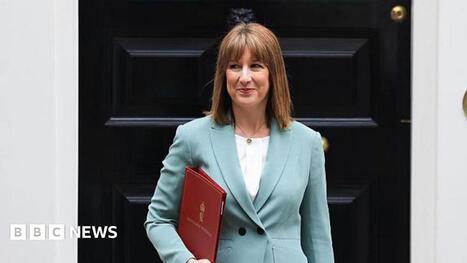
Chancellor Rachel Reeves will give an update on her plans for the UK economy when she gives a statement alongside an economic forecast on 3 March.
Graham Watson's insight:
One of the Chancellor's set piece moments, is probably the best description of the Spring Statement and the intention is that it is just that an not another mini-Budget as such Statements had become.
The gist is that the Statement ties in with the latest OBR report on the state of the UK economy and, in particular focuses on whether the government is meeting its own fiscal rules, namely not to borrow to fund day-to-day public spending by the end of this parliament and to get government debt falling as a share of GDP by the end of this parliament. That said, such a review will only take place annually going forward, and only in the Autumn.
Scoop.it!

French utility company EDF says operations in Somerset will start a year later as delay costs firm €2.5bn
Graham Watson's insight:
Well, I never, Hinkley Point C nuclear reactor is going to be both over budget - with costs having risen to £35bn - and open a year later than hoped, in 2030, a mere 13 years after the project started.
I'm thinking of becoming someone who advises on large infrastructure projects: I'm also capable of plucking imaginary figures for both out of the air - I could even do it alongside the day job.
Scoop.it!

Nick Thomas-Symonds says move could also create unnecessary UK-EU trade barriers and increase costs
Graham Watson's insight:
One government minister has warned that the proposed new EU industrial strategy "Made in Europe", intended to strengthen EU supply chains might have adverse implications for the UK. He worries that its introduction might increase administrative barriers to trade and that would be a bad thing.
The intention of the strategy is to boost competitiveness and productivity, and is part of a broader EU reset also including an Industrial Accelerator Act designed to boost strategic sectors.
Scoop.it!

The think tank suggests the chancellor's fiscal rules need to shift the focus from one key figure.
Graham Watson's insight:
The Institute for Fiscal Studies believe that the Chancellor's fiscal rules are counter-productive, arguing that those that "require some measure of borrowing or debt to be below a particular threshold in a specified year" have negative implications for policymaking.
On the other hand, the Treasury argues that they provide markets with greater certainty and have contributed to low interest rates and macroeconomic stability.
Scoop.it!

Chair of UK government review says dramatic changes in labour market risks putting ‘a generation on the scrapheap’
Graham Watson's insight:
This Guardian piece looks at the reality of youth unemployment and the costs that it imposes on the individuals who end up unemployed. The worry is that if young people can't find work, they are likely to be discouraged and potentially economically inactive in future, and their low levels of human capital will be further eroded by a period of unemployment.
All of this has been recognised, not least because at 16.1%, the UK's level of youth unemployment exceeds the EU average of 14.9%, but the government have appointed Alan Milburn to undertake a Young People and Work review, which is due to report in the summer.
Scoop.it!

The rate at which prices are rising is slowing down, which could lead to lower interest rates.
Graham Watson's insight:
Today's inflation figures make for good reading for the government and give the Bank of England food for thought. Inflation was 3% in January, from 3.4% in December. What's more with energy bills expected to come down from April, and fuel and airfares already lower, it's likely to drop further still.
And given that unemployment has ticked up to 5.2%, it's going to put pressure on the Bank of England to cut interest rates from 3.75% sooner rather than later, with most people expecting rates to be 3% by the end of the year.
Scoop.it!

Falls in inflation and interest rates could leave Britain better off this year, but at the cost of high unemployment
Graham Watson's insight:
Phillip Inman considers the wider macroeconomic implications of the rise in unemployment, noting that whilst the labour market looks flat, with many employers blaming the government for higher costs resulting from higher business rates, and AI meaning that firms are sometimes holding off hiring in some sectors.
However, he sees grounds for cautious optimism in as much as the latest data is likely to encourage another interest rate cut sooner rather than later and the sense that inflation too is on the way down.
Scoop.it!

It marks the highest rate since the Covid pandemic, official figures show.
Graham Watson's insight:
The latest labour market data suggests that unemployment has risen to 5.2%, a five year high, although, to be honest, the rate of unemployment has actually been fairly steadily creeping up since 2022. Additionally, wage growth has slowed, with annual pay up by 4.2%, all of which suggests that the economy is softening slightly.
Scoop.it!
Britons feeling ‘dismal’ about finances amid mounting debts, survey finds | Economics | The Guardian
Consumer confidence at its lowest level in two years, as young people in particular face money pressures
Graham Watson's insight:
An S&P Global survey suggests that UK consumer confidence is at its lowest level in a couple of years, with the dismal sentiments seemingly matching the weather at the start of this year.
It also implies that economic growth is going to remain subdued in 2026.
Scoop.it!

With an annual growth rate of 3.1%, Manchester's economy has performed twice as well as that of the UK as a whole.
Graham Watson's insight:
Faisal Islam writes about his hometown, Manchester, arguing that its renaissance might hint at how other places might also grow.
Manchester's mix of universities, private enterprise and revitalised transport infrastructure have combined to boost productivity, such that the city is now attracting more Londoners to the city than it loses of its own citizens to the capital.
Scoop.it!

Consumers and businesses are not yet taking the hint despite six interest rate cuts
Graham Watson's insight:
Heather Stewart seeks the silver lining in the latest growth cloud, with an optimistic take on the prospects for 2026. She argues that forthcoming interest rate cuts and Budget measures designed to lower prices are going to have a positive impact on consumer and business confidence and that growth is going to pick up. However, that said, growth forecasts for the year range from 0.9% (Ernst & Young) to 1.4%.
The potential headwind? A Labour leadership contest.

Graham Watson's curator insight,
February 13, 3:40 AM
Heather Stewart seeks the silver lining in the latest growth cloud, with an optimistic take on the prospects for 2026. She argues that forthcoming interest rate cuts and Budget measures designed to lower prices are going to have a positive impact on consumer and business confidence and that growth is going to pick up. However, that said, growth forecasts for the year range from 0.9% (Ernst & Young) to 1.4%.
The potential headwind? A Labour leadership contest. |






Nils Pratley looks at the view of Centrica boss, Chris O'Shea, that UK energy prices are going to be higher in 2030 than the average price in 2030, and the implications of this for the wider macroeconomy.
The reality is that this will hit international competitiveness, and make manufacturing in the UK less appealing in sectors where price is the major determinant of demand.
The issue is less one of the green transition, and more one of sustained under-investment, but politically it's going to be a hard sell to convince voters that the reason for more expensive energy is to be laid at the door of the party of government in 2010.