

Learn how to deploy a location aware EmberJS application to heroku. This presentation explains how to use ember-cli-deploy along with heroku redis and s3 to create an application that dynamically changes the internationalization translation based on what country you're visiting the site from. Also uses ember-cli-server-variables, ember-i18n, node-ember-cli-deploy-redis, cheeriojs, and ember-cli.

JavaScript for Line of Business Applications
606.4K views |
+29 today

Keeping track of current JavaScript Frameworks that help design your clientside Business Logic Layers.
Curated by
Jan Hesse
 Your new post is loading...
  Scoop.it! 
A fully reactive JavaScript framework for Human-Computer Interaction The building blocks in Cycle are Observables from RxJS, which simplify code related to events, asynchrony, and errors. Structuring the application with RxJS also separates concerns, because Observables decouple data production from data consumption. Most frameworks claim to provide Separation of Concerns, but often they prescribe rigid containers where to place your code: Models, Views, Controllers, Components, Routes, Services, Dispatcher, Stores, Actions, Templates, etc. Cycle has none of that. Instead, pure functions over Observables and immutable data structures (such as from mori orImmutable.js) allow you to slice your program wherever you wish.  Scoop.it! 
At some point in your Ember.js project, you will realize the need to externalize settings and refactor code to remove “hard-coded” settings from JavaScript files. Such settings could be in the form of location of graphics files, URLs to retrieve application data, Web Service, REST service URLs, externalized strings etc.
Scoop.it!
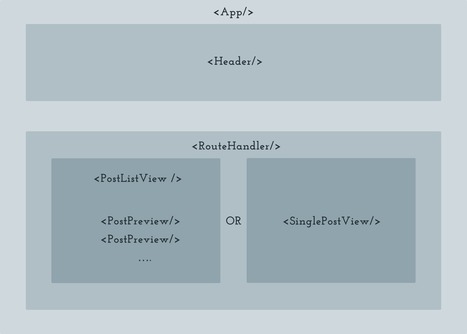
One of the many benefits of React is its ability to render components on both client and server. This tutorial aims to teach you how to create isomorphic apps using React and Flux architecture. We will also create a simple blogging app to understand how exactly Flux and React fit together.
Scoop.it!

Why should we even bother with reactive programming? Well, we all do care about writing testable, loosely coupled code, but are our dependencies really loose? Imagine that you have a working piece of code implementing particular business logic, and you would like to connect a new feature into the flow. If your code isn't reactive yet, you would have to add more "if-ology" to it, causing you to have to change the existing code base - that is not what I believe loosely coupled dependencies look like. How can the reactive, unidirectional Flux pattern help?
Scoop.it!

From
nylas

We are building a new email app using React, Flux, and Electron with a primary goal of extensibility. Over the past few months, we've designed a new way to structure large React applications in order to reliably and safely support plugins. This post is an overview of techniques for building modular, robust & flexible JavaScript applications that scale and support plugins.
Scoop.it!

The definitive guide to TypeScript. Dive into all the details that a JavaScript developer needs to know to be a great TypeScript developer
Scoop.it!

An in-depth look to the TypeScript implementation of decorators and how they make possible new exciting JavaScript features like reflection or dependency injection. This article is the third part of a series: PART I: Method decorators PART II:... | Wolk Software Limited | A group of young and ambitious people dedicated to creating cutting-edge applications in combination with beautiful and functional design.
Scoop.it!

The presentation is designed for developers with all levels of experience, from those who had never heard of Angular before to those who are advanced Angular developers and want to learn how to integrate KendoUI. I also posted the full slide deck and source code that I used in the presentation to GitHub.
Scoop.it!

The latest Ember Data has been totally overhauled to follow JSON API. The plan here is to put them to work. We’ll build a CLI-powered Ember 2.0-ready app step by step, hooked to a Rails 5 API using JSON API. Bleeding edge anyone? We will create a simple bookstore.
Scoop.it!
Creating cross-platform, application-scale JavaScript code that runs in any browser or in any host is very hard. TypeScript is a programming language that changes that situation. In this session, get to know the TypeScript language. Also, see how to build an end-to-end web app using the language.
Scoop.it!

From
jj09
0:00:00 – Intro (about me, and my work)
Scoop.it!

From
github
This is a book on the functional paradigm in general. We'll use the world's most popular functional programming language: JavaScript. Some may feel this is a poor choice as it's against the grain of the current culture which, at the moment, feels predominately imperative. However, I believe it is the best way to learn FP for several reasons:
That said, typed functional languages will, without a doubt, be the best place to code in the style presented by this book. JavaScript will be our means of learning a paradigm, where you apply it is up to you. Luckily, the interfaces are mathematical and, as such, ubiquitous. You'll find yourself at home with swiftz, scalaz, haskell, purescript, and other mathematically inclined environments.
|
Scoop.it!
Remember when we use to “render” websites directly from the backend?Single page applications are cool and catchy, but some times they fall short, for example, when hit by a search engine, and that’s when you start turning to isomorphic javascript applications.in this talk I share our experience gained on the field while turning our frontends form angular SPAs to isomorphic vanillaJS javascript apps with node a a thin active layer on the client side, taking the best form famous frameworks such as angular and react, and making our own mix.
Scoop.it!

Overall, my experience with Redux has been unsurprisingly positive and I’m eager to explore the tooling around it. As much as we all agreed that React components should eliminate side effects and be pure functions, it’s a bit convicting that we then proceeded to write many many Flux implementations with stateful stores. Dan Abramov and the rest of the Redux contributors offer a refreshing departure from the current Flux landscape and help get us back on track.

kajal jain's curator insight,
July 19, 2018 2:58 AM
Redux is one of the most popular frameworks for front-end development. It is going to be part of a series that will help you with data management for your web applications.Redux is stricter about how code should be organized, which makes the code more consistent and easier for a team to work with.
Scoop.it!

A lot of developers coming to JavaScript world attracted by React.js are confused with the tooling used to produce modern JavaScript code. Webpack, Babel, ESLint, Mocha, Karma, Grunt... what should I use and which tool is doing what?
Scoop.it!

Monad is a design pattern used to describe computations as a series of steps. They manage side effects in pure functional languages but can also be used in other languages to control complexity.
Scoop.it!
React Native's architecture has opened up many possibilities for re-inventing the clunkier aspects of UX construction on traditional platforms, making it easier and faster to build world-class experiences. This talk will walk through building an advanced gestural UI leveraging the unique power of the React Native layout and animation systems to build a complex and fluid experience.
Scoop.it!

I’m going to share how we transitioned to Flux and give some insight into why each part of the architecture is valuable. I’ll also show a couple examples similar to real problems we faced here at Kapost. I do assume the reader has some knowledge of React, a rough idea of what Flux is, and doesn’t mind reading a lot of code. If you are unfamiliar with React and Flux, check out the React documentation and the basic introduction to Flux. (Unfortunately the Flux docs are like a shoddy professor—giving a vague lecture and basic example, then running off and expecting you to solve the hard problems with no office hours.) I’ll try to explain the parts in more detail below.
Scoop.it!

InversifyJS is a lightweight (4KB) pico inversion of control (IoC) container for TypeScript and JavaScript apps. A pico IoC container uses a class constructor to identify and inject its dependencies. InversifyJS is easy to integrate with the majority of existing JavaScript frameworks and encourage the usage of the best OOP and IoC practices.
Scoop.it!

Why you should use TypeScript for Meteor projects and how to start? Introducing meteor-typescript-utils. It’s painful to build large Meteor projects with pure JavaScript. Meteor’s design makes it extremely easy to start building impressive applications. However, this comes at a cost of things being magically matched between files by their names and injected in various places. This is especially true when you’re using the great Iron:Router package, which provides URL routes, controllers and layouts. It’s just too easy for changes to break things, since all the matching of methods names, session variable names, templates’ helpers, events and data is done by their string names and all related errors happen on runtime.
Scoop.it!

Many web applications use query parameters in one way or another. Query params are great for defining things that don’t make sense as a dynamic segment in the URL. Ember realizes the importance of query params, and it has built a great way to interface with them. There are three places where you may need to use query parameters in your Ember application: routes, controllers, and templates.
Scoop.it!

There has been a concern circulating the Ember.js community about the removal of controllers. In this post I will attempt to demystify what is happening and what you need to do to be future-proof.
Scoop.it!
Scoop.it!

Now, I cannot possibly do a better job explaining this than Victor Savkin already has in his article: Angular 2 Template Syntax, so I am not going to try. I highly encourage you to go take a look at that article to get an in-depth explanation of the new data binding and template syntax within Angular 2. Instead, what I want to focus on is the 90% case, and the implications that has in terms of how you build your applications.
|




