JavaScript for Line of Business Applications
606.4K views | +18 today
JavaScript for Line of Business Applications
Keeping track of current JavaScript Frameworks that help design your clientside Business Logic Layers.
Curated by Jan Hesse
Beam to my Inbox:
Your new post is loading...

Popular Tags - Filter using the Funnel

Scoop.it!

Integrity protection for third-party JavaScript

Modern web applications depend on a lot of auxiliary scripts which are often hosted on third-party CDNs. Should an attacker be able to tamper with the files hosted on such a CDN, millions of sites could be compromised. Web developers need a way to guarantee the integrity of scripts hosted elsewhere. 

This is the motivation behind a new addition to the web platform being introduced by the W3C: sub-resource integrity (http://www.w3.org/TR/SRI/). Both Firefox and Chrome have initial implementations of this new specification and a few early adopters such as Github are currently evaluating this feature.

No comment yet.
Scoop.it!

Build a High-Performance Mobile App With Famo.us and Manifold.js

Build a High-Performance Mobile App With Famo.us and Manifold.js | JavaScript for Line of Business Applications | Scoop.it

In this tutorial, I'll look at the new JavaScript framework Famo.us, launched in October 2014. Famo.us includes an open-source 3D layout engine fully integrated with a 3D physics animation engine that can render to DOM, Canvas, or WebGL.


Via Mikael Bourges-Sevenier
No comment yet.
Scoop.it!

How React Components Make UI Testing Easy

How React Components Make UI Testing Easy | JavaScript for Line of Business Applications | Scoop.it

Unit testing is great: it’s the best way to see if an algorithm does the right thing every time, or to check our input validation logic, or data transformations, or any other isolated operation. Unit testing is perfect for fundamentals.

But front-end code isn’t about manipulating data. It’s about user events and rendering the right views at the right time. Front-ends are about users.

Here’s what we want to be able to do:

  • Test user events
  • Test the response to those events
  • Make sure the right things render at the right time
  • Run tests in many browsers
  • Re-run tests on file changes
  • Work with continuous integration systems like Travis

In the ten years I’ve been doing this, I hadn’t found a decent way to test user interaction and view rendering until I started poking at React.

No comment yet.
Scoop.it!

Including Front-End Web Components Into Microservices

Including Front-End Web Components Into Microservices | JavaScript for Line of Business Applications | Scoop.it

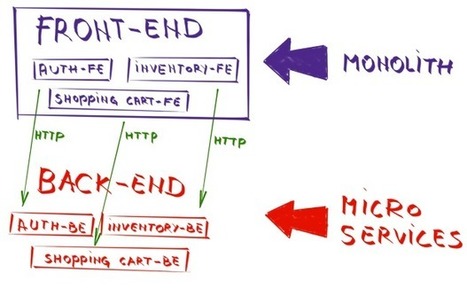
Microservices are becoming more and more popular and many are choosing to transition away from monolithic architecture. However, this approach was mostly limited to back-end services. While it made a lot of sense to split them into smaller independent pieces that can be accessed only through their APIs, same did not apply to front-end. Why is that? I think that the answer lies in technologies we’re using. The way we are developing front-end is not designed to be split into smaller pieces.

Server-side rendering is becoming history. While enterprise might not agree with that statement and continues pushing for server-side frameworks that “magically” transform, for example, Java objects to HTML and JavaScript, client frameworks will continue to increase in popularity slowly sending server-side page rendering into oblivion. That leaves us with client-side frameworks. Single-Page Applications are what we tend to use today. AngularJS, React, ExtJS, ember.js and others proved to be a next step in evolution of front-end development. However, Single-Page Applications or not, most of them are promoting monolithic approach to front-end architecture.

Jan Hesse's insight:

follow up:

http://technologyconversations.com/2015/08/09/developing-front-end-microservices-with-polymer-web-components-and-test-driven-development-part-15-the-first-component/

http://technologyconversations.com/2015/08/09/developing-front-end-microservices-with-polymer-web-components-and-test-driven-development-part-25-polishing-the-first-component/

http://technologyconversations.com/2015/08/09/developing-front-end-microservices-with-polymer-web-components-and-test-driven-development-part-35-the-second-component/

http://technologyconversations.com/2015/08/09/developing-front-end-microservices-with-polymer-web-components-and-test-driven-development-part-45-styling-and-communication/

http://technologyconversations.com/2015/08/09/developing-front-end-microservices-with-polymer-web-components-and-test-driven-development-part-55-using-microservices/

No comment yet.
Scoop.it!

Deep-Path Data Bindings in React (like Angular)

Deep-Path Data Bindings in React (like Angular) | JavaScript for Line of Business Applications | Scoop.it

Data bindings in ReactJS required much more code than in AngularJS, so we build a component to help. This post explains how to create deep-path data bindings quickly in ReactJS.

The move to React was great—we’ve enjoyed working with it and it has helped us accomplish our goals quickly. However, since our tech team comes from a background in AngularJS, we found React’s data bindings to be much less convenient.

Data bindings in React required us to code separate ‘binding’ methods, which we weren’t used to with its counterpart, Angular. In Angular, we would simply add a model attribute to our components and the job was done. 

No comment yet.
Scoop.it!

Grommet - User Experience for the Enterprise

Grommet - User Experience for the Enterprise | JavaScript for Line of Business Applications | Scoop.it

The most advanced open source UX framework for enterprise applications.

Grommet is based on ReactJS which provides great features in JavaScript for building user interfaces. You'll also use a JavaScript syntax extension called JSX.

We expect that you have at least a basic understanding on these technologies to be able to master Grommet, in addition to JavaScript of course. In terms of cascading style sheets (css), Grommet provides everything you need to quickly create applications based on the application Style Guide. Under the hood, you'll findInuitCSS and Sass to compile the style sheets. But, don't worry, you are not expected to write a lot of CSS when using Grommet. We've done that for you. But if you would like to contribute, please do so!


No comment yet.
Scoop.it!

Build a Real-Time Polymer To-Do App

Build a Real-Time Polymer To-Do App | JavaScript for Line of Business Applications | Scoop.it

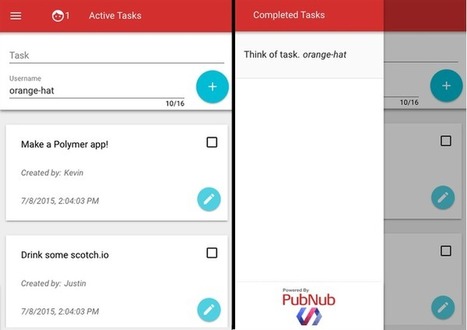
Today, we’ll be building a realtime collaborative to-do application, where task status is synced in realtime across all connected devices as their state is changed. We’ll use Polymer to build our application, and PubNub to send and receive updates between connected devices, and to sync state.

No comment yet.
Scoop.it!

Exploring ES6: Upgrade to the next version of JavaScript

Exploring ES6: Upgrade to the next version of JavaScript | JavaScript for Line of Business Applications | Scoop.it

Exploring ES6 …
Contains reliable and in-depth information on ECMAScript 6, the next version of JavaScript.
Is a book for people who already know JavaScript.
If you are a programmer and want to learn JavaScript (up to and including ECMAScript 5), check out Axel’s book “Speaking JavaScript” (free online).

No comment yet.
Scoop.it!

Fun with Functional JavaScript

It might be a surprise for some of you, but JavaScript can be regarded as a functional programming language. Why don't we use more functional programming concepts in our JavaScript code, then? In this talk you will learn how to start including some of them in your applications and when they might be particularly beneficial. You will also get familiar with libraries that extend the functional capabilities of JavaScript (lodash and FunctionalJS) and the upcoming ES6 features that make JavaScript even more functional.

No comment yet.
Scoop.it!

Speed Up Ember.js List Rendering By Example

Speed Up Ember.js List Rendering By Example | JavaScript for Line of Business Applications | Scoop.it
While Ember.js helps you a lot when it comes to building robust web applications it's not an out of the box solution for building mobile apps. Building a snappy app for already underpowered mobile devices requires work and deliberate thinking about performance.
No comment yet.
Scoop.it!

Introduction to Ember.js Routable components

Introduction to Ember.js Routable components | JavaScript for Line of Business Applications | Scoop.it

outable Components is used to replace Controller in the component-centric model for Ember.js 2.0

This is a rough introduction to Routable components as #11939 had merged to canary. The syntax is subject to change. There are two way to use routable component, without route or with route.

No comment yet.
Scoop.it!

Getting started with ECMAScript 6

Getting started with ECMAScript 6 | JavaScript for Line of Business Applications | Scoop.it
Scoop.it!

Compose all the things

At Wicked Good Ember 2015, I discuss composability patterns in Ember.js and modern web development in general. Detailed case studies are examined in the areas of CSS, Computed Properties, Components and Testing.

No comment yet.
Scoop.it!

How to make an idiomatic Javascript library with Scala.js

How to make an idiomatic Javascript library with Scala.js | JavaScript for Line of Business Applications | Scoop.it

Scala.js opens a big world of frontend development to Scala fans. Most of the time Scala.js project ends up being an independent browser or Node.js application. But there are cases, where you would want to make a library for general frontend developers.

There’re some interesting gotchas in writing Scala.js library such way, that it will be natural to use for an average JS developer. In this article we will develop a simple Scala.js library (code) to work with Github API and will focus on the idiomaticity of it’s JS API.

No comment yet.
Scoop.it!

Relay and Routing

Relay and Routing | JavaScript for Line of Business Applications | Scoop.it

Relay is changing how we think about client side applications at Facebook. A large part of this is routing and its integration with our Hack/PHP stack. This post aims to explain why Relay in open source doesn’t have any routing features and explains solutions.

No comment yet.
Scoop.it!

What the Flux? (On Flux, DDD, and CQRS)

What the Flux? (On Flux, DDD, and CQRS) | JavaScript for Line of Business Applications | Scoop.it

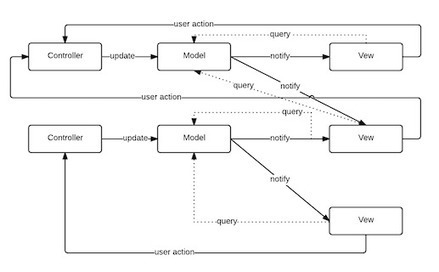
While the Flux pattern may have found a new home in JavaScript applications, they have been explored before in Domain-Driven Design (DDD) and Command-Query Responsibility Segregation(CQRS). I think it is useful to learn from these older concepts, and see what they may tell us about the present.

In this post I will:
  1. Give an overview of the Flux architecture.
  2. Present the CQRS pattern.
  3. Look at how Flux applies the concepts from CQRS.
  4. Discuss when Flux is useful for a JavaScript application.
No comment yet.
Scoop.it!

Easily debugging meteor.js

Easily debugging meteor.js | JavaScript for Line of Business Applications | Scoop.it

I recently read a post that talked about how Meteor, especially the server side, is hard to debug. I highly disagree with that statement. I actually think debugging is easier than in most languages that I've tried. Since I seem to think it is easy but others don't, it is time for a blog post to share that knowledge!

No comment yet.
Scoop.it!

React components as jQuery plugins

React components as jQuery plugins | JavaScript for Line of Business Applications | Scoop.it
Did you know, you can use React without rewriting your whole app? A client recently asked me for a shiny graph. They had an API that spits out a lot of data,
No comment yet.
Scoop.it!

Using ReactJS in AngularJS

How to use AngularJS and ReactJS together
No comment yet.
Scoop.it!

Functional Programming in JavaScript

In this video series, I will teach you how to do functional programming in JavaScript. In this first one, I will tell you about one of the most important concepts in functional programming: Higher-order functions. I will talk about what higher order-functions are, and then move on to code, and show you how to use them. I will also tell you why you should learn functional programming in the first place.

No comment yet.
Scoop.it!

Many JS Frameworks but Vue.js Is Different

Many JS Frameworks but Vue.js Is Different | JavaScript for Line of Business Applications | Scoop.it

Nowadays, we have countless Javascript libraries available for us to use. Every once in a while we get a new framework/library for Javascript. I’ve used many Javascript frameworks, but I’ve never seen something as simple and flexible as Vue.js.

You’ll be amazed by how a few lines you need to write to accomplish common tasks in Javascript with Vue.js.

No comment yet.
Scoop.it!

Creating Reactive, Loosely Coupled Apps with Aurelia and Flux

Creating Reactive, Loosely Coupled Apps with Aurelia and Flux | JavaScript for Line of Business Applications | Scoop.it

In the previous episode I covered different parts of aurelia-flux. This time, I would like to get you through creating a fully working reactive Aurelia application. Let us start with the simple Todo List application and we'll see where we can get to.

No comment yet.
Scoop.it!

Applying the Adapter Pattern for Analytics in Ember.js Apps

Applying the Adapter Pattern for Analytics in Ember.js Apps - The Ember Way - Medium

In this post, we’ll explore what the adapter pattern is, what it gives us, and demonstrate how to implement it to enable one API for orchestrating multiple analytics services.

We generally have a few players in the adapter pattern: the client, the adapter (or wrapper), and the adaptee.

No comment yet.
Scoop.it!

Longevity (or Lack Thereof) in JavaScript Frameworks

Longevity (or Lack Thereof) in JavaScript Frameworks | JavaScript for Line of Business Applications | Scoop.it
JavaScript Frameworks' longevity is an often overlooked yet critical ingredient in project success.

Every six months, a hot new framework hits the mainstream, and our community explodes with excitement.

Don’t believe the hype.

Framework longevity is a critical ingredient in project success. Most technology decision makers use metrics like community size, popularity, and big company support to justify their choice of framework, but these factors actually don’t predict longevity.


No comment yet.
Scoop.it!

Writing AngularJS 1.x with TypeScript

Writing AngularJS 1.x with TypeScript | JavaScript for Line of Business Applications | Scoop.it
AngularJS is a front end JavaScript framework that has gained huge traction and popularity in the development community. TypeScript and AngularJS tutorial.

Note: This tutorial tries to stay editor independent, meaning the concepts apply to TypeScript specifically and not to an editor. When necessary, screenshots showing relevant information will be of VS Code. VS Code is a free, cross platform editor hat has excellent built in TypeScript support.

No comment yet.