JavaScript for Line of Business Applications
606.4K views | +29 today
JavaScript for Line of Business Applications
Keeping track of current JavaScript Frameworks that help design your clientside Business Logic Layers.
Curated by Jan Hesse
Beam to my Inbox:
Your new post is loading...

Popular Tags - Filter using the Funnel

Scoop.it!

TypeScript Design Patterns

TypeScript Design Patterns | JavaScript for Line of Business Applications | Scoop.it

In software engineering, a design pattern is a general reusable solution to a commonly occurring problem within a given context in software design. A design pattern is not a finished design that can be transformed directly into source or machine code. It is a description or template for how to solve a problem that can be used in many different situations. Patterns are formalized best practices that the programmer can use to solve common problems when designing an application or system. Object-oriented design patterns typically show relationships and interactions between classes or objects, without specifying the final application classes or objects that are involved.

The 23 Gang of Four (GoF) patterns are generally considered the foundation for all other patterns. They are categorized in three groups: Creational, Structural, and Behavioral. This small web application explains these patterns and gives examples on how you can use these patterns in TypeScript.

Arik Grinstein's curator insight, July 23, 2015 10:07 AM

Interesting Read.

Scoop.it!

router5: Simple, framework-agnostic, powerful and functional HTML5 routing solution

router5: Simple, framework-agnostic, powerful and functional HTML5 routing solution | JavaScript for Line of Business Applications | Scoop.it
  • Just a router 
  • router 5 is just a router, nothing else. It won't take care of updating your view, and makes no demands regarding you app structure or how your code is organised.
  • Component trees in mind 
  • router5 is built to be framework agnostic, and was designed to provide a more flexible and scalable solution for Single Page Applications routing, especially those made of a component tree.
  • Be functional and reactive 
  • router5 exposes simple methods and mechanisms to observe route changes and react to them. You can then use it with your favourite stream implementation, FRP library, in a flux-like architecture, etc...
No comment yet.
Scoop.it!

Typescript and JSX

Typescript and JSX | JavaScript for Line of Business Applications | Scoop.it

JSX support has officially landed in TypeScript! A big thanks to Ryan Cavanaugh and François de Campredon for making this happen. In this post I want to explore how to use JSX and how to make use of TypeScript's #1 feature: static type checking.

No comment yet.
Scoop.it!

Yeoman generator for ReactJS and Webpack

Yeoman generator for ReactJS and Webpack | JavaScript for Line of Business Applications | Scoop.it

Yeoman generator for ReactJS - lets you quickly set up a project including karma test runner and Webpack module system.

No comment yet.
Scoop.it!

Easily testing React components with react-test-tree

Easily testing React components with react-test-tree - Qubit Engineering - Medium
While I love React, testing React components leaves a lot to be desired. The TestUtils are useful but don’t have a parti…
No comment yet.
Scoop.it!

React Native Playground: Share and test your React Native code in the browser

React Native Playground: Share and test your React Native code in the browser | JavaScript for Line of Business Applications | Scoop.it

For testing and sharing your React Native apps and snippets,
from the comfort of your browser.

No comment yet.
Scoop.it!

RethinkDB+Angular.js: Building realtime web applications

No comment yet.
Scoop.it!

TodoMVC written with React and jsx-typescript

TodoMVC written with React and jsx-typescript | JavaScript for Line of Business Applications | Scoop.it

TodoMVC implementation built on top of React with JSX-TypeScript

No comment yet.
Scoop.it!

How to Implement Node + React Isomorphic JavaScript & Why it Matters

How to Implement Node + React Isomorphic JavaScript & Why it Matters | JavaScript for Line of Business Applications | Scoop.it

With the proliferation of more and more of the web being driven by JavaScript, The speed of the browser DOM is becoming increasingly noticeable.

Lots of sites being driven by popular JavaScript frameworks like Ember, Backbone, or Angular can take a while to render into the DOM. This forces the user to wait for the app to bootstrap itself before they can start viewing & ‘using’ the app.

No comment yet.
Scoop.it!

Ionic Framework Tutorial

Ionic Framework Tutorial | JavaScript for Line of Business Applications | Scoop.it
What You Will Learn:
  • How to create and build (compile and package) an Ionic project using the CLI (Command Line Interface).

  • How to start from one of the Ionic starter apps

  • How to build a modern mobile UI using Ionic components such as side menu, cards, action sheets, etc.

  • How to create a service using the Angular resource module (ngResource) to access REST services

  • How to use controllers

  • How to use routing

  • How to login with Facebook, and publish information to your feed

Jan Hesse's insight:

https://github.com/ccoenraets/ionic-tutorial

No comment yet.
Scoop.it!

React.js - A guide for Rails developers

React.js - A guide for Rails developers | JavaScript for Line of Business Applications | Scoop.it
Integrate React.js with Ruby on Rails to build web apps

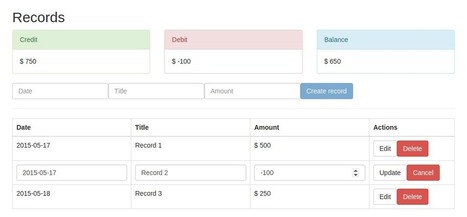
Summarizing, the application will behave as follows:

  • When the user creates a new record through the horizontal form, it will be appended to the records table
  • The user will be able to inline-edit any existing record
  • Clicking on any Delete button will remove the associated record from the table
  • Adding, editing or removing an existing record will update the amount boxes at the top of the page
No comment yet.
Scoop.it!

Loupe - Understand JavaScript's Call Stack and Event Loop

Loupe is a little visualisation to help you understand how JavaScript's call stack/event loop/callback queue interact with each other.

  • Loupe runs entirely in your browser.
  • It takes your code.
  • Runs it through esprima, a JS parser.
  • Instruments it a bunch so that loupe knows where function calls, timeouts, dom events, etc happen.
  • Adds a whole bunch of while loops everywhere to slow down the code as it runs.
  • This modified code is then turned back into JavaScript and sent to a webworker (in your browser) which runs it.
  • As it runs, the instrumentation sends messages to the visualisation about what is going on so it can animate things at the right time.
  • It also has some extra magic to make dom events, and timers work properly.


No comment yet.
Scoop.it!

Functional UIs and Unidirectional Dataflow

Slides: http://www.slideshare.net/mikaelbr/budapest-49024114 http://jsconfbp.com/#mikaelbrevik Let us bring back the days where we could write declarative re...
No comment yet.
Scoop.it!

Introduction To Web Components

Introduction To Web Components | JavaScript for Line of Business Applications | Scoop.it
A intro to the new web component spec by building a simple tab component.

One of the main issues in our components today are style conflicts. This is when our CSS or the imported component breaks CSS somewhere else. Another is lack of native templating of HTML. Storing HTML templates on a page have only been possible by using script tags or other hacks. The current component structures lack of semantic meaning. We end up with a big pile of div's that have little meaning. Angular has tried to help this with its custom element directives.

The new HTML5 Web Component Specification is a collection of specifications that when combined create a powerful web standard for creating reusable components.

No comment yet.
Scoop.it!

Create a character voting app using React, Node.js, MongoDB and Socket.IO

Create a character voting app using React, Node.js, MongoDB and Socket.IO | JavaScript for Line of Business Applications | Scoop.it

In this tutorial we are going to build a character voting app (inspired by Facemash) for EVE Online - a massively multiplayer online game. You will learn how to build a REST API with Node.js, save and retrieve data from MongoDB, track online visitors in real-time using Socket.IO, build a single-page app experience using React + Flux with server-side rendering and then finally deploy it to the cloud.

No comment yet.
Scoop.it!

Replacing callbacks with ES6 Generators

Replacing callbacks with ES6 Generators | JavaScript for Line of Business Applications | Scoop.it

By Matt Baker There are a lot of articles out there discussing the use of ES6 generators to remove the “callback pyramid” we so often encounter in JavaScript. Unfortunately, most of them rely on libraries, and few tell the whole story.

No comment yet.
Scoop.it!

Flux without Flux: Using Flux Architecture in Plain React

Flux without Flux: Using Flux Architecture in Plain React | JavaScript for Line of Business Applications | Scoop.it

If you are into ReactJS you probably wondered whether or not you should use Flux.

In this post I'll share with you a design pattern that implements a very similar Flux architecture, but using just plain React.

I have tested this "Flux without Flux" in many different settings, including reusable components, with great success and I'd love it if you gave it a try and let me know what you think.

No comment yet.
Scoop.it!

React Contexts and Dependency Injection

React Contexts and Dependency Injection | JavaScript for Line of Business Applications | Scoop.it

In this post I want to explore the idea of using contexts in React to implement dependency injection (DI) in our application.

We’ll cover two things:

What contexts are in React and how they work
Why we care about DI and how we can implement them using contexts.
React and Contexts
Contexts were formalized in React 0.12, and are planned for React 1.0. They are a mechanism for a component to pass properties down to their descendent components. The difference between props and context is that context chains to descendents, whereas props do not.

No comment yet.
Scoop.it!

Angular-Typescript Boilerplate

Angular-Typescript Boilerplate | JavaScript for Line of Business Applications | Scoop.it

Tiny Angular version 1 app written in Typescript with modularized Gulp tasks. Perfect as boilerplate.

No comment yet.
Scoop.it!

Better Unit Testing in ReactJS

Better Unit Testing in ReactJS | JavaScript for Line of Business Applications | Scoop.it

Better Unit Testing in ReactJS
with expanded-react-test-utils

No comment yet.
Scoop.it!

Comprehensive Beginner's Guide To ReactJS

Comprehensive Beginner's Guide To ReactJS | JavaScript for Line of Business Applications | Scoop.it

React in a way, resembles Angular directives but that’s all there is: these directives. In React, they’re called “Components”. When creating a component, certian methods are run (if available). The main one is render which uses data that React exposes (like state, props, etc. more on that later) and uses it to build a fake DOM using “JSX”.

The beauty of ReactJS is its one-way flow which is easier to follow and understand. There is no $digest nor any way to setup $watch. But let’s look at all the cool things about React first:...

No comment yet.
Scoop.it!

JavaScript Code Smells

JavaScript Code Smells | JavaScript for Line of Business Applications | Scoop.it

In the past I've given presentations, recorded videos, and written blog posts about fixing common JavaScript and jQuery bugs. This is a good skill to have, but what about working code? Fixing broken code is important, but have you ever gotten into the situation where your code works, but it doesn't feel quite right... maybe even smells?

No comment yet.
Scoop.it!

Static Site Generation with React and Webpack

Static Site Generation with React and Webpack | JavaScript for Line of Business Applications | Scoop.it

React is incredibly intuitive and flexible to work with, but relying solely on client side rendering leaves a lot to be desired in regards to percieved performance. With a static React site, the page loads just like any other static HTML, and the JavaScript kicks in whenever it’s downloaded. This is extremely helpful for combining documentation with interactive demonstrations, like Colorable or Building SVG Icons with React. Using React with webpack also allows you to consolidate the entire build process in Node and take advantage of anything in the npm ecosystem. Last but not least, React is just fun to use.

No comment yet.
Scoop.it!

The 8 Most Common Ember.js Developer Mistakes

The 8 Most Common Ember.js Developer Mistakes | JavaScript for Line of Business Applications | Scoop.it
Ember.js is an awesome framework for building rich and powerful front-ends, favoring convention over configuration to make development a breeze. Yet all this convention can hide some dangerous pitfalls, and developers must tread carefully to avoid falling through the cracks.

Thankfully, Toptal developer Balint Erdi is here to shine a guiding light, pointing out these 8 common mistakes for Ember.js developers to watch out for.
No comment yet.
Scoop.it!

Common Misconceptions About Inheritance in JavaScript

Common Misconceptions About Inheritance in JavaScript - JavaScript Scene - Medium

Classical and prototypal inheritance are fundamentally and semantically distinct.

There are some defining characteristics between classical inheritance and prototypal inheritance. For any of this article to make sense, you must keep these points in mind:

In class inheritance, instances inherit from a blueprint (the class), andcreate sub-class relationships. In other words, you can’t use the class like you would use an instance. You can’t invoke instance methods on a class definition itself. You must first create an instance and then invoke methods on that instance.

In prototypal inheritance, instances inherit from other instances. Usingdelegate prototypes (setting the prototype of one instance to refer to anexamplar object), it’s literally Objects Linking to Other Objects, orOLOO, as Kyle Simpson calls it. Using concatenative inheritance, you justcopy properties from an exemplar object to a new instance.

No comment yet.