JavaScript for Line of Business Applications
606.5K views | +6 today
JavaScript for Line of Business Applications
Keeping track of current JavaScript Frameworks that help design your clientside Business Logic Layers.
Curated by Jan Hesse
Beam to my Inbox:
Your new post is loading...

Popular Tags - Filter using the Funnel

Scoop.it!

Taking Meteor Apps Into Production with Modulus, Compose, and Codeship

Taking Meteor Apps Into Production with Modulus, Compose, and Codeship | JavaScript for Line of Business Applications | Scoop.it

Exploring continuous integration and scalable hosting for Meteor projects.

I’m going to focus on one setup that has worked well for projects I’ve worked on and that I know other production Meteor apps are using. The setup described here uses Modulus, Compose, and Codeship. Leveraging these services has the advantage of keeping deployment and hosting simple, so developers can focus on building their app and spend less time on server configuration and ops work.

No comment yet.
Scoop.it!

AngularJS Tutorial: Learn Angular by building a Gmail clone

AngularJS Tutorial: Learn Angular by building a Gmail clone | JavaScript for Line of Business Applications | Scoop.it

Get your feet wet with this popular Javascript framework in this hands-on introductory guide. You'll understand the basics and build your first Angular app, a Gmail clone.

No comment yet.
Scoop.it!

Writing React Components that Support the LinkedStateMixin and the valueLink Property

Writing React Components that Support the LinkedStateMixin and the valueLink Property | JavaScript for Line of Business Applications | Scoop.it

Learn how to create React components that support LinkedStateMixin's linkState() and the valueLink property.

In a React application, it’s very common for a component to contain state that should be editable by a child component. The most basic example uses a text input with a value and onChange handler to display and update the text.

No comment yet.
Scoop.it!

Building production websites with Node.js on the Microsoft stack

Node.js on Windows, in production, may not be the most common configuration – but it’s immensely powerful with the help of edge.js, iisnode, and other open sou…
No comment yet.
Scoop.it!

How to structure reactive programs

How do we make programs more immediate? How can we structure them so programs with immediate feedback is easier to program and reason about?

After reading around on the web, I take inspiration from two sources: Functional Reactive Programming (FRP) and immediate-mode GUIs.

No comment yet.
Scoop.it!

AngularJS intellisense in Visual Studio 2012

AngularJS intellisense in Visual Studio 2012 | JavaScript for Line of Business Applications | Scoop.it

As a .Net developer Visual Studio is my greatest power. This robust, adaptable and powerful IDE provides everything I could possibly need. 
But with upcoming new JavaScript technologies like Node and Single Page Applications, it sometimes falls short. It's not that Visual Studio is bad for creating JavaScript applications, but it could do better. 
AngularJS intellisense support is a good example of a missing feature, as it is neither included in the Visual Studio core or in the Web Essentials extension.

No comment yet.
Scoop.it!

Five Reasons ASP.NET Developers Should Care About Node.js

Five Reasons ASP.NET Developers Should Care About Node.js | JavaScript for Line of Business Applications | Scoop.it

Unless you’ve been living under a rock (or perhaps in a van down by the river) you may have noticed that Node.js is kind of a big deal. Since its introduction in late 2009, Node has steadily grown in popularity and now occupies prime real estate as a (if not *the*) de facto choice of server-side infrastructure for the modern web stack.

Node’s popularity is based on a few distinct advantages relative to its competition. First, Node is fast and very scalable, due to its lightweight hosting model and default pattern of asynchronous I/O (which is a fancy way of saying Node doesn’t wait around doing nothing while that 5 second database query you just issued hasn’t returned yet). Second, in contrast to its power, Node’s core programming model (the concepts needed to understand “the Node way”, and the actual APIs that implement those concepts) is very simple and straightforward.

Jan Hesse's insight:

Follow Up:

http://www.wintellect.com/blogs/jlane/five-reasons-asp.net-developers-shouldn%E2%80%99t-worry-about-node

No comment yet.
Scoop.it!

A chatroom for all! Part 3 - Building a Backend with Node, Mongo and Socket.IO

A chatroom for all! Part 3 - Building a Backend with Node, Mongo and Socket.IO | JavaScript for Line of Business Applications | Scoop.it

In this part, I will show you how to use your existing express-based node.js app to create a chatroom backend with WebSocket support.

Now we have a chat system capable of broadcasting a message received via websockets to all other connected clients, it saves the message to the database and retrieves the last 10 messages to give context to every new user who joins the chatroom.

No comment yet.
Scoop.it!

QUnit Page JS

QUnit Page JS | JavaScript for Line of Business Applications | Scoop.it

A Wrapper for QUnit to test Links and Navigation.

No comment yet.
Scoop.it!

everything you ever wanted to know about HtmlBars

No comment yet.
Scoop.it!

Flip - A ReactJS Game

Flip - A ReactJS Game | JavaScript for Line of Business Applications | Scoop.it

Building upon my experience with the ReactJS Slide Puzzle, I thought I’d take the concept of a React-based game one step further. Flip is not very practical, and uses a lot of potentially buggy CSS3 and ES5 methods, but I mean, it’s just a game. Besides, it shows some of what’s possible using React. React has been a real pleasure to use, despite some minor workflow issues related to JSX (as it matures, I imagine it will become easier to use).

No comment yet.
Scoop.it!

Testing and code coverage using grunt-mocha-istanbul in Sails js

Testing and code coverage using grunt-mocha-istanbul in Sails js | JavaScript for Line of Business Applications | Scoop.it

In this post, I will be showing how to write tests for sails js apps (version >= 0.10.4).

No comment yet.
Scoop.it!

9 anti-patterns for node.js teams

9 anti-patterns for teams moving to node.js. Learn from the experience we've had in adopting node.js at PayPal.
No comment yet.
Scoop.it!

From Backbone To React: Our Experience Scaling a Web Application

From Backbone To React: Our Experience Scaling a Web Application | JavaScript for Line of Business Applications | Scoop.it

As engineers we want to write our programs so that they have as few bugs as possible and are easily extendable, and as a company delivering value to customers we want stable features delivered quickly. Reconciling these objectives is a universal problem which is made easier in software engineering through the use of patterns and tools.

No comment yet.
Scoop.it!

JavaScript Performance For The Win

JavaScript Performance For The Win | JavaScript for Line of Business Applications | Scoop.it

JavaScript performance is a very hot topic nowadays. There's a lot of information out there on what browsers do with JavaScript code in order to execute it faster. Let's go over some of the tips that will help you write faster JavaScript code.

* Tooling
* Non-optimizable code
* Using Local Variables
* Literals
* For-In
* Arguments

No comment yet.
Scoop.it!

Writing Desktop and Web-Based JavaScript Applications

Writing Desktop and Web-Based JavaScript Applications | JavaScript for Line of Business Applications | Scoop.it

Desktop applications are another arrow in the web developer’s quiver. Node-webkit is a great, cross-platform way to use existing web development skills without having to learn new tools, languages or frameworks.

No comment yet.
Scoop.it!

Building dynamic forms with Facebook React

Building dynamic forms with Facebook React | JavaScript for Line of Business Applications | Scoop.it

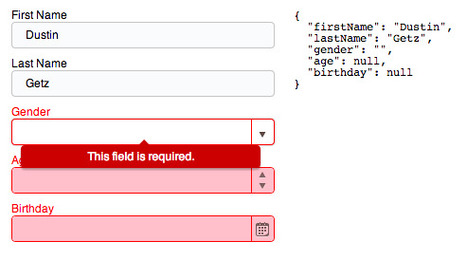
wingspan-forms is a a dynamic form library for Facebook React, providing abstractions for building dynamic forms and controlled grids. Widgets are provided by Telerik's KendoUI. wingspan-forms is about half "Kendo-React adapter", and half general functional-programming friendly form abstractions that aren't coupled to the underlying widget implementation. The higher level of abstraction is the important bit - this level of abstraction isn't possible in "just Kendo" or any other OOP style widget library.

No comment yet.
Scoop.it!

Build a Single Page Application with Angular, Node & Mongo – Part II

Build a Single Page Application with Angular, Node & Mongo – Part II | JavaScript for Line of Business Applications | Scoop.it

It’s now time to take a look at the back-end: Node.js and MongoDB with Mongoose. I’m a big fan of Nodejs to build RESTful APIs. It is fast and can scale easily.

The application needs to store Friends and Expenses, both being linked to a Sheets. We use MongoDB as the database. 

No comment yet.
Scoop.it!

react-cursor: Functional state management abstraction for use with Facebook React

react-cursor: Functional state management abstraction for use with Facebook React | JavaScript for Line of Business Applications | Scoop.it

Cursors makes it easy for us work with deeply nested immutable values that are backed by React state. This means we can store our entire application state in a single nested immutable value, allowing completely stateless React views.

No comment yet.
Scoop.it!

Emerging Patterns in JavaScript Event Handling

Emerging Patterns in JavaScript Event Handling | JavaScript for Line of Business Applications | Scoop.it

This article looks at the past, present, and future of event handling in JavaScript.

Developers had already been taking sides on whether it is still “mandatory” to have all the logic confined to script files, or if it is acceptable or even preferable to inline selected parts of this logic into HTML. In this post, we will try to sort out this debate, going through the different patterns for error handling, and then weighting pros and cons of these alternatives.

No comment yet.
Scoop.it!

Working with SVG in Ember

Working with SVG in Ember | JavaScript for Line of Business Applications | Scoop.it

At the time of this post, working with SVG in Ember can be a PITA to say the least.

The issues faced in Ember with SVG are the same issues faced by most frameworks. In fact, as of right now (now meaning while I'm typing this), there are no stable versions of JavaScript "frameworks" that fully support SVG properly. Angular, Ember, React and Polymer all have some pain around handling SVG. Some of them attempt to handle it, React for example, but there are certain cases where it will still break.

No comment yet.
Scoop.it!

The Inverted Web and the Future of the Internet

The Inverted Web and the Future of the Internet.

Introducing the HAT stack in Single Page Applications.

No comment yet.
Scoop.it!

Building a D3 Plugin

Building a D3 Plugin | JavaScript for Line of Business Applications | Scoop.it

Some awkward, common visualization constructs lend themselves to a plugin form, a reusable DOM-stamper that can be applied to an ‘svg’ or ‘div’ tag, with a few parameters and maybe some data. For example take a colorbar or legend-box, often unglamorous visual indicators which are tedious to repeat from scratch. I’ve been trying to make writing such things easier, limiting the initial boilerplate and focussing on the D3 build stage. What follows is my current state of play, with inspiration from Mike Bostock’s article on reusable charts  among others. Very much a work in progress.

No comment yet.
Scoop.it!

Log JavaScript client side events in your server side logs

Log JavaScript client side events in your server side logs | JavaScript for Line of Business Applications | Scoop.it

Make no mistake, one way or the other, your app will break. It might break for one user, or five, or hundreds. It might break today, tomorrow or weeks from now. But, as experience tells us, it will break. And then, when that office phone starts to ring, you realize that all you can really tell your client is that things work fine at your end.

Jsnlog is a JavaScript logging package that logs JavaScript errors, AJAX timeouts and other client side events in your server side log. It also supports .Net frameworks like Elmah, Log4Net, NLog, Serilog and Common.Logging. Jsnlog is available as standalone, as an AMD module or CommonJS module, or with (MVC.Net) bundles.

No comment yet.
Scoop.it!

On the Edge of the CLR - use .Net in Node.js

On the Edge of the CLR - use .Net in Node.js | JavaScript for Line of Business Applications | Scoop.it

WHEN NODE.JS IS NOT ENOUGH
* CPU-BOUND WORK
* LEGACY TECHNOLOGY CONSTRAINT
* REUSE EXISTING COMPONENTS
* UTILIZE BETTER IMPLEMENTATION


EDGE.JS CONNECTS
* Node.js and .NET
* cool with awesome
* on Windows, MacOS, and Linux
* IN ONE PROCESS


WHAT WILL YOU BUILD?

No comment yet.