JavaScript for Line of Business Applications
606.5K views | +6 today
JavaScript for Line of Business Applications
Keeping track of current JavaScript Frameworks that help design your clientside Business Logic Layers.
Curated by Jan Hesse
Beam to my Inbox:
Your new post is loading...

Popular Tags - Filter using the Funnel

Scoop.it!

Introduction to HTML5 Desktop Apps With Node-Webkit

Introduction to HTML5 Desktop Apps With Node-Webkit | JavaScript for Line of Business Applications | Scoop.it

The library combines WebKit engine and Node.js in a unique way. Both WebKit and Node share the same context, allowing you to write your code like it’s meant to be executed in a browser, but with the addition of all Node’s features.

The list of uses is endless. You can create business apps, text and image editors, games, presentations, admin panels, etc. Just name the desktop app that you would like to create, and I can assure you that it will be possible with node-webkit.


In this tutorial, I will show you how to get started by showing you how to create a simple text editor.

No comment yet.
Scoop.it!

MaskJS

MaskJS | JavaScript for Line of Business Applications | Scoop.it

MaskJS — is a markup | template | HMVC engine for modern and fast web(Browser), server(NodeJS) or mobile(PhoneGap) applications. Component-based architecture simplifies defining, implementing and composing loosely coupled independent elements into a single application.

No comment yet.
Scoop.it!

Why I Don't Want Your JavaScript Framework but I Love You

Why I Don't Want Your JavaScript Framework but I Love You | JavaScript for Line of Business Applications | Scoop.it
No comment yet.
Scoop.it!

Explorations In Automatically Fixing JavaScript Linting-errors

Explorations In Automatically Fixing JavaScript Linting-errors | JavaScript for Line of Business Applications | Scoop.it

FixMyJS (by Josh Perez) was created to try solving this problem. It aims to automatically fix linting errors in a non-destructive way. To an extent, it achieves this goal.

Under the hood the module uses Esprima for source parsing and Escodegen (from the Mozilla Parser API AST) to generate it back. While any form of automation code transformation should be approached with a healthy dose of skepticism, FixMyJS is able to handle fixing basic JSHint errors fairly well. Some of what it supports includes:

  • Adding missing semicolons
  • Enforcing camelCase and snake_case conventions
  • Adding curly braces to statements
  • Removing debugger statements
  • Enforcing single and double quite styles
  • Adding the radix parameter to parseInt
  • Dot notation conversion
  • Handling extra trailing commas

and a few other common linting issues.

No comment yet.
Scoop.it!

How to optimize your Mongo database for Meteor.js

How to optimize your Mongo database for Meteor.js | JavaScript for Line of Business Applications | Scoop.it

Kadira. The amount of insight and analytics you get from Kadira is worth every penny, especially when you are trying to optimize for production. Once I installed and deployed the app with Kadira in it, the app started sending back the metrics from the running meteor app.

As I've said before, publications are the life blood of your meteor app. I started by going to the Pub/Sub detailed tab in Kadira and switched to sort by response time. I quickly noticed that one publication had the second highest subscribe rate and an average response time of 2171ms - that signaled a pretty big bottleneck for me.

No comment yet.
Scoop.it!

How to scale a meteor.js app

How to scale a meteor.js app | JavaScript for Line of Business Applications | Scoop.it

Meteor is a little different than traditional 'static html' frameworks. The Meteor platform uses things like web sockets, DDP, and a pub/sub model to get data in the right spot. That means we can't just throw varnish in front of an app and get our 'magic scaling beans'.

No comment yet.
Scoop.it!

21 Meteor Tipps and HowTos

21 Meteor Tipps and HowTos | JavaScript for Line of Business Applications | Scoop.it

#21: Pagination System with Infinite Scroll
#20: Verify an Email with Meteor Accounts
#19: Deploying Your Applications in a Snap with Meteor-Up (MUP)
#18: Add Google Adsense to Your Application
#17: Using NPM Modules in your Application
#16: How to Use Jade in Your Application
#15: Load a Library for Specific Users
#14: Execute a UNIX Command
#13: Managing User Roles
#12: The Complete Guide to SEO
#11: Iron Router CheatSheet
#10: Set up Oplog Tailing on Ubuntu
#9: Internationalization (i18n)
#7: Must-Watch Videos
#6: Reactive and Nonreactive Join with MongoDB - 4 Examples
#5: CheatSheet
#4: Best Ressources to Become a Master
#3: SMTP Configuration
#2: Build a Complete Registration System
#1: Deploy and Manage a Meteor Application on Ubuntu with Nginx

No comment yet.
Scoop.it!

Tips and Tricks for Faster Front-End Builds

Tips and Tricks for Faster Front-End Builds | JavaScript for Line of Business Applications | Scoop.it

As a reduced test case for experimentation, I set up a sample repository. The project uses jQuery, Lo-dash, and Handlebars, along with 50-or-so custom CommonJS modules (bundling to half a megabyte) to give Browserify something to work with.

In this repository, our ideal build system will do the following (doubly ideal would be doing these things quickly... we'll get there).

  • Preprocess, prefix, and minify CSS
  • Lint/Hint, Browserify, and Uglify our JavaScript
  • Watch for changes and re-run any appropriate steps

Our build process at Pellucid has a few more requirements than this, but these should cover some of the longest operations, and this sample project should be generic enough to apply to many front-end projects.

No comment yet.
Scoop.it!

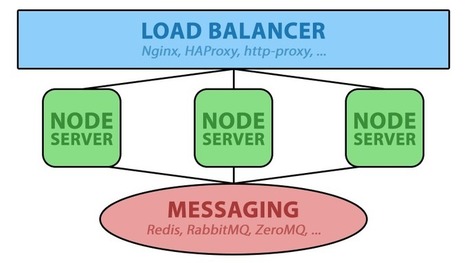
Horizontally Scaling Node.js and WebSockets with Redis

Horizontally Scaling Node.js and WebSockets with Redis | JavaScript for Line of Business Applications | Scoop.it
The Node.js cluster module is a common method of scaling servers, allowing for the use of all available CPU cores. However, what happens when you must scale to multiple servers or virtual...
No comment yet.
Scoop.it!

Using ServiceWorker in Chrome today

Using ServiceWorker in Chrome today | JavaScript for Line of Business Applications | Scoop.it

ServiceWorker is a background worker, it gives us a JavaScript context to add features such as push messaging, background sync, geofencing and network control.

In terms of network control, it acts like a proxy server sitting on the client, you get to decide what to do on a request-by-request basis. You can use this to make stuff work faster, offline, or build new features.

I'm biased, but I think ServiceWorker changes the scope of the web more than any feature since XHR.

No comment yet.
Scoop.it!

Testing Flux Applications

Testing Flux Applications | JavaScript for Line of Business Applications | Scoop.it

For a unit test to operate on a truly isolated unit of the application, we need to mock every module except the one we are testing. Jest makes the mocking of other parts of a Flux application trivial. 


Via Ofir Shalev
No comment yet.
Scoop.it!

Javascript promises and why jQuery implementation is broken

Javascript promises and why jQuery implementation is broken | JavaScript for Line of Business Applications | Scoop.it

It’s very easy to find blog articles and tutorials online, especially around jQuery Deferred object, and almost all of them show how to do callback aggregation using the “then”function to attach callbacks to a promise, whether for success or for errors (or even to signal that an operation has made some progress). When the promise transitions state, the callbacks will be called, that’s as simple as that.

No comment yet.
Scoop.it!

Bringing Sanity to JavaScript UTC Dates with Moment.js and Ember Data

Bringing Sanity to JavaScript UTC Dates with Moment.js and Ember Data | JavaScript for Line of Business Applications | Scoop.it

One "neat" (awful) feature in JavaScript is that it automatically changes dates to be in whatever timezone the user's computer is set to.

This is great if you are building the online version of The Podunk Gazette and all your servers and users are in one town. Otherwise, it can introduce small inconsistencies between clients and your backend servers.

No comment yet.
Scoop.it!

Twitatron: Building a production web app with Node

Twitatron: Building a production web app with Node | JavaScript for Line of Business Applications | Scoop.it

Using Favatron as a guide, I will take you through the entire process of creating a fully functional production ready Node web application. Some of the many parts we will touch on include authorization, user accounts, data storage, background workers, security, email, APIs, RSS, third party service integrations, and much more.

I am proud to introduce Twitatron, the web application we will be making. Twitatron will automatically monitor your Twitter account for mentions. When it finds those mentions, it will process them, store them, show them in the UI, expose them via an API endpoint and RSS feed, send an email digest, and share weekly stats with integrated social networks.

No comment yet.
Scoop.it!

Cleaning up after yourself in Knockout.js

Cleaning up after yourself in Knockout.js | JavaScript for Line of Business Applications | Scoop.it

With the rise of single-page applications and increased complexity (and amount) of JavaScript on the client-side, memory leaks are a common occurrence. Knockout.js applications are not immune to these problems. In this post, I will review some scenarios that often contribute to memory leaks and discuss the APIs in Knockout that can be used to prevent and resolve these issues.

No comment yet.
Scoop.it!

Backbone.js at a Glance

Backbone.js at a Glance | JavaScript for Line of Business Applications | Scoop.it

Backbone.js is a popular JavaScript framework used in Single Page Applications. In this article we will take a look at Backbone.js and how you can use some of its features.

No comment yet.
Scoop.it!

Refactoring single page app

Refactoring single page app | JavaScript for Line of Business Applications | Scoop.it

The following is my step-by-step refactoring path, including close look at some MVC-ish solutions. You can use it to get ideas on revamping your own spaghetti app, and/or to see how to approach design of <canvas>-based app, specifically. Each step is made as a separate commit in fabricjs.com repo on github.

No comment yet.
Scoop.it!

How to organize your Meteor.js app

How to organize your Meteor.js app | JavaScript for Line of Business Applications | Scoop.it

From a high level, Meteor.js gives you four folders that are treated special by the build tool: client, public, server, and test. Anything not in those special folders will be compiled by the build tool and sent to both the client and the server. This is where guidance from the Meteor Development Group stops.

No comment yet.
Scoop.it!

Discovering Meteor with David Burles

Discovering Meteor with David Burles | JavaScript for Line of Business Applications | Scoop.it

Discovering Meteor with David Burles


* Publishing data from an external API
* Publishing anything
* Random
* An interview with Arunoda
* Incoming
* Publications for authenticated users
* Understanding spacebars
* Joining on the client
* Simple modal pattern
* Project structure
* Simple search pattern

No comment yet.
Scoop.it!

Reactive Modeling with Ember

Reactive Modeling with Ember | JavaScript for Line of Business Applications | Scoop.it

The ideas behind reactive modeling are universal. After all, they underpin the MVC pattern which is, at this point, older than many Javsascript developers. Reactive modeling can be applied inside whatever runtime environment you happen to find yourself. However, it is my experience that when working on the web, the reactive primitives provided by Ember.js are the most intuitive and expressive to be found in a mainstream framework, and so all of the following examples are written with it.

No comment yet.
Scoop.it!

The ServiceWorker is coming, look busy

The ServiceWorker is coming, look busy | JavaScript for Line of Business Applications | Scoop.it
Look at the apps on your homescreen. Why are they native? Why aren't they just on the web? Its usually some combination of push messaging, background sync, offline & performance. When native has something the web doesn't, we should consider it a bug. Let's have a look at the fixes,...
No comment yet.
Scoop.it!

Componentize all the things!

Componentize all the things! | JavaScript for Line of Business Applications | Scoop.it

Web Components are a collection of standards that change the way we build web applications.
Four technologies:

* HTML Templates - Inert chunks of clonable DOM

* Shadow DOM - Style & DOM encapsulation

* Custom Elements - Define and use new DOM elements

* HTML Imports - Include/Reuse other HTML documents

No comment yet.
Scoop.it!

Building rich single-page application with Ember.js

Building rich single-page application with Ember.js | JavaScript for Line of Business Applications | Scoop.it

Logical Code Organization
Easy Persistence
Auto-Updating Templates
Helpful Object APIs


How Ember works

Everything starts with URL
A URL maps to a Route
A route prepares the Data
A route prepares the Controller
The Controller is showed into a template

No comment yet.
Scoop.it!

Debugging AngularJS Apps from the Console

Debugging AngularJS Apps from the Console | JavaScript for Line of Business Applications | Scoop.it

When building AngularJS apps, it can be challenging to access data and services hidden deep in our application through the Javascript console in Chrome, Firefox, and IE. Here are some simple tricks we can use to inspect and control a running Angular app through the browser Javascript console, making it easy to test, modify, and even program our Angular app in real-time:

No comment yet.
Scoop.it!

Mistakes I Made in My First Ember Project

Mistakes I Made in My First Ember Project | JavaScript for Line of Business Applications | Scoop.it

Because I didn’t need to take the time to learn up front about some of the more core features, values, and conventions of Ember, I experienced a lot of painful times metaphorically bashing my head against simple problems that were just one layer deeper than what I was currently understanding of the auto-wiring.

No comment yet.