


Today we will learn how to do the following:
- Setup Sails.js and get it running
- Creating a database ready app
Lets begin!
NOTE: This tutorial assumes that you have previously installed Node.js on your machine.


 Your new post is loading...
  Scoop.it! Today we will learn how to do the following:
Lets begin! NOTE: This tutorial assumes that you have previously installed Node.js on your machine. 
No comment yet.
Sign up to comment
Scoop.it!
Learn how to protect your Express Node application from cross-site scripting, script injection, clickjacking, insecure requests, and more by using a set of Express middleware provided by Helmet.
Scoop.it!

It’s very hard to predict the success of something, and probably even harder when it comes to development, and software engineering. Technology changes every day, but not everyone is capable of following the latest trends. I was pleased to see companies likeNodeGear open up to the public, giving more access to both developers and the curious to explore and learn.
Scoop.it!
The most simple example tutorial showing how to make a real-time, reactive, responsive, and awesome easy blog with Meteor JS web framework.
Scoop.it!

This blog post is an introduction to asynchronous programming via promises in general and the ECMAScript 6 (ES6) promise API in particular. It is second in a series of two posts – part one explains foundations of asynchronous programming (which you may need to learn in order to fully understand this post). Given that the ECMAScript 6 promise API is easy to polyfill for ECMAScript 5, I’m mainly using function expressions and not ECMAScript 6 arrow functions, even though the latter are much less verbose.
Scoop.it!

Make is over 30 years old and a standard tool on unix-ey systems (e.g. Linux and OSX). You probably already have it installed on your machine. While it is ubiquitous for C builds, it is flexible enough that you can use it to automate just about anything build-related. I have been a strong proponent of Grunt for the past few years, but I feel like it is too complicated for what it does. I had found myself fighting with it a bit, especially when I needed to define a complicated sequence of processing steps with intermediate artifacts.
Scoop.it!

For years ExtJS has been a leading JavaScript development UI framework for web and Hybrid applications. This new version cleans out a series of legacy features and adds many modern enhancements. These include moving towards HTML5, bringing corporate applications to larger touch devices and adding more widgets to an already impressive widget collection. Sencha have made the process of upgrading to ExtJS 5.x from ExtJS4.x fairly trivial, with a built-in compatibility layer giving developers a development-only shim that provides console messages during development alerting them to areas they need to focus on to transition to the new framework.
Scoop.it!

asynquence is a thin wrapper/abstraction on top of promises that makes using them for async flow control easier and more powerful.
Scoop.it!

The problem we thought we were solving was: How do you curry infix operators in prefix form, when the operation is not commutative? Haskell solves this problem very elegantly. For example, exponentiation. Haskell uses the caret symbol (^) for this operation.
Scoop.it!

AngularJS takes a different stance on how it delivers data-binding and other engineering concepts than frameworks such as Backbone.js and Ember.js. We stick with the HTML we already know and love, letting Angular hijack it and enhances it. Angular keeps the DOM updated with any Model changes, which live in pure JavaScript Objects for data-binding purposes. Once a Model value is updated, Angular updates its Objects which become a source of truth for the application's state.
Scoop.it!
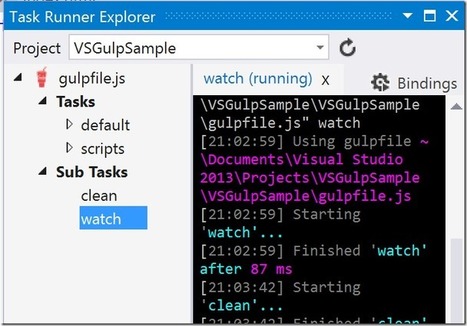
First, we need to create a package.json file in the root directory of the your project. Next, we will install a few packages that we will use for this project. Run the following command from the same folder that you added the package.json file. So far, we have been working primarily in the command line. It would be nice if we could integrate with our existing Visual Studio experience. Luckily, we can with the new Task Runner Explorer plugin. Once the plugin is installed, open the Task Runner Explorer from the View –> Other Windows –> Task Runner Explorer menu. This window will show you all the tasks in the gulp file and allow you to bind those tasks to certain Visual Studio events. This way, we don’t need to remember to run the gulp tasks from the command line. The IDE can handle it for us.
Scoop.it!

Not everything with Angular.js is bad and team behind it is brilliant. Vojta Jína did fantastic job with new DI container. Misko Hevery wrote awesome articles about TDD and writing testable code. And more. But I suppose initial decisions were wrong therefore I consider Angular as dead end. Is Angular worth the risk? No.
Scoop.it!

his month, I'm going to show how to use a Backbone View to display the Customer objects I defined in that column. This time I'll also be showing off some useful features in TypeScript, including the ellipse (…) syntax for defining a method that accepts an indefinite number of parameters and the TypeScript equivalent of a lambda expression. Backbone is designed with the expectation that you'll put your code that generates the HTML in the View's render method. Once you generate your HTML, you can, from within the View, append your HTML to the element set in the el/$el properties. You can also use the View's setElement method to set the View's el/$el properties to your generated HTML.
|
Scoop.it!
End-to-end JavaScript web applications? Thanks to Node.js, this has become a reality, with the added benefit of massive scalability. Despite approaching server-side web applications differently than traditional MVC platforms (like ASP .Net MVC), frameworks have emerged to bridge the knowledge to Node.js. Using one of these frameworks, Sails.js, we demonstrate how the tried and true MVC pattern is applied in Node.js.
Scoop.it!

async-profile gives you essential insight into the performance of your node.js programs, and can help you find and debug performance problems much more easily than with a traditional CPU profiler.
Scoop.it!

The study guide is for everyone, from absolute beginners to advanced developers. First, I give a comprehensive overview of Meteor, in which I discuss just about everything you want and need to know about Meteor before you commit to investing your time and other resources in this still burgeoning though exceptional technology. Contents: * How Will Your Life Change After You Learn Meteor Properly?
Scoop.it!
Scoop.it!

I want to show the listens for each episode and then show the average range in which those listens are falling. In order to show this, I need to be able to calculate the standard deviation based on the number of listens for each episode shown in the graph. And while I could reach for an existing JavaScript statistics library, like one of the many listed here, I decided it would be more fun to learn how to do this myself.
Scoop.it!

By bubbles I mean the UI controls browsers display validation errors in. For whatever reason, we developers (or more likely our designer colleagues) have a deep-seated desire to style these things. But unfortunately we can’t, as zero browsers provide styling hooks that target these bubbles. So what’s a developer to do? Well, although browsers don’t allow you to customize their bubbles, the constraint validation spec does allow you to suppress the browser’s bubble UI and build your own. The rest of the article shows you how to do just that.
Scoop.it!

Generate a web app instantly, directly from a database (SQL Server) The following sample application code is an alternative to using libraries such AngularJS, Knockout, etc. Only established libraries jQuery and boostrap are used in conjunction with JavaScript, HTML and CSS.
Scoop.it!

angular-filter - Bunch of useful filters for AngularJS (with no external dependencies!)
Scoop.it!

From
sriku

I wrote a macro for Javascript that expands “tasks” into async state machines that communicate using channels (i.e. CSP). I want to talk about the specific options for error management implemented in the task macro. When I asked myself “what would I do if JS was really a scheme?”. The answer was clear - I’d just write a macro to produce a state machine given async code and get on with life. I present to you cspjs, a compiler that transforms async “tasks” to state machines that can be run in ES5 as well - i.e. in any browser.
Scoop.it!

AngularJS is one of the most popular Javascript frameworks available today. One of AngularJS's goals is to simplify the development process which makes it great for prototyping small apps, but its power allows scaling to full featured client side applications. The combination ease of development, breadth of features, and performance has led to wide adoption, and with wide adoption comes many common pitfalls. This list captures common AngularJS mistakes, especially when scaling an app.
Scoop.it!

John looks at AngularJS and the MEAN stack as an alternative to Ruby on Rails as a productive stack for building typical web applications. To dive into MEAN, what better way for a Rails fan to get up to speed than by following the path of the famous demo, and creating my own blog application with MEAN.js. A more up-to-date version of the Rails blog exercise, without the “Uoooops,” is the Rails getting started guide. Our journey here will mirror this guide and summarize my comparison with Rails.
Scoop.it!

In this column, I'll show how to respond to a user selecting a customer from the dropdown list and display the related customer data. When I display that data, I'll also move the page to a new state that the browser will treat as if it were a different page.
|





