


This article looks at some common features of JavaScript MV* frameworks. Various frameworks are compared and contrasted with respect to these features.
Contents:
* Routing
* Data Binding
* Templates/Views
* Models
* Data Access
* Conclusion


 Your new post is loading...
  Scoop.it! This article looks at some common features of JavaScript MV* frameworks. Various frameworks are compared and contrasted with respect to these features. Contents: * Routing 
No comment yet.
Sign up to comment
Scoop.it!

If you’re developing web sites or web applications today, there’s a good chance you have data to communicate, and that data may be begging for a good visualization. But how do you know what kind of visualization is appropriate? And, even more importantly, how do you actually create one? Answers to those very questions are the core of this book. In the chapters that follow, we explore dozens of different visualizations and visualization techniques and tool kits. Each example discusses the appropriateness of the visualization (and suggests possible alternatives) and provides step-by-step instructions for including the visualization in your own web pages. Contents:
Scoop.it!

Flux is an architectural pattern based on unidirectional data flow. Although it is originated in the React community, it is general and can be used with any non-opinionated framework. In this article I will show how to use it with Angular.
Scoop.it!

For a long time it seemed like it was ok to just use a single file full of jQuery selectors and event handlers. This is just not a sustainable pattern. The Modern Web that we are entering here in the 23rd century demands a more thought out, and architected approach. An architectural pattern is not something that you sit down and write. No one sits at their desk and thinks about how to write a new shiny pattern. A pattern is something that comes about as a discovery. Some problem is solved potentially multiple times and a pattern is extracted from the solution(s). * Constructor
Scoop.it!

Fade in. The X-Men are on the main timeline (the master branch), but something has gone terribly wrong. Super-powerful shape-shifting sentinels (bugs) have emerged and are killing all the X-Men (the working features). Luckily, Kitty Pryde, aka Shadowcat, has the ability to send people’s consciousnesses back in time (she’s a Git master).
Jan Hesse's insight:
Scoop.it!
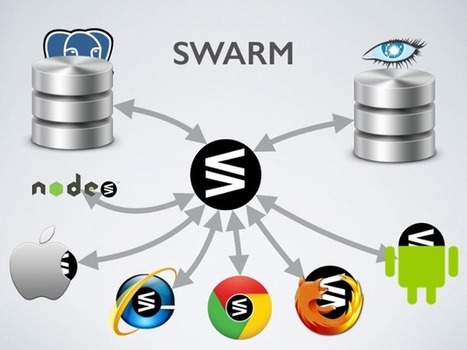
Skipping collaborative apps, these days even a single user needs to sync his/her devices. The device landscape is getting predominantly mobile, so an average user has multiple powerful devices with unreliable internet connections. Popular solutions suck for one simple reason: common sense fails us in distributed systems. Proper sync needs some math like a GPS device needs some relativity formulas. Yes, that is just a box that says your x and y. No, it can’t work by common sense alone; it needs math.
Scoop.it!
Joe talks about his experience learning and building feature with emberjs.
Scoop.it!

You can get started with Ember application development without understanding the runloop. However at some point you will want to dig in and understand it properly so you can use it skillfully. It is my sincere hope that this handbook can be your guide. We are about to take a deep dive into the Ember.js runloop. Together we will answer these questions:
Scoop.it!

Listing hundreds of modules that extend ember-cli.
Scoop.it!

Contents:
Scoop.it!
One of the reasons for AngularJS’ success is its outstanding ability to be tested. It’s strongly supported by Karma (the spectacular test runner written by Vojta Jína) and its multiple plugins. Karma, combined with its fellows Mocha, Chai and Sinon, offers a complete toolset to produce quality code that is easy to maintain, bug-free and well documented. Tests must define the code’s API. This is the one principle that will guide us through this journey. An AngularJS application is, by definition, composed of modules. The elementary bricks are materialized by different concepts related to the granularity at which you look at them. At the application level, these bricks are AngularJS’ modules.
Scoop.it!

A simple example of how testing Auth0 login on AngularJS with Protractor can be done My intention with this test is to transform it into a common method that I can use in any Protractor test with the help of the Page Object Pattern.
Jan Hesse's insight:
Scoop.it!

Unlike some other SPA frameworks, Kendo's SPA implementation doesn't do much to dictate your code layout. In this article we will see one way to lay out your SPA application using Require.js and the kendo-template Require.js plugin.
|
Scoop.it!

I've been developing Single-Page Applications for a while. I started using plain JavaScript, then jQuery, then a bunch of other crazy libraries, to then finally settle with AngularJS. I've been a fan since day one, and I believe users can benefit a lot from them.
Scoop.it!

React is often mentioned in the same breath as other Javascript frameworks, but "React vs Angular" doesn't make sense because they aren't directly comparable things. Angular is a complete framework (including a view layer), React is not. This is why React is so confusing to understand, it's emerging in an ecosystem of complete frameworks, but it's just the view. React gives you a template language and some function hooks to essentially render HTML. That's all React outputs, HTML. Your bundles of HTML / Javascript, called "components", are allowed things like storing their own internal state in memory (such as which tab is selected in a tab view), but in the end you just barf out HTML.
Scoop.it!

Developer Michael Perrenoud describes what it's like for .NET developers who want to explore the MEAN stack -- MongoDB, Expressjs, AngularJS, and Node.js I was standing in the middle of a matrix I'd avoided for a very long time: Microsoft vs. The World. It was a decision I thought I'd never have to make. Here I was, 33 years old and feeling like a dinosaur. Don't get me wrong, the skill set I had wasn't so out of date that it was already dead, but I could feel the market shifting. I knew that if I didn't make a change, in 10 years, I'd be staring down that same barrel those COBOL friends of mine were right now.
Scoop.it!

Angular 1.3 introduces a number of new features for form validation, including a new approach to writing validation code, a new approach to showing validation error messages, and plenty of small enhancements. like adding ng-submitted as a class to a form after a submit event. To only show validation errors or color code erroneous inputs after the user presses the submit button now only requires a more specific selector in CSS.
Scoop.it!

This article is a simple tutorial designed to teach you some fundamental skills for creating cross platform web applications. You will build a sample School Plan app, which will provide a dynamic “app-like” experience across many different platforms and work offline. It will use Apache Cordova and Mozilla’s Brick web components.
Scoop.it!

For Daniel and many React devs, there is no debate. If you care about performance, you use React instead of Angular. Period. I don’t think it is quite that simple. Performance is a means to an end. The real goal is providing a great user experience. No doubt speed matters, but not all changes in speed are perceived by humans the same way.
Scoop.it!

Some people find the use of `sendAction` in Ember components a bit confusing. In this post I'll go over how Ember component use `sendAction` to communicate with controllers and routes, with some examples of common pitfalls. There are several ways using actions in an Ember component is different than in a route or controller:
Scoop.it!
Parasut.com is a financial management SaaS for small businesses in Turkey. We use Ember.js to develop a beautiful, responsive, and incredibly powerful frontend. Ember.js also assists with our rapid development and deployment schedule. This presentation outlines our best practices with Ember.js.
Scoop.it!

In this post we’ll use momentjs to write an Ember helpers called formatted-date which we’ll be using in our templates to render dates. ember-cli uses Bower to manage frontend dependencies (we can also use addons but that’s a different story), the simplest way to consume a library is to add it via bower and then use app.import in our Brocfile.js.
Scoop.it!
MEAN stack is a full JavaScript solution that helps you build fast, robust and maintainable production web applications using MongoDB, ExpressJS, AngularJS and Node.js.
Scoop.it!

The biggest hurdle in this experiment was understanding the timing of various events and callbacks. Unlike Deferred values in the Q library ($q in AngularJS), not everything in Firebase is asynchronous. And, those things that are asynchronous aren't necessarily asynchronous all of the time. A lot of the timing depends on the state of the local cache and type of request being made (ex, transactional). This made it very hard to determine when and if an AngularJS digest needed to be triggered.
Scoop.it!

I structured the talk so that I could easily go from start to finish in stages. In the PowerPoint deck you'll see I have actual git checkout commands that reference the various commits. This will enable you to roll forward to each step after you've cloned the repository. The result is a responsive health calculator app that scales well to a variety of page sizes, has built-in validations for inputs and provides you with basal metabolic rate (BMR), body mass index (BMI), and target heart rate zones (THR). The app was developed using a test-driven (TDD) approach with a total of 83 specifications. The GitHub repository has full source and instructions.
|




