JavaScript for Line of Business Applications
606.5K views | +36 today
JavaScript for Line of Business Applications
Keeping track of current JavaScript Frameworks that help design your clientside Business Logic Layers.
Curated by Jan Hesse
Beam to my Inbox:
Your new post is loading...

Popular Tags - Filter using the Funnel

Scoop.it!

The Evolution of Ember: A Look at Its Past, Present and Future

The Evolution of Ember: A Look at Its Past, Present and Future | JavaScript for Line of Business Applications | Scoop.it

As much as I enjoyed Ember’s ambition, I’ll admit that I was bearish on the future of the framework. Angular was the next obvious step beyond Backbone and I worried that Ember had bit off more than it could chew.

Today Ember may not be as popular as Angular or Backbone, but I am bullish about its future. We’ve seen a growing number of companies using Ember, but to me, it’s all about the benefits for developers.

No comment yet.
Scoop.it!

Design Principles

Design Principles | JavaScript for Line of Business Applications | Scoop.it

* The Robustness Principle
Be conservative in what you send; be liberal in what you accept.
* The Pareto Principle
80% of the effects come from 20% of the causes.
* The Principle of Least Surprise
When two elements of an interface conflict, or are ambiguous, the behaviour should be that which will least surprise the user.
* The DRY Principle
Every piece of knowledge must have a single, unambiguous, authoritative representation within a system.

No comment yet.
Scoop.it!

Ember without Ember Data

This screencast shows how you can build an Ember.js application without using Ember Data. It starts off simple and then shows how to build advanced stuff like an identity map yourself.

No comment yet.
Scoop.it!

Continuations

Continuations | JavaScript for Line of Business Applications | Scoop.it
There is one abstraction that can be used to implement such apparently diverse concepts as exceptions, generators, coroutines and even the backtracking mechanism present in Prolog.

This article demonstrates how to use continuations to implement these constructs in a custom, small programming language. Then the implementation of an interpreter for that language is presented.

Finally a Java servlet is demonstrated. It uses continuations with server-side JavaScript to simplify writing complex workflows that hide the request/response cycle of HTTP.

No comment yet.
Scoop.it!

Writing Custom Components with Ember.js

Writing Custom Components with Ember.js | JavaScript for Line of Business Applications | Scoop.it

By extensively relying on components in your application architecture, you will be able to create an application with parts that are decoupled, reusable and highly maintanable. In this post I will go through how you can create custom components by embedding a third party jQuery plugin, the popular select-2 library.

No comment yet.
Scoop.it!

A Different Angle: What is AngularJS?

A Different Angle: What is AngularJS? | JavaScript for Line of Business Applications | Scoop.it

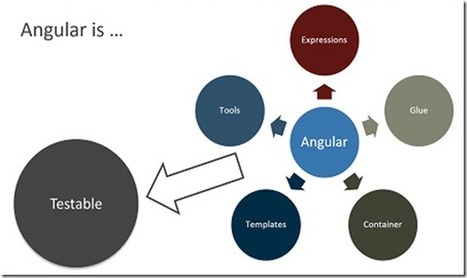
It was then I realized that most Angular articles and presentations I see tend to walk through the Angular API. Did you know Angular has a factory? What about a service? It does dependency injection, and oh, let me tell you about the data-binding!

Even before looking at features I’d probably want to know about real world use cases. How many times have you read a question posted that went something like, “Show me the money!” (Err, I know, it’s not really a question). In other words, what real world apps have been implemented with Angular? It’s one thing to point to a set of websites and say, “Look, that’s Angular.” It’s quite another to talk to someone on a team who built out an enterprise production app.

Scoop.it!

App Samples for Node-Webkit

App Samples for Node-Webkit | JavaScript for Line of Business Applications | Scoop.it

App Samples for Webkit Node

No comment yet.
Scoop.it!

AngularJS and ES6

AngularJS and ES6 | JavaScript for Line of Business Applications | Scoop.it

I was working on refactoring some of my Javascript code for an Angular app when I decided that I would convert most of my client side code to ES6 so that I am ahead of the curve come AngularJS 2.0. I have begun taking baby steps in this direction but information is hard to come by at the moment on using ES6 with AngularJS. I ran into a major hurdle before I could get my rudimentary HelloWorld app running and that is what instigated me to write this post (finally a post after 3 years). Hopefully it will help someone out.

No comment yet.
Scoop.it!

JWT-Backed Authentication with Ember and Express

JWT-Backed Authentication with Ember and Express | JavaScript for Line of Business Applications | Scoop.it

Our application will be split in two — a front-end web client written with EmberJS, and a JSON API powered by ExpressJS — each within their own self-contained project.

If you want to use JWT in your Ember Apps today there is a new extension by the team behind Blimp (Jose Padilla and Giovanni Colazzo) for the popular Simple Auth Add-on by Simple Labs.

No comment yet.
Scoop.it!

Building an EventStore with User Defined Projections on top of Postgresql and Node.js

Building an EventStore with User Defined Projections on top of Postgresql and Node.js | JavaScript for Line of Business Applications | Scoop.it

For most of the 2000’s my goto strategy for application persistence was to use some sort of object relational mapping to persist and read the object structures that I wanted to work with in my code. Sometimes I used hand rolled code to do the mapping, and other times my teams used NHibernate. In the past couple years I’ve been on projects that used the RavenDb document database with mixed success. I’ve also worked on a couple codebases that used an event sourcing strategy to persist meaningful business events, sometimes with RavenDb as the underlying storage engine and another project that uses an older version of NEventStore with Sql Server as the storage mechanism.

For various reasons, we’ve chosen to use a Node.js based stack to rewrite an old WPF application that is a suitable candidate for event sourcing on the backend.

No comment yet.
Scoop.it!

4 Questions to Ask Before Choosing a JavaScript Framework

4 Questions to Ask Before Choosing a JavaScript Framework | JavaScript for Line of Business Applications | Scoop.it

While these individual libraries and the resulting custom stack have the potential to do some things very well, the unfortunate reality is that a great deal of the functionality must be gathered together from disparate sources, written in-house and require a dedicated team of maintainers in order to meet the demands of enterprise software development.

Delchina Angelova's curator insight, October 27, 2014 11:01 AM

Not sure the compare is fair but questions are good.

Scoop.it!

Knockout Secure Binding

Knockout Secure Binding | JavaScript for Line of Business Applications | Scoop.it

KSB is a drop-in binding provider for Knockout that does not violate a Content Security Policy that prohibits eval.


At its core, KSB is two things:

  1. A parser that interprets data-bind attributes on the DOM elements and text of virtual elements that Knockout reads; and

  2. A process for converting the values produced by the parser into the valueAccessor argument that is given to Knockout bindings.

No comment yet.
Scoop.it!

Node-Webkit File Player - A File player for your desktop

Node-Webkit File Player - A File player for your desktop | JavaScript for Line of Business Applications | Scoop.it

We will be using a slush generator named slush-wean to scaffold a basic node webkit, Express.js and Angular.js app. And then we will build our application on top of it.

Our application logic is very simple. When the app loads, we will show all the folders right from the root on the left hand side of the app in a tree view. And when a user clicks on the resource, we play that file. Play here refers to viewing an image, displaying a md/log/json/txt file and playing media. A simple app that is more than a “media center”.

No comment yet.
Scoop.it!

AngularJS, the Digest Loop, Directives and jQuery

AngularJS, the Digest Loop, Directives and jQuery | JavaScript for Line of Business Applications | Scoop.it

I’ve been struggling with understanding when and how to use jQuery inside an AngularJS directive and have the data binding work as expected.  I’ve got a good example I put together that shows how to do this as well as shows when you need to use the scope.$apply(). 

You can see from the below example that in the directive, I am using AngularJS.  Because our DOM is being modified outside of what AngularJS can see, it does not have a watch assigned to it and therefore in the AngularJS digest loop, the scope.cntjQuery does not get updated.  As we know, the $scope contains the “truth” of this application but if the digest loop is not run then the truth never makes it to the browser.  Calling scope.$apply() causes the digest loop to be run.

No comment yet.
Scoop.it!

Fun with Named Functions in JavaScript

Fun with Named Functions in JavaScript | JavaScript for Line of Business Applications | Scoop.it
  1. Declaring a named function binds the function to the name in its surrounding environment. That’s why we can use the function rank within the function officer. Likewise, officer is declared in the global environment, and that’s why we can use it on the Node command line (or wherever we’re testing this code).

  2. We can declare a named function anywhere and its binding can be usedeverywhere. That’s why we can declare rank at the bottom of the function, but use it at the top.
No comment yet.
Scoop.it!

Statically typed JavaScript via Microsoft TypeScript, Facebook Flow and Google AtScript

Statically typed JavaScript via Microsoft TypeScript, Facebook Flow and Google AtScript | JavaScript for Line of Business Applications | Scoop.it

This blog post looks at three initiatives for adding static typing to JavaScript: Microsoft’s TypeScript, Facebook’s Flow and Google’s AtScript.


Contents:

* Typing
* Microsoft TypeScript
* Facebook Flow
* Google AtScript
* A common standard?
* Further reading


No comment yet.
Scoop.it!

AdmiralJS - a web app for admin generation + a node server for api + file upload.

AdmiralJS allows quick generation of an admin interface, letting you spend more interesting time on the design of the front end with your favorite framework.

  • Customisable field editors for your models
  • Instant admin generation from a schema.json
  • That means you can change your models’structure on the fly ! (great for development)
  • Pluggable on any CRUD or RESTFUL API (optimized for SailsJS)
  • Written in javascript with requirejs / jquery / backbone
  • Usable with the bundled server or as a standalone webapp

AdmiralJS was developped as a client-side webapp, to make it as much as possible independant from frameworks and platforms.

No comment yet.
Scoop.it!

Excercise Functional Programming in Javascript

Excercise Functional Programming in Javascript | JavaScript for Line of Business Applications | Scoop.it

This is an interactive learning course with exercises you fill out right in the browser.

Functional programming provides developers with the tools to abstract common collection operations into reusable, composable building blocks. You'll be surprised to learn that most of the operations you perform on collections can be accomplished with five simple functions:

  1. map
  2. filter
  3. concatAll
  4. reduce
  5. zip

Here's my promise to you: if you learn these 5 functions your code will become shorter, more self-descriptive, and more durable. 


No comment yet.
Scoop.it!

Converting Your JavaScript App to an iOS App w/ PhoneGap

Converting Your JavaScript App to an iOS App w/ PhoneGap | JavaScript for Line of Business Applications | Scoop.it

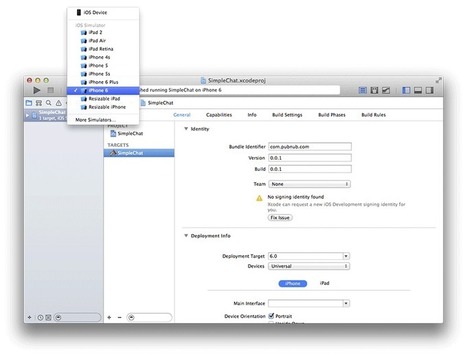
This tutorial shows you how to convert a JavaScript web application into an iOS application with PhoneGap, as well as how to launch your JavaScript app on the iOS App Store.

No comment yet.
Scoop.it!

The Basic Anatomy of an Ember Application

The Basic Anatomy of an Ember Application | JavaScript for Line of Business Applications | Scoop.it

If you’ve been a web programmer for some time, some of the anatomical units are probably pretty familiar to you. Actually most of them probably are, which is one of Ember’s best qualities. If its core architecture is familiar and comfortable to you, you can move around Ember projects simply because they’re all likely to use these same core units. But whether you’re new to each and every unit we’ll quickly summarize here, or an old hand at these concepts but new to Ember, I’m pretty sure you’ll learn something.

No comment yet.
Scoop.it!

AngularJs and Promises with the $http Service

AngularJs and Promises with the $http Service | JavaScript for Line of Business Applications | Scoop.it
The AngularJs $http object returns custom promises which can be surprising when you try to work with them. You can use either .then() or the easier .success() and .error() methods - at the cost of some inconsistency in Promise usage as these extension are specific to the $http functions. In this post I review a few different ways you can use promises and more importantly what the various $http methods return.
No comment yet.
Scoop.it!

Rails + Angular / Rails + Ember

Rails + Angular / Rails + Ember | JavaScript for Line of Business Applications | Scoop.it
In this comparison, Rails expert Fernando Villalobos breaks down the difference between AngularJS and Ember.js when it comes to choosing a JS framework for Rails applications.


Contents:

1. Introduction
2. Single-page applications and 'modules'
3. Installation process
4. Project setup
5. Turbolinks
6. CSRF token
7. Consuming a REST API
8. JS minification
9. Summary

No comment yet.
Scoop.it!

Message Systems in Programming: Callbacks, Events, Pub Sub, Promises, and Streams

Message Systems in Programming: Callbacks, Events, Pub Sub, Promises, and Streams | JavaScript for Line of Business Applications | Scoop.it
How you decide to allow objects to talk to each other has pro’s and con’s for each method and it’s good to know your options as you can use many together in effective hybrid approaches.This article will cover the 5 common ones you’ll often encounter.We’ll cover:* Callbacks* Events* Pub Sub* Promises* Streams
Arik Grinstein's curator insight, November 1, 2014 4:09 PM
A good summary about messaging options
Scoop.it!

Asynchronously Bootstrapping AngularJS Applications with Server-Side Data

Asynchronously Bootstrapping AngularJS Applications with Server-Side Data | JavaScript for Line of Business Applications | Scoop.it

Learn how you can manually bootstrap AngularJS applications and initialize them with asynchronously loaded JSON data.

If you want to bootstrap an AngularJS application with data from your backend, e.g. some essential configuration data, you basically have two main options. You can either …

  • embed the data in the HTML document, or
  • fetch it by making an additional HTTP request.
No comment yet.
Scoop.it!

Isomorphic JavaScript with LazoJS

Isomorphic JavaScript with LazoJS | JavaScript for Line of Business Applications | Scoop.it

How we solved the SEO and optimized page load issue for public facing web sites while keeping UI engineers, myself included, happy and productive. Let’s take a look at how we achieved this with the creation of a new isomorphic JavaScript web framework, LazoJS.

Jan Hesse's insight:

http://de.slideshare.net/JasonStrimpel/oscon2014v2

No comment yet.