


All Videos of JSConf EU 2014


 Your new post is loading...
  Scoop.it! 

Arik Grinstein's curator insight,
December 3, 2014 3:10 AM
JS Talk. JSConf EU 2014
Sign up to comment
Scoop.it!

What we'll cover * What are Web Components?
Scoop.it!

Node.js is getting more and more mature, no doubt - despite this, not a lot of security guidelines are out there. In this post I will share some points you should keep in mind when it comes to Node.js security. Contents: * No eval, or friends
Scoop.it!
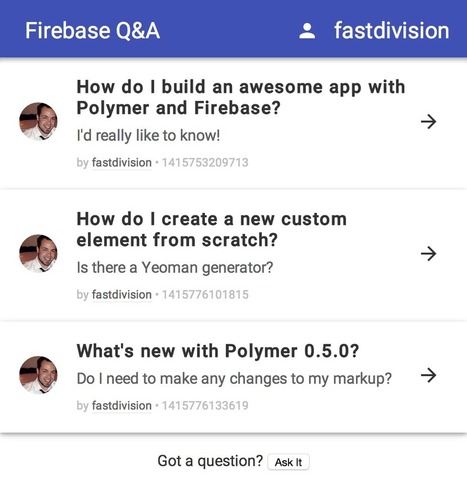
We’re going to build a Q&A system from scratch starting off with setting up your project using Yeoman and outlining the structure. Along the way we’ll talk about custom elements, material design, routing, authentication, security rules, and record priority. Users will be able to write questions, answers, and comments. Both questions and answers can be upvoted. Using security rules, we’ll make sure that users can only manage their own content within Firebase. This is an ambitious blog post with a lot of code. If you find an error or aren’t sure how to continue, leave a comment in the post and I’ll make improvements. Walking through this entire series (in progress) could take an hour or two, but by the end you’ll have a thorough understanding of how to build a basic Polymer app.
Scoop.it!

Detecting whether or not an element is visible in the viewport is very useful when it comes to triggering animations or events. Before you drop in another jQuery plugin though, have a look at how easy it is to create a Mixin that you can add to any View or Component. Once added, you can simply ask that element if it’s in the viewport using the property the Mixin injects.
Scoop.it!

Every now and then, you want to let your users quickly search for records that you’ve already loaded into your store. We can easily implement naïve search using Ember’s Array#filter and native String prototype methods, but let’s go a little step further and create a custom computed property macro (CPM) that wraps the search so we can easily drop it into other properties.
Scoop.it!
This is a hands-on introduction to Meteor, a JavaScript and Node.js framework built for the future. Meteor is an open-source platform for building top-quality web apps in a fraction of the time, whether you’re an expert developer or just getting started. Meter rocks because: you write in the same language on both the server and the browser; 50 lines of code gets you a working chat app; your app will work in real time; you get an awesome package system; and you can run your app natively on iOS and Android.
Scoop.it!
Scoop.it!

A tool like Angular can be easily abused. This series is designed to help you avoid common traps and pitfalls before they become a problem. The top five mistakes I see people make are:
In this series I’ll cover examples of both how these items are abused and my suggested “better practice.” Let’s get started with the first mistake.
Scoop.it!

* Introduction
Scoop.it!
Let's decompose the Flux flow to figure out how it could be used on the server.
Scoop.it!

Javascript single page application tutorial using Knockout JS data-bind. Code examples and takeaways from programming Foosball game tracking application....
Scoop.it!

This article describes on the following topics.
|
Scoop.it!

NuclearJS is an Immutable implementation of Flux Architecture. Nuclear provides a very decoupled solution to modelling state in a frontend system, leading to much thinner UI components, easier testability and more predictability. In fact, when done right, a Nuclear powered frontend will have ZERO state in UI components. NuclearJS is UI framework agnostic. It pairs well with almost every popular UI framework, since its only concern is state modelling and provides a very pleasant and simple to use API.
Scoop.it!

I've recently been looking into these emerging frameworks and wanted to highlight a few of their interesting features in contrast to ExtJS. This is by no means an objective comparison (and the frameworks are too far apart to really be compared that way), but rather an analysis of some interesting performance-oriented features that are addressing some of the most common performance/load issues associated with large HTML-based web applications like those usually developed in ExtJS.
Scoop.it!

Nemo is a framework and set of conventions for automated testing of web and even native applications. How you use it is only limited by your imagination. A common starting point is to pair Nemo with a task runner (e.g. Grunt) and a test runner (e.g. Mocha). But if you have a different task and test runner, Nemo will work with that as well.
Jan Hesse's insight:
Scoop.it!
Scoop.it!
Using _uihooks to animate UI elements in your Meteor.js apps.
Scoop.it!

Imagine a world where you aren’t confined to the existing standard for available HTML tags. You aren’t limited to <h1>s and <div>s and <section>s. You can define and use your own application-specific DOM elements for more semantic and readable markup.
Scoop.it!

Learn the basics of implementing your own authentication layer using accounts-base and accounts-password with the JavaScript framework Meteor 1.0... accounts-base and accounts-ui are awesome packages that happen to make a heap of assumptions about how you're going to reason about your user's authentication and session management using a system called Accounts. That's alright though, because accounts-ui isn't necessarily intended to be the de facto way to provide access to the API of Accounts. It's there to get newcomers started, to help more experienced developers quickly prototype their ideas, and probably only occasionally remain a permanent fixture of the UI. Here's a look at how we can replace the functionality of accounts-ui with custom behaviours and appearances.
Scoop.it!

JavaScript is a powerful and flexible dynamic programming language with a beautiful simple associative model at its core. However this design comes at the cost of ubiquitous mutability. Mori embraces the simple associative model but leaves mutability behind. Mori delivers the following benefits to JavaScript:
Modern JavaScript engines like V8, JavaScriptCore, and SpiderMonkey deliver the performance needed to implement persistent data structures well.
Scoop.it!

Over the years, there have been various approaches to building class hierarchies in JavaScript. All these approaches worked by stitching together constructor functions and prototype objects and each approach was slightly different from the others. The ES6 standard allows for a declarative, consistent approach to inheritance using the class and extends keywords. As an example, let’s start with a simple class to represent a person with a name.
Scoop.it!

Taunus focuses on delivering a progressively enhanced experience to the end-user, while providing a reasonable development experience as well. Taunus prioritizes content. It uses server-side rendering to get content to your humans as fast as possible, and it uses client-side rendering to improve their experience. While it focuses on progressive enhancement, usability and performance are both core concerns for Taunus. Incidentally, focusing on progressive enhancement also improves both of these. Usability is improved because the experience is gradually improved, meaning that if somewhere along the line a feature is missing, the component is still expected to work.
Scoop.it!

Here at Viget, we've become huge fans of React. It gives us greater flexibility by working with a virtual representation of the DOM. When the DOM simply becomes an idea, instead of a requirement, rendering becomes just another implementation detail. This is particularly useful when rendering content server-side, loosely diagrammed below... Now let's get started.
Scoop.it!

The Angular team at Google provides two tools for testing Angular applications: Karma, a test runner for unit testing, and Protractor, a test framework for writing end-to-end (E2E) tests. In this article, I'm going to be focusing on writing unit tests against Angular applications using Karma. We'll cover some unit-testing basics, Karma details, as well as Angular-specific strategies for writing unit tests that help improve overall developer productivity instead of adding an extra development burden to your application.
|




