JavaScript for Line of Business Applications
606.5K views | +9 today
JavaScript for Line of Business Applications
Keeping track of current JavaScript Frameworks that help design your clientside Business Logic Layers.
Curated by Jan Hesse
Beam to my Inbox:
Your new post is loading...

Popular Tags - Filter using the Funnel

Scoop.it!

Using the Strategy Pattern to Reduce Complexity in Your JavaScript

Using the Strategy Pattern to Reduce Complexity in Your JavaScript | JavaScript for Line of Business Applications | Scoop.it

The Strategy Pattern will be our weapon of choice for tackling the problem above. So what is the Strategy Pattern, you may ask? Essentially it is a way to evaluate an input at runtime and execute predefined code based off of that input. This is JavaScript, a dynamic language so we won't have to go the full polymorphic, implenting interfaces like in C# to use this pattern. As an aside, you could actually do it that way in JavaScript if you'd like.

No comment yet.
Scoop.it!

Getting To Know Flux, the React.js Architecture

Getting To Know Flux, the React.js Architecture | JavaScript for Line of Business Applications | Scoop.it

Flux is probably better explained by explaining its individual components:

  • Actions – Helper methods that facilitate passing data to the Dispatcher
  • Dispatcher – Receives actions and broadcasts payloads to registered callbacks
  • Stores – Containers for application state & logic that have callbacks registered to the dispatcher
  • Controller Views – React Components that grab the state from Stores and pass it down via props to child components.

Lets take a look at what this process looks like graphically:

No comment yet.
Scoop.it!

Reactris, part I : Getting Started

Reactris, part I : Getting Started | JavaScript for Line of Business Applications | Scoop.it
I'm trying to learn how React.js works. I have a website project that I want to apply it to, but that's already wrapped up with too many other different technologies and I want to understand how R...
No comment yet.
Scoop.it!

Frontend Dependency Management with Browserify

Frontend Dependency Management with Browserify | JavaScript for Line of Business Applications | Scoop.it

With frontend development moving as fast as it does at Bitly, things can get pretty messy. We found ourselves with piles of unmanaged script tags and little indication of what was still being used in the app’s current iteration. There had to be a better way!

Enter Browserify! 

No comment yet.
Scoop.it!

Getting To Know Flux, the React.js Architecture

Getting To Know Flux, the React.js Architecture | JavaScript for Line of Business Applications | Scoop.it
Contents:
  • Introduction
  • What is Flux?
  • The Dispatcher
  • Stores
  • Action Creators & Actions
  • Controller Views
  • Putting It All Together
  • Wrap Up
No comment yet.
Scoop.it!

React Tutorial: Creating a Simple Application Using React JS and Flux Architecture

React Tutorial: Creating a Simple Application Using React JS and Flux Architecture | JavaScript for Line of Business Applications | Scoop.it

React JS and Flux go together pretty well, as it was architected that way, but they’re by no means dependent upon one another. As a result, I’m going to split this article up into the React JS piece, which will go over how to create views and best practices, followed by a detailed look into how I’m getting data out of my mocked server API via Flux.

I’ve put a demo of the todo application in action, but prepare to be disappointed, as it’s really very straightforward.

No comment yet.
Scoop.it!

How to setup AngularJS in MVC4 application

How to setup AngularJS in MVC4 application | JavaScript for Line of Business Applications | Scoop.it
In this post, I would like to explain Part 1 - How to setup AngularJS in MVC4 application. This is our First Post about AngularJS. Here I have explained a little about AngularJS and What we will learn in this section part by part. In this part (Part 1) I am going to explain how to setup AngularJS in MVC4 application.
Jan Hesse's insight:

Part 1:

http://dotnetawesome.blogspot.de/2014/12/how-to-setup-angularjs-in-mvc4.html

Part 2:

http://dotnetawesome.blogspot.de/2014/12/part-2-how-to-fetch-data-from-database-using-angularjs.html

Part 3:

http://dotnetawesome.blogspot.de/2014/12/how-to-create-login-page-using-angularjs-in-mvc4.html

No comment yet.
Scoop.it!

Getting Started with ES6 – Transpiling ES6 to ES5

Getting Started with ES6 – Transpiling ES6 to ES5 | JavaScript for Line of Business Applications | Scoop.it

Before jumping into the first official ES6 feature (that’s coming in the next post) I wanted to write a step-by-step walkthrough that covers how to get the Traceur and 6To5 transpilers working with Gulp (a JavaScript task runner). I’m also going to sneak in a little TypeScript as well since it’s another option. By getting these tools in place you can start writing ES6 code, convert/transpile it to ES5, and then use the generated code in older browsers. Going that route lets you take advantage of the future of JavaScript right now without having to wait around until all of the browsers fully support ES6.

No comment yet.
Scoop.it!

Getting started with hapi 8 - tutorial

Getting started with hapi 8 - tutorial | JavaScript for Line of Business Applications | Scoop.it
Getting started with hapi 8: request lifecycle, plugins and server methods...
No comment yet.
Scoop.it!

Rethink Async With RXJS

This is an updated version of my "Add more fun to your functional programming with RXJS". It includes a bit more background information on Reactive programming.

Observables What to events and async functions have in common?

No comment yet.
Scoop.it!

Effective Event Binding with jQuery

Effective Event Binding with jQuery | JavaScript for Line of Business Applications | Scoop.it
This article explains how to efficiently, and effectively, bind events using jQuery.

If you've used jQuery much at all, then you're probably already familiar with event binding. It's fairly basic stuff, but dig a little deeper and you'll find opportunities to make your event-driven code less brittle and more manageable.

No comment yet.
Scoop.it!

The Two Pillars of JavaScript — Pt 2: Functional Programming

The Two Pillars of JavaScript — Pt 2: Functional Programming | JavaScript for Line of Business Applications | Scoop.it

How to Stop Micromanaging Everything


Over the course of the next few years, the way we code is going to change in radical ways, pushing us in a fundamentally different direction than the one we’ve been sprinting for the past 30 years or so. These changes will lead to many important breakthroughs in programming techniques, processes, application scalability, and quality controls.

No comment yet.
Scoop.it!

Meteor.js Two-Factor authentication

Meteor.js Two-Factor authentication | JavaScript for Line of Business Applications | Scoop.it

This article is for developers, who're already familiar with Meteor, and faced the problem of implementing two-factor authentication. Further you'll find whole logic and code for its implementation. No pictures, but lots of code.

In my case, the second factor is code, sent by SMS via Twilio service. But you can swap the second factor for your own after you get in touch with the further code.

No comment yet.
Scoop.it!

Breaking Down AngularJS to Smaller Components

Breaking Down AngularJS to Smaller Components | JavaScript for Line of Business Applications | Scoop.it

Separation of concerns has its own tradeoffs. A lot of people doesn’t seem to understand this; they tend to use Controller for everything. Even library authors instruct that way. Although library authors are not to be blamed, it seemed to have been applied in practice by everybody, and that’s not awesome.

No comment yet.
Scoop.it!

Async Fragments: Rediscovering Progressive HTML Rendering with Marko

Async Fragments: Rediscovering Progressive HTML Rendering with Marko | JavaScript for Line of Business Applications | Scoop.it
No comment yet.
Scoop.it!

Cheerp, the C++ compiler for the Web

Cheerp, the C++ compiler for the Web | JavaScript for Line of Business Applications | Scoop.it

A seamless C++ programming experience for the Web.

Use cheerp to write your Web applications in fully type-safe C++ code, make use of uncountable existing libraries, leverage your existing knowledge, reuse your code, improve your productivity.

Cheerp generates optimized JavaScript code that is compatible with any browser, on any platform. Let the compiler spot errors for you at compile time, instead of hunting them at run-time.


Port existing applications or write new ones, all in C++

Cheerp is based on the proven and robust LLVM stack and fully compatible with almost all C and C++11 code. If you want to take advantage of transparent RPC support, you just need to add some tags to tell cheerp if you want your methods compiled for the server or for the client. Everything else (including client to server remote procedure calls, serialization and deserialization, etc.) will work automagically!

No comment yet.
Scoop.it!

Videos: Backbone Conf III - 2014 by Bocoup

  • Jeremy Ashkenas - Keynote
  • Matt Dennewitz - Backbone at Pitchfork
  • Brenda Jin - Jasmine Testing for Backbone js Models and Views
  • John K Paul - Ember Components Make My Heart Sing
  • Gregor Martynus - Building Offline First Applications with Backbone
  • Ryan Muller - Go with the Flow Backbone and Streams
  • James Smith - Marionette The Backbone Framework
  • Rachel Baker - The WordPress JSON REST API
  • Tim Griesser - Data Based JavaScript
  • Henrik Joreteg - Ampersand.js
  • Clement Wehrung - A Visit to the World of Responsive Real time
  • Daan Mortier - The Backbone Tango Dancing with Geographical
  • Shirley Wu - Marrying Backbone js and D3 js
  • Andrew Rota - Web Components and Backbone
  • Kris Walker - Backbone in XBox and Windows Apps
  • Sam Breed - React and Backbone, Sittin’ in a Tree
  • Jason Laster - Backbone under the Magnifying Glass Tools for Exploring and Debugging Your Apps
  • Greg MacWilliam - Teaching Backbone and other cool technologies
No comment yet.
Scoop.it!

Asynchronous calls with ES6 generators

Asynchronous calls with ES6 generators | JavaScript for Line of Business Applications | Scoop.it

A few months ago Jake Archibald wrote an article about the awesomeness of the asyncfunctions in ES7 and how we can “emulate” them using ES6’s generators, using his spawn function, which has subset of the features of co.

In this blog post we’ll take a look at standard ways of handling asynchronous calls and how we can improve the readability of our code using generators. We’ll also take a further look at the implementation of spawn, since there are few tricky moments there.

No comment yet.
Scoop.it!

What is Meteor.js?

What is Meteor.js? | JavaScript for Line of Business Applications | Scoop.it

Meteor.js is a cohesive development platform, a collection of libraries and packages that are bound together in a tidy way to make web development easier. It builds on ideas from previous frameworks and libraries to offer an easy way to start a prototype app, but it gives you the tools and flexibility to build a full fledged production app. There are libraries like Tracker and Blaze that the Meteor Development Group has built specifically for a reactive front-end experience.

No comment yet.
Scoop.it!

HTML5 Mobile - Optimising for older or slower devices

HTML5 Mobile - Optimising for older or slower devices | JavaScript for Line of Business Applications | Scoop.it

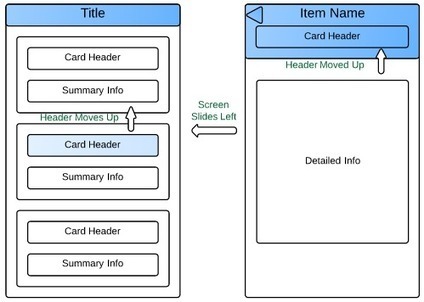
I built my App using Ionic Framework, which is based on AngularJS, but these lessons should apply to other frameworks too. Angular has built-in support for animations, and Ionic comes with some default transitions for sliding pages left and right. I used that, and added a Javascript animation for the “Hero” element. It extracts the element from the card and positions it so it’s in the same place on screen, then animates it to it’s new location before removing it. The corresponding element in the details page is initially hidden during the animation, and revealed at the end so it appears to be the same element.


Google’s success at making the OS available at lower price points means that many users have devices with relatively limited performance. Giving those users a good experience is vital. Here are some lessons I’ve learned while optimising my App to look good on older or slower devices.

No comment yet.
Scoop.it!

Manifests, plugins and schemas: Organizing your Hapi application

Manifests, plugins and schemas: Organizing your Hapi application - Nerds @ Zappos - Medium

If you’re building things for the web, love JavaScript and haven’t yet discovered hapi.js, you’re missing out. Billed as “a rich framework for building applications and services”, what you’ll find is a feature-rich, battle-tested and rapidly evolving foundation upon which to build your web application.

No comment yet.
Scoop.it!

rx-flux: The Flux architecture with RxJS

rx-flux: The Flux architecture with RxJS | JavaScript for Line of Business Applications | Scoop.it

The Flux architecture allows you to think your application as an unidirectional flow of data, this module aims to facilitate the use of RxJS Observable as basis for defining the relations between the different entities composing your application.

No comment yet.
Scoop.it!

Node.js - Building Web Apps on the MEAN Stack with OData in Microsoft Azure

Node.js - Building Web Apps on the MEAN Stack with OData in Microsoft Azure | JavaScript for Line of Business Applications | Scoop.it

In this article I’m going to show you that by using the MEAN stack, building create, read, update and delete (CRUD)-heavy applications can be fast and easy. I’m going to assume you have a basic conceptual understanding of AngularJS (angularjs.org), Node.js (nodejs.org), MongoDB (mongodb.org) and Express (expressjs.com).

No comment yet.
Scoop.it!

More Responsive Single-Page Applications With AngularJS & Socket.IO: Creating the Library

More Responsive Single-Page Applications With AngularJS & Socket.IO: Creating the Library | JavaScript for Line of Business Applications | Scoop.it
In this first tutorial, we'll learn how to build a Socket.IO library for AngularJS to help improve the responsiveness of your web application's user-interface. | Difficulty: Intermediate; Length: Medium; Tags: JavaScript, AngularJS, Web App, Web Development
No comment yet.
Scoop.it!

JavaScript Application Architecture On The Road To 2015

JavaScript Application Architecture On The Road To 2015 | JavaScript for Line of Business Applications | Scoop.it

* Composition
* Component messaging
* ES6 & Browserify
* The Offline Problem
* Component APIs and Facades
* Immutable & persistent data structures
* We have a long way to go yet
* Onward and upward


No comment yet.