A walk through which should help illustrate our design and development process. More specifically, we’ll dive into how to construct models, choosing the right Ember.js components, and developing reusable widgets.
Your new post is loading...
How Balanced Built Its New Search System Using Ember.js
A walk through which should help illustrate our design and development process. More specifically, we’ll dive into how to construct models, choosing the right Ember.js components, and developing reusable widgets. No comment yet.
Sign up to comment
When working with Ember Data version 0.13, you might want to inspect the records that are stored locally in the browser for debugging purposes or just for peeking at the internals of the persistence layer. First of all, Ember Data is accessible via the DS namespace in the browser. Ember Data has a default store along with a default transaction that every record belongs to (unless you manually create a transaction). Using TypeScript files with RequireJS is incredibly simple. However using JS files that are not aware of RequireJS can be a bit tricky. Also mixing Typescript with JavaScript all along using RequireJS can use a bit more documentation. So ... I made a video. Covers Using TypeScript with RequireJS, using a non RequireJS file with TypeScript when in the RequireJS mode and a RequireJS Module with TypeScript. The following is a guest post by Les James. Like many of us, Les has been gunning for a solution to responsive images that works for him. In this article he shares a technique he found where he can pass "named" media queries from CSS over to the JavaScript, which uses those names to swap out the image for the appropriate one for that media query. And even automate the process with Sass. HTML purists may balk at the lack of true src on the image, but at this point we gotta do what we gotta do. Use AngularJS directives to teach HTML new tricks. AngularJS is Google's framework for developing Web applications. Angular provides a number of essential services that work very well together and were designed to be extensible. These services include data-binding, DOM manipulation, routing/view management, module loading, and more. To me, the most exciting feature of AngularJS is the ability to write custom directives. Custom directives allow you to extend HTML with new tags and attributes. Directives can be reused within and across projects, and are roughly equivalent to custom controls in platforms like .NET. I've been using Lo-Dash in place of underscore for a while now, because it's faster, it has AMD support, and it has extra functionality that Underscore lacks. Because it's 100% compatible, if I have a library that requires Underscore (Backbone, for example) or an existing code base that already uses Underscore, I get all that performance for free just by dropping Lo-Dash in its place. That's great! We know what is MVC? MVC stands for Model-View-Controller. In simple words, MVC is a design technique in which application components are divided into 3 groups so that they can be developed separately without concerning, how they will interact. If build properly, few configuration code will bind them and they will be ready to use.
Jan Hesse's insight:
vanilla.js implementation Who doesn’t love peanut butter and chocolate? By themselves, they are equally delicious but together, they are irresistible! The same can now be said about Node.JS and WebRTC. Node.JS is an asynchronous, server-side JavaScript engine powered by Chrome’s V8 JS engine. Asynchronous is key for the nature of WebRTC (or telephony in general) because everything is an asynchronous event i.e. signaling, incoming/outgoing calls, presence, chat, etc. In addition to asynchronous, these events need to be handled in real-time. Modern web applications use WebSockets to manage bi-directional real-time requests/responses between clients and servers. The days of AJAX are *long* gone because it’s are slower than WebSockets and it polls for data. This is my #MagmaConf presentation, I talk about API's, Ruby on Rails and EmberJS
Jan Hesse's insight:
REST, CRUD, Versioning, Solr, Serializers
From
ext4all
Site about Ext JS - JavaScript framework for building rich internet applications.
Jan Hesse's insight:
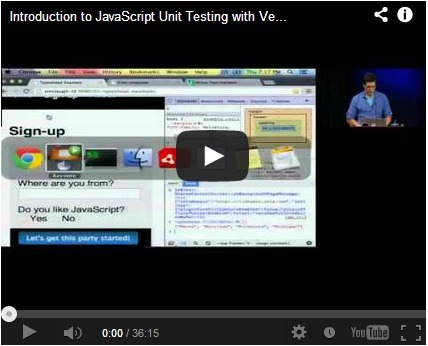
collection of code snippets Venus.js in an open source software testing tool developed by LinkedIn that allows you to organize and run your entire JS testing system with a single tool using Node.js. Venus eliminates repetitive tasks and friction points and lets you focus on writing tests instead of running them.
From
www
This tutorial will teach you the basics of building an ASP.NET MVC 5 Web application using Visual Studio Express 2013 Preview for Web or Visual Studio 2013 Preview. In the tutorial you run the application in Visual Studio. You can also make the application available over the Internet by deploying it to a hosting provider. Microsoft offers free web hosting for up to 10 web sites in afree Windows Azure trial account. I've been teeth-deep in Client-side Javascript frameworks over the last 4 months for Tekpub. This month is Angular, last month was Ember's turn and I gave up. It's the first time I've given up - here's why.
Jan Hesse's insight:
EmberJS compared to AngularJS and BackboneJS |
When considering whether or not to use Ember.js, some stumble because Ember Data isn’t considered production ready. This is a little unfortunate given that you can use Ember without Ember Data by communicating directly with the server via AJAX. However, for those who want want more than jQuery’s$.ajax(), here are five alternatives worth checking out as a stop gap or replacement. So the problem becomes, without Ember-Data, how to put the M in MVC? You could use plain-old Javascript objects. But Ember provides such a rich object model, coupled with live-updating templates, you'd be stupid not to take advantage of it. Fortunately, writing a very simple custom base model that plays nicely with its observer-based templates is not very difficult. In order to write your own base model, you need to understand that Ember's live-updating is not magic. It's based on always working with the same object references at all times. Therefore we make heavy use of caching via Ember.Map. Single Page Application aka SPA are the norms of the day for building HTML5 Web or Mobile Applications. They have been around for a while and lot of development is happening in various aspects of SPA. In order to begin understanding the SPA Ecosystem, we need to first understand how SPA can be broken down into various categories. The following diagram depicts that. What are web components? They are encapsulated, reusable and composable widgets for the web platform. If that sounds cool, then I urge you to check out one of the very good introductions to them that others have provided. In my opinion, they're the most exciting thing to happen in web development since HTML5. Why? Because they promise to put the power and extensibility necessary to build sophisticated widgets and applications right into core web feature set. Imagine the capabilities of libraries like Angular, Ember, and Backbone, but as a foundation of the platform, standardised across all browsers. The purpose of this page is to track progress across the various documents where web components are being specified, the polyfills that let you use them today, and their implementation in browsers that will make them a first class citizen of the web in the months and years to come. o far I have been using a WebSocket connection to push data to the client in the BirdWatch application, with mixed feelings. WebSocket communication is a separate communication protocol from HTTP, introducing new problems in the network layer, as I should soon find out. But there is an alternative: Server Sent Events (SSE). This blog post enables you to get started with JavaScript as quickly as possible – if you already know how to program. It describes the smallest subset of the language that allows you to be productive. I call that subset “Basic JavaScript” and recommend to program in it for a while, before moving on to more details and advanced topics. Learning everything at once is too confusing. The post concludes with tips for what to learn next. Marionette-Require-Boilerplate (MRB) is a simple boilerplate I created to help get Single Page Applications off the ground with a small starter project. It incorporates a number of great tools and best practices to save time in the early stages of a project. MRB integrates such cutting edge libraries as Backbone, Marionette, Require, Grunt, Jasmine, Bootstrap, and jQuery Mobile, among others. These libraries work together to help you start your project off with a rock-solid foundation, with a powerful module system, composite architecture, simple build process, and unit tests.
From
mrbool
In this article we will cover AngularJS at a glance, this article is not intended to be technically detail but to give you an overview of how powerful Angular is from the small pieces of its features. One of the lesser known yet more surprisingly powerful features of AngularJS is the way in which it allows promises to be used directly inside views. To better understand the benefits of this feature, we’ll first migrate a typical callback-style service to a promise-based interface. This codelab covers the techniques and design fundamentals required to create modern, 'lick-able' web applications. The exercises look at the fundamentals of building web applications: * Using an MVC framework By now, everyone knows about Test-Driven Development and unit testing. But are you using the testing frameworks to their fullest? In this tutorial, I’ll introduce you to some of the more advanced techniques available to you. As this tutorial will cover some advanced topics, I assume you’ve already created unit tests before and are familiar with the basics and its terminology. If not, here’s an excellent article to you get started: TDD Terminology Simplified. We’ll be using SinonJS. This is a standalone framework which provides an API for mocks, stubs, spies and more. You can use it with any testing framework of your choosing, but for this tutorial, we’ll be using BusterJS, as it ships with SinonJS built-in. Yehuda Katz recently gave a talk entitled "The Future of the Client-Side Web" in which he detailed the current challenges that web standards bodies face when trying to design APIs for web developers to use. In this talk, Yehuda also highlighted Google's recently announced Polymer Project as a good example of the right way to push the web platform forward. Polymer provides a "low enough" level API that gives web developers the power to redefine the way they write markup using the power of newer features coming to JavaScript in ES6. The specifics of the implementation aren't relevant to what I want to say here, but Yehuda does a great job covering the details at a high level in the video; I suggest you watch it if they interest you. |
Your new post is loading...