

stacktrace.js - Framework-agnostic, micro-library for getting stack traces in all web browsers.

JavaScript for Line of Business Applications
606.5K views |
+7 today

Keeping track of current JavaScript Frameworks that help design your clientside Business Logic Layers.
Curated by
Jan Hesse
 Your new post is loading...
  Scoop.it! The concept of closures exists in various programming languages. Javascript is one of such language, and anybody who spends an ample time with it would sooner or later run into situation where using closures is warranted.  Scoop.it! 
In all of JavaScript, I’m not sure there is a more maligned piece than eval(). This simple function designed to execute a string as JavaScript code has been the more source of more scrutiny and misunderstanding during the course of my career than nearly anything else. The phrase “eval() is evil” is most often attributed to Douglas Crockford. Since Douglas hasn’t put dates on most of his writings, it’s unclear whether he actually coined the term as an article in 2003 also used this phrase without mentioning him. Regardless, it has become the go-to phrase for anyone who sees eval() in code, whether or not they really understand it’s use.
Scoop.it!

This application is another proof of concept towards make a web application for graph generation with Javascript based Web Server.
Scoop.it!

This article takes a jQuery lover through some of the harder, more misunderstood, JavaScript methods, functions and more to show how native technology has caught up, how it's not as difficult as it seems and that native JavaScript is probably going to hit you like a brick in the face fairly soon - if it hasn't already. As a front-end developer I am pretty passionate about knowing my tech, and admittedly I began with jQuery and moved to learning JavaScript, I know many others have too. This article is here to talk anyone looking to dive into native JavaScript development over jQuery, and should hopefully open up some doors into the future of your coding.
Scoop.it!

I’m giving a presentation on KnockoutJS and TDD at DevTeach in Toronto on Wednesday. I’ll be doing a live code demo, which is always exciting (at least for the presenter). I thought I’d write a quick article recording the steps I go through as part of the demo. With a proper suite of unit tests in place, it’s much safer to make changes. It took me way too long to realize this, but the easiest way to make sure you have a great suite of unit tests is to practice some form of Test Driven Development (TDD) or Behavior Driven Development (BDD). Since you write the tests first in these practices, you never have to go back and try to shoe horn your code in to a test harness. Also, if you wrote the tests before the code, you wrote the tests already, so there’s no risk you’re going to skip them when the schedule gets tight.
Scoop.it!

The latest Razor View Model of ASP.Net MVC 3/MVC 4 uses considerable amount of JavaScript/JQuery. Sometimes the ActionResult returned by the Controller methods are refined further using JQuery methods before the result in the view. It’s very common when we are returning JSON formatted output from the controller method. We have various options to run the unit test on the .Net code written within controller. But sometimes it’s required to test those JavaScript/JQuery codes as well, to check the sanity of the output especially in the situation mentioned above. QUnit (http://nuget.org/packages/QUnit-MVC, a NuGet package) can help us to run such Unit Test.
Scoop.it!
From
github

frontend-dev-bookmarks - A huge list of frontend development resources I collected over time. Pull requests are welcome. Website coming soon. * Guides * Architecture * Workflow * Frameworks * CSS * Cross Browser * Cross Device * Patterns & Snippets * Typography * Services * Programming & Markup Languages * Animation * Widgets * Visualization * Validation & Forms * Transitions * Testing * Template Engines * Routing And URLs * Code Viewers & Editors * Performance * Modularity & Loaders * Package Management * WebSocket * Documentation * Windows 8 Style * Scrolling * Tables & DataGrids * Security
Scoop.it!
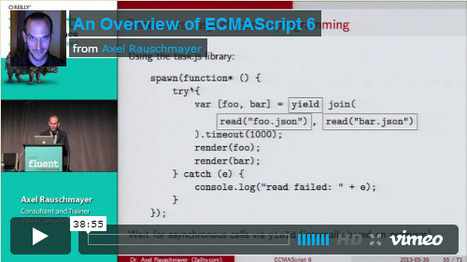
Held 2013-05-30, at Fluent Conference in San Francisco [1]. This talk gives an overview of what is most likely going to be in ECMAScript 6. ECMAScript 6 is the next version of the JavaScript language standard. Its specification will be finished by the end of 2014, but you can already use many parts of it today (how is explained in the talk).
Scoop.it!

Learn how to fully test your AngularJS application with Karma in every possible area using E2E, Unit and Midway testing
How do you setup your test environment? How should you organize your code? How do you setup a runner and how to automate the process? The bigger question is how do you usually test your JavaScript code? You may also be wondering what exactly to test in your application? What should my tests really look for? How should I write my specs? As you can see there are many questions to answer. It doesn't take much time to realize that testing JavaScript is difficult and finicky. However, if you wish to get arobust understanding of how to properly test your JavaScript code within your AngularJS application, then continue and read along... :)
Scoop.it!

JavaScript has grown from a webpage toy to being used in large-scale deployments both on the server and in the browser. This rapid growth has outpaced the growth of the language itself, which lacks features that allow teams to communicate requirements and build applications safely. This session will describe TypeScript, a modern superset of JavaScript built for the needs of modern JavaScript development. We'll explore features in the language and demonstrate how these features work together with tooling to avoid common pitfalls and enable a pleasant developer experience.
Scoop.it!

This article provides an overview of how I changed some of My Dashboard's features to use Angular instead of jQuery. After finishing the prototype work in January, we started moving bits and pieces into the main application. We kept the same file names for our Angular-related files and copied them into the project.
Scoop.it!

It’s a myth that if you use a client side MVC framework that your application’s content cannot be indexed by search engines. Search engine visibility does, however, require a little more work to implement. This is a real trade off you’ll have to consider before you decide to go with an MVC framework instead of an application that does its rendering on the server side. Before you get scared off: I’d like to point out that our search engine code was done by Sam Saffron in a day! This extra work might take you less time than you thought.
|
Scoop.it!

Software development is an art, not just a science. You can learn all the technicalities of software development, but you need to be absolutely passionate about coding and perceive it as an art to be extremely good at it. If you are one such person, I will introduce you to the journey of becoming a "Great Developer". The objective of a Great Developer, as i name him/her is to make his/her art as beautiful as possible and make it the best.
Scoop.it!

I am building a little project that lets the user keep a list of artists and albums and I needed a typeahead / autocomplete that would match on such things. My first thought was to wrap the Twitter Bootstrap typeahead in Angular. The problem is I wanted full control over the html in the typeahead. For instance I wanted little sidebars that said ‘artists’ and ‘albums’. I had no idea how to do this with the Bootstrap typeahead. Another problem is from a purely aesthetic point of view I don’t like wrapping things in Angular if the problem itself is easily solved using Angular.
Scoop.it!

Map-reduce is a programming technique to solve any aggregation-grouping-summation related problem, where we have huge amount of data and try to do the above operation in parallel in no of distributed machines. In map function/s, we will collect the frequency of data after processing on some subset of data. In reduce function/s, we will merge and aggregate the intermediate processed data from map function/s and can apply any other statistical formula on the result to make final output. So the final result from map-reduce is a form of summery of raw data in repository before processing the data with map-reduce framework.
Scoop.it!

Current post is a proof of concept towards make a web application with Javascript based Web Server. To make this possible, we have selected - 1> Angular.js for client side development – Single Page Application 2> Cross Domain Communication in between Angular.js and Node.js 3> Node.js for server side development 4> Rest based web service creation with express.js 5> Database – MongoDb 6> Node.js MongoDb Module Extention (mongojs) We have created a Proof of Concept with Javascript based web server, where we have focused on dealing with NoSql (MongoDB) with javascript based framework Node.js and angular.js on client side.
Scoop.it!

In our last post, we created a ViewModel which models the basic functionality we would like on the page. As a reminder, we have a Knockout “observable array” of items suitable for binding; each item is a JavaScript object containing a title and description in addition to a value called complete which indicates if this item has been completed. Our ViewModel function object accepts a parameter of any initial items we may need to load in to to our list from the server. We have a method called add_item which can add new items to our list, and we have a test suite that ensures that all of this is working. So far, all of this is inside a single file calledToDontListSpec.js.
Scoop.it!

weekly News - Best of JavaScript, HTML & CSS
Scoop.it!

The web is a rapidly evolving universe. An important part of our job as front-end developers is keeping up to date and staying close to new tools, trends and workflows. Hundreds of blog posts and articles are published every day, but there is no way you can read all of them. We think you should have a strategy to keep up to date, so we have created this recipe.
Scoop.it!
You may have read my other post about Async CouchDB queries with nano and promises. In that post I built a small app to track how many goals a player scored per match. Every action was stored as a single document in CouchDB. JavaScript promises were used to access the data which allowed functions be easily reused. In this article I will build the same application without any backend. I use PouchDB as my database and AngularJSas the frontend framework.
Scoop.it!

The first post in this series, Ember.js Hello World, shows Ember working without a persistence backend. This post covers setting up Rails4 as the persistence engine behind that example, plus adding and deleting records. The amount of Ember and Rails code to make this example is almost completely included in this article. It’s that tiny!
Scoop.it!

From
tech
In my previous tutorial, Ember.js Views and Live Templates with Handlebars.js Part 1, we explored the Handlebars.js template library when used with Ember.js views, the Handlebars API, the capabilities of Handlebars expressions and helpers, and how to write your own Handlebars helpers. In Part 2, you will learn more about the capabilities of the Ember view layer, and how to use ember-testing and QUnit to test your views.
Scoop.it!

Small collection of Code Snippets that might help you get into ExtJS. Best Practices Included: 1. Use customized / pre-configured components by extending existing components. 2. Do no extend a non-Ext.Component class. If an Ext class does not inherit from Ext.Component, the initComponent is never called, so the code you have written there is never executed. 3. Remember to call the parent method, unless you know exactly what you are doing: YourExtension.superclass.afterLayout.apply(this, arguments) 4. Define your own components
Scoop.it!

There's many, many different introductions to AngularJS available on the internet. This article is not another introduction, but rather a story about my learning experience. It all started way back in January of this year. I was working as a UI Architecture Consultant at Taleo/Oracle, my client for the last 21 months. My gig there ended last month, but they agreed to let me publish a series of articles about the knowledge I gained.
|




