JavaScript for Line of Business Applications
606.5K views | +0 today
JavaScript for Line of Business Applications
Keeping track of current JavaScript Frameworks that help design your clientside Business Logic Layers.
Curated by Jan Hesse
Beam to my Inbox:
Your new post is loading...

Popular Tags - Filter using the Funnel

Scoop.it!

Pipefish - Our Single Page Application development stack

Pipefish - Our Single Page Application development stack | JavaScript for Line of Business Applications | Scoop.it

On our journey through Node.js we encountered several new problems that were either not a problem or were easily solved back when we were on Ruby on Rails. But I suppose this is to be expected when moving into a platform that's the first server-side implementation of its kind. When making the decision to move to Node, we evaluated a lot of different requirements we had for building our Single Page App, namely:

No comment yet.
Scoop.it!

My favorite alternative to JavaScript's switch statement

My favorite alternative to JavaScript's switch statement | JavaScript for Line of Business Applications | Scoop.it

One of my least favorite parts of nearly every programming language I’ve spent much time with has been the ubiquitous switch statement. Though it does serve a useful purpose in some compiled languages, I think switch is a clunky eyesore in most code. Its structure is prone to taking root and only growing larger and more cumbersome over time.

No comment yet.
Scoop.it!

Using QUnit for JavaScript unit test and BlanketJS for code coverage

Using QUnit for JavaScript unit test and BlanketJS for code coverage | JavaScript for Line of Business Applications | Scoop.it

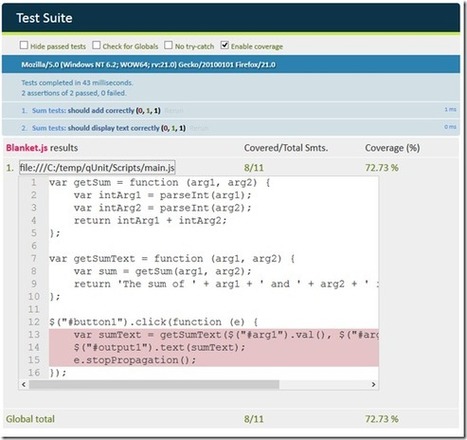
I recently started using QUnit for unit testing JS code and I’m really impressed with it. I’m sure Jasmine framework is equally good, but I picked up QUnit because none of the languages/frameworks I have learned so far have the letter ‘Q’ in them!!

So I have a simple page which is used to add two numbers and show the sum as a text.

No comment yet.
Scoop.it!

AngularJS Directive for Mobile Sliders

AngularJS Directive for Mobile Sliders | JavaScript for Line of Business Applications | Scoop.it

I ditched jQuery Mobile's sliders for my growing AngularJS poker app. It had served as the app's poker bet slider. All I wanted was a simple slider widget from jQuery Mobile, but the UI framework wanted me to marry it in return. It had its way with my HTML markup, littering my DOM elements with selfish classes and attributes, like an open garbage truck on the freeway. My CSS rules felt oppressed like liberal college students as jQuery Mobile's CSS files applied forceful rules my top-level html and body elements. The kicker? The slider quickly became deprecated, not working on newer versions of Firefox. Never even saw it work on Chrome.

No comment yet.
Scoop.it!

A better way to learn AngularJS

We love AngularJS, but it was a pain to learn, so we've picked out & enhanced the best resources for you to learn from.

Your path to learning AngularJS is broken down into required reading (parts of books & websites), videos (primarily from Egghead.io), example source code and more. If you hate it, we'll give you your entire $0 back, 1000 times over.

No comment yet.
Scoop.it!

Building Modular Web Applications: How To Build a Good Component

Angelina Fabbro's talk: Building Modular Web Applications: How To Build a Good Component at jQuery Conference Portland 2013
No comment yet.
Scoop.it!

Working with AMD modules in Knockout.js

Working with AMD modules in Knockout.js | JavaScript for Line of Business Applications | Scoop.it

After being a bit resistant at first, I have happily moved to using require.js to manage dependencies in most of the Knockout.js applications that I have written in the last year or so. With each application, I have tried a number of patterns to make it easier to work with AMD (Asynchronous Module Definition) modules. Recently, I decided to formalize some of these patterns into a lightweight plugin that makes it simple to bind against modules and pull in templates that live in external files.

No comment yet.
Scoop.it!

ExtJS 4: MVC Quick Tips

ExtJS 4:  MVC Quick Tips | JavaScript for Line of Business Applications | Scoop.it

Only recently it has reached a certain maturity thanks to bugfixes and improvements, which led to the release of the 4.2.1 version, and thanks to the integration of the official documentation, inclusive of articles and examples.

To not dwell too much on the details by which this pattern has been applied by Sencha (for those wishing to deepen highly recommend to consult the official guide), below we want to give some tips that might facilitate the transition from the classical style of client-side web application programming to this new approach.

No comment yet.
Scoop.it!

Five Patterns to Help You Tame Asynchronous JavaScript

Five Patterns to Help You Tame Asynchronous JavaScript | JavaScript for Line of Business Applications | Scoop.it

You can hardly write ten lines of JavaScript before you're confronted with asynchronous behavior. In this post we're going to look at 5 patterns that can help you tame the beast - or at least keep it at bay. It would be nearly impossible to cover each pattern in depth in this post alone, but my aim is to provide enough information to get you started, with an additional reading section at the end.

Let me emphasize here that none of these patterns are onlyasynchronous. In fact, all of them work well in synchronous contexts also.

No comment yet.
Scoop.it!

AngularJS: Creating / managing content dynamically from external resources

AngularJS: Creating / managing content dynamically from external resources | JavaScript for Line of Business Applications | Scoop.it

Managing content created dynamically is something that has always interested me. These days I’m working in a really interesting project where I need to develop something like a “web content player”, so I don’t know what content I’m going to work with in the player.

I thought on it a bit more, and I decided to develop the app with AngularJS, because I love it but also because I think Angular’s templating system fits perfectly with this project’s needs. So I started coding to see what I could do…

No comment yet.
Scoop.it!

Experimenting with Ember.js & ShareJS, part II

Experimenting with Ember.js & ShareJS, part II | JavaScript for Line of Business Applications | Scoop.it

ShareJS is a nice looking chunk of code. The library uses a pattern called Operational Transforms to share changes to a document (or data structure) over a web connection. Combined with Ember’s data bindings, it isn’t difficult to brainstorm up some fun app ideas.

For a first experiment, all I want to achieve is creating a text field that has persists it’s changes to a server and updates when another user is editing. A basic, classic use of ShareJS.


No comment yet.
Scoop.it!

WebGLStudio - 3D modelling in the Browser

WebGLStudio - 3D modelling in the Browser | JavaScript for Line of Business Applications | Scoop.it

Today I have presented in front of an audience for the very fist time the work I’ve been doing for that last year and a half. It is a 3D editor entirely made for the web, using my own 3D rendering engine. It is called WebGLStudio.

No comment yet.
Scoop.it!

Form Validation: The AngularJS Way

Form Validation: The AngularJS Way | JavaScript for Line of Business Applications | Scoop.it

In this post I will show how perform client side data validation with AngularJS. I will use both built-in directives, both custom directives.

AngularJS has many directives to run form validation. The following are only those usable on a classic input field...

Some of these (like required, pattern, etc.) repeat the behaviour of the new HTML5 attributes. The advantage of using AngularJS directives instead of classic HTML5 attributes, is that AngularJS way allows to mantain the two way data binding between model and view.

No comment yet.
Scoop.it!

Learn Node.js - Code School

Learn Node.js - Code School | JavaScript for Line of Business Applications | Scoop.it
Learn Node.js and start building lightweight, real-time applications. Our interactive course will teach you the fast and scalable perks of Node.js.
No comment yet.
Scoop.it!

A popup directive for your AngularJS project

A popup directive for your AngularJS project | JavaScript for Line of Business Applications | Scoop.it

If you are working on an AngularJS project definitely you have written at least on directive in the application. As you know directives are those components of project in which DOM manipulation has the main role. One of these components in a web application can be aPopup that open by user interaction to show or collect extra information without changing the whole page.

No comment yet.
Scoop.it!

Levelling Up With AngularJS: Building a Reusable Click to Edit Directive

Levelling Up With AngularJS: Building a Reusable Click to Edit Directive | JavaScript for Line of Business Applications | Scoop.it

If you’ve sprinkled Angular into your apps at all, you’ve already worked with its built-in directives, things like ng-model, ng-repeat and even ng-controller and ng-app. With a directive you can add hooks into the HTML markup for injecting your own custom markup and logic. As the AngularJS documentation puts it, “directives are a way to teach HTML new tricks.” They help you keep your markup declarative and intention-revealing, and your implementation packaged away in a self-contained, reusable components.

No comment yet.
Scoop.it!

AngularJS Fundamentals in 60 Minutes - Modules, Routes and Factories

One of the challenges associated with learning AngularJS is understanding how all of the different pieces fit together. What's a module and how do you use it to work with controllers, factories, services and more? In this video you'll learn about the role of modules and see how they can be used to define routes, create controllers and define factories and services.

No comment yet.
Scoop.it!

AngularJS Tutorial - AngularJS in 30 minutes

AngularJS Tutorial - AngularJS in 30 minutes | JavaScript for Line of Business Applications | Scoop.it
This AngularJS tutorial will teach you all the basics in 30 minutes allowing you to create rich angularjs applications. Learn AngularJS quick!
No comment yet.
Scoop.it!

KnockoutJs Data binding in SharePoint 2013 with jQuery, SPServices and DataJs

KnockoutJs Data binding in SharePoint 2013 with jQuery, SPServices and DataJs | JavaScript for Line of Business Applications | Scoop.it
In this article we can see how to bind the SharePoint 2013 List Items retrieved via popular Java script frameworks like jQuery, SPServices , DataJs with KnockoutJs.
No comment yet.
Scoop.it!

Sails.js | Realtime MVC Framework for Node.js

Sails.js | Realtime MVC Framework for Node.js | JavaScript for Line of Business Applications | Scoop.it

Sails.js make it easy to build custom, enterprise-grade Node.js apps. It is designed to mimic the MVC pattern of frameworks like Ruby on Rails, but with support for the requirements of modern apps: data-driven APIs with scalable, service-oriented architecture. It's especially good for building chat, realtime dashboards, or multiplayer games.

No comment yet.
Scoop.it!

Intermediate Ember Controller Concepts

Intermediate Ember Controller Concepts | JavaScript for Line of Business Applications | Scoop.it

I’ve been finding issues in an Ember application I’m working on where the author (me) didn’t fully grasp Ember controllers. Here are a few controller concepts I’ve learned.
In this example I’m going to show a list of items and let the user select one at a time. This is a pretty common use case where controllers shine.

First we’ll setup a route with some dummy data and render a list of names.

No comment yet.
Scoop.it!

AngularJS calculator application tutorial

AngularJS calculator application tutorial | JavaScript for Line of Business Applications | Scoop.it

With this calculator tutorial you will see how two-way databinding works in AngularJS.

A few days ago I was talking with Marcos about the benefits and he started playing with AngularJS writing a very simple calculator application. I really liked that example because, it’s simple and it shows the power of AngularJS. So I decided to complete a little bit the example and explain how it works for those that are looking to a simple application.

No comment yet.
Scoop.it!

Modular Javascript using Require.js

Modular Javascript using Require.js | JavaScript for Line of Business Applications | Scoop.it

A look at creating well structured modular javascript using AMD library Require.js

I don't know how many of you use lots of javascript libraries, but we found ourselves using quite a lot within certain projects. One of the strange issues that came about from linking JavaScript files was that we occassionally ran into dependency issues, where by a particular JavaScript source file would have a dependency on another JavaScript source file that was not loaded (and therefor not available) yet.

As luck would have it there is an excellent library for dealing with interlinked JavaScript dependencies and module loading which is called : RequireJs

No comment yet.
Scoop.it!

Create and Deploy an Ember App in 5 Minutes

The ember-rails gem is a great way to get started with Ember.js in a Rails project. Another approach is to create and serve an Ember app on a static webpage, totally decoupled from the backend environment. It would be great to have some of the modern front-end development tools we get with something like Rails in a static web environment. A great project to consider for this is Middleman.

No comment yet.
Scoop.it!

Integrating Ext JS with 3rd Party Libraries

Integrating Ext JS with 3rd Party Libraries | JavaScript for Line of Business Applications | Scoop.it

Sometimes you might want to use a 3rd party library that is not built using the Ext JS component system. There are a number of ways you can address this situation, but the easiest one is to create a custom wrapper component to handle your library, which can be reused across any of your apps.

The goal of your wrapper component is to encapsulate the logic required by the 3rd party library to set itself up and interact with the Ext JS framework. You have the freedom over how much of that 3rd party API is available to use in your application. There are a few options for how you handle this.

No comment yet.