I would like to take this opportunity to explain a few pitfalls that arise when in development with Sencha. This article is designed to help develop Sencha applications faster and more robust.
Your new post is loading...
I would like to take this opportunity to explain a few pitfalls that arise when in development with Sencha. This article is designed to help develop Sencha applications faster and more robust. No comment yet.
Sign up to comment

From
ozan
P is a small JavaScript library for creating peer-to-peer applications in browsers. It allows for transitive connections across peers which makes certain network topologies, such mesh networks, easy to establish. Specifically, with P you can: * Establish connections to other browsers using a WebSocket server. * Establish connections to other browsers using connections you've established to other browsers. After a connection is established the middleman is no longer nescessary – no proxies are involved.
Sencha Ext JS is maybe the only JavaScript framework that can be used well to build large applications that run in a web browser. Ext JS is based on Ajax communication with a server backend. We use mainly the CodeIgniter PHP framework, but any other PHP backend can be used. The frontend is used for user interaction, where the backend is used for handling the processes of communicating with the database or retrieving data from web services that offer API’s. The this keyword in JavaScript is notorious for confusing JavaScript developers. This article aims to elucidate this in its entirety. The goal: by the time we make it through this article, this will be one part of JavaScript we will never have to worry about ever again, in any scenario, for we will understand how to use this completely and in every scenario. Via Skipper Abel
From
blackbe
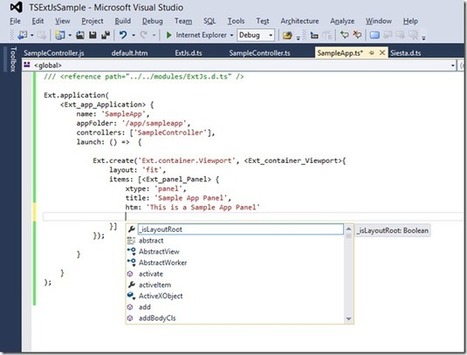
The Problem Ember.js has a limited set of user definable attributes that can be passed in to their form controls by default. Below you will find a list of supported attributes for each form element control: ... Some of the things missing include file upload attributes and the newer HTML5 form attributes which are becoming a necessity for mobile compatible websites: accept autocomplete autofocus name required Ember-testing is a recent addition to the Ember.js framework that allows you to create integration tests for your app using a custom DSL for interacting with your async Ember.js app. We’re going to walk through how to write integration tests with ember-testing using the qunit-rails gem. We have came through D3.js coding for Graph generation in our projects. To me personally, this coding is somewhat complex for startup programmers. Recently I am going through learning Angular.js and Angular Directive. So I had a thought to introduce an angular directive which will wrap the complex functionality of D3.js. So here is the result – this post – creating a bar chart through Angular Directive with the help of D3.js. This was the first time we pair programmed on Ember.js. We started building a list of recipes, a single recipe page and started showing comments for each recipe. Since the release of TypeScript there has been an explosion of JavaScript libraries that have had TypeScript definition files written for them. Kudos to Mike Aubury (zz9pa) who has been able to use jsduck to reverse-engineer an ExtJs definition file from the ExtJs documentation, and load the project into his github repository ( extjsTypescript ). For the purpose of this blog, I have had to modify Mike’s ExtJs.d.ts file generation slightly, just to mark each property and function as optional. Read on to find out why. JavaScript MVC frameworks are booming, but this post may change your mind about them. Before I explain to you the ten very good reasons to stop using JavaScript, I will first list a few popular JavaScript MVC frameworks:...
Bartley's comment,
July 5, 2013 9:36 AM
this is NOT a good article, more an example of how not to write an article: it has no real basis in fact as to what it asserts - ref. comments at the end of the article.
Elasticsearch and AngularJS are two great technologies with a lot of momentum. This post will explore how they can be combined to create data driven Web applications that provide a responsive and fluid user experience. In my last article, I introduced Firebase and presented too simple demos, a poll and a chat application, integrated to a Python based Plone CMS website. To continue, I would like to show the details on how this works. This time, prepare for a longer reading, or ...
From
github
AngularJS-Learning - A bunch of links to blog posts, articles, videos, etc for learning AngularJS
Jan Hesse's insight:
books, videos, directives, post, tutorials ... you name it |
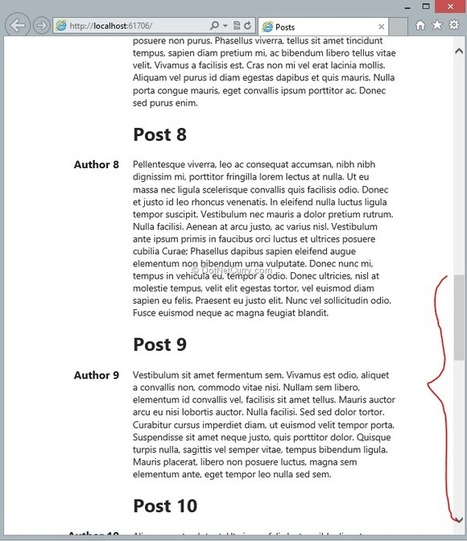
Voodoo is a new Javascript library based on WebGL and ThreeJS that lets you create reusable 3D objects to be positioned seamlessly on 2D webpages. It’s designed to be both simple for developers and simple for designers. I can imagine one day having an ecosystem of 3D controls, 3D page themes, 3D data visualizations, and 3D advertisements — all easily dropped onto existing 2D pages and just as natural to use. That’s the vision. RequireJS is great, and if you are using or planning on using RequireJS for managing JavaScript then you’ll really notice the benefits. However one of the trickier parts of RequireJS greatness is finding a way to organise JavaScript modules across multiple pages and on a more granular level, multiple HTML modules on those pages. This post won’t be an intro to what AMD modules are, or even a RequireJS tutorial, as a basic understanding of AMD and RequireJS is assumed but I will break some of the concepts down where necessary. Single-page JavaScript web apps seem to be all the rage right now. I don’t think I’ve gone more than a day or two without seeing another blog debating the merits of Backbone, Knockout, Ember, Angular, and the myriad other client-side frameworks. For me, it started with jQuery Mobile. This was my first taste of paging within a single DOM, requesting only data from the server. Unfortunately, jQuery Mobile isn’t something that is meant to be used on all devices from mobile to desktop. My friend Dave (@geddski) and I presented this at FluentConf 2013. We wanted to present on three subjects that we love. Chromeapps (which should be the default platform for teams who are building "Native" apps), AngularJS (the most powerful of clientside JavaScript frameworks), and Nodejs (our backend server of choice). This time we "tried" adding a comment to a recipe. We mean "tried" because sadly we didn't succeed, but we'll get there! People keep asking these questions and probably there is a good reason for it. Humans hate choices. If there are resources out there which help them make these choices easier, they like it. So, if you havent already tried the two frameworks, here are some comparisons / differences betwen the two. AngularJS directives allow you to create custom reusable components. In this AngularJS Directives Tutorial, we cover how to create a simple ratings widget. TypeScript and Backbone are a great fit in terms of writing simple, Object-Oriented code using JavaScript. The simplicity of Backbone, coupled with the TypeScript generated closure syntax allow one to simply use the TypeScript extends keyword to derive from any of Backbone’s base classes – and start implementing functionality immediately. This is a very natural way to write Object-Oriented JavaScript: ... The infinite scroll pattern is simply a different kind of pagination. In this article, we will see how to implement an infinite scroll using ASP.NET WebAPI, KnockoutJS and jQuery he most common requirement for a line of business application is to represent data in pages. Usually this involves showing data in a grid and showing a navigate pane with either page numbers or Next/Previous button (or both) to navigate to multiple pages. This works fine in most cases. I thought it might be worthwhile to create an ExtJS version of the Todo list which uses the same Grails back-end* as Joe’s app. This way, we (and you) can compare and contrast the two approaches. I’m also throwing CoffeeScript into the mix because…well, because I use CoffeeScript for just about everything I do nowadays. A set of AngularJS directives that provide common visualizations based on D3 Dangle provides directives that allow you to create visualizations of your data. You can easily bind the result of queries to HTMLelements. When the results update, your visualizations will also update. You can build powerful, interactive applications with just a few lines of HTML. An interesting way for building responsive web apps quickly FireBase is a cloud database service, that allows developers to "power real time collaborative applications". What does this mean for you? It means that with FireBase you can easily build applications that allow users to interact via your website. FireBase provides your front-end with persistent and shared real-time data out of the box, letting you focus on your application itself. Developing applications with FireBase can be refreshingly easy, as I will try do demonstrate in this article. I will show this in combination with the AngularJS MVC framework, on an existing Plone CMS back-end. |
Your new post is loading...