JavaScript for Line of Business Applications
606.5K views | +2 today
JavaScript for Line of Business Applications
Keeping track of current JavaScript Frameworks that help design your clientside Business Logic Layers.
Curated by Jan Hesse
Beam to my Inbox:
Your new post is loading...

Popular Tags - Filter using the Funnel

Scoop.it!

Tweak.js - Component driven MVC

Tweak.js - Component driven MVC | JavaScript for Line of Business Applications | Scoop.it

Tweak.js is a MVC framework built to help developers' structure code; for use in web applications and web components. Tweak.js is also accompanied with extra features that advances typical MVC concepts.

Tweak.js is not another backbone.js or anything as big as Ember. It's designed to be slap bang in the middle. It offers simple improvements over backbone.js and is way simpler compared to the massive MVC frameworks. It keeps in mind that not all applications are data driven, and when they are you don’t want to be told how to retrieve, monitor, and send that data; that should be down to you.

No comment yet.
Scoop.it!

AngularJS For Everyone - YouTube Playlist

#0 Series Introduction - AngularJS For Everyone
#1 Two-way Data Binding - AngularJS For Everyone
#2 Repeating Over Data With ng-repeat - AngularJS For Everyone
#3 Basic Filtering In Angular - AngularJS For Everyone
#4 Our First Controller - Angular For Everyone
#5 Adding A Form Event - Angular For Everyone
#6 Controller As Syntax - AngularJS For Everyone
#7 Using Filters In Angular Templates - AngularJS For Everyone
#8 Conditional Classes With ngClass - AngularJS For Everyone
#9 ngIf vs ngShow & ngHide - AngularJS For Everyone
#10 Properly Including Images With ngSrc - AngularJS For Everyone
#11 Including Templates and Inline SVG with ngInclude - AngularJS For Everyone
#12 Adding External Modules - AngularJS For Everyone
#13 Animating With Angular Part 1 - AngularJS For Everyone

No comment yet.
Scoop.it!

Getting started with Vue.js: AngularJS perspective

Getting started with Vue.js: AngularJS perspective | JavaScript for Line of Business Applications | Scoop.it

Writing Vue.js applications after working with AngularJS will feel familiar. Vue won't pack as many goodies out of the box, but it will still give Angular a run for its money.

No comment yet.
Scoop.it!

Production ready apps with ionic framework

Production ready apps with ionic framework | JavaScript for Line of Business Applications | Scoop.it

Complete guide to prepare your ionic app for production. Uglify, minify and obfuscate your app and many other tips to protect your code.


For all the previous task we are going to use a mixture between gulp tasks andcordova hooks . Gulp tasks will be “running” all the time after you run ionic serve. Cordova hooks will run each time you build or run your project with ionic build ios [android] or ionic run android [ios]

No comment yet.
Scoop.it!

Using JSON Web Tokens to Authenticate JavaScript Front-Ends on Rails

Using JSON Web Tokens to Authenticate JavaScript Front-Ends on Rails | JavaScript for Line of Business Applications | Scoop.it

Since those dark times, a few tools have cropped up and improved the landscape. As I mentioned before, I have recently been working on a project that I wanted to have a stand-alone front-end app for (inb4 single page apps don't work). I wanted to avoid the messes I've encountered with JavaScript-heavy Rails apps and keep Rails as API-centered as possible. Once I had a functioning back-end, I knocked together a rudimentary front-end with React using Bower to manage dependencies and Jekyll to compile it all down to a static page.

No comment yet.
Scoop.it!

A cookbook for using Webpack with React JS

A cookbook for using Webpack with React JS | JavaScript for Line of Business Applications | Scoop.it

Recipes for solving common Webpack problems.

The purpose of this cookbook is to guide you into the world of React and Webpack. Both are powerful technologies and when used together, frontend development becomes a joy.

The cookbook should have something to offer for all skill levels. If you are interested in just React, skip the Webpack part and vice versa.

No comment yet.
Scoop.it!

Faster Mobile Websites

As mobile device usage continues to grow, developers need to ensure that their mobile websites are fast and offer a high quality experience for all users. A fast mobile website can be the difference between winning or losing a customer. A few seconds delay in your page load time and you might find that users to your site easily become frustrated and navigate away to another site...or even worse, your competitors site!

Developers understand the need for fast, smooth websites - but how do you apply this to a mobile website and the vast amount of mobile devices out there? This talk is aimed at all developers that build websites and will dive into basic and advanced web performance techniques - there is something for everyone! The talk also covers free tools that developers can use to test and profile the performance of their mobile websites.

This talk will cover a variety of performance related issues specifically aimed at mobile websites and the techniques that developers can use to overcome them and will include:

- Mobile Network Overhead
- Critical Path Rendering
- Basic web performance techniques
- Responsive images
- Performance build automation
- Mobile Website profiling and debugging tools
- A step by step website optimization

No comment yet.
Scoop.it!

Creating an Isomorphic Web Application with ReactJS and Express

In our fast-changing world, technology is rapidly taking giant leaps forward. For the people who are just beginning to take part in this new “gold rush” of web development, it is sometimes inevitable to feel a sense of desperation of not being able to keep up with the evolution. In this article, I will attempt to give a brief overview of one of the most-adored features of Facebook’s Reactframework—isomorphism(a.k.a. server side rendering).

No comment yet.
Scoop.it!

Idiomatic React aims to be the simplest API-centric Flux app

Idiomatic React aims to be the simplest API-centric Flux app | JavaScript for Line of Business Applications | Scoop.it

It's complemented by Idiomatic React Chat (on the branch chat of this repository), implementing Facebook's Flux Chat app.

Features
  • Routing, with stateful navigation bar
  • ES6/ES7 transpilation to ES5, allowing ES6 constructs and ES7 await/async in the code
  • REST API adapter to I/O data, bufferring in stores
  • Immutable stores
Motive

Considering the frequent mutation of technology happening on the React scene, we believe developers might feel the need for a simple, idiomatic app reflecting the current state of the technology and techniques, be it for bootstrapping awesome apps, or simply to improve their skills.

This project aims to be simple and idiomatic. We're not there yet, and we rely heavily on contributors (on you !) to make this happen.

No comment yet.
Scoop.it!

The state of web components

The state of web components | JavaScript for Line of Business Applications | Scoop.it
  • Web Components are ambitious
  • Standards are hard
  • All vendors are on-board
  • We're near the end
No comment yet.
Scoop.it!

Why Backbone.js?

As front-end application development matures, more and more people find themselves reaching for a special-purpose library to structure their codebase. The web abounds with choices – look no further than TodoMVC.com for proof of that. While pluralism serves the open source ecosystem well, any given application should only commit to a single framework. During Roost, we build a web application from the ground up. This forced us to make the same (sometimes very personal) decision while designing the content. We chose Backbone.js; in this post, I’d like to discuss why.

No comment yet.
Scoop.it!

november-cli - Generate a Node.js API for your Ember.js app

november-cli - Generate a Node.js API for your Ember.js app | JavaScript for Line of Business Applications | Scoop.it

November helps you generate a simple Node.js API tailored for Ember.js apps, with the help of Express and Sequelize.

No comment yet.
Scoop.it!

Using the Page Object Pattern With Ember CLI

Using the Page Object Pattern With Ember CLI | JavaScript for Line of Business Applications | Scoop.it

One of the most appealing features in Ember and Ember CLI is the ability to easily create functional or acceptance tests. But, the everyday interaction between UX and development, can hurt how these tests are maintained. Here, I try to describe an approach that helped us overcome this problem.

No comment yet.
Scoop.it!

Angular Expressions

Angular Expressions | JavaScript for Line of Business Applications | Scoop.it

One of the first things a developer writes in Angular, other than the ng-app directive, is an expression. This is easily identified as the code written inside of a binding {{ }} or directive.

<input type="text" ng-model="name" />
{{'Hello ' + name + '!'}}

In this example, 'Hello ' + name + '!' is the expression. 

No comment yet.
Scoop.it!

First Look at Angular2

First Look at Angular2 | JavaScript for Line of Business Applications | Scoop.it

Better? Worst? More simple? complex? Lets look at a first application created with a first draft version of Angular2 + Firebase and its change detection.

Im not going to post any opinion. It is too early in the game. NG-CONF is around the block and it IS going to be Angular2 centric.

No comment yet.
Scoop.it!

WebPack For Visual Studio Developers -

WebPack For Visual Studio Developers - | JavaScript for Line of Business Applications | Scoop.it
Burke Holland explains how the WebPack module loader let's you load any asset - CommonJS or AMD, JavaScript or CSS - and how to use it with Visual Studio.

WebPack calls itself a “Module Bundler”. We tend to think of modules in terms of JavaScript, but WebPack thinks of them in terms of any assets that you might want to transpile, minify and pipe to the browser. JavaScript, TypeScript, CoffeeScript, CSS, SASS, images – it doesn’t matter to WebPack. But this is not the reason why I love it. The reason why WebPack is my tool of choice, is that it bridges the gap between AMD and CommonJS.

No comment yet.
Scoop.it!

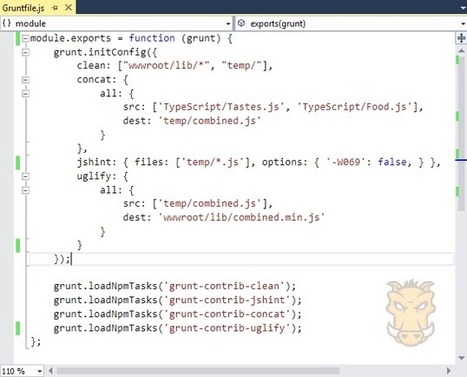
Grunt and Gulp: Task Runners in Asp.Net 5

Grunt and Gulp: Task Runners in Asp.Net 5 | JavaScript for Line of Business Applications | Scoop.it

What’s the difference between Gulp and Grunt? While Gulp is a later entry to the field, it has gained popularity for crisp performance and elegant syntax. Unlike Grunt, which tends to read and write files to disk, Gulp uses a stream (Vinyl) object to pipe method results to following methods, allowing calls to be chained together in a fluent syntax. Grunt is an earlier entry in the client-build-tool space. Grunt modules predefine most everyday tasks like linting, minimizing, and unit testing, and Grunt is widely adopted and downloaded thousands of times each day.

No comment yet.
Scoop.it!

An overview of Javascript reactive frameworks

An overview of Javascript reactive frameworks | JavaScript for Line of Business Applications | Scoop.it

This post is only meant to be a snapshot of the current state of the various DOM virtualising webframeworks that are around. I’m partly publishing it to try and discover more that I may not be aware of.

No comment yet.
Scoop.it!

Mobile App Framework Matrix - Build iOS/Android apps in JavaScript

Mobile App Framework Matrix - Build iOS/Android apps in JavaScript | JavaScript for Line of Business Applications | Scoop.it
The Mobile App Framework Matrix represents a comparison and documentation of technologies for building iOS/Android apps with a single JavaScript code base.
No comment yet.
Scoop.it!

Native Mobile Apps in JavaScript with Tabris.js

Native Mobile Apps in JavaScript with Tabris.js | JavaScript for Line of Business Applications | Scoop.it

Today I want to highlight the rather new and unknown JavaScript framework Tabris.js.

In contrast to many other hybrid frameworks, Tabris.js is no HTML5 + WebView framework, but still offers the possibility to use Javascript libraries, npm modules and Cordova plugins! I will show you the strengths, we will develop a simple app to get a feeling for the code structure and finally inspect the similarities and differences to other well known frameworks.

Sounds good? Let’s take a closer look!

No comment yet.
Scoop.it!

JSX Looks Like An Abomination

JSX Looks Like An Abomination - JavaScript Scene - Medium

JSX expressions evaluate to ReactElements. Think of them as shorthand for calling `React.createElement()`. Babel has built-in support for JSX.

Let’s break this down:

JavaScript Expressions

You can embed JavaScript expressions in JSX using syntax that will be familiar to any handlebars user, e.g. `style = { displayStyle }` assigns the value of the JavaScript variable `displayStyle` to the element’s `style` attribute.

Styles

You can set styles by assigning an ordinary JavaScript object to the `style`attribute. You don’t use CSS syntax. Instead, you use the similar JS object literal format.

Events

There’s a set of event handlers that you hook up in a way that should look very familiar to anybody who knows HTML.

No comment yet.
Scoop.it!

Learn React with chantastic

Learn React with chantastic | JavaScript for Line of Business Applications | Scoop.it
3ish minute videos on React
No comment yet.
Scoop.it!

True Hash Maps in JavaScript

True Hash Maps in JavaScript | JavaScript for Line of Business Applications | Scoop.it

Using an object literal as a simple means to storing key-value pairs is common place within JavaScript. However, an object literal is not a true hash map and therefore poses potential liabilities if used in the wrong manner. While JavaScript may not offer native hash maps (at least not cross-browser), there is a superior alternative to object literals to capture the desired functionality without the pitfalls.

No comment yet.
Scoop.it!

Backbone.js Tutorial

Backbone.js Tutorial | JavaScript for Line of Business Applications | Scoop.it
Learn Backbone.js and start building sophisticated and structured web apps. Try out Backbone’s JavaScript library with a RESTful JSON interface.
No comment yet.
Scoop.it!

Ember.js: An Antidote To Your Hype Fatigue

Ember.js: An Antidote To Your Hype Fatigue | JavaScript for Line of Business Applications | Scoop.it

If you are a person with a lot of free time and curiosity, this is an excellent time to be a front-end developer. If you are running a consulting agency, this might even be good for business. Unfortunately, if you have a real job and a product to maintain, then these new developments doesn’t really benefit you that much unless you rewrite your project using the latest framework every three months. Worse, even if you managed to resist the temptation to do that, you will keep hearing people around you raving about their shiny new toys, making you feel inferior about the way you approach your project.

That, my friend, is what hype does to you.

Jan Hesse's insight:

Follow Up:

https://medium.com/@RobertTheGrey/the-future-of-the-javascript-front-end-framework-bc329d2af600

No comment yet.