The Inside Story. What Internal Communicators in every organization need to know: tools, resources, how-to's, issues, strategies, and plans. Find me on Twitter @kzinke
Using two devices (two screens) in the workplace will become common place. Read the full article to find out more on these examples of how this 'double vision' could enhance employee communications:
I think the inclusion of the multimedia/transmedia components are the elements that excite me most. It will bring together all the communications, developed for different reasons and audiences, under one umbrella.
Most of the organizations are good at attracting talent and some even have a great interview and the new hire induction program, but they go wrong on their employee retention model. Here is what we can do to retain the best talent. Read the full article to find out more about these communication tips:
In my experience this is a step that many companies forget about. Information is often provided for new or departing employees, but is lacking for those in between. Other items to consider are creating mentorship opportunities and knowledge sharing.
The average employee might know where each departments sits, but when it comes to what each person does… no chance.
You can produce quick and easy content for your intranet by approaching people around the business and asking them to explain their job. You need questions that come at their job from a surprising or unusual angle. Try:
- How would you explain your job to a 9 year-old?
- Who do you talk to the most in your line of work?
- What aspect of your work do you think about at home?
"Yammer is an internal social network for enterprises. If you are trying to introduce Yammer in your organization or make a case to senior management of its usefulness, then this illustrated guide is for you."
Today’s digital age is changing the way we communicate with our employees—instead of talking at them, we can talk with them. Shifting from one-way to open communication can strengthen internal relations and help break the departmental and geographical boundaries within a company.
What should we share? Of course, not everything within a business should be up for public sharing and discussion. Obviously, information pertaining to benefits and retirement, private personnel matters, salary, and performance reviews should be communicated privately and securely with employees via corporate email, an intranet, private social network, internal blog or at a staff meeting.
Read the full article to find out more about:
- other ways to use social media in order to connect and share with your current and prospective employees
It takes people to staff a successful internal communications function. William Amurgis takes us through the roles communicators need to play to carry it out based on these three underlying assumptions:
1) No longer can we afford to (only) cascade messages down from the top
2) As much as I might prefer face-to-face or print communication, those methods are too inefficient, costly, and slow for any organization above a certain size and geographic scope
3) Even though I advocate a future where everyone is a communicator, communications professionals still have a pivotal role to play
All these roles should be represented in some capacity:
An interesting view of the future roles communicators will take. I've always believed to be a communicator, you need to be a jack-of-all-trades. But at some point we can't cover all the ground necessary nor do we have the skills to carry out all the functions. Like Amurgis, I believe the communications department should be lean. The comms people should be providing guidance and showing others how to best communicate rather than being the doers. And they should have access to people who can provide services like web development and graphics.
“We need to really engage with our employees – it's a priority! But there's no budget allotted.”
This obstacle is so universal I won’t bother with any further introductions. Let’s just get to some potential practical solutions that don’t involve revising the current political system, solving unemployment or finding a solution to the ongoing Fiscal Cliff crisis shall we?
Read the full article to find out more about these solutions: - Double duty
- Plan ahead
- Cost vs efficiency
- Reasons to consider a “video replacement” strategy - Reuse and recycle
"A podcast is a multimedia file distributed by subscription over the Internet using syndication feeds and played back on a personal computer or mobile device. A podcast can be an audio or video file. For now, let’s stick to audio. It’s important to point out that for many internal podcasts, whether they’re produced at corporations, nonprofits or governments, a feed may not be used, and listeners are instead encouraged to stream the audio using their desktop or laptop computer at the office.
Why should communicators care about podcasts? The human touch of audio makes podcasting an engaging communications tool that can augment traditional face-to-face, print and online media for company news, investor relations, marketing, product announcements, employee recruitment, training and more.
That’s why such organizations as Disney, IBM, Oracle, Microsoft, Whirlpool and others have produced podcasts that inform employees, educate the public and reinforce their brands."
Read the full article to find out more about:
- How to use a podcast internally
- How do organizations benefit from an internal podcast?
- How do you measure success? - How is a podcast made? - So what are you waiting for? - A few ideas for internal podcasts
- Recommended communications podcasts for internal communicators
I am a big fan of podcasts. While we have produced a regular video recording of executives in a state-of-the nation chat, we've never tried producing a formal podcast in-house. An audio podcast is a great idea for staff who are on the road, but I'm not sure how well it would be received where staff are working on the front line or sitting at desks in close proximity to one another. I'd certainly like to give it a try and find out.
A review and data-findings from the webinar put together by Melcrum and Newsweaver titled, "Measuring and benchmarking internal communications."
Channels you use as part of your IC strategy
#1 - email
#2 - intranet
#3 - leadership communication F2F
Tools communicators plan to use
#1 - social networking
#2 - blogs
#3 - webcasts
Channels most effective as part of an IC strategy
(author questions if this is time spent on these channels or effectiveness)
#1 - intranet
#2 - email
#3 - F2F
The use of newsletters is declining. But a format showcased from Aon Hewitt is using a format that could be used in various channels. They use an icon-based system for signaling to employees not just the urgency of the content but who the audience is for that content. If employees trust the level of prioritization, it could work across multiple platforms.
As for benchmarking, the average open rate for internal emails is 52%. But is that good? If you get a 55% open rate then you are doing better than the average, but it still means that close to half the company isn't reading the communication you are sending.
I believe that benchmarks are required. Without them, we don't know what is working or not. Determining what an acceptable level is important. You will never achieve 100%. This does emphasize the need to use multiple channels and formatting information appropriately for each - as each channel has the potential of attracting a different audience.
Companies are just spending more and more money on the critical task of getting their employees to know, believe and understand their business and its objectives. Yet after many years of using the same approach, there was clearly something wrong with the recipes being applied.
If the communications techniques are not giving us the results we want, then we need to question the message. Very often, the message does not really make sense. Read the full article to find out about some common message errors and communication tactics that ARE working.
You will also find out more about these useful guidelines from author and business consultant Steve Nicholls for implementing successful internal communications, especially when it comes to using social media and the Internet: 1. Create a common language
2. Understand your company culture
3. Create internal social networks
4. Information sharing
5. Encourage employee participation
6. Collect intelligence
7. Mobile technology and online project management tools
8. Don't forget the risks
9. Have a solid social media policy
10. Do not go enthusiastically in the wrong direction
Gamification only really took off around 2010 and since then, the geeks of the gaming industry and the marketing buzzword wizards have taken it to a whole new level.
So what is gamification? Previously known as game mechanics, gamification is the use of game, loyalty and economic concepts in order to engage and reward individuals, solve problems and boost learning.
Doubters think it sounds like a new way to waste time, but supporters claim it can help organisations accelerate digital transformation projects by engaging, rewarding and motivating employees and customers.
But all that said, what does it mean for the Internal Communications industry? Towards the end of last year, the internal comms industry started to get bitten by the gamification bug and departments around the country started to ask whether it was right for them – and with good reason. With companies like Accenture, who released an excellent report on their experiences with gamification, and Google adopting the technique to drive loyalty and employee engagement, other companies are wanting in. The idea of gamification does offer us a creative and innovative way to bolster loyalty, foster collaboration and secure engagement and it is not something that should just be seen as a digital led tool but one that could be used offline as well.
But before you jump on the bandwagon ask yourself if it really is the right solution for your organisation. Gamification has been around for a long time and people are only sitting up and paying attention now that it has become a buzzword.
Definitely some good food for thought in this article. I'm of the thought it's another tool that can be added to our toolkit. I can see it being used as an educational tool or as a way to keep "score' in friendly cross-company competitions.
The links to the report from Accenture and the article about Google are worthwhile checking out.
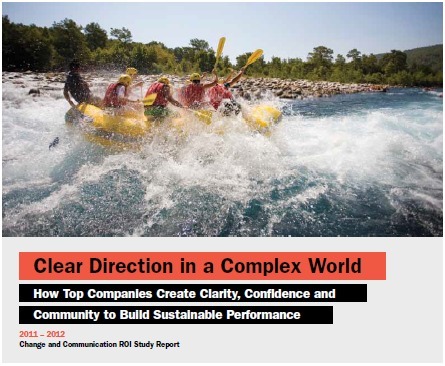
The 2011 – 2012 Change and Communication ROI Study Report sheds new light on the pivotal role that effective change and communication processes play in global organizations today. This year's findings reveal that the way companies handle employee communication is fundamentally changing, largely due to increased expectations, diversity and globalization, as well as the growth of social media and networking. The most effective change and communication organizations do the hard work of creating clear, relevant and measurable programs that drive results and create a sense of shared purpose.
Does your organisation distribute long service awards to people who’ve worked there for a certain number of years?
Then, get in touch with a short questionnaire that they can fill out in a few minutes. You can snag some fun intranet content, and give the employee a nice write-up to commemorate their employment milestone. Try asking questions like:
- What are your 3 favourite memories of working here?
- How has the company changed since you joined?
- What were your first impressions of the company?
- What’s been the most challenging period of your time here?
- If you travel back in time and give yourself a piece of advice on your first day, what would it be?
Wonderful and highly inspirational video. Reminds us all to strive for authentic and purposful communication. So chose your words wisely. They are extremely powerful.
A favourite video of mine. I've watched it many a time when I need a reminder that what I do as a communicator is important. For a interesting tidbit on the back story to this video, read Karen Dietz's March 12 comment below.
I'm sharing this courtesy of Karen Dietz and Ken Mikkelson - which only proves how worthwhile it is to check out what other people are discovering and writing about on the web. Karen's take is that of a storyteller -business person. Mine is as an artist; where communication is essential and has the potential to be equally compelling. How can we as artists strive for authentic and purposeful communication?
I will hazard a guess that compelling artwork begins in my head as an idea, migrates down through my chakras/system to my heart, where it engages me emotionally, and then lifts unstoppably into my Will - or throat - where it manifests as a proclamation of what I intend to make next.Perhaps that part is sometimes a silent proclamation, but when it happens I know it.
Does your Artist Self recognize this chain of events in you? If not, pay closer attention next time an idea arises and see where it leads.
Thanks to Karen and Ken for a big lift to my afternoon!
One of the key roles of Internal Communications is to provide advice and expertise on how to position messages to employees. When a business has negative news to communicate this may impact on engagement and moral.
It is important when communicating negative news you follow a set formula – that will sometimes include challenging business leaders on the range of factors that will influence your message.
Read the full article to find out more about these 5 steps when developing a negative communication:
Another way to access Ragan Communications (www.ragan.com) articles. Ragan delivers practical advice, real-world solutions and field-tested strategies for today's corporate communicator.
When it comes to communications teams, the employee communications function is often at the low end of the totem pole. To work in employee communications is often to be in a junior role, away from the important stuff and disconnected from where the real action takes place.
More and more, employee communications and engagement is being recognized as a critical function. It is not only vital to any successful communications or marketing campaign; it is also fundamental to organizational performance.
Read the full article to find out more about these best practices for employee communications and engagement:
"For my business, blogging has been an excellent lead generator, website optimiser and credibility builder. But it’s also helped us make management more accessible to employees and communicate important company information to everyone on the team."
Three ways the author has used employee blogs:
- Each employee had to contribute a minimum of one post a month, in which they had to learn about an element of B2B social media, and share their experiences with blog readers.
- She wrote a 10,000 word training guide that she broke down into 20 blog posts and released them every weekday for a month.
- Department heads are required to contribute weekly posts on how they run their departments and why our service is delivered in the way that it is.
I like the way employee's were encouraged to be the bloggers. On a multi-author blog, it's easy to mix in the personal experiences with the training or more corporate ones.
Even in the digital age, employee newsletters, whether they are still printed on paper (for employees without email access) or available as intranet content, continue to be valuable internal communications tools. If you’re challenged to revamp an existing newsletter or create a new one, here are some general rules for content in today’s business environment:
- Align with the Business Strategy
- Don’t Lose Sight of People
- Celebrate Successes
- Tell Them How You’re Really Doing
- Showcase Your Corporate Social Responsibility Efforts
I think the Elizabeth hit it on the head when she said "communicating holistically to employees about the business and the people." People need to see themselves in the stories and how they fit in. But it can be a fine balancing act.
Videos, quizzes, news, and interest groups are a few of the most popular features on internal sites. Makes sure yours is populated with these features.
The more ability the employee has to engage with the system on their own, the better the chance they will participate. Networks that require vetting first puts up an added barrier.
To get content containing either thought or leadership enter:
To get content containing both thought and leadership enter:
To get content containing the expression thought leadership enter:
You can enter several keywords and you can refine them whenever you want. Our suggestion engine uses more signals but entering a few keywords here will rapidly give you great content to curate.


 Your new post is loading...
























I think the inclusion of the multimedia/transmedia components are the elements that excite me most. It will bring together all the communications, developed for different reasons and audiences, under one umbrella.