The Inside Story. What Internal Communicators in every organization need to know: tools, resources, how-to's, issues, strategies, and plans. Find me on Twitter @kzinke
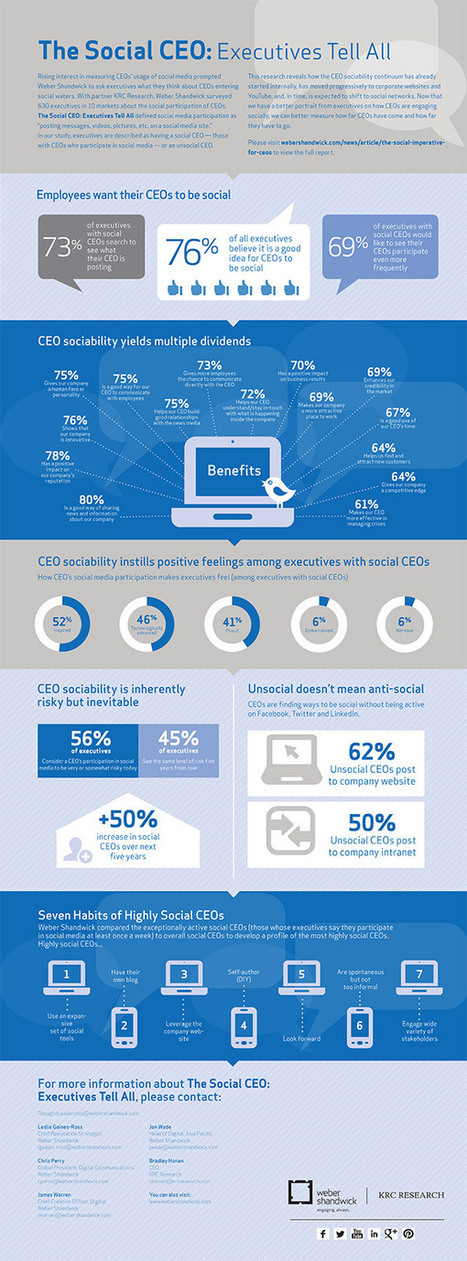
A new study found that the majority of global executives (76%) believe that it is a good idea for CEOs to actively participate in social media. These executives recognize a multitude of returns when CEOs are social, including improved company reputation, business results and employee engagement. These findings, from global public relations firm Weber Shandwick and research partner KRC Research, demonstrate that social media is quickly becoming a critical leadership tool.
Social media use on the part of CEOs is essential because it allows them to narrate their company news. Whether it’s on the company website, blog, or on their own personal social media channels, the very act of telling the story empowers them to exert a high degree of influence over the discussion surrounding their company, both internally and externally, as well as engage with employees and the general public.
Highlights of the study revolve around:
- CEO sociability yields multiple dividends – internally and externally
- Unsocial doesn't mean anti-social - Resistance to CEO sociability starts with the CEO - Sector and regional variations
They were also able to determine the seven habits of highly social CEOs: 1. use a more expansive set of social tools
2. own a blog
3. leverage the company website
4. self-author
5. are forward-looking
6. are spontaneous yet not too informal
7. engage a wider variety of external stakeholders
Read the full article to view the infographic and watch videos discussing key themes in the study.
I am not surprised by these findings especially about the most resistance come from the CEOs themselves. The more engaged the CEOs or executive are, the more engaged employees will be. This is a great report to have in hand if you're trying to convince your executive to become more social.
"Make it easier for your audiences to digest your messages and engage directly by turning to ‘infographics’.
Infographics are increasingly becoming a tool to simplify information and share stories not just on social media vehicles but also internally within organizations."
Read the full article to find out more about the steps that will make creating your own infographic fast and easy:
Infographics are a great option for simplifying complicated information - including data, processes, and information. There are many online tools that can help you produce your own - to find out more visit http://pinterest.com/thatissome/infographics-data-visualizations/
This ongoing series from Candidio will provide you with a new Production Brief (a purpose, interview questions and even BRoll ideas) to help keep those creative juices flowing and keep your Audience connected to your organization through video.
Coming up with new video ideas is one of the biggest challenges that comes with maintaining a consistent, successful online video plan. Candidio has produced a number of brief videos, each providing a new idea and how to put it together.
The above links to their YouTube page. You can also access posts that are related to each video with the production brief from the video written out. You can access the posts from their archive at http://candidio.com/blog/category/a-video-you-can-do/.
Case study of Glasgow Housing Association's Think Yes campaign. The objective of Think Yes was to raise customer satisfaction levels by asking staff to think positively when faced with a customer request.
This campaign changed the culture of how staff solve problems for customers, leading to a real improvement in engagement and customer satisfaction.
"This is the first survey in a series that looks into how companies are building community within their organizations: creating a sense that employees and leaders are in it together, sharing both the challenges and rewards of working."
"Despite the explosion of social media in the personal lives of many people, a new survey by global professional services company Towers Watson shows that just over half of employers are using social media tools to communicate and build community with employees. Further, among those employers that have embraced social media technology, there is little consensus as to which ones are most effective."
"CIPR Inside launched the Internal Communication Measurement Matrix to make it easier for internal communication professionals to measure their work and the impact that it has. We hope it helps professionals to demonstrate the value of their work in internal communication, measure success and inform their practice."
Whether it’s an internal memo, a universal email to the staff or a letter to the troops that that you have written on behalf of a C-level executive, internal communications can spell the difference between whether your employees are on board with a new program or event, for example, or simply confused by the message and don’t know what to do with it.
Read the full article to find out more about these tips:
- Don’t write in corporate-speak
- Keep it short and sweet
- Don’t bog down the memo, email, etc. with statistics from a spreadsheet
- Try and infuse written communications with a little humor
- Give employees the opportunity to chime in on the contents of the memo and how well it was received
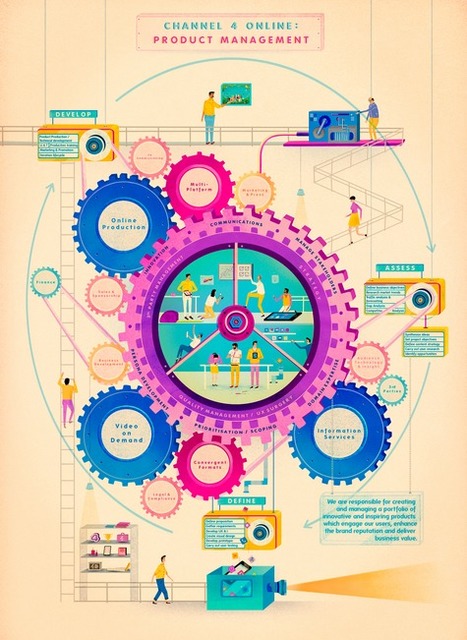
It’s not a secret that design has become a strategic weapon for external communications. Whether it’s an easy-to-use website or an engaging ad campaign, companies of all sizes understand that design can differentiate and create loyal customers. When it comes to employee communications, fewer examples of stand-out design tend to surface. What if your internal communications efforts were so beautifully designed that they were worth sharing externally?
Read the full article to see two examples of:
- Channel 4's infographic showing how the company works
There is tremendous value in beautifully visual items. It captures the eye and draws the reader in. That's half the battle. Now you have to make it worth their while.
For more information, and a bigger picture, of Channel 4's infographic (and a second infographic) read this article by Fast Co. Design
A manager's guide to communicating with employees. This guide provides very practical suggestions to help you decide how best to communicate with staff in different situations.
This is my all time favourite internal communications guide Doesn't hurt that it's Canadian. It's well laid out and provides some very easy to understand and implement advice. The quick guide sums up the the whole document. And the plain language section is worthy of note. An impressive guide for a provincial government to put together and support.
Internal communications can make or break a company's culture. Give your team the tools they need to ensure strong and effective communications within your organization.
Read the full article to find out more on these actionable steps for improving internal communication:
Integrating internal comms in the planning of leadership visits is smart. It helps keep your company's message on track and focused. And these visits provide a wealth of materials to share, so the ability to do pre-planning for video, photos, interviews, etc will only make your job easier in the end.
People read less than you think. According to a Nielsen study, people tend to read only 20 percent of a text longer than 100 words. For the record, it takes about 25 seconds for the average reader to read 100 words.
A few seconds, that’s the attention span for your message. If, and this is very important too, your title and opening paragraph catches the reader’s interest.
I also believe that a shorter message and/or visuals is the way of the future. It does make you really work hard to create a clear, concise message. I will miss, just a little, some of the fluff.
"Think Eurovision, Europe’s annual song contest, and you’re probably thinking sequins, white suits and some questionable songs. But interestingly, the Eurovision Song Contest represents one of the world’s most popular and longest-running internal engagement activities.
Eurovision helped European nations build stronger connections after war, and offers these lessons for organisations that are looking to heighten internal operational efficiencies and unity:
BASF started work on a corporate online business platform as early as 2008. Five years later, over 35,000 employees are using connect.BASF to build up their internal network, share knowledge and collaborate more efficiently across units.
For an online business network to create true value for an organization, there are multiple steps that need to be taken. Read the full article to find out more about their road to a successful enterprise social network:
This study features in-depth interviews with senior communications officers from 10 leading global companies - Cargill, Chevron, FedEx, GE, IBM, Johnson & Johnson, McDonald's, Navistar, Petrobras and Toyota.
The research says it's imperative for heads of employee communications to deeply understand their companies' business objectives.
Business leaders should also expect employee communications programs to involve direct supervisors, who remain the most trusted source for employees, according to the research. One best-in-class company equates efficient employee messaging to providing the entire leadership team "with what they need to be disciples of communication in their own individual areas."
In addition, employee communicators should be responsible for fostering a collaborative and engaged corporate community aligned by shared purpose. As one global communications leader said, "You need to help your employees understand how they fit and why they matter. It comes down to their level of engagement at the end of the day."
"Employee communication is changing rapidly as new social media tools evolve and impact the workplace. Employees and other internal audiences are key ambassadors and reaching them today is both challenging and rewarding when done right. Navigate the world of workplace communication and employee engagement including internal communications planning, best practices, tips and resources."
A great visual of what people are using and when. We're definitely a connected world. This showcases how many times there is an opportunity to capture their attention.
Examples of communication materials produced for marketing campaigns for these corporations - Intel (2), Accenture (28), Bharati AXA (63), Al Raffah Hospital DMG (92).
A key reason to implement Employee Generated Videos (EGV) is to engage employees and improve internal communications. EGV can be used to relay information to employees, by using how-to videos, online presentations and webinars or even video diaries.
There are a lot of mixed thoughts about EGV in the business world, executives are often put off using it for fear their employees will upload “irresponsible content”. According to a study last year by Qumu, 51% of executives are concerned about this yet 100% of respondents have never actually experienced any inappropriate video being uploaded to the company network.
Read the full article to find out more on:
- Using internal video to enhance employee engagement
- Sharing knowledge with video in the workplace
- What if employees upload inappropriate content?
- Making sure Employee Generated Video is right for your company
Funny how the fear about staff putting up inappropriate content is a fear with all organizations. You have to trust staff.
I thought the example of Pfizer providing 10 employees with a camera and tripod and asking them to record video diaries of their experiences as the company changes took effect was brilliant. I can think of a few recent change management experiences that could have benefitted from this format.
Positive internal communication can create a stronger sales force and happier employees. Read the full article to find out more about these six ways small businesses can improve communication among employees:
What’s the best way of creating an internal communications strategy where one has never existed?
This article examines seven key areas to take into consideration when devising a plan for a business that is introducing internal communication for the first time, and recommends research and books to help you.
This article outlines the steps for a comprehensive communications audit that can help organizations focus time, energy and resources on the communications methods and tools most likely to reach and engage employees during times of change. Such an audit may also be used for other types of communications campaigns as well.
Read the full article to find out more about these communications audit steps:
- Inventory everything that's fit to print
- Explore all forms of formal electronic communications
- Look at informal communication channels
- Assess the perceived credibility and usefulness of communications channels through employee interviews
- Identify and interview likely influencers of change
- Factor in geographical dispersion of your targeted audiences
- Complete your communications matrix of the "as-is" state
Written nearly 1.5 years ago, these points are still valid. In my experience #5 is always high on the list of wants. So as long as that remains true, we need to provide a format specifically for the supervisors. It should be easily digestible and point to additional information and resources. If you can keep that information in a central area and make it searchable, you'll have a winner on your hands.
To get content containing either thought or leadership enter:
To get content containing both thought and leadership enter:
To get content containing the expression thought leadership enter:
You can enter several keywords and you can refine them whenever you want. Our suggestion engine uses more signals but entering a few keywords here will rapidly give you great content to curate.


 Your new post is loading...
















I am not surprised by these findings especially about the most resistance come from the CEOs themselves. The more engaged the CEOs or executive are, the more engaged employees will be. This is a great report to have in hand if you're trying to convince your executive to become more social.
You can view the full study at http://www.webershandwick.com/uploads/news/files/Social-CEO-Study.pdf
I was very interested in the section on the top 5 benefits of each engagement platform.