Immunology
199.4K views | +15 today
Immunology
Teaching and Learning Immunology. Information you never would have searched for!
Your new post is loading...
Scooped by Gilbert C FAURE
May 21, 2020 8:22 AM
Scoop.it!

COVID-19: the vasculature unleashed

COVID-19: the vasculature unleashed | Immunology | Scoop.it
On the basis of emerging evidence from patients with COVID-19, we postulate that endothelial cells are essential contributors to the initiation and propagation of severe COVID-19. Here, we discuss current insights into the link between endothelial cells, viral infection and inflammatory changes and propose novel therapeutic strategies. Here, Carmeliet and colleagues discuss the role of endothelial cells in inflammation and viral infection and propose novel therapeutic strategies for COVID-19.
No comment yet.
Scooped by Gilbert C FAURE
May 18, 2020 10:27 AM
Scoop.it!

The Prime Cellular Targets for the Novel Coronavirus –

The Prime Cellular Targets for the Novel Coronavirus – | Immunology | Scoop.it
There’s still a lot to learn about SARS-CoV-2, the novel coronavirus that causes COVID-19. But it has been remarkable and gratifying to watch researchers from around the world pull together and share their time, expertise, and hard-earned data in the urgent quest to control this devastating virus.
No comment yet.
Scooped by Gilbert C FAURE
May 15, 2020 2:54 AM
Scoop.it!

https://www.cell.com/action/showPdf?pii=S0092-8674%2820%2930610-3 T cells and Covid-19 

T cells and Covid-19 at last

Société Francaise d'Immunologie's comment, June 4, 2020 8:37 AM
Summary
Understanding adaptive immunity to SARS-CoV-2 is important for vaccine development, interpreting coronavirus disease 2019 (COVID-19) pathogenesis, and calibration of pandemic control measures. Using HLA class I and II predicted peptide “megapools,” circulating SARS-CoV-2-specific CD8+ and CD4+ T cells were identified in ∼70% and 100% of COVID-19 convalescent patients, respectively. CD4+ T cell responses to spike, the main target of most vaccine efforts, were robust and correlated with the magnitude of the anti-SARS-CoV-2 IgG and IgA titers. The M, spike, and N proteins each accounted for 11%–27% of the total CD4+ response, with additional responses commonly targeting nsp3, nsp4, ORF3a, and ORF8, among others. For CD8+ T cells, spike and M were recognized, with at least eight SARS-CoV-2 ORFs targeted. Importantly, we detected SARS-CoV-2-reactive CD4+ T cells in ∼40%–60% of unexposed individuals, suggesting cross-reactive T cell recognition between circu
Scooped by Gilbert C FAURE
May 10, 2020 4:39 AM
Scoop.it!

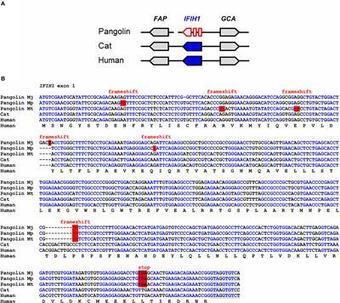
Frontiers | Pangolins Lack IFIH1/MDA5, a Cytoplasmic RNA Sensor That Initiates Innate Immune Defense Upon Coronavirus Infection | Immunology

Frontiers | Pangolins Lack IFIH1/MDA5, a Cytoplasmic RNA Sensor That Initiates Innate Immune Defense Upon Coronavirus Infection | Immunology | Immunology | Scoop.it
Zoonotic infections are an imminent threat to human health. Pangolins were recently identified as carriers and intermediate hosts of coronaviruses. Previous research has shown that infection with coronaviruses activates an innate immune response upon sensing of viral RNA by interferon-induced with helicase C domain 1 (IFIH1), also known as MDA5. Here, we performed a comparative genomics study of RNA sensor genes in three species of pangolins. DDX58/RIG-I, a sensor of cytoplasmic viral RNA and toll-like receptors (TLR) 3, 7, and 8, which bind RNA in endosomes, are conserved in pangolins. By contrast, IFIH1 a sensor of intracellular double-stranded RNA, has been inactivated by mutations in pangolins. Likewise, Z-DNA-binding protein (ZBP1), which senses both Z-DNA and Z-RNA, has been lost during the evolution of pangolins. These results suggest that the innate immune response to viruses differs significantly between pangolins and other mammals, including humans. We put forward the hypothesis that loss of IFIH1 and ZBP1 provided an evolutionary advantage by reducing inflammation-induced damage to host tissues and thereby contributed to a switch from resistance to tolerance of viral infections in pangolins.
No comment yet.
Scooped by Gilbert C FAURE
April 30, 2020 2:19 PM
Scoop.it!

The trinity of COVID-19: immunity, inflammation and intervention

The trinity of COVID-19: immunity, inflammation and intervention | Immunology | Scoop.it
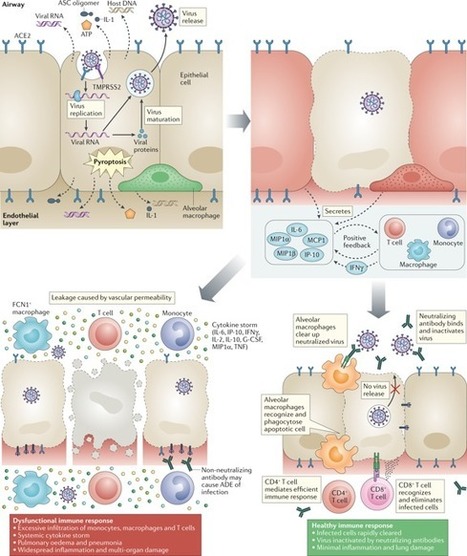
Severe acute respiratory syndrome coronavirus 2 (SARS-CoV-2) is the causative agent of the ongoing coronavirus disease 2019 (COVID-19) pandemic. Alongside investigations into the virology of SARS-CoV-2, understanding the fundamental physiological and immunological processes underlying the clinical manifestations of COVID-19 is vital for the identification and rational design of effective therapies. Here, we provide an overview of the pathophysiology of SARS-CoV-2 infection. We describe the interaction of SARS-CoV-2 with the immune system and the subsequent contribution of dysfunctional immune responses to disease progression. From nascent reports describing SARS-CoV-2, we make inferences on the basis of the parallel pathophysiological and immunological features of the other human coronaviruses targeting the lower respiratory tract — severe acute respiratory syndrome coronavirus (SARS-CoV) and Middle East respiratory syndrome coronavirus (MERS-CoV). Finally, we highlight the implications of these approaches for potential therapeutic interventions that target viral infection and/or immunoregulation. In the short time since SARS-CoV-2 infections emerged in humans, much has been learned about the immunological processes that underlie the clinical manifestation of COVID-19. Here, the authors provide an overview of the pathophysiology of SARS-CoV-2 infection and discuss potential therapeutic approaches.
No comment yet.
Suggested by LIGHTING
April 26, 2020 4:23 AM
Scoop.it!

Higher levels of NETs in blood associated with more severe COVID-19

Higher levels of NETs in blood associated with more severe COVID-19 | Immunology | Scoop.it
New research finds a connection between destructive white blood cells and a more severe disease course in patients with COVID-19.
No comment yet.
Scooped by Gilbert C FAURE
May 29, 2015 8:21 AM
Scoop.it!

The TOP 10% information you need!


The scoops deal with published (classical or OPEN) and grey literature (blogs, websites, social networks, press releases) allowing rapid access to recently published relevant information


May 29, 2015 you were 26796 visitors, viewing this topic 34.5K times., 4900 scoops

May 2025: >8.2K scoops, >98.2 visitors,  >177,8 views

Gilbert C FAURE's insight:

This topic is focusing mainly on fundamental systemic immunology.


Some subjects are particularly adressed, according to my personal interests in research or teaching, for instance

Lymph node 

https://www.scoop.it/topic/immunology?q=lymph+node

200 selected posts on Covid 

https://www.scoop.it/topic/immunology?q=covid

Use the search engine (filters) on top right with #tags or simply natural language


Feel free to browse other related topics!

Mucosal Immunity:

 http://www.scoop.it/t/mucosal-immunity

Immunology and Biotherapies

http://www.scoop.it/t/immunology-and-biotherapies

Autoimmunity

http://www.scoop.it/t/autoimmunity

Allergy and clinical immunology:

http://www.scoop.it/t/allergy-and-clinical-immunology

History of Immunology

http://www.scoop.it/t/history-of-immunology

and more recently

Fake News and Vaccinations

https://www.scoop.it/topic/assim-actualites


Kaupang's comment, October 8, 2021 9:31 AM
nice
wynndental's comment, January 25, 2023 1:44 AM
super
MortonDonaldson's comment, February 20, 2024 11:54 PM
good
Scooped by Gilbert C FAURE
May 19, 2020 9:03 AM
Scoop.it!

Glycans are crucial for the response to SARS CoV-2 infection - GlycanAge

Glycans play an important role in the course of SARS-CoV-2 infection and should not be overlooked when searching for ways to understand and control this new disease. Glycans might become a great biomarker tool to predict disease severity, response to therapy and recovery prognosis.
No comment yet.
Scooped by Gilbert C FAURE
May 15, 2020 2:34 PM
Scoop.it!

T cells found in COVID-19 patients ‘bode well’ for long-term immunity

T cells found in COVID-19 patients ‘bode well’ for long-term immunity | Immunology | Scoop.it
New findings suggest past infections may offer some protection against the novel coronavirus
No comment yet.
Rescooped by Gilbert C FAURE from Top Selling Monoclonal Antibodies
May 13, 2020 6:20 AM
Scoop.it!

Potent neutralizing antibodies from COVID-19 patients define multiple targets of vulnerability | bioRxiv

Potent neutralizing antibodies from COVID-19 patients define multiple targets of vulnerability | bioRxiv | Immunology | Scoop.it
Abstract
The rapid spread of SARS-CoV-2 has a significant impact on global health, travel and economy. Therefore, preventative and therapeutic measures are urgently needed. Here, we isolated neutralizing antibodies from convalescent COVID-19 patients using a SARS-CoV-2 stabilized prefusion spike protein. Several of these antibodies were able to potently inhibit live SARS-CoV-2 infection at concentrations as low as 0.007 μg/mL, making them the most potent human SARS-CoV-2 antibodies described to date. Mapping studies revealed that the SARS-CoV-2 spike protein contained multiple distinct antigenic sites, including several receptor-binding domain (RBD) epitopes as well as previously undefined non-RBD epitopes. In addition to providing guidance for vaccine design, these mAbs are promising candidates for treatment and prevention of COVID-19.

Competing Interest Statement
Amsterdam UMC has filed a patent application on COVID-19 monoclonal antibodies.

Paper in collection COVID-19 SARS-CoV-2 preprints from medRxiv and bioRxiv

Via Krishan Maggon
No comment yet.
Scooped by Gilbert C FAURE
May 8, 2020 3:45 AM
Scoop.it!

https://www.jacionline.org/action/showPdf?pii=S0091-6749%2820%2930578-9

IFN type I and Covid-19

No comment yet.
Scooped by Gilbert C FAURE
April 28, 2020 1:49 PM
Scoop.it!

The trinity of COVID-19: immunity, inflammation and intervention | Nature Reviews Immunology

Severe acute respiratory syndrome coronavirus 2 (SARS-CoV-2) is the causative agent of the ongoing coronavirus disease 2019 (COVID-19) pandemic. Alongside investigations into the virology of SARS-CoV-2, understanding the fundamental physiological and immunological processes underlying the clinical manifestations of COVID-19 is vital for the identification and rational design of effective therapies. Here, we provide an overview of the pathophysiology of SARS-CoV-2 infection. We describe the interaction of SARS-CoV-2 with the immune system and the subsequent contribution of dysfunctional immune responses to disease progression. From nascent reports describing SARS-CoV-2, we make inferences on the basis of the parallel pathophysiological and immunological features of the other human coronaviruses targeting the lower respiratory tract — severe acute respiratory syndrome coronavirus (SARS-CoV) and Middle East respiratory syndrome coronavirus (MERS-CoV). Finally, we highlight the implications of these approaches for potential therapeutic interventions that target viral infection and/or immunoregulation. In the short time since SARS-CoV-2 infections emerged in humans, much has been learned about the immunological processes that underlie the clinical manifestation of COVID-19. Here, the authors provide an overview of the pathophysiology of SARS-CoV-2 infection and discuss potential therapeutic approaches.
No comment yet.
Scooped by Gilbert C FAURE
April 3, 2020 1:44 PM
Scoop.it!

JCI - Clinical and immunologic features in severe and moderate Coronavirus Disease 2019

No comment yet.