Via Krishan Maggon
|
|
Rescooped by
Gilbert C FAURE
from Top Selling Monoclonal Antibodies
May 3, 2016 5:03 AM
|
Your new post is loading...
No comment yet.
Sign up to comment
|
Société Francaise d'Immunologie's curator insight,
October 5, 2015 6:02 AM
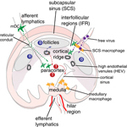
CD169 siglec Dendritic cells can capture and transfer retroviruses in vitro across synaptic cell-cell contacts to uninfected cells, a process called trans-infection. Whether trans-infection contributes to retroviral spread in vivo remains unknown. Here, we visualize how retroviruses disseminate in secondary lymphoid tissues of living mice. We demonstrate that murine leukemia virus (MLV) and human immunodeficiency virus (HIV) are first captured by sinus-lining macrophages. CD169/Siglec-1, an I-type lectin that recognizes gangliosides, captures the virus. MLV-laden macrophages then form long-lived synaptic contacts to trans-infect B-1 cells. Infected B-1 cells subsequently migrate into the lymph node to spread the infection through virological synapses. Robust infection in lymph nodes and spleen requires CD169, suggesting that a combination of fluid-based movement followed by CD169-dependent trans-infection can contribute to viral spread.
Krishan Maggon 's curator insight,

February 13, 2015 8:08 AM
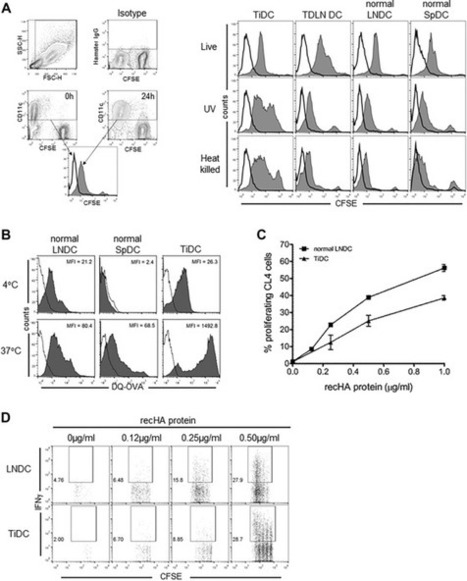
Tumor-infiltrating dendritic cells exhibit defective cross-presentation of tumor antigens, but is reversed by chemotherapy
Volume 45, Issue 1
Gilbert C FAURE's curator insight,
September 24, 2014 9:48 AM
plus We also elucidate a carbohydrate-recognition pathway that targets B cells to intestinal lymphoid tissues, defining CD22 as a lectin-homing receptor for mucosal HEVs. |