We previously generated artificial lymph node-like tertiary lymphoid organs (artTLOs) in mice using lymphotoxin α-expressing stromal cells. Here, we show the construction of transplantable and functional artTLOs by applying soluble factors trapped in slow-releasing gels in the absence of lymphoid tissue organizer- (LTo) stromal cells. The resultant artTLOs were easily removable, transplantable, and were capable of attracting memory B and T cells. Importantly, artTLOs induced a powerful antigen-specific secondary immune response, which was particularly pronounced in immune-compromised hosts. Synthesis of functionally stable immune tissues/organs like those described here may be a first step to eventually develop immune system-based therapeutics. Although much needs to be learned from the precise mechanisms of action, they may offer ways in the future to reestablish immune functions to overcome hitherto untreatable diseases including severe infection, cancer, autoimmune diseases, and various forms of immune deficiencies including immune-senescence during aging.
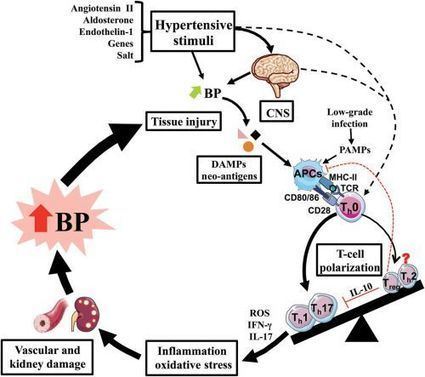
Pathophysiology in Hypertension: Opposing Roles of Human Adaptive Immunity Reporter: Aviva Lev-Ari, PhD, RN T regulatory lymphocytes counteract hypertensive effects by suppressing innate and adaptive immune responses and T effector lymphocytes promote...
Summary IgG4, the least represented human IgG subclass in serum, is an intriguing antibody with unique biological properties, such as the ability to undergo Fab-arm exchange and limit immune complex formation. The lack of effector functions, such as antibody-dependent cell-mediated cytotoxicity and complement-dependent cytotoxicity, is desirable for therapeutic purposes. IgG4 plays a protective role in allergy by acting as a blocking antibody, and inhibiting mast cell degranulation, but a deleterious role in malignant melanoma, by impeding IgG1-mediated anti-tumor immunity. These findings highlight the importance of understanding the interaction between IgG4 and Fcγ receptors. Despite a wealth of structural information for the IgG1 subclass, including complexes with Fcγ receptors, and structures for intact antibodies, high-resolution crystal structures were not reported for IgG4-Fc until recently. Here, we highlight some of the biological properties of human IgG4, and review the recent crystal structures of IgG4-Fc. We discuss the unexpected conformations adopted by functionally important Cγ2 domain loops, and speculate about potential implications for the interaction between IgG4 and FcγRs.
Dengue is caused by infection with any of the four dengue virus serotypes. This PrimeView highlights the mechanisms underlying the clinical course of a dengue infection, which can range from mild febrile illness through to haemorrhagic fever and circulatory shock.
Using cellular barcoding to resolve developmental changes in lineage potential, Kristiansen and colleagues show that fetal liver definitive hematopoietic stem cells (HSCs) initially give rise to both B-1a and B-2 cells, but gradually lose B-1a potential. Their findings provide insight into the origin of B-1a B cells and anchor B-1a cell output to HSC regenerative potential.
T cell antigen receptor δ (Tcrd) variable region exons are assembled by RAG-initiated V(D)J recombination events in developing γδ thymocytes. Here, we use linear amplification–mediated high-throughput genome-wide translocation sequencing (LAM-HTGTS) to map hundreds of thousands of RAG-initiated Tcrd D segment (Trdd1 and Trdd2) rearrangements in CD4−CD8− double-negative thymocyte progenitors differentiated in vitro from bone marrow–derived hematopoietic stem cells. We find that Trdd2 joins directly to Trdv, Trdd1, and Trdj segments, whereas Trdd1 joining is ordered with joining to Trdd2, a prerequisite for further rearrangement. We also find frequent, previously unappreciated, Trdd1 and Trdd2 rearrangements that inactivate Tcrd, including sequential rearrangements from V(D)J recombination signal sequence fusions. Moreover, we find dozens of RAG off-target sequences that are generated via RAG tracking both upstream and downstream from the Trdd2 recombination center across the Tcrd loop domain that is bounded by the upstream INT1-2 and downstream TEA elements. Disruption of the upstream INT1-2 boundary of this loop domain allows spreading of RAG on- and off-target activity to the proximal Trdv domain and, correspondingly, shifts the Tcrd V(D)J recombination landscape by leading to predominant V(D)J joining to a proximal Trdv3 pseudogene that lies just upstream of the normal boundary.
The online version of Mechanisms of Ageing and Development at ScienceDirect.com, the world's leading platform for high quality peer-reviewed full-text journals.
Adenosine deaminase (ADA) deficiency is best known as a form of severe combined immunodeficiency (SCID) which results from mutations in the gene encoding adenosine deaminase. Affected patients present with clinical and immunological manifestations typical of a severe combined immunodeficiency. Therapies are currently available that can that target these immunological disturbances and treated patients show varying degrees of clinical improvement. However, there is now a growing body of evidence that deficiency of ADA has significant impact on non-immunological organ systems. This review will outline the impact of ADA deficiency on various organ systems, starting with the well understood immunological abnormalities. We will discuss possible pathogenic mechanisms and also highlight ways in which current treatments could be improved. In doing so, we aim to present ADA deficiency as more than an immunodeficiency and suggest that it should be recognized as a systemic metabolic disorder that affects multiple organ systems. Only by fully understanding ADA deficiency and its manifestations in all organ systems can we aim to deliver therapies that will correct all the clinical consequences.
20 BEST UNIVERSITIES FOR IMMUNOLOGY #20. London School of Hygiene & Tropical Medicine - Country: United Kingdom - Acceptance Rate: N/A The London School o
Recent data suggest that NETosis plays a crucial role in the innate immune response and disturbs the homeostasis of the immune system. NETosis is a form of neutrophil-specific cell death characterized by the release of large web-like structures referred to as neutrophil extracellular traps (NETs). NETs are composed of DNA strands associated with histones and decorated with about 20 different proteins including neutrophil elastase (NE), myeloperoxidase (MPO), cathepsin G, proteinase 3 (PR3), high mobility group protein B1 (HMGB1), and LL37. Reportedly, NETosis can be induced by several microbes, and particulate matter including sterile stimuli, via distinct cellular mechanisms. Meanwhile, suicidal NETosis and vital NETosis are controversial. As we enter the second decade of research on NETosis, we have partly understood NETs as double-edged swords of innate immunity. In this review we will discuss the mechanisms of NETosis, its antimicrobial action and role in autoimmune diseases, as well as the relatively new field of NET-associated mitochondrial DNA.
T regulatory (Treg) cells play important roles in the resolution of inflammation. Pan and colleagues show that, in turn, inflammatory cues induce the expression of miR-17, which targets transcriptional co-regulators that act in concert with Foxp3 to diminish the suppressive activity of Treg cells.
Immunologic memory promotes faster and more-efficient responses after re-exposure to pathogens. Ahmed and colleagues characterize a subset of human B cells that arise after vaccination against or exposure to influenza or Ebola virus and contribute to the memory cell pool.
Serum-circulating complement is critical for protection against invading pathogens. However, it is becoming increasingly clear that the complement system serves additional “non-classical” roles. Hess and Kemper discuss newly described intracellular and autocrine functions of complement in the regulation of metabolism and basic cellular processes.
In a new study from Oxford University, scientists ask: How does the human immune system rate an attack and decide how strongly to fight back? They describe
To get content containing either thought or leadership enter:
To get content containing both thought and leadership enter:
To get content containing the expression thought leadership enter:
You can enter several keywords and you can refine them whenever you want. Our suggestion engine uses more signals but entering a few keywords here will rapidly give you great content to curate.


 Your new post is loading...