By Doug Ward The rush to create large, free online classes has generated anxiety at universities around the country.
With finances already tight and with a surge of movement toward online learning, universities are being forced to move quickly to change centuries-old models of learning. Terms like historic, seismic and revolutionarynow pop up in descriptions of the challenges that higher education faces in the coming years.
Many institutions have been preparing for these changes for years, building infrastructure and expertise, experimenting and recruiting, and integrating online learning into long-term strategies. Many others, especially traditional research universities, have been caught flat-footed as education has transformed around them.
The transformation of the higher education LMS market continues, and I expect more changes over the next 2 – 3 years. However, it seems time to capture the state of the market based on changes over the past year or two.
Google has entered the increasingly crowded eLearning fray with their new Course Builder software, an open source software that will allow educators to create courses…...
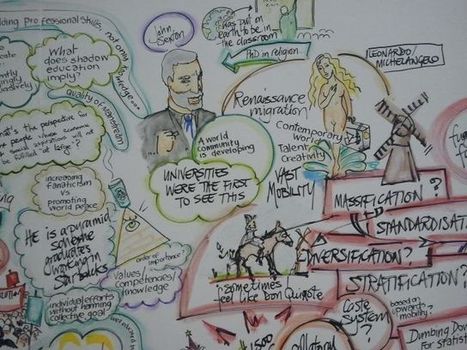
PARIS -- Massification. It's a not-so-pleasant word, with seemingly embedded implications of a lowering of standards, especially when contrasted, as it sometimes is, with the sort of "elite" and "world-class" higher education that countries or states or other entities are often portrayed as having to choose between.
Much of the first day of the biennial higher education conference of the Organization for Economic Cooperation and Development here explored the tension unfolding in many nations and regions over their relative emphasis on providing high-quality research and training aimed at their would-be future leaders and idea creators vs. continuing to expand a meaningful post-high school education to the much larger numbers of citizens who may populate the work force, fill the voting booths, and parent the children.
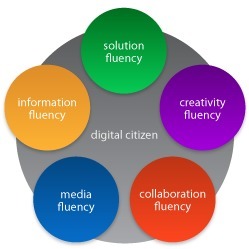
The 21st Century Fluencies are not about technical prowess, they are critical thinking skills, and they are essential to living in this multimedia world. We call them fluencies for a reason. To be literate means to have knowledge or competence. To be fluent is something a little more, it is to demonstrate mastery and to do so unconsciously and smoothly.
A young learner who is literate in the use of a tool, say a pencil for example, can use it to write, but does so haltingly because a great deal of focus is on the use of the tool. As time goes on, this learner will develop fluency with the use of the pen or pencil, or keyboard. No longer will it be an impediment, instead their thoughts and ideas flow directly to the paper. The use of the tool is transparent. This is the level of proficiency we will need to thrive in this digital landscape and is what we strive to develop in today's learners.
KF: And just as learners need to develop these fluencies, the effective tecaher must also embrace them and marry them to pedagogical and content fluencies!
Higher education in the UK, and beyond, appears to be experiencing a period of unprecedented change. Together, global trends and national policies are generating a debate that is increasingly focussed on the cost of higher education. Tuition fees, research grants and ROI are the issues of the day.
It’s time to widen the debate. The Pearson Think Tank is pleased to present a range of bold, new ideas about the future of higher education. Leading experts, including a few less-well known voices, set out their vision for the future.
There is disagreement at times about priorities, but together this diverse collection demonstrates the qualities of higher education and how it can drive both economic growth and better wellbeing in the future.
With new funding laws meaning more competition, the Australian student marketing war to attract students is waging on both home ground and overseas.
In WA, Curtin’s brand is all about the future. The Curtin line, Make Tomorrow Better, promotes it as a future thinker. The campaign launch included a TVC featuring students with light bulbs instead of heads, and the line ‘you can always spot the brightest minds’.
“It positioned Curtin as innovative, and we needed to relate that back to what it means for students,” says Carriero. “Its message is about making your future, your career and your community better.”
Yole, whose agency The Brand Agency was behind Make Tomorrow Better, says the brand campaign “reflects the philosophy of Curtin – they are looking for people who can bring ideas into reality”.
The University of Iowa’s Transform, Interact, Learn, and Engage (TILE) project encompasses a commitment to an active-learning pedagogical philosophy that infuses technology into collaborative learning spaces. The project is designed to foster collaboration and student interaction with both peers and faculty in an effort to enhance student learning outcomes. This case study discusses a study we conducted to investigate student perceptions of the factors that helped them learn subject material in TILE classrooms; why instructors in TILE classrooms used specific strategies; and how students perceived the effectiveness of those strategies.
The Seeking Evidence of Impact (SEI) program is intended to bring the teaching and learning community into a discussion about ways of gathering evidence of the impact of our innovations and current practices. The goal of the SEI Case Studies is to provide examples of successful projects evaluating the impact of innovation, technology, and best practices in teaching and learning.
xEducation is a book that George Siemens, Bonnie Stewart, and Dave Cormier have agreed (and been contracted) to write for Johns Hopkins University Press. We expect the book will be published in mid-2013. Our focus is on sidestepping the rather substantial hype around educational reform, particularly from the technological angle, and present a solid discussion of the scope and nature of higher education (HE) change.
This site has been set up to chronicle our thinking and engage with others who are interested in the dramatic change being predicted for HE. Over the past decade, we have done most of our work in the open. We write, blog, and publish in open spaces where ever possible. We also started the first Massive Open Online Course (MOOCs), together with Stephen Downes, in 2008.
This book, however, is not open. We decided that the audience we wanted to reach about how the internet is restructuring knowledge was different than the one we interact with in our blogs. We’re confident we’ll be criticized for that choice. To partially apease our guilt, we are treating this site as our field notes for the book.
Presentation by Jackie Gerstein for integrating the flipped classroom approach in higher education with a focus on experiential learning with videos and other content supporting not driving the instruction.
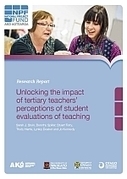
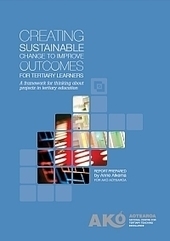
This National Project Fund project examined the extent to which teaching practices are informed by learner feedback in New Zealand tertiary institutions.
This project investigated tertiary teachers’ views of, and engagement with, feedback gathered through student evaluations. The study drew on a combination of quantitative and qualitative techniques; in all, 1,065 staff from 3 institutions (1 polytechnic and 2 universities) participated in a questionnaire and 60 volunteers were interviewed.
This study highlights the need for greater use of student evaluation as an integral part of professional development. Closing the loop is introduced as a principle to encourage individual teachers, departments and organisations to:
provide evidence to demonstrate the quality of teaching to government, to staff, to colleagues, to students and other stakeholders enable planning for ongoing personal, professional, course/programme and institutional development enable students to be involved in development activities and give them a voice in the quality aspects of their tertiary experience.
Two outputs are available from this project: a research report and a summary guide.
OB3 is a learning environment for medical education. It helps educators and students create, manage, collaborate and learn online.
OB3 wraps the latest web technologies into an easy-to-use application designed for complex content and busy people.
OB3 beta 4 released
We're excited to announce the release of OB3 beta 4, the web application for online study. OB3 is the result of over 3 years of research and development, we're committed to improving the way graduate and professional education is delivered online.
KF: An online learning environment that's been in development for a few years - has garnered a little interest globally and currently pulling focus in some large Australian universities. Worth getting familiar with its approach as it might be what you're asked to use next.
This paper documents the approach taken by an Australian University to enhance student study skills, development of academic language, and writing skills. The Curtin Business School (CBS) has the only fully faculty-based student learning support centre at Curtin University in Western Australia. Called the CBS Communication Skills Centre (CSC) it has seven academic staff charged with enhancing learning outcomes, intercultural communication and study proficiency for a diverse student cohort having a large proportion of international students. Described here is the CSC approach to using a suite of targeted services and collaborative practices in multiple academic disciplines to assist transnational learning. Challenges faced by international students using learning support services, and by staff designing and delivering those services in an Australian University form part of this discussion.
In his 2005 article Connectivism: A Learning Theory for the Digital Age, Siemens outlined a new way of thinking about learning based on the recent advances in information technology. He argues that this new theory, connectivism, supersedes previous learning theories, including behaviourism, cognitivism, and contructivism. In this post, I am seeking to further my understanding of this new theory, examine its limitations, and consider its relevance to both classroom teaching as well as knowledge management practices within organizations.
Curtin University initiated its eScholar program in 2009 making funds available for academic staff to implement innovative teaching using Curtin’s extensive suite of learning technologies. The program is based on the philosophy of engaging students with learning technologies that support their growing understanding through authentic and assessable activities.This publication presents the research findings of each of the eScholar projects conducted in 2010 and 2011. Each chapter has undergone a process of double-blind review resulting in high quality descriptions of learning using current and emerging technologies. The publication is divided into 6 sections based on these technologies.University teaching and learning is faced with many challenges. A major one is recognising appropriate learning technologies and their use that support ways in which adults learn. Rapid advances in technologies can easily seduce those with limited understanding of adult learning. This publication offers clear directions founded on teacher and learner experiences grounded in real classroom activity.
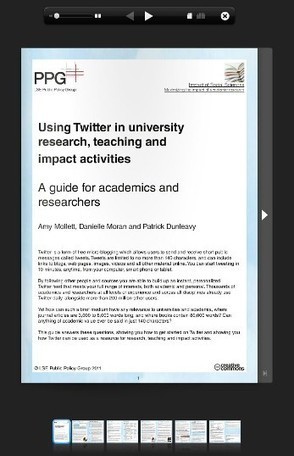
How can Twitter, which limits users to 140 characters per tweet, have any relevance to universities and academia, where journal articles are 3,000 to 8,000 words long, and where books contain 80,000 words? Can anything of academic value ever be said in just 140 characters?
Today, the USC Annenberg Innovation Lab released Designing with Teachers: Participatory Approaches to Professional Development in Education.A PDF of the full report is attached below/
This report represents the collaboration of a working group composed of “a mixture of researchers, teachers and school administrators from a variety of disciplines, schools, and states,” who wanted to better understand how we might best prepare educators in order to incorporate “participatory learning” models into their classroom practices. This working group emerged as part of the MacArthur Foundation’s Digital Media and Learning Initiative.
Try ripping up the syllabus and other experiments to teach students how to think.
This past year, Baylor University created a program to reward some of its best teachers and challenge them to do something truly daring: teach their students how to think—not just how to think about course material, but rather how to think through the material. The idea is to help students learn how we, as practitioners of our disciplines, analyze, make meaning, understand, look at the world, and create.
KF: A few examples of what flipping might really mean and what a shift to student-centredness and authentic learning might entail.
Marina Ciccarelli contextualises how the classroom was flipped to cater meet the needs of a large, core first year, interprofessional unit in the faculty of Health Science at Curtin University
Transmedia storytelling usually ends up in the shape of alternate reality games, which all-too-often become scheduled, passive on-rales experiences for the user. How can content creators make it more meaningful?
"Well, despite much recent evangelising about transmedia storytelling as a revolutionary and innovative progression, too often these digital manifestations become scheduled, passive, on-rails experiences for the user....The web excels at democratising creation. It does not want to simply be another channel, another delivery system. It wants to be a toolbox, a sandbox and a toybox all rolled into one. So when we think about transmedia and multiplatform, we should also be talking about transexperience and multicontributor. We need to stop creating more closed narratives and finite tales, and instead concentrate on fragmenting the stories we already have into a million pieces and sparking the imaginations of our audiences so they want to put them back together in the way that feels right to them."
KF: This closing statement also resonsates with innovative educators embracing student-centredness. In an educational model that is ast once connectivist and constructionist this same principle applies. Rather than creating the totality of the content of a unit of study, teachers could look at how they can enable revolutionary and innovative education. Open up the learning and assessment activities to invit further development and input from the learner; break the cycle of delivery and assessment to allow the same type of fragmentation that Hindcliffe proposes in this article.
In January 2011, Oregon State University ichthyologist Brian Sidlauskas led a research expedition into the little-known Cuyuni River region of Guyana in South America. His team documented more than 5,000 fish, but Guyana’s immigration policies required them to identify and catalog every specimen they wanted to bring back—a nearly impossible task, especially on a tight schedule. Sidlauskas uploaded his research photos to Facebook and tagged members of the scientific community who were able to identify almost all of the photos in under 24 hours.
KF: I begin to wonder how such crowdsourcing approaches can be leveraged for eLearning. Certainly there are some research possibilities with this... reminds me of Fold.it using the human capacity of the network.
The future impact of the Internet on higher education: Experts expect more-efficient collaborative environments and new grading schemes; they worry about massive online courses, the shift away from on-campus life.
Higher education worldwide is entering a period of creative disruption. In many ways, the space is poised to experience challenges similar to those facing journalism, manufacturing, and finance all at once, as novel funding structures, new international institutions, applied research into the neuroscience of learning, and emerging digital tools for knowledge discovery begin to converge on traditional organizational structures.
Sunday June 10, 2012 at 1400 GMT Laine Marshall For this session, Laine will share her experience flipping her Fundamentals of Linguistics class this spring semester for the first time.
For this session, Laine will share her experience flipping her Fundamentals of Linguistics class this spring semester for the first time. There were many surprises in what occurred when she decided to try the flip. She hopes to generate discussion on the rationale for the flipped classroom, what students and courses are best suited for this model and how it has worked out in her class. One of her students, Edith Ramirez-Lopez, will join in to provide the learner perspective.
To get content containing either thought or leadership enter:
To get content containing both thought and leadership enter:
To get content containing the expression thought leadership enter:
You can enter several keywords and you can refine them whenever you want. Our suggestion engine uses more signals but entering a few keywords here will rapidly give you great content to curate.


 Your new post is loading...