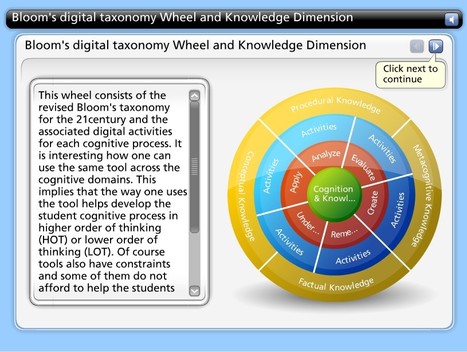
If students can only focus for 15-minute intervals, shouldn't we devote precious class time to something more engaging?

 Your new post is loading...
 Your new post is loading...
Your new post is loading...
 Scoop.it!
If students can only focus for 15-minute intervals, shouldn't we devote precious class time to something more engaging? 
No comment yet.
Sign up to comment
Scoop.it!

Australian universities will not survive the next 10 to 15 years unless they radically overhaul their current business models, according to a report released today.The Ernst & Young report, titled…...
Scoop.it!

Let's say Professor Smith wanted to use Understoodit. She would start by creating an account and choosing the screen name 'smith'. Professor Smith would then tell her students to go to understoodit.com/smith on their laptop, tablet or smartphone. When students are confused they would click the 'confused' button, and when they understand they'd click 'understood', and in real-time Professor Smith can see the percentage of students that understand. It's that simple.
Professor Smith's students only need to create accounts if she wishes to keep track of their progress or answers. This means that Professor Smith can use Understoodit at conference presentations, even if her audience members don't have Understoodit.com accounts.
Scoop.it!
Online learning calls for new set of skills...
Scoop.it!

FUTURE OF HIGHER EDUCATION: The rise of online and blended learning and the development of free online courses is set to transform the higher education sector.
The steady measured progress of innovation in higher education has been replaced with an explosion of new ideas. The change is both exhilarating and frightening. Each day there are new innovations, as more and more experts explain where these changes might take us.
Scoop.it!

Live-stream.Five of our authors will today present their ideas on the future of higher education in a conversation with Tertiary Education Minister Chris Evans.
Scoop.it!

The proper place of social media in the classroom remains a mystery to most people, with Wikipedia standing as the biggest, baddest new media nemesis of them all.
Scoop.it!

How 21st Century Thinking Is Just Different...
New contexts—digital environments that function as humanity-in-your-pocket—demand new approaches and new habits. Specifically, new habits of mind. Persisting. Managing Impulsivity. Responding with awe. Questioning. Innovating. Thinking interdependently. And in an era of distinct academic standards and increasingly brazen technology, they are increasingly relevant.
The tone of thinking in the 21st century should not be hushed nor gushing, defiant nor assimilating, but simply interdependent, conjured to function on a relevant scale within a much larger human and intellectual ecology, one that exposes itself daily across twitter, facebook, and a billion smartphone screens.
Scoop.it!

FUTURE OF HIGHER EDUCATION: We continue our series on the rise of online and blended learning and how free online courses are set to transform the higher education sector.
Scoop.it!

Tanner Lecturer and respondents tackle the challenges of preserving the best of higher education while venturing onto new ground.
Scoop.it!
|

|
Rescooped by
Kim Flintoff
from Into the Driver's Seat
October 6, 2012 9:31 PM
|
Scoop.it!

Posted by Katie Lepi
"Personal learning networks are a great way for educators to get connected with learning opportunities, access professional development resources, and to build camaraderie with other education professionals.
"Although PLNs have been around for years, in recent years social media has made it possible for these networks to grow exponentially.
"Now, it’s possible to expand and connect your network around the world anytime, anywhere. But how exactly do you go about doing that?
"Check out our guide to growing your personal learning network with social media, full of more than 30 different tips, ideas, useful resources, and social media tools that can make it all possible."
|
|
Scooped by
Kim Flintoff
October 2, 2012 7:05 AM
|
Scoop.it!

A special program at the University of Texas known as UTeach is an effort to entice talented math and science majors who might otherwise become doctors or engineers to choose teaching instead.
This story was produced by The Hechinger Report, a non-profit, independent journalism organization housed at Columbia University in New York. It is part of a series written in collaboration with NBC for the annual Education Nation summit.

|
Suggested by
Kerensa Pickett Clark
October 28, 2012 8:56 PM
|
Scoop.it!

SCAMPER is a technique you can use to spark your creativity and help you overcome any challenge you may be facing. Click for a complete SCAMPER primer, along with two free creativity-boosting resources.
|
|
Scooped by
Kim Flintoff
October 24, 2012 2:44 AM
|
Scoop.it!
The Conversation's authors present their ideas on the online revolution facing higher education to Tertiary Education Minister Chris Evans at a Canberra symp...
|
|
Scooped by
Kim Flintoff
October 23, 2012 6:13 PM
|
Scoop.it!

What constitutes learning in the 21st century? Should reading, watching, memorizing facts, and then taking exams be the only way to learn? Or could technology (used effectively) make learning more interactive, collaborative, and constructive? Could learning be more engaging and fun?
We construct, access, visualize, and share information and knowledge in very different ways than we did decades ago. The amount and types of information created, shared, and critiqued every day is growing exponentially, and many skills required in today’s working environment are not taught in formal school systems. In this more complex and highly-connected world, we need new training and competency development—we need to design a new learning environment.

|
|
Rescooped by
Kim Flintoff
from MOOCs, SPOCs and next generation Open Access Learning
October 23, 2012 12:42 AM
|
Scoop.it!

Udemy co-founder Eren Bali makes a bold statement: "In 10 years, we believe every expert in the world will be teaching online." Find out more about his thoughts behind massive open online classes (MOOCs) and mission behind the fast-growing online platform Udemy.
|
|
Scooped by
Kim Flintoff
October 22, 2012 6:21 PM
|
Scoop.it!

McGown and Lightbody felt that students needed instruction beyond the guidelines and that they needed repeated instruction in subsequent courses, especially those courses in the major. Not all fields handle the use of sources in the same way. Once students are in a major, they need to learn the particulars of referencing for that field.
|
|
Scooped by
Kim Flintoff
October 19, 2012 6:31 PM
|
Scoop.it!

If there's one thing we've seen plenty of here at Techdirt, it's the damage a single DMCA takedown notice can do. From shuttering a legitimate ebook lending site to removing negative reviews to destroying a user's Flickr account to knocking a copyright attorney's site offline, the DMCA notice continues to be the go-to weapon for copyright defenders. Collateral damage is simply shrugged at and the notices continue to fly at an ever-increasing pace.
|
|
Rescooped by
Kim Flintoff
from Educational Technology News
October 18, 2012 7:36 PM
|
Scoop.it!

"For at least the past decade there has been much talk about the advantages of highly sophisticated online courses and the use of online tools in traditional courses. One of the significant advantages of technology-enhanced courses, it is said, is that they can be tailored to individual students’ needs, and thus achieve desired learning outcomes for each student better and faster... But using technology to individualize student learning is not at all a new idea — it does not originate with online courses or with the technology developments of the past decade, or two, or even three."
|
|
Scooped by
Kim Flintoff
October 17, 2012 4:20 PM
|
Scoop.it!

|
|
Scooped by
Kim Flintoff
October 16, 2012 9:29 PM
|
Scoop.it!
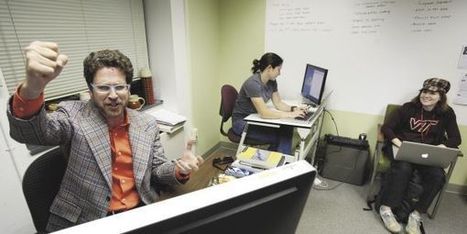
John Boyer of Virginia Tech employs a host of technologies in a world-events class that attracts students in droves—and they're learning.
|
|
Scooped by
Kim Flintoff
October 14, 2012 8:45 PM
|
Scoop.it!

FUTURE OF HIGHER EDUCATION: We continue our series on the rise of online and blended learning and how free online courses are set to transform the higher education sector.

|
Suggested by
Peter Bryant
October 7, 2012 7:55 AM
|
Scoop.it!

|
|
Scooped by
Kim Flintoff
October 3, 2012 8:55 PM
|
Scoop.it!

When Collège Boréal, established in 1995, moved to its main campus in Sudbury in 1997, it used videoconferencing to serve students spread across northern Ontario. Some first year courses, for the programs in its northern campuses, were transmitted through videoconferencing and then students would come to the Sudbury campus for subsequent years for most diploma programs. In 1999, technology improvements were made to address issues of time lag and quality. In 2010, another large investment was made to upgrade the videoconferencing system which continues to be used extensively for course delivery throughout northern, southern, and southwestern Ontario.