


8 Things To Look For In Today’s Classroom by TeachThought Staff What are the kinds of things you should look for in today’s classroom? The common response often begins and ends with technology, but as [...]
Via juandoming

 Your new post is loading...
 Scoop.it! 8 Things To Look For In Today’s Classroom by TeachThought Staff What are the kinds of things you should look for in today’s classroom? The common response often begins and ends with technology, but as [...] Via juandoming No comment yet.
Sign up to comment
Scoop.it!
Published on Nov 20, 2016
Jim Lerman's insight: Another starter video, this one's about 8 minutes and is very good for absolute beginners with the NEW Sites. Via Jim Lerman
Scoop.it!

Teachers can use technology to boost student creativity in the classroom through gamification, videos and the flipped classroom, just to name a few. Via Dr. Tom D'Amico (@TDOttawa) 
thelma.davila@yahoo.com's curator insight,
September 18, 2021 9:12 PM
This article is about how technology can boost student creativity. It asks for teachers to transform their teaching method. Examples they give are puzzles or a quest of their own. They also discuss the flipped class method. All of these types of technology lessons lead to student creativity. 
Karinna Lazcano's curator insight,
June 9, 2022 12:12 AM
Schools are not doing enough for students to use their imagination trhough creativity. Maybe is becuase as grownups our imagination is curbed by rules, limits and theories. Children are very creative and they have great imagination. Teaching methods should be transformed using the technology available such as students taking pictures, making videos, and expressing their thoughts creatively with others.

Jose Manuel Garza's curator insight,
May 22, 2023 4:55 PM
The advantage of using technology devices in the classroom is that it opens the doors to a vast universe of possibilities in which the student may take part and use to complete assignments and homework. The large quantity of sources available to students online, including learning applications, serve students as a springboard to their imagination and their creative tendencies to help them understand more about the world. In my classroom I incorporate the use of applications and the internet by assigning students assignments that require them to search the web and apply their creative ideas to make one-of-a-kind projects and assignments.
Scoop.it!

Free resource of educational web tools, 21st century skills, tips and tutorials on how teachers and students integrate technology into education Via Educatorstechnology
Scoop.it!

"Confession: We at EdSurge are a bit in love with what may be America’s favorite new pastime: making. Indeed, it’s been a busy two years since we published our first guide on making, during which makerspaces have spread into classrooms and curriculum far and wide. But for many, issues of budget and buy-in mean maker education is still far from mainstream. To be sure, there have been changes in the Maker movement in the decade-plus since the first Maker Faires wooed a new generation of DIYers. Along the way, we’ve celebrated successes and asked hard questions. How can we help making become more equitable and inclusive? How can maker ed embrace traditional technology, including computer science? What are the benefits of a maker education, and how do we measure them? In this guide, we hope you’ll find answers to—or at least ideas about—these and other questions that explore the meaning of making." Via John Evans
Scoop.it!

Coding–that geeky subject that confounds students and frightens teachers. Yet, kids who can code are better at logical thinking and problem solving, more independent and self-assured, and more like… Via Dr. Tom D'Amico (@TDOttawa) , Alfonso Gonzalez
Scoop.it!

Free resource of educational web tools, 21st century skills, tips and tutorials on how teachers and students integrate technology into education Via Educatorstechnology
Scoop.it!

Load The Game LEGO Fusion Allows Virtual World Building With Actual LEGOs Load The Game A senior design manager behind the project, Ditte Bruun Pederson, noted that while researching a new project to pursue, the LEGO team discovered that children... Via Michèle Drechsler
Scoop.it!

Google vient de lancer Google Earth VR, un outil amélioré de sa carte satellite, qui permet d'explorer le monde entier en réalité virtuelle.
Via Freewares&Tutos 
Eric Mathez's curator insight,
November 26, 2016 6:33 AM
Article intéressant sur Google Earth et la réalité virtuelle...
Scoop.it!

In this second article in the Performance Support series, the authors ask, “Isn’t it our core mission to develop learning solutions that ensure people can perform effectively when they are called upon to act?” The authors begin to explore what it means to broaden the scope of our work to include the Five Moments of Learning Need. Via callooh 
callooh's curator insight,
November 20, 2016 9:17 AM
Performance support tools at the 5 moments of need
Scoop.it!

A l’ère du digital, de nouveaux métiers sont en train de voir le jour. 60% des Métiers de 2020 n’existent pas encore alors quels sont ceux qui s’imposeront demain ? Voici un zoom sur les nouveaux métiers qui nous donnent une idée de la variété des nouvelles compétences du digital ! Découvrez le petit lexique pour...Cet article Le lexique des métiers du digital est apparu en premier sur ABILWAYS DIGITAL .
Via Xavier Van Dieren
Scoop.it!

How might education look beyond today? What can we look forward to seeing in learning? Here are 6 future learning scenarios to get you thinking. Via Dr. Tom D'Amico (@TDOttawa) |
Scoop.it!

Many thanks to the folks who commented on Part 1 of this blog series, and to those people who contacted me privately to tell me about cases where face-to-face learning is playing a significant role for MOOC learners. In this post I will share what I have learned from that communication, as well as briefly summarising some of the literature I… Via juandoming
Scoop.it!

There are many good resources about Creative Commons on the web. I have used a film from Creative Commons New Zealand whenever someone have asked me to explain CC Licences. The short video is a rea… Via Dr. Susan Bainbridge
Scoop.it!
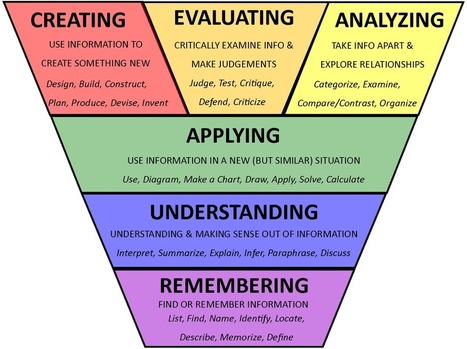
Knowledge is everywhere. In a mobile phone, a fitness tracker and our brains. Not a science fiction film but the learning theory of connectivism. Recently over a coffee Via Dr. Susan Bainbridge 
Gust MEES's curator insight,
January 13, 2017 9:12 AM
Knowledge is everywhere. In a mobile phone, a fitness tracker and our brains. Not a science fiction film but the learning theory of connectivism.
Learn more / En savoir plus / Mehr erahren:
http://www.scoop.it/t/21st-century-learning-and-teaching/?tag=Connectivism

Elizabeth Karvonen's curator insight,
January 20, 2017 4:44 AM
Definitely a new slant on Bloom. Important for all teachers in the digital age.
Scoop.it!

Pour la seconde fois, le ministère de l’éducation nationale, de l’enseignement supérieur et de la recherche a organisé avec ses opérateurs (Canopé, Cned, Onisep) durant le salon Educatec-Educatice #HackÉduc, le Hackathon de l’Éducation nationale pour la création de ressources numériques par les enseignants, pour les enseignants. Cette 2nde édition à permis de primer 5 initiatives, […]
Via Xavier Van Dieren
Scoop.it!

Educatice : Les ressources pédagogiques entre auto création des enseignants et normalisation https://t.co/Bs7DloQnwl
Via Claude Tran 
Claude Tran's curator insight,
November 21, 2016 4:32 PM
Ce qui se joue c'est la culture professionnelle numérique des enseignants", explique-t-il. Apparemment elle se fabrique largement hors de portée de l'institution. "Il y a besoin d'un tissu associatif, de réseaux", estime-t-il. "La seule chose qu'on demande c'est qu'on soit bien dans un projet Education nationale avec des référentiels communs. Ce qui importe c'est ce qui se fait sur le terrain mais dans un cadre commun, celui de l'Education nationale".
Et le ministère pense avoir trouvé l'outil pour cela avec Myriaé, le moteur de recherche des ressources pédagogiques que le ministère a lancé au salon Educatice. A vrai dire c'est une nouvelle tentative du ministère après Edubase et Educasources, qui n'ont pas rencontré un très grand succès. Les enseignants utilisent les mêmes moteurs de recherche que le grand public. Et ils font confiance à l'échange de bonnes adresses entre collègues.
Scoop.it!

Comment évaluer les compétences ? Rémi Massé,, a inventé un #outil original d’évaluation. Son « sphérier », outil dont l’aspect visuel est important, prend la forme de sphères de compétences Le sphérier est un outil d’évaluation complété à chaque cours d’#éducation musicale par les élèves. Les quatre champs de compétences du nouveau programme d’éducation musicale sont symbolisés par des lignes de sphères de couleurs différentes, et la taille des sphères représente des niveaux de maîtrise de la compétence. Suivre une […]The post Un sphérier pour évaluer les compétences ? appeared first on La Digital Learning Academy .
Via Xavier Van Dieren
Scoop.it!

Peekapak is a SEL platform that bridges the gap between the class and home - with curriculum, progress tracking & communication tools. Via Dr. Tom D'Amico (@TDOttawa)
Scoop.it!

A few months ago I was introduced to Slack through my role as Community Administrator for the Flipped Learning Network. We started using the platform as a communication, content sharing, and engagement resource for the flipped learning community. Via John Evans, Pauline Porcaro
Scoop.it!

Scoop.it!
Pix est un projet public de plateforme en ligne d'évaluation et de certification des compétences numériques, en cours de développement. Pix est gratuit. Via Frédéric DEBAILLEUL, Elena Pérez
Scoop.it!

The way we learn today is just wrong. Learning needs to be less like memorization, and more like…Angry Birds. Half of school dropouts name boredom... read more Via callooh
Scoop.it!
Il y a quelques jours, le CEO de LinkedIn réaffirmait, au cours d’une keynote, sa volonté d’accélérer sur le segment de la formation professionnelle. Un an et demi après le rachat de la société Lynda.com, le réseau social lance LinkedIn Learning, une plateforme dispensant des vidéos de #formation adaptées aux profils de chaque abonné. Eclairage. 9000 contenus de Lynda.com Réservé aux abonnés premium, l’espace LinkedIn Learning héberge 9000 vidéos de formation sur un large panel de thématiques : la programmation, […]The post Formation : ce qu’il faut retenir de la keynote de LinkedIn appeared first on La Digital Learning Academy .
Via Xavier Van Dieren |






