"Nearly all of higher education moved online at the beginning of the pandemic. For longtime proponents of online education like myself, you might think it would be an accomplishment. Except that many students showed up resentful, taking digital courses only by force of circumstance, and the teaching they got did not always fit the medium."
It can take years to become a seasoned online instructor, and many of the strategies faculty were able to use effectively in the traditional classroom did not translate very well into the online classroom.
Everyone involved in teaching and learning online should learn to recognize the signs of digital fatigue early on, to reverse its consequences and limit its damage
Digital Fatigue is a fallout of excessive dependence on digital or learning platforms. Its symptoms, treatment and causes need to be studied in great detail.
Added this to our 'Wellbeing' board, as I think this is an important issue facing both students and staff - the serious risk of burnout from too much screen time. While the article focuses on the issue as a 'remote learning' issue - I believe the impact is still significant within an in-school environment as the use of technology in learning consistently increases.
The article does not adequately address what the 'signs' are - but does give a valuable 'prompt' for our consideration of this issue.
COVID-19 and all Rena Beban, Thomas Grlic (TG3), Sally Lau, and I have been working hard getting the physics maker space ready for after COVID times. We have been focusing on using the Raspberry Pi, Beaglebone Black, and other single-board computers to control external devices.
A new set of electronic building blocks has been launched via Kickstarter in the form of the Arduino, ESP32, Micro:bit based Crowbits.Offering a STEM...
Édupages Créator est un logiciel pour réaliser un livre numérique à imprimer ou à consulter en ligne. Simple, intuitif, il se prête à de nombreux usages.
This article really speaks to what I’ve seen working in higher ed, students are confident using technology, but that doesn’t always translate into digital literacy, especially when it comes to academic or professional settings. I liked how the article challenges higher ed institutions to stop treating digital skills as “extra” and instead embed them into the core of how we teach and support students. As someone who works with students navigating online systems I see how much they struggle when those digital foundations aren’t there. I also appreciated the point about shifting from passive learning to students being co-creators of their education. I think that approach really aligns with building long-term skills, not just checking boxes. This article makes it clear that digital literacy in college isn’t just about using tech, it’s about preparing students for lifelong learning and problem solving.
La alfabetización digital se presenta en este artículo como un proceso complejo que exige un cambio de enfoque en la educación actual. Más allá del uso instrumental de la tecnología, se subraya la importancia de comprender cómo se produce, circula y consume la información en los entornos digitales.
En el caso de los jóvenes, que participan activamente en redes sociales desde edades tempranas, esta cuestión resulta especialmente relevante, ya que sus prácticas digitales influyen en la construcción de opiniones, relaciones e identidad; desde una perspectiva educativa, promover una alfabetización digital crítica permite dotar al alumnado de herramientas para interactuar en la red con mayor autonomía, responsabilidad y capacidad de reflexión.
Last week a new app called Overviewer got a lot of buzz on social media. The app lets you use your phone as a document camera. Overviewer isn’t the only way to use your phone as a document ca…
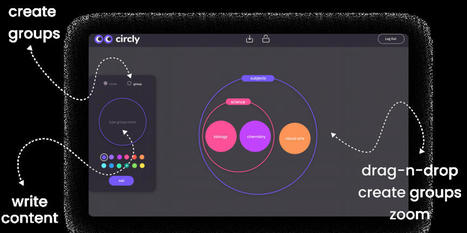
Beautiful and easy drag & drop based tool with circles. Perfect for personal, business or educational purposes. Creative visual organiser tool for you. Visual collaboration platform for your team. The best option for remote teams to get things done.
Microlearning is all the rage, but what is it exactly? What does a successful microlearning object look like? And, how are the pedagogical practices surrounding microlearning design and implementation? Through the webinar, renowned authors, speakers, consultants, and educators, Drs. Badrul Khan and Karl Kapp will examine the recent phenomenon of "microlearning" happening online and traditional learning contexts for enhancing instruction, professional development, training, and personalized learning. Click here tp learn more: http://link.utrgv.edu/the-frontier/
In this webinar, guest panelists Drs. Badrul Khan and Karl Kopp will examine the recent phenomenon of “microlearning” happening in education, professional development, corporate training, and personalized learning.
"No one can deny the enormous potential of immersive learning technology, including Virtual Reality, Augmented Reality, and Mixed Reality. While these tools were used mostly by marketing specialists and gamers a couple of years ago, the application is becoming broader, with teachers also becoming interested in integrating these learning methods."
Audiomass est un éditeur audio en ligne gratuit qui fonctionne directement dans votre navigateur internet, sans inscription et sans aucune installation logicielle. Son interface (en anglais) n'est pas sans rappeler celle du logiciel Audacity auquel il peut se substituer de manière ponctuelle, dans le cas où vous n'avez pas le programme sous la main
Developing the skills and infrastructure for lifelong learning was at the top of my agenda before the pandemic. But as the general economic fallout from the pandemic and the impact on jobs and job displacement become clearer, the issues of upskilling and reskilling are also moving up the agenda for corporations and executives across the world. Governments play a role here, as we have seen in the case of Singapore, which offers a model for government-sponsored initiatives aimed at promoting skill development and lifelong learning. But the corporate role is vital. That’s in part because the experience of work itself is a major developer of skills, and corporations have an intimate view of skill requirements. In some cases, they also have a finely honed way of developing skills. Indeed, in a recent survey, 94% of business leaders said they expect their employees to pick up new skills on the job (which represents a sharp uptick from 65% in 2018).
Human capital—that is, resources associated with the knowledge and skills of individuals—is a critical component of economic development1,2. Learning metrics that are comparable for countries globally are necessary to understand and track the formation of human capital. The increasing use of international achievement tests is an important step in this direction3. However, such tests are administered primarily in developed countries4, limiting our ability to analyse learning patterns in developing countries that may have the most to gain from the formation of human capital. Here we bridge this gap by constructing a globally comparable database of 164 countries from 2000 to 2017. The data represent 98% of the global population and developing economies comprise two-thirds of the included countries. Using this dataset, we show that global progress in learning—a priority Sustainable Development Goal—has been limited, despite increasing enrolment in primary and secondary education. Using an accounting exercise that includes a direct measure of schooling quality, we estimate that the role of human capital in explaining income differences across countries ranges from a fifth to half; this result has an intermediate position in the wide range of estimates provided in earlier papers in the literature5–13. Moreover, we show that average estimates mask considerable heterogeneity associated with income grouping across countries and regions. This heterogeneity highlights the importance of including countries at various stages of economic development when analysing the role of human capital in economic development. Finally, we show that our database provides a measure of human capital that is more closely associated with economic growth than current measures that are included in the Penn world tables version 9.014 and the human development index of the United Nations15. Analyses of a global database reveal that in many developing countries progress in learning remains limited despite increasing enrolment in primary and secondary education, and uncover links between human capital and economic development.
electronic blocks - The ‘Crowbits’ electronic blocks are a new STEM education toy that can be used by makers at any age to create a range of projects that ...
Learners are consuming information in different ways, and it’s our role as training professionals to recognize that and adapt our programs accordingly.
"Derived from research-based best practices, these principles are intended to supplement the QM Higher Education 6th edition course design rubric and the Ecampus Essentials to guide effective facilitation of online and hybrid courses at Oregon State University. These principles are a tool for faculty development and are not intended as an exhaustive list of online or hybrid instructor competencies or tasks; moreover, other “applied examples” beyond those listed may fulfill the spirit and intent of these principles."
To get content containing either thought or leadership enter:
To get content containing both thought and leadership enter:
To get content containing the expression thought leadership enter:
You can enter several keywords and you can refine them whenever you want. Our suggestion engine uses more signals but entering a few keywords here will rapidly give you great content to curate.


 Your new post is loading...





















It can take years to become a seasoned online instructor, and many of the strategies faculty were able to use effectively in the traditional classroom did not translate very well into the online classroom.