La ludopédagogie en formation d'adultes, c'est possible ! Oui mais... Pourquoi faire jouer des adultes en formation ? Quand et quels jeux mettre en place en formation ? Comment scénariser la séquence ludique ? Quels sont les pièges à éviter ?
"A wide range of organizations are working to gauge students’ needs and public schools’ performance in ways that go far beyond disparities in test scores and graduation rates. These new metrics—ranging from the availability of advanced coursework to students’ proximity to parks, trails, transit, and grocery stores—challenge traditional definitions of a good school and stand to reframe the national debate on accountability in education.
"Expanding the conversation on school performance beyond test scores and other traditional success metrics poses many challenges. Which of the many new indicators relate clearly to student success? How many of them are needed to provide a clear picture of educational equity? How should the new information’s accuracy be ensured? What’s the role of parents and other local stakeholders in selecting the new indicators? What’s the most productive way to use the new information?
"In this FutureEd report, Senior Fellow Lynn Olson and Director Thomas Toch examine the fast-growing movement to introduce new equity indicators into the school-performance equation and explore its implications for students, educators, and policymakers."
Jim Lerman's insight: A much-needed effort to redefine measures of success/excellence in education. How do we change the story?
Create a shared vision of teaching and learning. Using learning as a process and not an event. Allow authentic learning through practice, trail, and authentic activities. Evolve with the world today and #GoOpen with open education resources.
Katie Martin is the Director of Professional Learning at USD’s Mobile Technology Learning Center. She teaches graduate-level courses in the School of Leadership and Education Sciences and works with teachers and administrators in diverse K-12 schools. Through partnerships with local and national school districts, she has helped develop systems that facilitate personalized professional learning for educators.
"Dr. Martin works with leaders to create a culture of learning and innovation to ensure all students are equipped with knowledge and skills to be successful today and in their future.
"Prior to joining USD, Katie spent 10 years in Hawai’i on the Leeward Coast of O’ahu. She taught middle school English language arts and was an instructional coach. She continued as a new teacher mentor and coordinator of district programs to support and retain effective teachers."
Supporting social-emotional learning (SEL) continues to be a priority for educators and parents alike. Fortunately, there is an ever-growing number of sites and apps available that provide helpful resources. Here, in alphabetical order, are 15 to get you started.
Comme beaucoup d'entre vous, j'ai découvert Notion il y a quelques mois. Je dois dire qu'au début, j'ai eu du mal avec cet outil multi-fonctions, d'autant qu'il est uniquement en anglais et je l'ai d'ailleurs abandonné après un premier essai qui m'avait donné plus de questions que de réponses.
Mais j'y suis revenu par la suite, j'ai persévéré et j'ai regardé pas mal d'articles et de tutos et je commence à apprécier et à maîtriser Notion (à mon humble niveau).
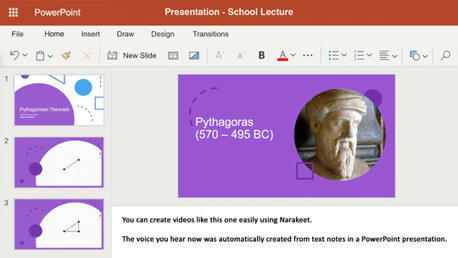
Stop wasting time on recording voice, synchronising picture with sound and adding subtitles. Let Narakeet do all the dull tasks, so you can focus on the content.
Alors que la pandémie s’étire, le personnel scolaire s’adapte à la nouvelle réalité d’un enseignement qui peut basculer à distance à tout moment et acquiert de nombreuses compétences. Cette expérience influencera à long terme la perception des outils numériques. Conscient des difficultés vécues actuellement en ce sens, le Conseil supérieur de l’éducation partage dans cet article sa vision du numérique en éducation.
Via Sandrine Decamps
Aborder, comprendre, et débattre des technologies relevant de l’IA
Ce carnet conçu par la Scientothèque s’organise en 6 entrées thématiques : cours (MOOC, tutoriel, lexique), fiches pédagogiques, outils interactifs (reconnaissance d’images, agents conversationnels, génération de contenus, test de Turing), programmation, internet des objets et robotique (cartes programmables ou robots pédagogiques), s’informer. Le public visé est celui des enseignants ou des animateurs pour les jeunes publics (de 4 à 18 ans).
Hormis la navigation au sein des différentes rubriques il est aussi proposé de recourir à un outil de recherche interne par mot-clef. Les contenus sélectionnés sont majoritairement placés sous Creative Commons, licence également appliquée à l’ensemble du carnet (CC BY-SA 4.0). Ce site est en outre collaboratif : il est possible d’y ajouter toute ressource potentiellement utile ou remarque constructive relative à la structure ou au contenu.
Thinkio est un petit outil simple et efficace pour partager en ligne des copies avec vos élèves ou étudiants. Un utilitaire idéal pour les cours en ligne
"This post contains 8 of the best Ted Talks all teachers should watch for motivation, inspiration, and ideas to develop student passions for and interests in learning."
On March 12 and 13, 2020, the University of Michigan cancelled class to prepare the whole campus for emergency remote teaching starting on March 16. In that brief interim, the institution made Zoom available to everyone—possibly the fastest rollout of any tech in the university’s history, says Ravi Pendse, vice president for information technology and chief information officer.
With digital tools it is no longer necessary for students to learn at the same time as each other. What’s needed, they say, is a mix of online and face-to-face learning – so-called blended learning or the flipped classroom, where students read or watch lectures in their own time, beyond the school walls, and solve problems in the presence of their teacher and peers.
Many students are in different places with what they know and are able to do. As we are settling into the year, we are learning about some strengths and opportunities that coexist for all of our students. In math particularly, there are some gaps that are more present than ever. The pandemic is obviously a factor and for middle and high school students, we shouldn’t ignore the implications of young adolescence and all that comes with this time in life.
As I learned in my own classroom and was also reinforced in my graduate studies, the growth that young adolescents experience is second only to their first year of life. As a result, there are a lot of changes that young people are enduring that impact how and what they learn.
My children, Abby and Zack, are in middle school and I am grateful for their teachers who allow for multiple opportunities to show what they know and can do. Instead of Abby’s teacher grading her on what she knew and was able to do on a fixed timeline, she expects Abby and her other students to show up and do their best for an assessment but also allows them to review their mistakes, learn the material, and revise her thinking and understanding.
Virtual reality offers promising affordances for language learning in the classroom. With virtual reality we can design and create meaningful immersive environments that focus on unique characteristics of the target language practice and culture. VR has the potential to facilitate higher performance in terms of memory and, in turn, language learning.
TinyTap is a social platform which empowers families, teachers and students to learn from each other by creating their own personalized interactive lessons and games and playing thousands of new ones shared daily by a worldwide community of educators and learners worldwide.
All-In-One Solution For Academic Research Writing Editing Publishing Referencing Connecting the most innovative solutions for collaborative research, writing, editing, and publishing.
"What does the future of creativity and innovation look like and how do we get students involved? In our latest episode of the Fueling Creativity podcast, Matthew Worwood and I speak with Jonathan Nalder, a globally awarded innovator in education and Chief Futures Officer at STEM Punks, about the best practices for integrating digital tools and forward thinking in learning environments.
"Listen in as Jonathan shares his thoughts on why future trends are important in education, how STEM is connected to creativity, and the trends you can expect in education in the next 10-15 years.
"They also discuss the role of empathy in design thinking, how he and STEM Punks are preparing students to work in collaboration with machines and AI, and the strategies he uses in project-based learning environments to get students thinking about potential human problems of the future. Then, he sheds light on his program, First School on Mars, and how it has grown over the years."
To get content containing either thought or leadership enter:
To get content containing both thought and leadership enter:
To get content containing the expression thought leadership enter:
You can enter several keywords and you can refine them whenever you want. Our suggestion engine uses more signals but entering a few keywords here will rapidly give you great content to curate.


 Your new post is loading...