


|
Rescooped by
michel verstrepen
from Digital Delights
onto gpmt May 16, 2:52 PM
|

No comment yet.
Sign up to comment

|
|
Rescooped by
michel verstrepen
from Digital Delights
onto gpmt May 16, 2:52 PM
|
 Scoop.it!
 Your new post is loading...
 Your new post is loading...
Your new post is loading...
Scoop.it!

Learn how faculty can make informed decisions about AI in teaching while protecting critical thinking, human interaction, and durable learning. Via Ana Cristina Pratas
Scoop.it!

Blog de la "RIED. Revista Iberoamericana de Educación a Distancia". La Revista Iberoamericana de la Educación Digital. Via LGA
Scoop.it!

The 2026 EDUCAUSE Teaching and Learning Horizon Report highlights how artificial intelligence, enrollment pressures, policy shifts, and sustainability Via EDTECH@UTRGV 
EDTECH@UTRGV's curator insight,
May 18, 1:07 PM
"AI increasingly complicates traditional assessments; institutions are moving toward authentic, process‑based demonstrations of learning."
Scoop.it!

Por Melissa Guerra Formalmente, el campo de la Inteligencia Artificial (IA) inició en los años 50 con Alan Turing, mucho antes de la creaci... Via LGA
Scoop.it!

AI usage has reached 17.8% among the world's working-age population, while adoption remains far higher in developed economies than in the Global South. Via EDTECH@UTRGV
EDTECH@UTRGV's curator insight,
May 19, 11:04 AM
"The growing gap between developed and developing economies shows that AI's benefits are not spreading evenly, according to the company's data. Microsoft found a 12.1 percentage point difference in adoption between the Global North and Global South, a divide that appears to be widening as infrastructure, language support and economic barriers continue to shape who can use these tools."
Scoop.it!

Explore practical ways to integrate AI into online courses through process-based assessment, collaborative learning, and AI literacy strategies. Via EDTECH@UTRGV
EDTECH@UTRGV's curator insight,
May 13, 7:53 AM
"Instead of prohibiting the use of AI, it is more effective to assign tasks that require students to use AI tools and then have them critically assess the outputs."
Scoop.it!

AI course creation tools speed up course creation but fall short in instructional judgment. What will the ideal AI-L&D partnership look like? Via EDTECH@UTRGV
EDTECH@UTRGV's curator insight,
May 13, 7:57 AM
"The deeper weakness is that they still treat course creation too much like a production problem and not enough like a judgment problem."
Scoop.it!

From
podcast

À l’heure où l’intelligence artificielle rend le savoir disponible partout, cet épisode interroge en profondeur la valeur du diplôme, la place des études longues, l’avenir des jeunes diplômés, le rôle des formateurs et la manière dont les entreprises doivent repenser le développement des compétences. Car si l’IA peut produire, synthétiser, analyser et expliquer à grande vitesse, une question devient centrale pour les responsables formation, les DRH, les Learning & Development managers, les formateurs et les ingénieurs pédagogiques : Qu’est-ce qui fera encore la valeur d’un apprenant, d’un collaborateur ou d’une organisation ? Via GREF Bretagne, Luc Deleplanque
Scoop.it!
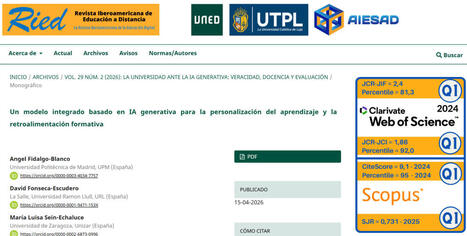
Acabamos de publicar un trabajo donde presentamos el modelo UTC (“Ubícate, Transfórmate y Corónate”), una propuesta que integra IA generativa dentro de un ecosistema educativo que incorpora: diagnóstico inicial, personalización del aprendizaje, retroalimentación continua, generación dinámica de... Via LGA
Scoop.it!

Meta Platforms has acquired Assured Robot Intelligence (ARI), a robotics artificial intelligence startup focused on humanoid systems, as the company expands its AI work beyond software and into models that could help robots operate in physical environments. Via EDTECH@UTRGV
EDTECH@UTRGV's curator insight,
May 15, 3:04 PM
"The deal signals an industry shift toward physical AI. Large AI companies are increasingly looking at systems that can act in the real world, not just generate digital content."
Scoop.it!

This article explores the AI learning gold rush, blending research with personal anecdote, to show how to truly build capability using AI. Via EDTECH@UTRGV
EDTECH@UTRGV's curator insight,
May 11, 12:42 PM
"We're building familiarity with the feeling of learning. Familiarity is not the same as capability. And exposure is not the same as application." 
Ricardo Jasso's curator insight,
May 12, 1:27 PM
The article is states that AI learning is a good thing, but companies shouldn’t rush it just to say they’re “doing AI.” Instead of expecting everyone to become AI experts overnight, the focus should be on helping people feel comfortable using AI in ways that actually make sense for their jobs. |
Scoop.it!

From
davewebster
How can we teach and work in what Adam Aleksic calls our ‘hypermediated reality’? I spoke today at EdTech World Forum in London on Education in an Age of Brain Rot, AI Slop and Cognitive Offloading. The title is not elegant, like my usual efforts… But it tries to capture the feeling many of us… Via Ana Cristina Pratas
Scoop.it!

From
workshift
Training providers are under enormous pressure to integrate AI, but sometimes getting it right means slowing down and asking, why? Via EDTECH@UTRGV
EDTECH@UTRGV's curator insight,
May 18, 1:06 PM
"For workforce organizations on their own AI implementation journeys, our main advice is this: don’t wait for the perfect tool or the perfect study. Start with a clear theory of change, measure what you can, take adoption seriously, and create the conditions for honest learning."
Scoop.it!

What if the greatest danger of #AI is not the technology itself… but the way we think? This reflection is part of a broader journey through #ReverseTHINKing—where we move from awareness to responsibility, from reaction to understanding. Image created by ChatGPT, click please to enlarge. Introduction As already discussed in my latest tutorial, When Convenience...
https://www.scoop.it/topic/21st-century-learning-and-teaching?tag=Gust-MEES
https://gustmees.wordpress.com/
Via Gust MEES 
Gust MEES's curator insight,
May 18, 5:46 PM
What if the greatest danger of #AI is not the technology itself… but the way we think? This reflection is part of a broader journey through #ReverseTHINKing—where we move from awareness to responsibility, from reaction to understanding. Image created by ChatGPT, click please to enlarge. Introduction As already discussed in my latest tutorial, When Convenience...
https://www.scoop.it/topic/21st-century-learning-and-teaching?tag=Gust-MEES
https://gustmees.wordpress.com/
Scoop.it!

From
www
Paddy Rodgers said the Observatory's rich history showed the power of human knowledge and the need to avoid "dependence" on AI.
Learn more / En savoir plus / Mehr erfahren:
https://www.scoop.it/topic/21st-century-learning-and-teaching?tag=Gust-MEES
https://gustmees.wordpress.com/
Via Gust MEES
Gust MEES's curator insight,
May 19, 7:49 AM
Paddy Rodgers said the Observatory's rich history showed the power of human knowledge and the need to avoid "dependence" on AI.
Learn more / En savoir plus / Mehr erfahren:
https://www.scoop.it/topic/21st-century-learning-and-teaching?tag=Gust-MEES
https://gustmees.wordpress.com/

Marco Bertolini's curator insight,
May 19, 9:24 AM
It's something that looms since people imagined artificial intelligence system: what if it made human beings less smart?
Scoop.it!

Without a coordinated strategy that involves multiple academic and administrative units across the entire campus, colleges risk wasting resources, duplicating efforts, and ultimately failing to deliver on the promise of deploying technology to improve learning and operations. Via EDTECH@UTRGV
EDTECH@UTRGV's curator insight,
May 19, 11:00 AM
"[E]ducation has the highest AI usage rate of any industry, with nearly nine in 10 education institutions globally reporting that students, instructors, and campus leaders are using generative AI."
Scoop.it!
From
teachtools
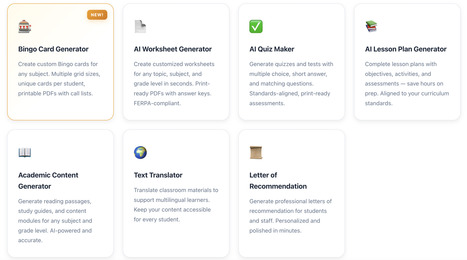
FERPA-compliant AI worksheet generator trusted by 30,000+ teachers. Create quizzes, lesson plans, rubrics — no student data collected, ever. Free to start. Via Ana Cristina Pratas
Scoop.it!

Sixty-eight percent of surveyed students say they turn to AI tools for math assignments or exams when they need extra help. Via EDTECH@UTRGV
EDTECH@UTRGV's curator insight,
May 13, 7:55 AM
"AI plays a supportive educational role for nearly 70 percent of top-performing math students asked about their study habits, according to a new survey."
Scoop.it!

Les formations sont de plus en plus individualisées. C-Campus modestement, propose depuis plusieurs années une offre dédiée aux acteurs de la formation – cliquez ici. Pour autant, la majorité des formations se déroulent encore en groupe. Via Doc Grieps, Luc Deleplanque
Scoop.it!

From
www
A cyberattack against one of the world’s largest digital education platforms has forced attention onto the vulnerability of U.S. schools’ data Via EDTECH@UTRGV
EDTECH@UTRGV's curator insight,
May 14, 8:05 AM
"[H]ackers breached Instructure’s “free for teacher” account, or those specifically offered to give teachers access to Canvas courses."
Scoop.it!

Parents have concerns about cheating, privacy and equity. Experts say clear policies, transparency and communication are needed to address those concerns. Via EDTECH@UTRGV
EDTECH@UTRGV's curator insight,
May 15, 3:03 PM
“While AI use is happening, communication from schools is lagging, which leaves families feeling like they're playing catch up on something that directly affects their child's learning”
Scoop.it!

Strategies for enterprise teams who aim to build a data foundation to move the institution from AI experimentation to real-world execution. Via EDTECH@UTRGV
EDTECH@UTRGV's curator insight,
May 15, 3:06 PM
"The trust deficit surrounding AI is especially acute in higher education. AI data leaders must produce and leverage centralized sources of governed data. Effective data models should provide organizational context so that AI can provide more relevant responses."
Scoop.it!

The Student Guide to Artificial Intelligence Series Elon University’s Imagining the Digital Future Center and the American Association of Colleges and Universities (AAC&U) have collaborated to create a publication series to guide students as they learn about and use AI. The first Studen Via Dr. Tom D'Amico (@TDOttawa) |





