In this talk, Dr. Peter Gray compellingly brings attention to the reality that over the past 60 years in the United States there has been a gradual but, overall dramatic decline in children's freedom to play with other children, without adult direction. Over this same period, there has been a gradual but overall dramatic increase in anxiety, depression, feelings of helplessness, suicide, and narcissism in children and adolescents. Based on his own and others' research, Dr. Gray documents why free play is essential for children's healthy social and emotional development and outlines steps through which we can bring free play back to children's lives.
In the spirit of ideas worth spreading, TEDx is a program of local, self-organized events that bring people together to share a TED-like experience. At a TEDx event, TEDTalks video and live speakers combine to spark deep discussion and connection in a small group. These local, self-organized events are branded TEDx, where x = independently organized TED event. The TED Conference provides general guidance for the TEDx program, but individual TEDx events are self-organized.* (*Subject to certain rules and regulations)
In a Q&A, PIK Professor Sarah Tishkoff, the Perelman School of Medicine’s Giorgio Sirugo, and Case Western Reserve University’s Scott Williams shed light on the “quagmire” of race, ethnicity, genetic ancestry, and environmental factors and their contribution to health disparities.
Empirical Nursing: The Art of Evidence-Based Care, (PDF) aims to provide students and practicing nurses with the tools to better understand and engage in scientific arguments to back quality nursing and evidence-based practice.
The long read: For children with ADHD, getting the help they need depends on being correctly diagnosed. As a doctor, I have seen how tricky and frustrating a process that can be
"The American Academy of Pediatrics has recently issued two new sets of recommendations on media use for children. At first glance, popular news headlines suggest elimination of the previous “no screens before age two” recommendations (see NPR’s American Academy of Pediatrics Lifts ‘No Screens Under 2’ Rule and KQED’s American Academy of Pediatrics Says Some Screen Time is Okay for Kids Under Two). However, close examination of the new guidelines reveal nuanced suggestions that maintain a primary focus on limiting tech usage. What appear to be obscured in public discussions are the same AAP organization’s recommendations issued just months earlier, specifically encouraging parents to reduce children’s exposures to cell phone radiation.
For ease of access, both sets of recommendations are provided in this post.
American Academy of Pediatrics Issues New Recommendations for Children’s Media Use
“Healthy Digital Media Use Habits for Babies, Toddlers & Preschoolers Media in all forms, including TV, computers, and smartphones can affect how children feel, learn, think, and behave. However, parents (you) are still the most important influence.
The American Academy of Pediatrics (AAP) encourages you to help your children develop healthy media use habits early on. Read on to learn more.”…
“What About Apps and Digital Books? Most apps advertised as “educational” aren’t proven to be effective and they don’t encourage co-viewing or co-play that help young children learn. Also, most educational apps target rote skills, such as ABCs and shapes. These skills are only one part of school readiness. The skills young children need to learn for success in school (and life) such as impulse control, managing emotions, and creative, flexible thinking, are best learned through unstructured and social play with family and friends in the real world.
Digital books (“eBooks”) that have lots of sound and visual effects can sometimes distract children, who then “miss the story” and don’t learn as well as they would from a print book.
If you plan to read e-books to your children:
Choose e-books that don’t have too many “bells and whistles.”Read e-books with your children (parent-child interaction around books is one of the most important factors to a child’s success at reading and literacy).
Why Limit Media Use? Overuse of digital media may place your child at risk of:
Not enough sleep. Young children with more media exposure or who have a TV,computer, or mobile device in their bedrooms sleep less and fall asleep later at night. Even babies can be overstimulated by screens and miss the sleep they need to grow.Delays in learning and social skills. Children who watch too much TV in infancy and preschool years can show delays in attention, thinking, language, and social skills. One of the reasons for the delays could be because they interact less with parents and family. Parents who keep the TV on or focus on their own digital media miss precious opportunities to interact with their children and help them learn. See Parents of Young Children: Put Down Your Smartphones.Obesity. Heavy media use during preschool years is linked to weight gain and risk of childhood obesity. Food advertising and snacking while watching TV can promote obesity. Also, children who overuse media are less apt to be active with healthy, physical play.Behavior problems. Violent content on TV and screens can contribute to behavior problems in children, either because they are scared and confused by what they see, or they try to mimic on-screen characters.
Other Tips for Parents, Families, and Caregivers
Do not feel pressured to introduce technology early. Media interfaces are intuitive and children can learn quickly.Monitor children’s media. For example, know what apps are used or downloaded.Test apps before your child uses them, play together, and ask your child what he or she thinks about the app.Turn off TVs and other devices when not in use. Background media can distract from parent-child interaction and child play, which are both very important in child language and social-emotional development.Keep bedrooms, mealtimes, and parent-child playtimes screen free and unplugged for children and parents. Turn off phones or set to “do not disturb”during these times.Avoid exposure to devices or screens 1 hour before bedtime. Remove devices from bedrooms before bed.Avoid using media as the only way to calm your children. Although media maybe used to soothe children, such as during a medical procedure or airplane flight,using media as a strategy to calm could lead to problems with a child’s own ability with limit setting and managing emotions. Ask your child’s doctor for help if needed.Develop a Family Media Use plan for you and your family.Remember that your opinion counts. TV, video-game, and other media producers, and sponsors pay attention to the views of the public. Let a TV station know if you like a program, or contact video game companies if the content is too violent. For more information, visit the Federal Communications Commission(FCC) website.Encourage your school and community to advocate for better media programs and for healthier habits. For example, organize a “Screen-Free Week” in your town with other parents, teachers, and neighbors.
Additional Information from HealthyChildren.org (American Academy of Pediatrics)
How to Make a Family Media Use PlanHealthy Sleep Habits: How Many Hours Does Your Child Need?How Virtual Violence Impacts Children’s Behavior: Steps for Parents10 No-Cost, Screen-Free Activities to Play with Your PreschoolerObesity Prevention: AAP Policy Explained“
The related recommendations below on cell phone use were issued by the same American Academy of Pediatrics, yet appear to be receiving much less media attention. American Academy of Pediatrics Issues New Recommendations to “Reduce Exposure to Cell Phones”: Nation’s largest group of children’s doctors responds to new government study linking cell phone radiation to cancer.
“In response to the U.S. National Toxicology Program study results finding exposure to wireless radiation significantly increased the prevalence of highly malignant heart and brain cancers in rodents, the American Academy of Pediatrics (AAP) has issued specific recommendations to reduce wireless cell phone exposure and updated their online resources for parents concerning cell phones and wireless devices.
“They’re not toys. They have radiation that is emitted from them and the more we can keep it off the body and use (the phone) in other ways, it will be safer,” said Jennifer A. Lowry, M.D., FAACT, FAAP, chair of the AAP Council on Environmental Health Executive Committee in the AAPs press release on the NTP Study Results.
“The findings of brain tumors (gliomas) and malignant schwann cell tumors of the heart in the NTP study, as well as DNA damage in brain cells, present a major public health concern because these occurred in the same types of cells that have been reported to develop into tumors in epidemiological studies of adult cell phone users,” stated Ronald L. Melnick, PhD, the National Institutes of Health toxicologist who lead the NTP study design and senior advisor to the Environmental Health Trust. “For children the cancer risks may be greater than that for adults because of greater penetration and absorption of cell phone radiation in the brains of children and because the developing nervous system of children is more susceptible to tissue-damaging agents. Based on this new information, regulatory agencies need to make strong recommendations for consumers to take precautionary measures and avoid close contact with their cell phones, and especially limit or avoid use of cell phones by children.”
The AAP has updated their Healthy Children Webpage on Cell Phones entitled Cell Phone Radiation & Children’s Health: What Parents Need to Know. The webpage reiterated children’s unique vulnerability to cell phone radiation stating, “Another problem is that the cell phone radiation test used by the FCC is based on the devices’ possible effect on large adults—not children. Children’s skulls are thinner and can absorb more radiation.”
The AAP issued the following cell phone safety tips specifically to reduce exposure to wireless radiation:
“Use text messaging when possible, and use cell phones in speaker mode or with the use of hands-free kits.When talking on the cell phone, try holding it an inch or more away from your head.Make only short or essential calls on cell phones.Avoid carrying your phone against the body like in a pocket, sock, or bra. Cell phone manufacturers can’t guarantee that the amount of radiation you’re absorbing will be at a safe level.Do not talk on the phone or text while driving. This increases the risk of automobile crashes.Exercise caution when using a phone or texting while walking or performing other activities. “Distracted walking” injuries are also on the rise.If you plan to watch a movie on your device, download it first, then switch to airplane mode while you watch in order to avoid unnecessary radiation exposure.Keep an eye on your signal strength (i.e. how many bars you have). The weaker your cell signal, the harder your phone has to work and the more radiation it gives off. It’s better to wait until you have a stronger signal before using your device.Avoid making calls in cars, elevators, trains, and buses. The cell phone works harder to get a signal through metal, so the power level increases.Remember that cell phones are not toys or teething items.
Even though the cell phone manual contains specific instructions that say do not carry the phone next to the body, the US government does not publicize this information nor mandate companies inform the public, leaving most people unaware of potential hazards, unwittingly allowing their young children to play with them like toys,” stated Devra Davis MPH, PhD, president of the Environmental Health Trust pointing to the Berkeley Cell Phone Right To Know Ordinance being challenged in court this month.
In 2012, the AAP published Pediatric Environmental Health, 3rd Edition recommending, “exposures can be reduced by encouraging children to use text messaging when possible, make only short and essential calls on cellular phones, use hands free kits and wired headsets and maintain the cellular phone an inch or more away from the head.”
Since 2012, the AAP has supported the Federal Cell Phone Right to Know Legislation and has written letters to the FCC calling on the federal government to review and strengthen radiation standards for wireless devices in an effort to protect children’s health.
Links AAP Healthy Children.org Cell Phone Radiation & Children’s Health: What Parents Need to Know
AAP responds to study showing link between cell phone radiation, tumors in rats May 27, 2016
2012 AAP Letter in Support of the Cell Phone Right to Know Act
2013 AAP Letter to the FCC calling for a review of RF guidelines”
An ongoing open-source literature review posted and curated by Jonathan Haidt (NYU-Stern) and Jean Twenge (San Diego State U). You can cite this document as:
Haidt, J., & Twenge, J. (2019). Social media use and mental health: A review. Unpublished manuscript, New York University.
The review contains comments added by other researchers: Chris Ferguson (Stetson U), Sarah Rose Cavanagh (Assumption College), Tom Hollenstein (Queens U., Canada), Kai Lukoff (U. Washington), Ian Goddard, Ray Aldred (??), Sonia Livingstone (??). You can find this doc linked from www.thecoddling.com/better-mental-health, or from tinyurl.com/MediaMentalHealth
Also see our companion review: Is there an increase in adolescent mood disorders, self-harm, and suicide since 2010 in the USA and UK? A review
See also additional Google docs laying out evidence for trends in mental health and social media use in Australia, Canada, and New Zealand.
First posted: Feb 7, 2019. Last updated: August 22, 2019.
This Google doc is a working document that contains the citations and abstracts of the published articles we have found that shed light on a question that is currently being debated in the USA and UK: Does social media use contribute to the recent rise of adolescent mood disorders (depression and anxiety) and related behaviors (especially self-harm and suicide)? [See companion review for studies documenting this recent rise.]
This Google Doc is a work in progress. We (Haidt & Twenge) have not done an exhaustive search of citation databases. A Google Scholar search for [“social media” depression] yields 72,000 hits. We begin instead with articles published in or after 2014 that are being cited by scholars on either side of the debate. (We pick 2014 because the increase in adolescent depression and anxiety is not clearly visible until around 2013, and it takes a while for papers to be published.) We invite fellow scholars to point us to studies we have missed, or to note ways in which we are misinterpreting the studies we cite below.
We are not unbiased. Haidt came to the tentative conclusion that there is a causal link, and said so in his book (The Coddling of the American Mind, with Greg Lukianoff.) Twenge said the same thing in her book (iGen). Haidt’s own research (presented in The Righteous Mind) says that we likely to be motivated to find evidence to support the positions we took publicly. Like all people, we suffer from confirmation bias. But we take J.S. Mill seriously, and we know that we need help from critics to improve our thinking and get closer to the truth. If you are a researcher and would like to notify us about other studies, or add comments or counterpoints to this document, please request access to the Google Doc, or contact Haidt directly, and he will set your permissions to add comments to the Google doc. This document is evolving based on feedback. A copy of the original document, as posted on Feb 7, is here.
QUESTION 1: IS THERE AN ASSOCIATION BETWEEN SOCIAL MEDIA USE AND BAD MENTAL HEALTH OUTCOMES? 6
1.1 STUDIES INDICATING AN ASSOCIATION 6
1.2: STUDIES INDICATING LITTLE OR NO ASSOCIATION 22
QUESTION 2: DOES SOCIAL MEDIA USE AT TIME 1 PREDICT ANYTHING ABOUT MENTAL HEALTH OUTCOMES AT TIME 2? 27
2.1: STUDIES INDICATING EFFECTS AT T2 27
2.2: STUDIES INDICATING LITTLE OR NO EFFECT AT T2 32
QUESTION 3: DO EXPERIMENTS USING RANDOM ASSIGNMENT SHOW A CAUSAL EFFECT OF SOCIAL MEDIA USE ON MENTAL HEALTH OUTCOMES? 35
3.1: STUDIES INDICATING A CAUSAL EFFECT ON MENTAL HEALTH OUTCOMES 36
3.2: STUDIES INDICATING NO CAUSAL EFFECT 41
4.0: MAJOR REVIEW ARTICLES AND DATABASES 41
5. STUDIES SUGGESTED BY COMMENTERS THAT ARE RELEVANT BUT NOT FOCUSED ON THE CENTRAL QUESTION OF SOCIAL MEDIA AND TEENAGERS [e.g., those that focus on screen time and young children] 43
6. DISCUSSION 44
INTRODUCTION
Two studies published in January 2019 suggest that there is little or no association between social media use and harmful mental health outcomes: Orben & Przybylski (2019) and Heffer, Good, et al. (2019). A third study published in January suggested that there is a more substantial link: Kelly, Zilanawala, Booker, & Sacker (2019). These three studies, all published in reputable journals in the same month, are now getting attention from journalists, leaving many parents and policymakers confused about what to believe. We therefore thought it would be useful to gather together in one place the abstracts of the studies that are often referred to in these debates.
We divide the studies into three categories, based on which method they use: 1) cross-sectional correlational studies, 2) time lag or longitudinal studies, and 3) true experiments. Each method answers a different question. Finding answers to the three questions will allow us to address the question everyone cares about: is social media contributing to the recent rise in anxiety, depression, self-harm, and suicide among American and British teenagers? The answers may be too tentative to form the basis of legislation in 2019, but not to form the basis for advice to parents, millions of whom are asking questions like: Should I let my 11-year old child have an Instagram or Snapchat account? If not now, then when? If yes, then should I impose any time limits? These questions are important and in the forefront of many parents’ minds. We’ll offer some suggestions for parents at the end of the document.
We structure this list of abstracts around three questions, each one addressed by a different kind of study. Within each question we present the studies that DO find a relationship in subsection 1, and the studies that DON’T find a relationship in subsection 2. For each study we offer a link to the original publication and we reprint the full abstract with no edits, other than bold-facing some parts. We offer brief comments and show figures from some of the studies."...
Provided by The Cool Down New research suggests that exposure to plastic could be contributing to obesity, with thousands of chemicals in items made from the material unknown. A study published in the journal Environmental Science & Technology found over 55,000 types of chemicals present in common plastic products, and only 11 of those compounds were able to…
"Students were also more likely to feel negative emotions than positive ones while studying and completing their assignments, according to data collected by Kahoot!..."
Many are bizarre and live in salt lakes, hydrothermal vents and other extreme environments.
Researchers have used artificial intelligence (AI) to uncover 70,500 viruses previously unknown to science, many of them weird and nothing like known species. The RNA viruses were identified using metagenomics, in which scientists sample all the genomes present in the environment without having to culture individual viruses. The method shows the potential of AI to explore the ‘dark matter’ of the RNA virus universe. Viruses are ubiquitous microorganisms that infect animals, plants and even bacteria, yet only a small fraction have been identified and described. There is “essentially a bottomless pit” of viruses to discover, says Artem Babaian, a computational virologist at the University of Toronto in Canada. Some of these viruses could cause diseases in people, which means that characterizing them could help to explain mystery illnesses, he says. Previous studies have used machine learning to find new viruses in sequencing data. The latest study, published in Cell this week, takes that work a step further and uses it to look at predicted protein structures. The AI model incorporates a protein-prediction tool, called ESMFold, that was developed by researchers at Meta (formerly Facebook, headquartered in Menlo Park, California). A similar AI system, AlphaFold, was developed by researchers at Google DeepMind in London, who won the Nobel Prize in Chemistry this week.
Missed viruses
In 2022, Babaian and his colleagues searched 5.7 million genomic samples archived in publicly available databases and identified almost 132,000 new RNA viruses. Other groups have led similar efforts. But RNA viruses evolve quickly, so existing methods for identifying RNA viruses in genomic sequence data probably miss many. A common method is to look for a section of the genome that encodes a key protein used in RNA replication, called RNA-dependent RNA polymerase (RdRp). But if the sequence that encodes this protein in a virus is vastly different from any known sequence, researchers won’t recognize it. Shi Mang, an evolutionary biologist at Sun Yat-sen University in Shenzhen, China, and a co-author of the Cell study, and his colleagues went looking for previously unrecognized viruses in publicly available genomic samples. They developed a model, called LucaProt, using the ‘transformer’ architecture that underpins ChatGPT, and fed it sequencing and ESMFold protein-prediction data. They then trained their model to recognize viral RdRps and used it to find sequences that encoded these enzymes — evidence that those sequences belonged to a virus — in the large tranche of genomic data. Using this method, they identified some 160,000 RNA viruses, including some that were exceptionally long and found in extreme environments such as hot springs, salt lakes and air. Just under half of them had not been described before. They found “little pockets of RNA virus biodiversity that are really far off in the boonies of evolutionary space”, says Babaian.
“It’s a really promising approach for expanding the virosphere,” says Jackie Mahar, an evolutionary virologist at the CSIRO Australian Centre for Disease Preparedness in Geelong. Characterizing viruses will help researchers to understand the microbes’ origins and how they evolved in different hosts, she says. And expanding the pool of known viruses makes it easier to find more viruses that are similar, says Babaian. “All of a sudden you can see things that you just weren’t seeing before.” The team wasn’t able to determine the hosts of the viruses they identified, which should be investigated further, says Mahar. Researchers are particularly interested in knowing whether any of the new viruses infect archaea, an entire branch of the tree of life for which no RNA viruses have been clearly shown to infect. Shi is now developing a model to predict the hosts of these newly identified RNA viruses. He hopes this will help researchers to understand the roles that viruses have in their environmental niches.
Instead of throwing a big party, Tammy Zanotti celebrated her 50th birthday by taking up competitive bodybuilding. She left her first meet a medallist.
Have you noticed that your older loved ones don’t stand quite as tall as they used to? It’s not your mind playing tricks on you. In fact, men may lose an inch of height between the ages of 30 and 70, while women can lose about 2 inches. Typically, from age 40, half an inch is lost with each passing decade. Those who live up to age 80 and beyond may lose an additional inch (both sexes)….Continue reading….
Urbanization promotes economy, mobility, access and availability of resources, but on the other hand, generates higher levels of pollution, violence, crime, and mental distress. The health consequences of the agglomeration of people living close together are not fully understood. Particularly, it remains unclear how variations in the population size across cities impact the health of the population. We analyze the deviations from linearity of the scaling of several health-related quantities, such as the incidence and mortality of diseases, external causes of death, wellbeing, and health-care availability, in respect to the population size of cities in Brazil, Sweden and the USA. We find that deaths by non-communicable diseases tend to be relatively less common in larger cities, whereas the per-capita incidence of infectious diseases is relatively larger for increasing population size. Healthier life style and availability of medical support are disproportionally higher in larger cities. The results are connected with the optimization of human and physical resources, and with the non-linear effects of social networks in larger populations. An urban advantage in terms of health is not evident and using rates as indicators to compare cities with different population sizes may be insufficient.
The non-linear health consequences of living in larger cities Luis E. C. Rocha, Anna E. Thorson, Renaud Lambiotte
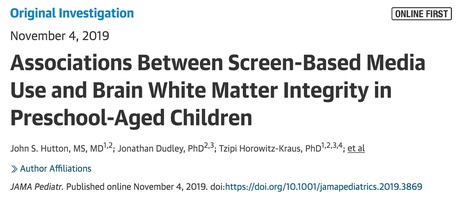
Importance The American Academy of Pediatrics (AAP) recommends limits on screen-based media use, citing its cognitive-behavioral risks. Screen use by young children is prevalent and increasing, although its implications for brain development are unknown.
Objective To explore the associations between screen-based media use and integrity of brain white matter tracts supporting language and literacy skills in preschool-aged children.
Design, Setting, and Participants This cross-sectional study of healthy children aged 3 to 5 years (n = 47) was conducted from August 2017 to November 2018. Participants were recruited at a US children’s hospital and community primary care clinics.
Exposures Children completed cognitive testing followed by diffusion tensor imaging (DTI), and their parent completed a ScreenQ survey.
Main Outcomes and Measures ScreenQ is a 15-item measure of screen-based media use reflecting the domains in the AAP recommendations: access to screens, frequency of use, content viewed, and coviewing. Higher scores reflect greater use. ScreenQ scores were applied as the independent variable in 3 multiple linear regression models, with scores in 3 standardized assessments as the dependent variable, controlling for child age and household income: Comprehensive Test of Phonological Processing, Second Edition (CTOPP-2; Rapid Object Naming subtest); Expressive Vocabulary Test, Second Edition (EVT-2; expressive language); and Get Ready to Read! (GRTR; emergent literacy skills). The DTI measures included fractional anisotropy (FA) and radial diffusivity (RD), which estimated microstructural organization and myelination of white matter tracts. ScreenQ was applied as a factor associated with FA and RD in whole-brain regression analyses, which were then narrowed to 3 left-sided tracts supporting language and emergent literacy abilities.
Results Of the 69 children recruited, 47 (among whom 27 [57%] were girls, and the mean [SD] age was 54.3 [7.5] months) completed DTI. Mean (SD; range) ScreenQ score was 8.6 (4.8; 1-19) points. Mean (SD; range) CTOPP-2 score was 9.4 (3.3; 2-15) points, EVT-2 score was 113.1 (16.6; 88-144) points, and GRTR score was 19.0 (5.9; 5-25) points. ScreenQ scores were negatively correlated with EVT-2 (F2,43 = 5.14; R2 = 0.19; P < .01), CTOPP-2 (F2,35 = 6.64; R2 = 0.28; P < .01), and GRTR (F2,44 = 17.08; R2 = 0.44; P < .01) scores, controlling for child age. Higher ScreenQ scores were correlated with lower FA and higher RD in tracts involved with language, executive function, and emergent literacy abilities (P < .05, familywise error–corrected), controlling for child age and household income.
Conclusions and Relevance This study found an association between increased screen-based media use, compared with the AAP guidelines, and lower microstructural integrity of brain white matter tracts supporting language and emergent literacy skills in prekindergarten children. The findings suggest further study is needed, particularly during the rapid early stages of brain development.
Our leading health economist says that when it comes to healthcare funding, we should think about compassion and social justice, as well as being efficient.
To get content containing either thought or leadership enter:
To get content containing both thought and leadership enter:
To get content containing the expression thought leadership enter:
You can enter several keywords and you can refine them whenever you want. Our suggestion engine uses more signals but entering a few keywords here will rapidly give you great content to curate.


 Your new post is loading...