Your new post is loading...

|
Rescooped by
Edwin Rutsch
from Empathy Movement Magazine
October 23, 2018 6:18 PM
|
Designers, it’s time to stop talking about “empathy.”
According to Google Trends, the term “empathy” now appears in Search more than six times as often as it did in 2004. Finding a job description for a design role that doesn’t mention “empathy” is near impossible. Undergraduate and graduate schools alike espouse “learning how to empathize” in the curricula. Empathy is everywhere, and especially in design. - BECOME MORE EMPATHIC
- MAKE EMPATHY A RITUAL
- BROADCAST YOUR FINDINGS
- CREATE EMPATHY MAPS
- HELP OTHERS UNDERSTAND THE VALUE OF EMPATHY
- HIRE EMPATHIC DESIGNERS
- KNOW YOUR LIMITS
- COPY OTHERS
Michael Chanover is vice president of design and user experience at NerdWallet.
|
|
Rescooped by
Edwin Rutsch
from Empathy Movement Magazine
September 21, 2018 12:50 PM
|
In my experience, the most effective way to practice empathy as a designer is to observe users interacting with your product or service in their own environment, be that home, work, or out and about. Observing users in the field allows us to glean insights that cannot be captured through other research methods. However, the reality is that observational field work rarely happens because it is time and resource intensive. How else can we build empathy for users? Firstly, try to utilize a diverse set of research methods to gather insights about your existing or potential customers. This way you can capture a range of insights from participants and gain a well-rounded picture of how they perceive and experience your product. Understanding how your product fits into and impacts the lives of your customers will help you to develop empathy for them, so create a variety of opportunities to learn as much about them as you can.
|
|
Rescooped by
Edwin Rutsch
from Empathy Movement Magazine
August 24, 2018 5:51 PM
|
Designing an action or an app to benefit a user is a mission in itself. We run largely on empathy. Empathy binds us and also motivates us. When we unlock the proper points and sequence we have an empathy map.
In any sort of user design action we map out a journey for the user based on their anticipated preferences. Preparing a product or service for a user is like clearing a field. You have to scope out the plot, anticipate desired usage, then position buildings and constructs to best advantage.
You must survey, clear obstacles, grade and prepare the plot for habitation. The action depicted above defines the objective of creating an effective video production. The user must be thought of every step of the way.
You are mapping actions against anticipated o
|
|
Rescooped by
Edwin Rutsch
from Empathy Movement Magazine
August 18, 2018 8:40 PM
|
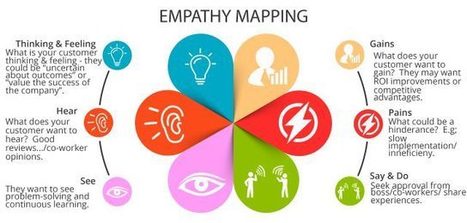
What is an Empathy Map?
Empathetic thinking might not be something you’d jump to address when outlining a basic plan of action for a client. However, it is slowly creeping into business concept planning and product strategy in the form of an empathy map.
To put it simply, an empathy map is a tool that, if used correctly, allows you to understand your target audience. Through filling in an empathy map you can understand and cater to the clients wants, needs, goals and feelings.
Below you can see an Example of a Map and How the Attributes of the Client are Thought About:
|
|
Rescooped by
Edwin Rutsch
from Empathy Movement Magazine
August 18, 2018 8:38 PM
|
Michael Ventura is quick to dismiss the notion that empathy is some touchy-feely emotion that makes leaders seem soft. In business, he argues, empathy is what can help a company vanquish the competition, gain loyal customers, retain innovative employees and elevate itself from good to great. Ventura, founder and CEO of strategy and design studio Sub Rosa, has put the lessons he’s learned from working with major brands into a book titled, Applied Empathy: The New Language of Leadership. He recently joined the Knowledge@Wharton show on SiriusXM to discuss why this particular emotion is becoming paramount in the business world.
|
|
Scooped by
Edwin Rutsch
August 17, 2018 10:49 PM
|
There’s a stereotype in politics that the left is all about “bleeding hearts” and the right is only about “personal responsibility”. I’m not here to challenge political stereotypes, but I know that for growth—personal and communal growth—we need both. We need to empathize while also holding ourselves and others accountable. One or the other does nobody any good.
So, yes, men need to come together into groups. They need to come out of isolation and give up the myth of full independence, but they need to do so outside of the space that reinforces patriarchy and inside the space that moves us forward.
|
|
Rescooped by
Edwin Rutsch
from Empathy Movement Magazine
August 2, 2018 8:51 PM
|
Empathetic design is an evolving process that's being enhanced by new digital tools that offer a deeper look inside user experience. Patients and families are confronted daily with difficult decisions that impact their future, and caregivers are responding to patient needs in a swiftly changing healthcare system. Designing healthcare environments that address patients’ well-being while increasing caregiver efficiency is the goal of good design. Yet successful healthcare design often depends on an in-depth understanding of how people use and experience spaces. As such, empathetic design is gaining prominence as a way for designers to truly see and experience the healthcare environment as patients see and experience it. Rather than rely exclusively on the trackable data of evidence-based design (EBD), Lean planning, practice-based research, and patient experience strategies, empathetic design relies more on experiential data. By Kara Freihoefer August 2, 2018
|
|
Scooped by
Edwin Rutsch
July 29, 2018 10:10 PM
|
Business Design Process PowerPoint Templates
|
|
Rescooped by
Edwin Rutsch
from Empathy Movement Magazine
July 9, 2018 11:40 PM
|
In a recent webinar that I delivered for the British Council on Emotional Intelligence and Coaching, I introduced the concept of Empathy Mapping. This caused quite a stir and many people were quite excited by the prospect of having a tool that enabled the development of empathy, although for many the empathy mapping process was hard to grasp within the confines of a webinar. So in this post I’d like to expand on some of the aspects of this tool and how to use it.
Firstly, why empathy? There are many reasons why we would all benefit from developing a little more empathy. Empathy is defined as ‘the ability to understand and share the feelings of another.’
This is something that’s becoming increasingly necessary in a world that seems polarised by intolerance and a lack of cultural understanding and sympathy. Having a greater sense of empathy with and understanding of the people around us can also help us to develop more productive and positive relationships and help reduce personal conflicts.
|
|
Rescooped by
Edwin Rutsch
from Empathy Movement Magazine
May 29, 2018 12:47 PM
|
A Culture of Empathy and Empowerment
Over the past five years, a partnership with MIT’s D-Lab and a desire to involve my students in work that truly matters have prompted me to transition from the use of such “semi authentic” strategies as simulations, role-playing, and design challenges to PBL projects centering on purposeful designing and real world making. Brookwood students constructed an efficient biomass stove for our campus, built a 3D printed Enable Community Foundation prosthetics for my son, created “purpose-built” attachments for his “Raptor Hand”, designed solutions for problems teachers have identified in our school, and invented assistive devices for residents at a seniors’ affordable housing residence; and in each case, taking another’s perspective has proven critical to the success of the solutions by Rich Lehrer
|
|
Rescooped by
Edwin Rutsch
from Empathy Movement Magazine
May 26, 2018 5:50 PM
|
Use a template to conduct more efficient user interviews for better understanding of your product A User Interview is a conversation with your end user(s), during which a researcher asks specific questions and records the user’s responses. It can be focused on examining the user experience, the usability of a product, or fleshing out data for input into Customer Personas, etc. Ideally, an interview should be conducted by two UX researchers and one user, where the first researcher would be in charge of asking questions and guiding the interview, while the second would collect observations on the interviewee’s behavior and emotional feedback to the questions, as well as take notes. Alternatively, a video/audio recording can be of support as well, if the second researcher is not available.
|
|
Rescooped by
Edwin Rutsch
from Empathy Movement Magazine
May 26, 2018 5:49 PM
|
User Story Mapping is a technique applied by product managers and development teams to plan product features that will enable the most delightful user experience. First introduced by software leader Jeff Patton, this visual exercise allows envisioning a product or service as a series of activities or tasks that the users perform. User Story Mapping suggests building a detailed grid of user stories arranged under the headings that reflect an outline of the users’ interactions with the product. This enables assessing which steps are perceived as the most valuable by the users, and prioritize what features to build next.
|
|
Rescooped by
Edwin Rutsch
from Empathy Movement Magazine
May 21, 2018 2:57 PM
|
Empathy is an important element in Design Thinking and Human-Centred Design. What is empathy exactly? Why is empathy so important to designing solutions that actually work for people? Here, we’ll not only look at what empathy means, but will also look at how it helps design thinkers create solutions that work and, conversely, how a lack of empathy can result in product failure. We’ll also come to understand the empowering notion that everyone can master empathy and design truly human-centred solutions. Empathise methods
The following are our favourite Empathise methods - Assume a beginner’s mindset
- Ask What-How-Why
- Ask the 5 whys
- Conduct interviews with empathy
- Build empathy with analogies
- Use photo and video user-based studies
- Use personal photo and video journals
- Engage with extreme users
- Story share-and-capture
- Bodystorm
- Create journey maps
|
|
|
Rescooped by
Edwin Rutsch
from Empathy Movement Magazine
October 9, 2018 4:38 PM
|
What is a human-centric culture?
A human-centric culture requires a level of empathy because it focuses on the needs of others, such as employees concerned about workloads and customers needing their product delivered on time, while fulfilling the financial team’s role to maintain profitability.
Citera says it involves the personal touch: “You don’t operate from your desk and shoot emails. You have to be face to face. You have to have a seat at the table. It’s about becoming a true business partner.”
He says the human-centric finance team must participate in conversations around the organisation, enabling team members to direct, guide and highlight issues.
|
|
Rescooped by
Edwin Rutsch
from Empathy Movement Magazine
September 8, 2018 3:41 PM
|
Good Design Requires Two Things: Empathy To Understand A Problem, And Creativity To Solve It.…”
|
|
Rescooped by
Edwin Rutsch
from Empathy Movement Magazine
August 21, 2018 9:07 PM
|
Find the optimal level of empathic engagement. There are 3 levels of empathy: cognitive, emotional, and compassionate empathy.
a. Cognitive empathy is when you put yourself into someone else’s place, and see their perspective. It is very possible that you do this without feeling any sympathy/pity.
b. Affective / emotional empathy is when you feel the other person’s emotions alongside them. Careful not to be overwhelmed by those emotions. You might have a empathy overload where you are unable to respond and might destroy the users’ trust and even destroy you.
c. The last is compassionate empathy. It is what usually understood by people as empathy. We need to first understand and then sympathise with what they are going through. Finally we take, or help them to take, action to resolve the problem.
|
|
Rescooped by
Edwin Rutsch
from Empathy Movement Magazine
August 18, 2018 8:40 PM
|
|
|
Rescooped by
Edwin Rutsch
from Empathy Movement Magazine
December 21, 2018 6:03 PM
|
Design thinking comes of age, design thinking and empathy There are other ingredients that should enrich the conversation about design thinking that are not fully represented in this human-centered approach. - Empathy Is Single-Minded
- Empathy Lives in the Present
- Empathy Is Only One Language
- Design Thinking Culture Can’t Live within an Organization
|
|
Rescooped by
Edwin Rutsch
from Empathy Movement Magazine
August 17, 2018 1:39 PM
|
What is an Empathy Map?
Empathetic thinking might not be something you’d jump to address when outlining a basic plan of action for a client. However, it is slowly creeping into business concept planning and product strategy in the form of an empathy map.
To put it simply, an empathy map is a tool that, if used correctly, allows you to understand your target audience. Through filling in an empathy map you can understand and cater to the clients wants, needs, goals and feelings.
Below you can see an Example of a Map and How the Attributes of the Client are Thought About:
|
|
Rescooped by
Edwin Rutsch
from Empathy Movement Magazine
July 29, 2018 10:13 PM
|
This is the "classical" Empathy Map from a Design Thinking perspective - to ensure you do observe appropriately in the Empathise Phase! F…
|
|
Rescooped by
Edwin Rutsch
from Empathy Movement Magazine
July 19, 2018 12:40 AM
|
Design thinking is more than just a passing fad. Some of the world’s top brands including IBM, Apple, and Google have embraced the design thinking mindset in an effort to guess less and design products and experiences that truly resonate with their user base. Unlike decades prior, the one-size-fits-all, mass production approach is no longer enough to succeed and thrive.
Design thinking is a human-centric, iterative process to understand the user, challenge assumptions, and redefine problems. It’s made up of five core phases: empathize, define, ideate, prototype, and test. The first step, empathy, draws on our ability as researchers and designers to see the world through other people’s eyes, feel what they feel, and experience things as they do. We do this by putting aside our own preconceived ideas, adopting humility, and choosing to understand the ideas, thoughts, and needs of others instead.
|
|
Rescooped by
Edwin Rutsch
from Empathy Movement Magazine
July 5, 2018 4:47 PM
|
The old saying that you should ‘walk a mile in someone else’s shoes’ to understand what they are going through is really the essence of what design thinking is all about. If the goal is to design a technology solution to a customer problem, it makes a great deal of sense to go the extra mile to understand that problem from their perspective. A design thinking approach puts empathy for the end user foremost in problem solving. “Empathy for the customer’s problems is at the center of a good design. If the solution is empathetic, people are more likely to want to engage with the design. They will then be more willing to fall in line with the solution that emerges,” said Pierre Enriquez, Scrum Master at TDK Technologies. Design Thinking Process: Explore, Create, Implement
|
|
Rescooped by
Edwin Rutsch
from Empathy Movement Magazine
May 26, 2018 5:53 PM
|
Infolio space is a collection of notes, tasks, documents, weblinks and other information on a large visual board. You are welcome to review it, save, update and collaborate with ease.
|
|
Rescooped by
Edwin Rutsch
from Empathy Movement Magazine
May 26, 2018 5:50 PM
|
When to Use an Empathy Map
Its common knowledge that users are more likely to buy the products that meet their actual pain points and needs rather than those targeting their wants. If done properly, an Empathy Map works as a great Lean User Persona.
Drafting an Empathy Map is a great exercise to apply every time you need to understand the people you design your product for. Filling it in enables insights into your customers' critical needs, for you to deliver "must-have" rather than "nice to have" products, be profitable and win your market share.
How to Use an Empathy Map
An Empathy Map can provide insights for various departments of your business, be it design team or marketing. You can draw it yourself or fill in a ready template online - if you work in a remote team and need a framework for ideas generation and planning.
|
|
Scooped by
Edwin Rutsch
May 21, 2018 7:11 PM
|
Michael Ventura, founder and CEO of brand and business consultancy Sub Rosa, gets noticeably enthusiastic when talk turns to his new venture, a book called Applied Empathy: The New Language of Leadership, out May 22. Several years in the making, the book is the manifestation of his acknowledgment both that Sub Rosa needed to refine and clarify its purpose and also that culture—and business—were evolving. Empathy was taking center stage as a competitive advantage in so many contexts of companies and marketing and communication and leadership.
|