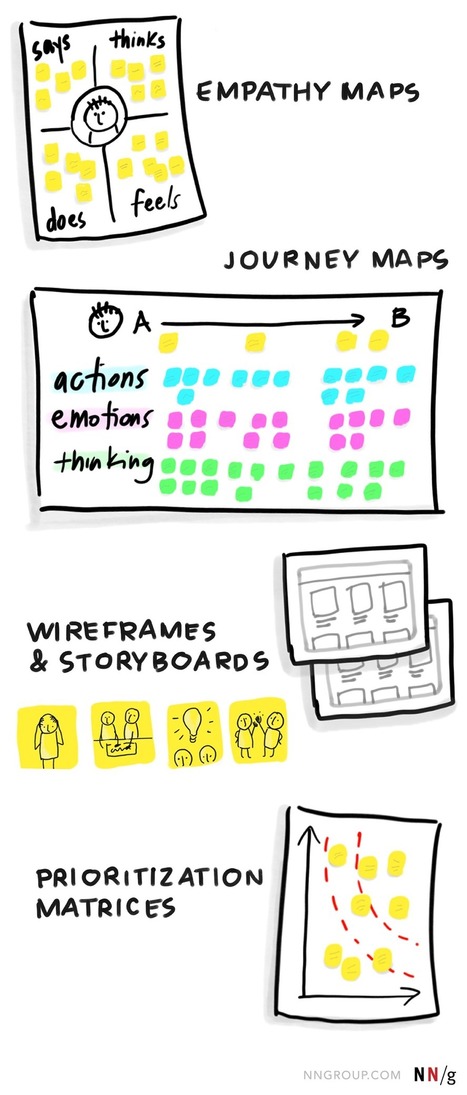
Not only does design thinking foster innovation, but it also strengthens teams by creating common vocabulary and artifacts, and a trust-based team culture.
A key principle of design thinking is “show, don’t tell.” Throughout the design-thinking process, the team produces several tangible artifacts: empathy maps, journey maps, storyboards, and wireframes, to name a few.
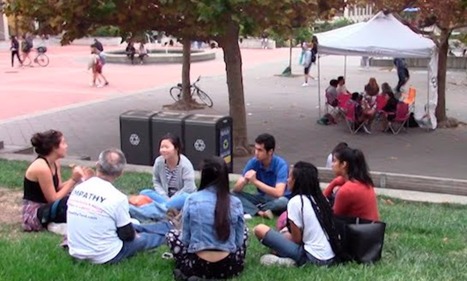
In the last few years, I’ve been exploring the use of Empathy Circles with some of my organizational clients, with facilitator learning groups, and in communication workshops. I’ve been finding that it is a great introduction and warm-up for Dynamic Facilitation, as it offers everyone in the room the opportunity to engage in offering listening reflections to one another.
At the same time, I’m totally excited to see that Edwin Rutsch, the creator of Empathy Circles, has been bringing his work into the arena healing political divides. My experience is that this simple-yet-powerful form is actually quite revolutionary, in the best sense of the word, and so I want to delve a bit into what I see as the underlying dynamics. But first, a brief description, followed by a distinction and clarification…
But the future will be best embraced by those who go back to the basics.
“For me as a designer, empathy is not the end, it’s the means,” Brown said. “I don’t want to be designing things just for me. I want to be designing things for people who are different from me.”
Empathizing is crucial to a design process because people do not buy the product – they buy the experience. Creating a good experience requires careful exploration and detailed studies, considering that utility and usability are two sides of the coin.
Designers are not the end users. They can never be objective and realistic unless they have previously listened to the needs of the target group. If we were to exclude the creative ego and give a real-life scenario to the users by putting them through it, we would confirm and validate the ideas and the solutions during the process. The following are some of the methods we use on our projects, especially during the phases of exploration of the industry, target audience, and product’s purpose.
Design Thinking and Human-Centered Design approaches, as applied to eLearning, focus on designing solutions that work for real learners in real workday situations. As such, empathy is an essential element in a Design Thinking approach to eLearning, and it is the first stage of any Design Thinking-based process.
Figure 1: The Design Thinking process starts with empathy
In a instructional design context, empathy requires understanding the pain points and the daily reality of your target audience; it also requires some knowledge of learners’ motivations and needs, which might not be obvious.
In some ways, this stage is similar to a conventional needs analysis: You’re defining your target audience and describing the problems the eLearning is meant to solve. You might come up with a profile of a typical learner—a persona—for whom you develop the training solution. You might brainstorm possible solutions—a conventional eLearning course, microlearning, a job aid—that could solve the learner's problem.
Empathy is a big word these days, especially in the world of design. A lot of times though people use the word empathy without giving the empathic bond the time or patience it deserves, causing it’s meaning and purpose to become convoluted.
Empathy is not a hard thing to understand.
Empathy helps us to feel how another person feels.
Empathy provides a perspective outside of our own.
Empathy is a transformation from acting as self to acting as other
Role-Playing Games are in some respects an exercise in empathy
An empathic bond takes time to accomplish
Personas are only as useful as the designer allows them to be
Empathy is one of those things that can help in any part of life whether it’s your family, friends, that special person and even also at work. Understanding what empathy is and how it effects people…
What good will empathy do?
There are so many benefits of having empathy, so I’ll just state a few. The end result of it is
a happy team
a well groomed end-product
good work culture.
So, like many other problems we face as software engineers, we tend to solve problems by devising an algorithm. Here is “pseudo code” for empathy.
1- better understanding of your colleagues: If you understand them better., you can help them better.
2- The unsaid things: Your team might not share everything with you. Based on their body-language, tone, voice, you will have a better idea of their situation.
3- Resolving conflicts: When you understand the unsaid things, you can address them and make your team members feel heard. This is the first step of resolving a conflict.
Empathy is the experience of understanding another person’s thoughts and feelings from their point of view, rather than your own. An empathy map is a tool that I like to use with teachers to take a human-centered approach when thinking about personalizing students learning.
Originally designed for businesses to think about their customers needs, schools are now using them to think about their students needs. Empathy maps shed light on which problems to solve within your school or classroom through a protocol
Tips for introducing an empathic mindset in your company
Without a mutual understanding of the benefits that an empathic design approach can bring, it can be difficult to stand up to business-driven product requirements or unvalidated assumptions about the right solutions to implement.
One of the easiest ways to help others in your team or company to start thinking more empathically is to invite them to sit in on user research or user testing. Ask them to be your note taker, or simply have them observe. When a non-design team member can actually see and hear first hand a user experiencing and interacting with a product, it gives them an opportunity to develop empathy for that user and create a meaningful connection with them.
Here’s a common scenario: Your team just spent a crazy week pulling together a prototype for upcoming user research. Schedules are tight, pressures are high. Despite all the effort, it turns out the prototype isn’t really what you needed to have an awesome conversation with a customer.
But at this point, only small tweaks to the prototype are feasible — because who has time for more? And frankly, you would feel like a real jerk if you were to ask for more. The team just sunk in a massive amount of time and effort. ...
These are a mix of things we’ve been trying, as well ideas that emerged in conversations we’ve had with dozens of researchers (within and outside of Microsoft) about how they ensure empathy is built in — versus bolted on — while prototyping.
Empathy can be thought of as a "superpower" students as young as 3rd grade can learn and develop, writes Roberto Brandao of New Jersey's Solomon Schechter Day School of Bergen County
Here are some actionable ways educators can teach empathy in the classroom.
Teaching empathy through project-based learning One way that schools can teach students empathy is engaging students in creative, interdisciplinary technology projects focused on building empathy. For example, at SSDS, our 3rd graders recently collaborated with change management and marketing guru Cynthia Phillips — founder and CEO of The Disruptive Factory, a social change consultancy — as testers and ambassadors for a new animated cartoon series and a transmedia campaign called “Verti.” This year-long project introduces students to fictional characters in the animated cartoon and will ultimately culminate in students building prototypes of a space station they think would benefit the characters, promoting empathy.
Creating empathy maps
Research shows the best way for students to begin to understand empathy is by doing — which is why one of the best things educators can do is to promote active learning.
Designing a curriculum that teaches active listening Another way to promote empathy is through active listening, which is why I created Pocket Empathy, an exercise that teaches 3rd graders the skill of active listening.
Integrating design thinking
Teaching kids about empathy starts with demonstrating what it means to maintain a positive mindset that’s reflected in the way they speak.
EMPATHIZE WITH CUSTOMERS, EMPLOYEES, AND OTHER END USERS.
One way to develop more empathy with—and gain new insights about—your customers is to look beyond the narrow definition of your offering and consider the customer’s total experience. The more broadly you define the customer experience, the more opportunities you can identify for improvement.
Say, for example, you make interior house paint. You could focus narrowly on the characteristics of the product itself, on making the paint less drippy or making it cover a surface in a single coat. But you’ll find many more opportunities for innovation if you think about the arc of the customer experience. In something as simple as repainting a bedroom, there are probably a dozen steps (each one of which is a chance to innovate): from getting customers to realize that it’s time to repaint, to helping them choose the color, to shortening the preparation and cleanup time, to keeping track of which colors are on which walls for future reference when it comes time for touch-up.
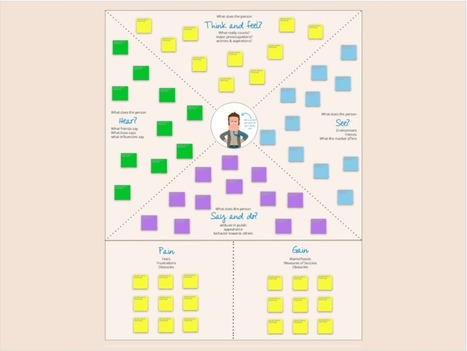
What is an Empathy Map? Empathy maps describe what a customer goes through as he/she is trying to complete a task, in a product or brand agnostic way. In other words, empathy maps allow you to take a step back from your product and paint a picture of a typical customer’s experience — their needs, expectations, goal, hurdles, and behavior as they try to overcome those hurdles.
A typical empathy map has 4 main ‘observation-based’ sections – say, think, do, feel. This framework can be further evolved by adding two more ‘analysis-based’ sections: pains and gains. Open-ended empathy maps yield better results, however, to limit the scope of the exercise, it is better to limit it to a specific problem or a task at hand.
"In the last few years, I’ve been exploring the use of Empathy Circles with some of my organizational clients, with facilitator learning groups, and in communication workshops. I’ve been finding that it is a great introduction and warm-up for Dynamic Facilitation, one of my core practices, as it offers everyone in the room the opportunity to engage in offering listening reflections to one another.
At the same time, I’m totally excited to see that Edwin Rutsch, the creator of Empathy Circles, has been bringing his work into the arena healing political divides. My experience is that this simple-yet-powerful form is actually quite revolutionary, in the best sense of the word, and so I want to delve a bit into what I see as the underlying dynamics. But first, a brief description, followed by a distinction and clarification…"
At this time code.Talks about the definition of empathy, - talks about against empathy. - the different types of empathy,, - empathy in design.
Empathy is a means, how people will use and experience products I design. I want to imagine how the person in the future will use it. it is extremely useful to imagine the experience of others.
Fortune's Clay Chandler interviews IDEO President and CEO on stage at Brainstorm Design in Singapore.
Instead, there is another human trait we can use to lead through the uncertainty of complex challenges: empathy.
Design thinking is one approach to solving complex, human-centered challenges that points to our evolving leadership. Made popular in part by the design firm IDEO, design thinking builds on the principles of problem definition, solution design and experimentation. To define the problem, however, all design thinking begins with the need to empathize with those needing the solution.
Start by building empathy Healing centered engagement begins by building empathy with young people who experience trauma. This process takes time, is an ongoing process and sometimes may feel like taking two steps forward, and three steps back.
However, building empathy is critical to healing centered engagement. To create this empathy, I encourage adult staff to share their story first, and take an emotional risk by being more vulnerable, honest and open to young people. This process creates an empathy exchange between the adult, and the young people which is the foundation for healing centered engagement (Payne 2013).
This process also strengthens emotional literacy which allows youth to discuss the complexity of their feelings. Fostering empathy allows for young people to feel safe sharing their experiences and emotions. The process ultimately restores their sense of well-being because they have the power name and respond to their emotional states.
Should toilets in refugee camps have built-in lights? That might seem like a no-brainer – it certainly did to us when we were faced with this question. As it turns out, that’s a terrible idea.
This is an example that illustrates why we need to take the time to understand and build empathy for the people we’re designing for. Otherwise, we risk doing more harm than good.
This first encounter with design thinking helped me or rather reminded me of the thing that was never accentuated enough, EMPATHY.
The underlying principle behind all the great products is empathy, it all narrows down to how well is a product or a service designed according to the people who are actually supposed to use it.
In a world where there are copious choices available on everything, the one that we as humans gravitate towards happens to be the one that is actually designed for us.
Yes ,there are other factors like brand, price to name a few but in long run we only tend to stick to things that doesn’t seem like work, that doesn’t feel like work, things that just gets inculcated in our daily life seamlessly.
(19:05) Creating time for empathic work: Doing something is better than nothing. Make explicit the things you don’t know and seek out opportunities to go learn.
(22:58) A career in empathy: How empathy became essential to Jane’s design research methods.
Empathy is critical not only to the design process but also to the framing and approach of how individuals address important social issues. Every decision we make as designers can raise or lower a person’s ability to participate in society.
On a larger scale, its impact manifests in the products we create, the breakdown of communication barriers, and an increased awareness of others’ lived experiences. The ability to empathize serves as a catalyst for inclusive design.
What is an empathy map? It's a key tool that helps you better understand your customer base. Learn how to use empathy maps in this blog post.
How to Create an Empathy Map
1. Decide on a customer persona.
Before diving in, it's important to understand who your customer is. Start by analyzing customer data. Figure out some average demographics and psychographics associated with your customer base.
For instance, according to Chron.com, the average Starbucks customer profile includes high-income high-spenders, busy people living in cities, and healthier professionals, among others. Using these insights can help Starbucks come up with a customer profile, such as "Jackie, 28 years old, lives in Boston and makes an income of $90,000 as an account executive. She regularly attends spin classes, is vegetarian, and enjoys sushi and rooftop bars." Similarly, you should come up with a customer persona to which the empathy map is directed.
Ten years ago, in a project interview, I was asked a question by Rob, CEO of a large healthcare organization: “How can design improve empathy in our organization?”
The question has stayed with me, and continues to profoundly shape my work as a designer committed to health and wellness in the built environment. I reflect on the question often, imagining and exploring potential responses—which can and do vary greatly.
Ten years ago, I did my best to respond based on work I’d done with Planetree, and our team was fortunate to be awarded the project. In truth however, my reply that day and work on the project was just the beginning of my immersion into this significant topic.
Empathy maps describe what a customer goes through as he/she is trying to complete a task, in a product or brand agnostic way. In other words, empathy maps allow you to take a step back from your product and paint a picture of a typical customer’s experience — their needs, expectations, goal, hurdles, and behavior as they try to overcome those hurdles.
A typical empathy map has 4 main ‘observation-based’ sections – say, think, do, feel. This framework can be further evolved by adding two more ‘analysis-based’ sections: pains and gains. Open-ended empathy maps yield better results, however, to limit the scope of the exercise, it is better to limit it to a specific problem or a task at hand.
Drawing empathy maps reveals previously overlooked parts of the customer experience and helps find gaps in the current offering and future roadmaps. Empathy maps can also yield adjacent products and services that can elevate the usability of the product or simplify the task at hand.
To get content containing either thought or leadership enter:
To get content containing both thought and leadership enter:
To get content containing the expression thought leadership enter:
You can enter several keywords and you can refine them whenever you want. Our suggestion engine uses more signals but entering a few keywords here will rapidly give you great content to curate.


 Your new post is loading...