Empathic Design: Empathy Team 7 - How might we design tools to foster a more empathic way of being?
This is information about the Acumen-IDEO Human-Centered Design Course - Starting August 20th. We are forming two to three teams to take the Acumen-IDEO Human-Centered Design Course together.
This is a 7 week course, however, since we are doing our own design challenge it takes longer and we will go for 10 weeks.
4 to 6 people per team
10 weeks commitment
5+ hours per week. 3 hours meetings, 2+ hours readings, research, etc.
We will be doing our own custom design challenge which is initially,
Empathic Design: Empathy Team 7 - How might we design tools to foster a more empathic way of being?
This is information about the Acumen-IDEO Human-Centered Design Course - Starting August 20th. We are forming two to three teams to take the Acumen-IDEO Human-Centered Design Course together.
This is a 7 week course, however, since we are doing our own design challenge it takes longer and we will go for 10 weeks.
4 to 6 people per team
10 weeks commitment
5+ hours per week. 3 hours meetings, 2+ hours readings, research, etc.
This is information about the Acumen-IDEO Human-Centered Design Course - Starting August 20th. We are forming two to three teams to take the Acumen-IDEO Human-Centered Design Course together.
This is a 7 week course, however, since we are doing our own design challenge it takes longer and we will go for 10 weeks.
4 to 8 people per team
10 weeks commitment
5+ hours per week. 3 hours meetings, 2+ hours readings, research, etc.
We will be doing our own custom design challenge which is initially, How might we design a more empathic way of being?
It's no secret that I spend a lot of time thinking about, practicing, and spreading empathy. Jeremy Rifkin's The Empathic Civilization anchored my praxis with the thesis: Preserving humanity and the biosphere require empathy.
According to Rifkin, this isn't a soft skill some people embody more than others, but rather a necessary intervention for humanity to get off a collision course. From my end, I endeavor to make it a bigger part of education, the place where we receive most instruction and participate in learning.
For Edwin Rutsch, his reach is a lot wider, more global, and covering people of greater age and geographical range. It is an honor to collaborate with Edwin, and support his work.
Edwin is influenced by Carl Rogers, the father of the person-centered approach to therapy. Edwin shared this quote with me about how empathy arises when one has a companion with them on a journey, which inspires me to cultivate even deeper empathy practices:
A workshop activity that forges alignment on user needs, goals, and pain-points, Persona Empathy Mapping bridges the gap between personas and design concepts.
Empathy: it’s a buzzword in the UX design world. Everybody’s doing it! But what exactly are they doing?
There isn’t a quick “Empathy Filter” that we can apply to our work or our team, no formula to pump out results, and no magic words to bring it forth. There is, however, a simple workshop activity that you can facilitate with stakeholders (or anyone responsible for product development, really) to build empathy for your end users. At Cooper, we call it Persona Empathy Mapping.
When considering how to design products, teams or even common every day household objects, empathy doesn't end up on the required features list.
Yet, without empathy, teams with enormous technical skills can fail in their quest to deliver quality products to their users. Incredible projects fail to create communities because they don't exercise it. Fail at empathy and your chances of failing at everything skyrocket.
Contrary to what you may have heard, empathy is not something you're innately born with - it's a skill that can be learned, cultivated, refined and taught to others. In this presentation, your lovely co-speakers will discuss the value of empathy, how you can cultivate in yourself and your organizational culture, and conclude with concrete steps for leveling up in your interactions with your fellow human beings.
Find out how to use an empathy map as a collaborative tool for agile teams to gain deeper insight into their customers.
Ask questions, such as what would this user be:
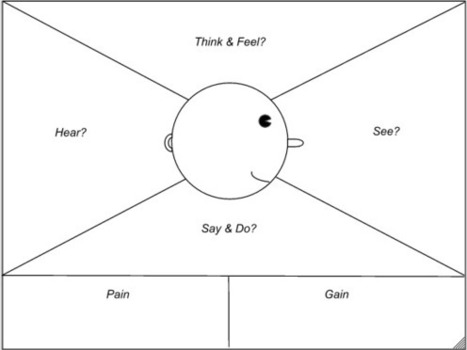
– thinking & feeling about their worries or aspirations? – hearing while using our product, from their friends or boss? – seeing while using our product in their environment? – saying & doing while using our product in public or in private? – experiencing as a pain point or fear when using our product? – experiencing as a positive or gain when using our product?
Designers translate human needs and desires into experiences that fulfill them. Over the last decade I've practiced human-centered design and believe it demands more than just empathy with others; it requires a deep understanding of our own selves.
In this talk I will share thoughts on the future of human-centered design, the dangers of empathizing with the needs of the few, and the importance of designing for friction and self-reflection.
I will share principles and practical tools for designing experiences that help us — practitioners and consumers — know ourselves, and the impact that this knowledge can have on customer satisfaction, delight, behavior change, even transformation.
What does it mean to practice "human-centered" design?
Why is it important — as a designer, product manager, engineer, or strategist — to "know yourself"?
How do we put these philosophical ideas into practice and make better products?
At this year's Google I/O conference in San Francisco, I sat down with the two UX experts and asked them what designers could do to make their apps more accessible. The key, they told me, was using your imagination and having a little more empathy. Here are six ways designers can reach that extra billion.
Designers can reach over 1 billion people just by keeping accessibility in mind, says Google's Astrid Weber and Jen Devins.
PUT YOURSELF IN YOUR USERS' SHOES
Empathy is all about understanding, but many designers never think beyond what life is like for them. Handicapped users have a very different experience of the world, even doing simple things. You need imagination if you're going to design an app that works for them.
This certainly offers an insight into the President’s thinking and priorities, but how would anyone set about closing that empathy deficit in practice?
Design may be leading the way. In the UK and globally, designers are embracing empathy to improve not just objects, as they traditionally have, but systems and services – often with dramatic results.
While design today is most often associated in the public consciousness with stylish furniture and smart phones, designers’ renewed emphasis on empathy goes much deeper, borrowing from neuroscience, behavioural psychology, economics and mindfulness. In an era of multidisciplinary approaches to problem solving, designers are often leading projects that bring together a range of ostensibly more academic disciplines.
When navigating obstacles, we often turn to well-established solutions and get stuck churning in that problem space. We become cyclical and self-referential. Involving others and developing empathy can bring fresh input, perspective, and ideas.
In Practical Empathy for Powerful Decision Making, Indi Young teaches you the different types of empathy, how to develop it, and some tips for persuading the people around you to pay more attention to this powerful tool.
Attend this seminar if you want to learn:
How empathy can actually be used in your work and the most reliable, repeatable kind
Differences between developing empathy using listening sessions and traditional user research through user interviews
How to set up a practice to develop empathy
Tips to help those around you understand how investing in developing empathy can improve your work
This is information about the Acumen-IDEO Human-Centered Design Course - Starting August 20th. We are forming two to three teams to take the Acumen-IDEO Human-Centered Design Course together.
This is a 7 week course, however, since we are doing our own design challenge it takes longer and we will go for 10 weeks.
4 to 6 people per team
10 weeks commitment
5+ hours per week. 3 hours meetings, 2+ hours readings, research, etc.
We will be doing our own custom design challenge which is initially,
How might we design tools to foster a more empathic way of being?
By exploring human emotions through a creative lens, MsThighlights how the ability to understand and feel for others can facilitate an artist’s creative process....
Drawing from the emotional experiences of others helps a creative thinker build a connection with their audience.
In whichever way it is utilised, empathetic creativity helps solving problems whether these are social, financial or technological. It brings social issues to light and forms bridges between people, identifying that each life is, in many ways, similar to our own.
Kanwal Tariq is a bio-technologist, a writer and a feminist.
This is an initial description of the mini empathic design workshop that Edwin Rutsch, director of the Center for Building a Culture of Empathy is prototyping and testing. We are inviting a select group of people who have a proven background and interest in design or empathy to take part.
Participants: 4 to 5 per workshop Time Required: 3 hours Dates/Times: Various dates and time during the coming months. Location: Meet Online Using Google Hangouts. Recording: The call is recorded for educational purposes. No cost to take part in the testing phase.
As we were getting seated, I started telling him about an Empathy Design Workshop that I participated in on August 6, 2015. The Workshop was organized by Edwin Rutsch, Founding Director of Center for Building a Culture of Empathy. That organization's "mission is to build a movement for creating a global worldwide culture of empathy and compassion."
Edwin works tirelessly to create such a culture through community organizing, facilitating empathy circles and "creating a portal for resources and information about the values of empathy and compassion. The site contains the largest collection of articles, conferences, definitions, experts, history, interviews, organizations, videos, science and much more about empathy and compassion."
We are excited to launch our first ever design thinking in schools map and directory. A collaboration between the d.school’s K12 Lab and IDEO’s Design for Learning practice the map is a tool to help parents and educators find inspiration from others and make the connections they need to bring design thinking into their schools.
We are thrilled to feature so many of the schools leading the movement and look forward to more schools and programs adding themselves to the map in the coming weeks. We know we have much to learn from places we haven’t even imagined are using design thinking to build creative confidence. Check out the map at http://designthinkinginschools.org/ and share the news with #DTK12chat.
WHAT is an empathy map? A User Empathy Map can help tee up a discussion about the needs a user has. The discussion will be centered around what was observed, and what can be inferred about these user groups’ beliefs and emotions
Why use an empathy Map
Good design is grounded in a deep understanding of the person for whom you are designing. Designers have many techniques for developing this sort of empathy. An Empathy Map is one tool to help us synthesize our observations and draw out unexpected insights.
We teach it as a synthesis tool to help quickly uncover latent user needs. By introducing this synthesis tool and others, students are provided with tools to help them quickly go through their notes from needfinding in the field to distill down to what are the golden nuggets of opportunity.
This totem exercise is intended to develop empathy for your student by describing them, their challenges and passions, creating a physical representation of them in the form of a totem, and then creating a point of view statement about their challenges and needs
. This all serves as a launching point for designing great curriculum and classroom experiences for them throughout the year.
You can do the exercise with a group of teachers and create a living gallery that you can add to and revisit any time you need throughout the year.
19m 45sec the primary goal of design thinking is to prototype, but I think the biggest goal it is to develop empathy and take the perspective of others. You launch a bunch of kids like that into the world, and it is going to be a better place https://vimeo.com/120727536#t=19m45
Our products have been redesigned from the ground up, but why? Because we're designing with empathy. Vice President of Design Jon Kolko explains what that means and how we're putting it into action.
Walking a mile in your customers' shoes is the first step toward designing great products. Can data help us get there?
You never really understand a person until you consider things from his point of view, until you climb in his skin and walk around in it," declares Atticus Finch in Harper Lee's To Kill a Mockingbird. Gaining that kind of empathic insight is helpful not only for fostering humanity, but for improving business results...
This is the first step toward what Hedman calls "empathic design," an approach he defined in the course of earning his PhD from MIT. He described his techniques in depth in his 2014 paper "Thick Psychophysiology In Empathic Design." His technique is defined by four characteristics:
Psychophysiological data is quantitatively measured.
The research answers explorative, open-ended questions.
Bringing empathy to design is only part of the story. Combining empathy with the Lean Startup methodology allows us to get under the skin of not only our users, but our teams too.
This deck briefly introduces empathic mvps along qith a couple of templates to get you going and building MVPs for empathy.
To get content containing either thought or leadership enter:
To get content containing both thought and leadership enter:
To get content containing the expression thought leadership enter:
You can enter several keywords and you can refine them whenever you want. Our suggestion engine uses more signals but entering a few keywords here will rapidly give you great content to curate.


 Your new post is loading...