Creative decision-making is all about combining intellect and intuition. The UX profession has done well developing our collective design intellect, but we have relatively few resources for developing our intuition.
Empathy helps us by training our intuition, so we can make better design decisions.
In a very real way, UX professionals are in relationships with the people we create things for. Truly empathizing with them is the only way we can build real a real connection, so we can craft meaningful things.
My biggest influences along this journey have come from these sources. I hope they resonate with you as much as with me.
Design Kit is IDEO.org's platform to learn human-centered design, a creative approach to solving the world's most difficult problems.
Empathy
“I can’t come up with any new ideas if all I do is exist in my own life.”
Empathy is the capacity to step into other people’s shoes, to understand their lives, and start to solve problems from their perspectives.
Human-centered design is premised on empathy, on the idea that the people you’re designing for are your roadmap to innovative solutions. All you have to do empathize, understand them, and bring them along with you in the design process.
Anyone who works in tech knows that integrating the right programming languages and using an agile development process are essential to getting a job done.
But the real key to navigating both the exhilaration and the exhaustion of working in the tech space is much more basic—and much more human.
It’s empathy.
Empathy, defined, is “the ability to understand and share the feelings of another.” More simply put, it means being able to put yourself in someone else’s shoes or to see the world through the eyes of someone else.
Join us in our next Ask the UXperts session to chat with Indi about why empathy and active listening are such a key part of great design. The sessions run for approximately an hour and best of all, they don’t cost a cent.
They are text based so there is no audio or video, but a full transcript will be posted up on here in the days following the session.
Where: The UX Mastery Campfire Chatroom When: 3pm Tuesday 4 August PDT or 8am Wednesday 5 August AEST (or find out what time that is for you)
This is the first of a series on Designing for Clinical Empathy,
An over of clinical empathy, how it can influence patient outcomes for the better and being implemented in different types of care systems.
Clinical Empathy
What this comes down to is a concept called clinical empathy, defined as “a cognitive attribute that involves an ability to understand the patient’s inner experiences and perspective and a capability to communicate this understanding.”
Clinical empathy has been linked to improved outcomes for patients with diabetes, colds, and depression. Yet many patients don’t experience it in their healthcare encounters: one study found that doctors interrupt patients within an average of 18 seconds.
To understand why, we must also empathize with doctors. In the 1950s and 60s, medical journals began spreading a concept called ‘neutral empathy,’ based on detached reasoning. They argued that truly experiencing the patient’s pain could bias decisions. In a 1963 article, “Training for Detached Concern,”
In this webinar, you will learn how to bring some foundational design thinking techniques into a current work project. Stanford professors Perry Klebahn and Jeremy Utley combine case study, instruction, and live-fire, real-time working activities in this session to advance an active project in your work and/or life.
Empathy is what we gain when we understand the view points of others. In design, this may be in terms of the needs of a product's users, or it may be in designing solutions to problems faced by people.
We can access empathy in many ways across the content and beyond. This allows us to dig deep into things that people often do not associate with design, such as English and History class. By digging into the content, literature, stories, history, and such, we can begin to practice the skills of empathy and re-design solutions for problems throughout time and literature. We can also do this for social issues, and product development.
“Human-centered design has a role in solving every problem,” says Pam Scott, a serial design thinker whose career has wended from advertising to customer research to a board seat at IDEO.org to a current chapter that might be dubbed activist philanthropy. A born connector, Scott has spent nearly three decades working at the intersection of design and impact, and much of her power lies at getting the right people in the room and prompting them to ask — and answer — the right questions.
“It’s only from a place of deep empathy and connection, that you can have real impact. That’s our creative starting point,”
says Scott of what is at the base of a methodology that marries a handful of cutting-edge techniques resulting in a “new form of human-centered design that not only deeply engages community members in the creative process, but also the NGO that serves that community...
“Everyone who participated in the immersion now has a much deeper understanding of human-centered design and how to create impact by starting from a place of deep empathy.”
By Aaron Britt, senior editor for IDEO.org and Karen Sommer Shalett, managing editor for Impact Magazine
Here are six of the eight members of our Empathy Team at our last meeting. We are taking the Acumen-IDEO, 10 week human-centered design course and are working to design a tool kit to support the nurturing of an empathic way of being in families. We are at the research phase of interviewing people and families about their experiences and needs now.
You can join us and take part in the next iteration of the course starting in August, 2015. We have Bay Area in-person and international online teams forming. Sign up here. http://facebook.com/events/1432429460395307/
The phases of the design process from the Stanford d.school are:
* Empathy - "Empathy is the centerpiece of a human-centered design process. The Empathize mode is the work you do to understand people, within the context of your design challenge. It is your effort to understand the way they do things and why, their physical and emotional needs, how they think about world, and what is meaningful to them. "
* Define - define the problem based on the evidence of the observations.
* Ideate - brainstorm and generate many ideas for potential solutions of to the defined problem.
* Prototype - research and build working examples of ideas.
* Test - test out the prototypes and listen to users feedback.
* Iterate - repeat the process until practical solutions are developed.
You never really understand a person until you consider things from his point of view, until you climb in his skin and walk around in it," declares Atticus Finch in Harper Lee's To Kill a Mockingbird. Gaining that kind of empathic insight is helpful not only for fostering humanity, but for improving business results....
This is the first step toward what Hedman calls "empathic design," an approach he defined in the course of earning his PhD from MIT. He described his techniques in depth in his 2014 paper "Thick Psychophysiology In Empathic Design." His technique is defined by four characteristics:
Psychophysiological data is quantitatively measured.
The research answers explorative, open-ended questions.
The research measures external context.
The research measures internal context.
According to Wired, the technique has been used in design development for a number of major brands, including Google, Best Buy, Lowe's, Hasbro, and Lego.
Now her main job is director of design and innovation programs at SMU.
Much of Canales’ work focuses on integrating empathy with design. In 2012, after she gave a TED talk at SMU on the subject, the dean of the engineering school approached her about incorporating her ideas into their curriculum.
Canales uses a surgery patient as an example of why empathy is essential to design. “
We ask, ‘What is the human experience that the patient is having and how can you design that to be more pleasant, more effective, more filled with compassion?’” she says. “It seems a little callous to say that empathy is a tool, but it is. If you can achieve empathy, you’ll see something new.”
To be successful, we have to better understand them and their needs. Deep customer empathy is the process that occurs when you seek to understand what is behind the customers’ words.
We start with open-ended questions, and move further upstream from energy questions.
We ask about their personal history, which often leads to financial history. We talk about children, school, and their hopes, aspirations and disappointments. We use observation because we are often sitting in the customers’ home. We casually inquire about items or people we see, or overheard conversations.
We listen and look for surprises, and then over time we see if the surprises are one-offs or an actual pattern. This effort is more art than science, although we try to employ tried-and-true techniques I learned in the States, not surprisingly with mixed results
Empathy is the ability to understand and share the feelings of end users, resulting in breakthroughs in experience design and enhanced user interface design
It’s time for product designers to start thinking differently. Why? We have all experienced how great design, coupled with technology, has the potential to make the world a better place. However, what is not very clear is how great design happens or what it entails.
To be successful at digital product design, designers need to create seamless experiences for users. They need to create journeys that feel effortless. Ideally, the design should allow the user to do more with less thought, and without frustration.
A designer cannot achieve this without a strongly? developed sense of empathy.
Putting yourself in the end users’ shoes allows you to move beyond a superficial understanding to a real appreciation of users’ feelings and behaviors.
We create things for other people. When we feel what others are feeling, we understand them and connect much more deeply than with just market research or pers…
1. Empathy in Design Feeling with people to create meaningful things
3. Deep connections make relationships real
6. We tend to block deep connections. surface ourselves others 7. Empathy enables deep connections. surface deep ourselves others
When considering how to design products, teams, or even common every day household objects, empathy doesn't end up on the required features list.
Yet, without empathy, teams with enormous technical skills can fail in their quest to deliver quality products to their users. Incredible projects fail to create communities because they don't exercise it. Fail at empathy, and your chances of failing at everything skyrockets.
Contrary to what you may have heard, empathy is not something you're innately born with - it's a skill that can be learned, cultivated, refined and taught to others. In this presentation, your lovely co-speakers will discuss the value of empathy, how you can cultivate it in yourself and your organizational culture, and conclude with concrete steps for leveling up in your interactions with your fellow human beings.
Leslie HawthornDirector of Developer Relationsat Elasticsearch
If boys can be empathic, it helps in nearly every area of their lives, says Wachtel. He found research showing that empathic boys do better in school, have more high-quality friends, are seen as leaders and deal better with bullies.
As they get older, he found empathic males tend to get better jobs and report higher satisfaction in romantic relationships and life in general. “I figured it was a good thing but it was surprising to see how much stuff it helped with.”
In his research, Wachtel discovered that there’s a pretty clear difference in the way we socialize boys and girls. “When they are born, boys and girls have an equal propensity to develop empathy and for aggression and anger.”
But as my colleague Leonard Medlock says, you have to be careful when finding free alternatives online, because it can lead to a “proliferation of design thinking sans any notions of empathy or learning from failure.”
Keep in mind, design thinking--problem discovery and solution generation using empathy and rapid prototyping, described as “human-centered design”--isn’t something you can just implement in a classroom lesson plan with your students right away.
You’ve got to work on the skills and mindsets yourself first, and develop an openness to iteration and a willingness to be truly honest.
Great UX design requires you to step out of your comfort zone and build relationships with others, whether users, stakeholders or clients.
The better you get at building relationships, the more empathy you will have with the experiences of others unlike yourself.
We are not our target audience, but as designers and researchers, we are charged with building experiences that our target audience’s find efficient, effective, engaging, error tolerant and easy to learn. In order to do this well, Neema encouraged UX professionals to:
This post is Part 2 of a 2 Part Series on Design Thinking Students Designing Their Own School.
In my vast research spanning history, politics, psychology, philosophy, neuroscience, mindful awareness, and pedagogy, I've found a dearth of empathy and compassion.
Most alarming is the absence of empathy and compassion for students and educators who are oppressed by ineffective educational practices. I introduced the concept of Educational Trauma, to explain the inadvertent perpetration and perpetuation of victimization against producers and consumers of educational systems.
And, this month, Pedagogies of Kindness and Respect, a textbook for pre-service teachers went to press. It includes a chapter I wrote that explores our students' answer to this problem: EmpathicEducation for a CompassionateNation: A Pedagogy for Kindness and Respect for Healing Educational Trauma.
EmpathicEducation for a CompassionateNation isn't just a theoretical proposition, it is an educational model piloted by The Connect Group in Los Angeles. When we launched the pilot program in May 2014, I wrote about it for Ashoka's Start Empathy blog, and here's how the year went!
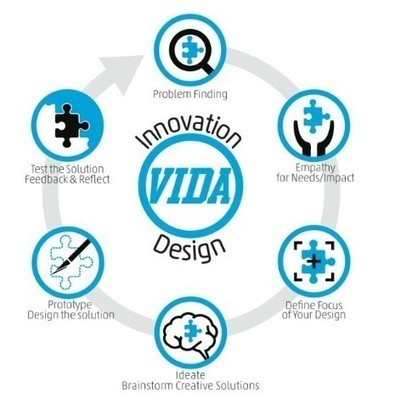
At the Vista Innovation & Design Academy (VIDA), we utilize the highly renowned "Design Thinking" process as the base of our design & problem solving curriculum.
Our presenters will explore how recent advances in brain science and empathic competency may offer practice owners and businesses measurable ways to hire and cultivate individuals who can make a true difference in the success of their products and teams.
The two will share findings from their 2015 survey of more than 500 practitioners throughout Europe, Canada and the United States on the importance of empathy in designing informational environments.
1. EMPATHY: SCIENCE OF FEELING UXPA 2015 | June 25, 2015 Bern Irizarry @bernirizarry bern@empathyux.com Emma Chittenden @emchi emma@empathyux.com
2. Where we started Our journey began in London…
3. Bernadette Irizarry CEO and Founder VLVT / Velvet Hammer @bernirizarry Emma Chittenden CEO Oubliette @emchi
4. SOFT @bernirizarry, @emchi SKILL
5. EMPATHY @bernirizarry, @emchi DEFICIT
6. What is empathy? Is it “real”? Is it scientific?
The neuroscientist Vittorio Gallese talks about “mirror neurons” and explains to the architects that form follows emotion, not function!
“Actually, there is nothing new in neuroscience; they used to write about space empathy over one-hundred years ago within the aesthetic debate”, explains the neuroscientist Vittorio Gallese, discoverer of “mirror neurons” together with the team directed by Giacomo Rizzolatti at Università di Parma.
Over the course of six years, I brought ambulatory psychophysiology into a variety of industries as a means of conducting design research. I looked at the stress of children in occupational therapy, the frustration of playing Hasbro board games, the thrill of driving a Google Self Driving Car, the confidence of shopping at Best Buy and Lowes, the excitement of playing LEGO Technic for the first time, the tension of watching one's first symphony, and the anxiety of talking about birth control. Working with stake holders within these settings I developed "Thick Psychophysiology," defined by four characteristics:
1. Psychophysiological data is quantitatively measured,
2. The research answers explorative, open ended questions,
3. The research measures external context, and 4. The research measures internal context.
By combining ethnographic methods with psychophysiology, researchers can address the challenges of specificity that ambulatory, explorative research produces. Two case studies of preliminary design research are provided about the LEGO Group and the New World Symphony, showcasing how thick psychophysiology can help uncover customer's unarticulated needs.
Once needs are uncovered, the challenge is how to motivate an organization to address those needs
DESIGNERS CAN REACH OVER 1 BILLION PEOPLE JUST BY KEEPING ACCESSIBILITY IN MIND, SAYS GOOGLE'S ASTRID WEBER AND JEN DEVINS.
At this year's Google I/O conference in San Francisco, I sat down with the two UX experts and asked them what designers could do to make their apps more accessible.
The key, they told me, was using your imagination and having a little more empathy. Here are six ways designers can reach that extra billion.
Whether you’re a user experience professional, visual designer, marketer, developer, empathy is the new skill to have. Unfortunately, like most buzz words that become jargon, the value of the word is being lost in the noise.
What really is empathy? The first definition that may likely come to mind is “the ability to put yourself in someone else’s shoes.”
Much like its cousins, sympathy and mindfulness, its a skill that requires emotional intelligence and awareness.
To get content containing either thought or leadership enter:
To get content containing both thought and leadership enter:
To get content containing the expression thought leadership enter:
You can enter several keywords and you can refine them whenever you want. Our suggestion engine uses more signals but entering a few keywords here will rapidly give you great content to curate.


 Your new post is loading...