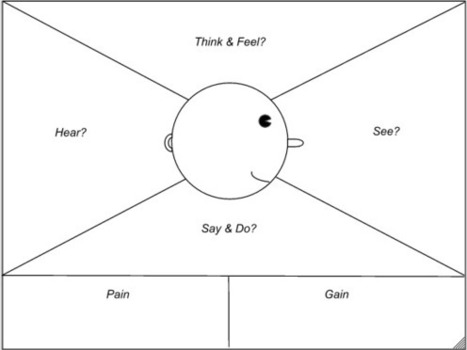
In human-centered design, we use a set of tools to observe and communicate with people and better understand their journey. Empathetic listening and observation are essential during the entire design process:
Immersion: Place ourselves in the full experience through the eyes of the user.
Observation: Carefully watch and examine what people are actually doing.
Conversation: Accurately capture conversations and personal stories.
It was the famous Carl Rogers that once said: "The curious paradox is that when I accept myself just as I am, then I can change." Carl Rogers definitely was on to something!
At the core of empathy is understanding and recognizing someone else's perceptive, concerns, and feelings. But why empathize? Well, if people can express what they feel and think in an honest, accepting, and caring atmosphere then those same people will naturally make healthy and fruitful life decisions.
What makes an environment honest, accepting, and caring? Empathy!
Carl Rogers believed that empathy is part of humanistic psychology, at which it motivates how others work. In this article, it explains how to show empathy and what to do and not to do.
When I started using empathy maps in my Selling design value workshop I was asked what the difference is between personas and empathy mapping.
On the surface of it they seem similar. They both help you create a description of your clients and they get your team talking in a more user centred way and viewing a product, service or issue from the perspective of a client.
Empathy mapping differs from personas in that it focuses on uncovering the sensory information and experience of your users. While personas focus on interests, skills, personality, dreams and environment, empathy maps uncover what your persona sees, thinks/feels, hears, gains, and is challenged by.
In this way empathy mapping is all about sensory impact. And that’s what makes it such a powerful tool.
Roman Krznaric is a philosopher and writer whose books include Empathy, The Wonderbox and How to Find Fulfilling Work. He believes that we need to cultivate empathy to create change: both politically and in our relationships.
He considers himself a “late developer” philosopher. Although he attended Oxford to study philosophy, his time there as a young student “was a disaster”, he says. “It was all logic and analytical philosophy. The Plato stuff – how to be good, how to lead a good life – is not taught so much any more. Academic philosophy has been a failure for the last century.”
Although he left the country at 14, Krznaric considers himself Australian and visits regularly. He will discuss the importance of empathy at talks in Sydney and Melbourne and has brought his Empathy Museum to the Perth International arts festival.
Kate Snow at CreativeMornings Cleveland, September 2015. Free events like this one are hosted every month in dozens of cities. Discover hundreds of talks from the world's creative community at https://creativemornings.com/talks
Having empathy is critical to the design process. Understanding how that differs from sympathy is even more powerful. Explore how this develops into participatory, insightful design.
An intro to inclusive design https://www.microsoft.com/en-us/design/inclusive?ocid=inclusivethefilm A 20 minute short film examining inclusive design as an approach to making and sharing examples from the physical and digital worlds.
Having empathy is critical to the design process. Understanding how that differs from sympathy is even more powerful. Explore how this develops into
Welcome to the official Microsoft YouTube channel, your source for news about Microsoft's consumer products and services.
AJ Paron-Wildes Regional Architectural and Design Manager Allsteel A.J. Paron-Wildes has acquired significant experience working in the design/build industry .
Dev Patnaik's presentation at the Better by Design CEO Summit earlier this year delves into empathy and how it can be a powerful tool within any business.
A panel of experts, mostly outside the field of education, discussed how they use design thinking to approach problems. In this discussion, business owner and consultant Coonoor Behal, said something that became my most important take-away of the day:
Empathy isn’t simply one skill we can teach. Instead, empathy is a way of thinking resulting from proficiency with a collection of skills. In other words, to effectively teach empathy, we have to understand its components.
Empathy is a mindset resulting from proficiency with a skill set
And surprisingly, this new, more empathetic approach to my own needs also illuminated some ways to improve my diet.
I realized a carb crash around lunchtime was making me very tired during the day, so I eliminated sugar and processed carbohydrates and immediately had more energy. In shifting my focus away from weight loss to the real issues weighing on my life, I ended up losing 25 pounds.
I still have a long way to go, but developing empathy for myself was truly a breakthrough made possible by design thinking.
“Design thinking on the highest level is a way of reframing the way you look at the world and deal with issues, and the main thing is this idea of empathy,” Dr. Roth says. “If you have tried something and it hasn’t worked, then you’re working on the wrong problem.”
Empathy empowers us to be better designers — when we understand the user’s perspective, we make products that are better suited to them. At SEEK we have a variety of means to build empathy, with different levels of engagement.
EMPATHIZING Over the past several months, I started with empathizing as I set out on the exciting path to build Educate78’s School Design Lab. Our audacious vision is for the lab to support school design teams in creating high quality, innovative new schools.
In launching this work, I am thoroughly relishing my first round of empathizing. In a relatively short amount of time, I had the opportunity to: watch and listen, engage, and observe from an incredible cast of courageous educators and innovators taking on the task of transforming our schools.
The key to making this happen for those around us is EMPATHETIC RESPONDING! The traditional definition of empathy is the ability to understand and share feelings. When we utilize empathetic responding, we are acknowledging what's being told to us and also by a certain means we're recognizing the core of the other person's humanity.
"When people feel heard it not only builds trust but it also increases problem solving!"
Rachel L Rosenthal, PhD
Access, Quality & Usability UX Researcher I Data Scientist I Human Factors i
We spend more time in our browsers than in bed and more time with our smartphones than with our families. Computing and digital user interfaces are now woven into the fabric of everyday life. As designers, we are no longer just tampering with people’s productivity, we are handling the worlds most precious resource: attention.
This talk examines the challenges of building empathy with a global audience. It takes a critical look at how design decisions shape our everyday lives and at our role as mediators between the interests of users and businesses.
Chris Witeck discusses empathy mapping which is so much more than a one-time session of profiling your customer, showing off your idea, and collecting the feedback. Chris covers key lessons learned by Citrix Labs as they tackle their goal of customer led innovation.
Lorraine Gamman is Professor of Design at the University of the Arts London; She founded the award-winning Design Against Crime Research Centre at Central Saint Martins in 1999 that has delivered many student projects and been supported by external funding between 2000-2015 from the AHRC, ESCRC , EPSRC and the Design Council/Home Office, to deliver numerous academic outputs.
She is currently (2014-16) Principal Investigator on the AHRC funded ‘Extending Empathy’ network 2014-15; Co-Investigator on the EU FP7 funded ‘Graffolution’ project and also Principal Investigator on the AHRC-funded 2015-16 ‘Design Thinking for Prison Industries’ project that will explore how best to co-design products against crime with prison inmates in the UK and India to help visualize the idea of anti crime design as a form of restorative justice in action.
If you’re managing and leading the delivery of great experiences, this is your community. We will speak frankly about design, organizations, and leadership. Together we will gain the new insights, inspiration, and fortitude necessary to produce tomorrow’s great human experiences.
We will cover:
Warning signs when you need to spend time developing empathy
Listening to customers, stakeholders, and peers to get at a deeper level
TBD (either learning to find patterns, or exploring a real data set for insights)
Ways to practice and adapt this mindset to your own work
A.J. Paron-Wildes has acquired significant experience working in the design/build industry.
She has created and led a multi-million dollar award-winning design/build firm, developed national programs for ASID (American Society of Interior Designers), developed and funded design research programs for the University of Minnesota and pioneered various charitable programs.
She, and her work, is featured in many television segments on HGTV, PBS and Bob Vila. Ms. Paron-Wildes helps corporate clients look to the future when designing their spaces and facilities.
Our expectations as consumers are on the rise. It's not just the ever upwards trend for better service, 'engaging' experiences or easier interactions. We demand to be understood and to be treated as an individual. We demand more meaningful relationships with the companies we choose to use.
Those companies who set out to build authentic mutual relationships with consumers will prosper in what Martin Dowson describes as the empathy economy. One which will be dominated by a new breed of business which truly understands its purpose in the world by being human centred, design led and sustainably profitable.
It's a new economy that values empathy and a world in which designers will play a central role in bringing that empathy back into the design of business
I realized that in all the work I do, I use empathy as my foundation — as a way to connect and resonate with those different from me — and when doing development work, this is crucial in order to bring out the voice of the target community. It also strengthened my personal viewpoint that we, as a society, need to fight complacency.
Empathy empowers us to be better designers. When we understand the user’s perspective, we make products that are better suited to them.
At SEEK, we have a variety of means to build empathy, with different levels of engagement. Here’s a closer look at some of our methods.
Embrace a research culture
If you work at SEEK and don’t know that user research happens every week, you’ve been hiding under a rock. Mimi Turner, our researcher, advertises and advocates research, along with the UX designers within their product teams. The research calendar is up to date and color-coordinated, emails are sent inviting the core team and those interested in UX to the sessions, and the schedule for the day is posted on the observation room. When she’s not busy doing research, Mimi gives presentations on UX research at SEEK to build our research culture.
To get content containing either thought or leadership enter:
To get content containing both thought and leadership enter:
To get content containing the expression thought leadership enter:
You can enter several keywords and you can refine them whenever you want. Our suggestion engine uses more signals but entering a few keywords here will rapidly give you great content to curate.


 Your new post is loading...