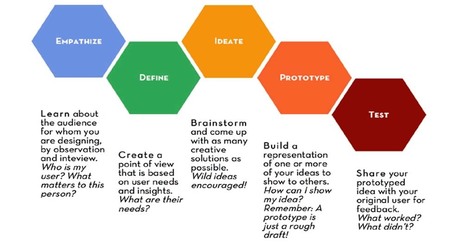
In prepping for @WestwoodPUSD @VIDASharks & @HighTECHHigh #DEEPdt Learning for this Friday, I organized some handouts from the DEEPdt Widgets section of this site. Here are the uploaded handouts via Scribd. Enjoy
Design thinking, not unlike legal services, is all about people. As David Maister noted, “above all, what I, the client, am looking for is that rare professional who has both technical skill and a sincere desire to be helpful, to work with both me and my problem. The key is empathy – the ability to enter my world and see it through my eyes.”
Empathy is also the key to making design thinking pay off. Opportunities for driving growth and competitive advantage are everywhere – the challenge is knowing where and how to look for them. Design thinking provides a framework for consistently identifying insights and systematically translating them into opportunities for the firm to create value.
The first step in any design-thinking approach is to assume a beginner’s mindset. Set aside any preconceptions about what the client needs or about the solutions that the firm can offer. The aim of a client conversation shifts from ‘what are they asking for?’ to ‘what are they trying to achieve?’ The same applies to the way business functions like L&D and marketing serve their internal customers.
The curriculum will strengthen your existing knowledge of the human-centered design process and help you to become a more innovative problem solver by building up your prototyping skills. You'll walk away knowing how to prototype products, services, and environments, and get constructive feedback along the way.
What will you learn in this course?
Learn how to build and test prototypes out of ideas using the human-centered design process.
Strengthen your existing knowledge of the human-centered design process
Become a more innovative problem solver by building up your prototyping skills.
Take a deep dive into the nature and experience of empathy and learn about it and get better at it.
Learn to use the Mural.ly online brainstorming, synthesis and collaboration platform
Empathy maps are a powerful tool for helping teams better understand users. But that doesn’t mean they are perfect. You should feel free to adapt them to your circumstances.
You've heard empathy is a learned skill. Let's really talk about it. What does it mean to have empathy? Why does it matter, anyway? And if empathy is useful (I hope to show you how it is), how do you get better at it?
In this session, you'll learn real stuff about what's in your
Dev Bootcamp developed its Engineering Empathy (EE) curriculum to address the human side of software development. Many of our emplolyer partners have expressed interest in engaging in this training because the topics that the EE curriculum tackles, specifically implicit bias, privelege, allyship, feedback, and resliliance, are as applicable in organizations and communities as they are in the classroom. In order to attract and retain a diverse and inclusive workforce, a company must have an environment that allows for that.
Creating an Inclusive Work Culture
This EE program tackles the topics of institutional bias and oppression, privilege, and allyship to create both diverse and inclusive organizations. Teams will leave the conversation with:
Innovation insider Geoff Zoeckler is sharing his secrets for building empathy to get breakthrough innovation.
With over 15+ years in new product development, including seven years in front end innovation for General Mills and Birds Eye Foods, plus five years leading innovation programs with many Fortune 100 companies including P&G and more, Geoff Zoeckler has distilled the key elements for developing empathy into this info-packed, 45-minute webinar.
You’ll learn:
What empathy is.
Why we do it.
Why we don’t.
What it requires.
The return on investment that it provides.
How to implement it in your organization for breakthrough results.
We recently hosted a webinar with Indi Young, author, UX consultant, and founding partner at Adaptive Path. Check out the video to hear what Indi had to say about empathy, or read the full transcript of the session below!
Indi: Great! Thank you, Martha. That was a great intro. Hi everybody, presumably you’ve already found the little door in your brain that lets new things in, and you’ve opened it, because we’re going to talk about empathy. Yeah, empathy. That word means a lot of things to a lot of people, and quite frequently it gets associated with little hearts, hearts everywhere. I even see them when other people try to talk about empathy in relationship to the book that I just finished writing.
How can you use empathy to better connect with guests?
First, take a moment to talk to your guests, gather feedback, and connect with them so you can gain better understanding of their needs, preferences, and concerns. Once you've collected their feedback, you can move forward to brainstorm with your team (and other managers) to decide what other things you can do to improve the guest experience.
While brainstorming, use an empathy map to focus on these four main categories: thinking, seeing, doing, and feeling.
Thinking:
How do your guests perceive the world around them? What are their hopes, dreams, concerns, fears? By knowing them and how they think, you can be more proactive in meeting their needs and providing superior service.
Seeing:
What is missing in the hotel room that they will need or want? When you have a better understanding of how they see and interact with the world around them, you build a deeper connection and a loyal guest.
Doing:
What are their daily habits? By knowing what their morning and night rituals are, the more you can anticipate and provide them with the services to enhance those experiences.
A Practical Training Course That Teaches Real World Skills
In this project-based Designing with Empathy video tutorial series, you'll quickly have relevant skills for real-world applications.
Follow along with our expert instructor in this training course to get:
Concise, informative and broadcast-quality Designing with Empathy training videos delivered to your desktop
The ability to learn at your own pace with our intuitive, easy-to-use interface
A quick grasp of even the most complex Designing with Empathy subjects because they're broken into simple, easy to follow tutorial videos
Practical working files further enhance the learning process and provide a degree of retention that is unmatched by any other form of Designing with Empathy tutorial, online or offline... so you'll know the exact steps for your own projects.
Lance Poole is the Annuity Product Manager at Protective Life and also shares his thoughts around empathy, design thinking, and innovation on his personal blog.
Innovation, change, relationships even depend on our ability to practice empathy, Karen Tilstra encourages.
Empathy is a practice, a way of coming to the moment not knowing or assuming we know but rather in a state of curiosity remaining open to what the unspoken and spoken needs of others are...Empathy it's a practice.
Course Description:This four-week course builds on Design Kit: The Course for Human-Centered Design, a class that has been taken by thousands of teams around the world. The curriculum will strengthen your existing knowledge of the human-centered design process and help you to become a more innovative problem solver by building up your prototyping skills. You'll walk away knowing how to prototype products, services, and environments, and get constructive feedback along the way.
What will you learn in this course?
Learn how to build and test prototypes out of ideas using the human-centered design process.
Strengthen your existing knowledge of the human-centered design process
Become a more innovative problem solver by building up your prototyping skills.
Take a deep dive into the nature and experience of empathy and learn about it and get better at it.
Learn to use the Mural.lyonline brainstorming, synthesis and collaboration platform
Empathy is at the core of the human-centered design process. It helps you understand the people you’re designing for: what they do and why, their physical and emotional needs, how they see the work and what matters to them. Empathy is central to develop valuable and useful innovations.
This is one powerful way to understand better your future users and customers. It helps you define your problem and generate innovative solutions. Remember: framing the right problem is the only way to create the right solution!
In this 90 minutes workshop, we will invite you to explore (through a hands-on activity) what empathy means and how it can help you generate ideas.
Empathic design makes us better designers. You’ve probably experienced empathetic interactions in your life that have made you feel more helpful and generous. That’s because empathetic listening changes the listener.
Neuroscientists have confirmed what we’ve all experienced – that listening empathetically enhances your ability to receive information. And that’s exactly what’s happening when we conduct research in the field. ..
This is empathic design: studying users and their behavior in context to open up opportunities for product innovation. We meet the users where they are.
1. Empathic design turns preconceived notions on their heads.
2. Empathic design reveals opportunities for new product applications.
3. Empathic design also reveals future mistakes.
4. Empathic design lets you see what people do, and not be limited to what they say.
Listening empathetically enhances your ability to receive information. And that’s exactly what’s happening when we conduct research in the field.
Click here to register for the Activating Empathy - A learner's course to master empathy
Who is this course for? We designed this course with busy elementary school teachers in mind. It is also a great learning opportunity for parents and anyone interested in learning how to help children practice empathy and develop as confident and creative changemakers.
What will you gain? Insights into how pioneering Changemaker Schools instill empathy in their classrooms and an action plan based on resources that you think will be helpful for your class and school.
How do you complete the course?
All information that you share during registration, including your name and email, will be confidential. Once logged-in, go to "Unit 1: Orientation and Inspiration" under "Schedule" found directly below to get started. To receive your certificate for the course you will be invited to produce an Empathy Action Plan tailored for your classroom.
To solve real problems for people, Design Thinking methodologies require that you start by creating empathy. However, what is empathy and how does it translate into developing products that people love?
With over 15 years of new product development experience, Kaleidoscope's Director of Innovation Geoff Zoeckler will share the essential elements for developing empathy in this 45-minute webinar. You'll learn:
What empathy is.
Why we do it.
Why we don’t.
What it requires.
The return on investment.
How to implement it in your organization for breakthrough results.
Kaleidoscope Director of Innovation Geoff Zoeckler has explored the return on empathy in his writings, and will host a webinar on Nov. 5, 1-2 pm
Calculating the Return on Empathy
In “What Is the Return On Empathy?
Can it Be Used as a Creative Problem Solving Tool?”
Zoeckler examines the possible return on investment for companies that take time to develop empathy.
He uses both real-life observations and in-depth research from the fields of neuroscience and psychology to prove the ROI of investing in empathy in his chapter in the book, Big Questions in Creativity 2015, edited by Mary Kay Culpepper and Cynthia Burnett.
Here is a sneak peak of our internal evaluation of the program, informed by deep empathy interviews and observation at all of our school sites.
“I had a BIG empathy challenge after changing sites to co-locate with another school. I was able to approach the problem with creativity and empathy. I met with the mayor, the head of PTO, worked with the principal, and created a task force. Talking to the parents, I came to understand that they were left in the dark about the new initiative…”
— Middle school teacher
After participating I feel even more connected to a larger movement around bringing design thinking and empathy work to learners and teacher-learners. I also look more critically at my own practice and find ways to challenge myself and get myself out of my own routine.”
Empathy — the ability to recognize and respond to the feelings of another person — is the closest connection between two human beings.
Empathy also is the place to start when undertaking an innovative enterprise, says Yonah Schiller, executive director and rabbi of Tulane Hillel.
Schiller is co-teaching a course at Tulane University called Introduction to Social Innovation and Social Entrepreneurship with Anna Monhartova, program director of Social Innovation & Social Entrepreneurship in the Taylor Center for Social Innovation and Design Thinking. About half of the students in the class are first-year students. The students are from all majors, with many majoring in business or finance.
To get content containing either thought or leadership enter:
To get content containing both thought and leadership enter:
To get content containing the expression thought leadership enter:
You can enter several keywords and you can refine them whenever you want. Our suggestion engine uses more signals but entering a few keywords here will rapidly give you great content to curate.


 Your new post is loading...