Design Against Crime Research Centre has been joined by other partners to launch the Makeright initiative, which is calling for designer volunteers.
Promoting empathy
Gamman says: “I suspect design volunteers will learn as much from teaching as our team have from the experience of working in prison. In fact I hope very much that the Makeright project will promote empathy in two specific ways.
“First that volunteers will understand inmates’ lives and experiences better. Secondly that inmates will find their hidden and often better self and that this humanising experience will activate more empathy, which many “switch off” to survive the prison.”
Empathy is our governing philosophy. It allows us to reflect on the way our work relates to larger human concepts and ideals; and ultimately to better think across problems, recognizing patterns for coming to solutions.
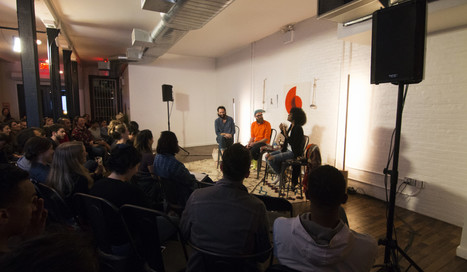
It is in this spirit that we proudly announce Applied Empathy, a monthly speaker series that explores the contexts and behaviors in which empathy flourishes in the creative process. Each event will feature two exemplary leaders who integrate empathic thinking into their creative and working lives. The dynamic individuals presented every month will explore a unique theme, facilitated through a moderated conversation and dialogue with attendees.
The inaugural evening, centering around the theme Changing Tastes: How Design Shapes Demand, will be held in our studio space And&And on Tuesday, March 29th at 7pm. Serving as moderator will be Sub Rosa’s Founder & CEO Michael Ventura, who will be joined by siblings Piera Gelardi (Creative Director and Co-founder of Refinery29) and Pepin Gelardi (Partner, Innovation Strategy & Industrial Design at Tomorrow Lab.)
Transformative empathy When stakeholders are having trouble imagining things being different than they are, or when they are extremely removed from (and even judgmental of) their customers, the experience of being wholly immersed in somebody else’s perspective can free up their thinking. The desired outcome is that stakeholders come away from the experience in agreement about the challenge we are solving and with a felt understanding of why things need to change.
More than any organization I’ve worked with, Weight Watchers employees are in tune with their customers’ needs and feelings. That’s because so many of them are members....
Co-design
When stakeholders don’t feel capable of changing the way things work today, and when there are naysayers among them, we involve them throughout the design process — in questions, prototypes, and iterations along the way. The process of co-design should make everyone responsible for approving and implementing the new vision feel invested and confident in the design.
Ashlea Powell is a Senior Director at IDEO New York with a background in writing and design research.
‘Empathy and the Revolution of Human Relationships‘ – a public talk by cultural thinker and writer on the art of living and social change, Roman Krznaric.
28 Apr 2016
6.30pm to 8pm
LVMH Theatre (E002)
Central Saint Martins, University of the Arts London, 1 Granary Square, Kings Cross, London
N1C 4AA
Roman Krznaric’s writings on empathy have been widely influential amongst political and ecological campaigners, education reformers, social entrepreneurs, and designers. His books include: Empathy (2014),How to Find Fulfilling Work (2013) and The Wonderbox (2011). He is founder of the world’s first Empathy Museum and of the digital Empathy Library as well as a founding faculty member of The School of Life and on the faculty of Year Here. www.romankrznaric.com
Design Against Crime is a socially responsive, practice-led research centre located at Central Saint Martins College of Art and Design, University of the Arts London. DAC is a practice-led design research project that emerged at Central Saint Martins College of Art and Design (CSM).
It was founded by Lorraine Gamman as an ‘initiative’ in 1999, and continues to flourish. It has primarily been funded by the University of the Arts London and by monies raised from successful research council funding applications, that are linked to independent peer review assessment.
Today, design processes are used to create far more than consumer products. As design is used to develop comprehensive solutions for complex problems, the introduction of the solution can be just as important as the solution itself. How to solve for this? Design the intervention!
Explore how design thinking can help system innovators create the new worlds they’ve imagined, and discuss how stakeholder engagement throughout the process is key. Hear from social entrepreneurs who have successfully designed a solution and prepare to share your own.
Proto-personas are a light way to depict user archetypes for your whole team to see. This helps build empathy quickly and ensures you're thinking about the user at every step. MURAL helps you create proto-personas fast with our built in frameworks so you can continue your creative work no matter where you team is location. Find out more in this post!
More and more, companies understand the importance of user-centered design. Every company should be asking, How can we strengthen empathy for customers and get closer to our users?
The first step in building empathy is gathering information and insights about your users.
Depending on what kind of information you’re looking for, you can run focus groups, conduct context interviews or analyze customer feedback.
But what do you do with all that information? Personas are an effective method to develop empathy.
Where empathic design improves sites Developed in the 90s, empathic design has become the first step in the design thinking process for many. In it, a designer will study customer feelings and perceptions to determine which ideas lead to the best user-centered design.
Designing with empathy can be challenging. it requires discipline, reflection and experience. To design with empathy, you need to check your personal preferences—and your ego—before working closely with a brand on a new design. It also means using the technical experience you’ve gained as a designer, coupled with an understanding of how the latest trends can help a brand meet an established goal.
Finally, designing with empathy requires an understanding of how technology can help or hinder design—you’ve got to be able to translate big ideas into a design that fits within the confines of your specific ecommerce platform.
Virtual reality has repeatedly been called an "empathy machine," and filmmakers and advertisers are flocking to the nascent technology to leverage its emotive connectivity. But how accurate is that moniker?
Certainly, VR projects can offer viewers immersive, sometimes exhilarating experiences. Its potential to touch audiences is unquestioned, but to do so in its current form requires careful manipulation, experimentation and an ability to think outside the 16:9 box.
Brands, nonprofits and even advertising agencies are investing exorbitant amounts of money in VR activations on the assumption it has a unique capacity to drive empathy.
Design Kit: Introduction to Human-Centered Design: An Online Workshop more: http://j.mp/1RjYXs7
You’re invited to learn about and apply human-centered design in this workshop. Using the process and tools developed by IDEO and the Stanford d.school, this workshop will introduce you to human-centered design and help you generate, prototype and test your ideas quickly. We will apply this process to address a practical problem and project.
Also take a deep dive into learning how to build your empathy skills and apply them to fostering teamwork, creativity, innovation and action.
Human-centered design is a process that has been used for decades to create better products, services, experiences, and businesses that keep people’s needs
I believe that design thinking offers a different way of gathering information- a softer side- that allows us to engage with users in deeper, more nuanced ways. Empathy is central to this notion....
I wanted to share some insights I’ve learned about what constitutes a good ethnographic interview because I truly believe that gathering good qualitative data is the most essential part of gaining user insights and empathy.
1. You can’t “phone in” an ethnographic interview...
2. You have to lose yourself...
3. You have to be willing to abandon any script and follow where your interviewee takes you. ...
4. You have to be willing to be a co-creator of the experience....
5. You have to be willing to entertain the notion that you can learn something from one person that can change the lives of many. ...
Explicitly Teach Empathy Through my work with National Equity Project, I learned that empathy is a skill or “set of muscles” that must be built.
You must dedicate time explicitly to enhancing this skillset. And so we must do that for our students. Here are a number of ways to go about doing that:
In The Classroom:
Teach the skill of listening...
Teach students the craft of asking beautiful questions — of themselves and of others...
Teach students how to analyze assumptions..
Teach students the power of a lens....
Experience Empathy:
In the field:
Teach students ethnographic research methods for collecting data in the field...
THEN get students out into the field… and as much as possible....
Go virtual....
How have you taught your students to be empathetic?"
Even physically experiencing someone else’s living situation isn’t enough to design with empathy. I have had all sorts of experiences to simulate someone else’s living experience, from donning weighted gloves and scratched glasses to emulate driving like an elderly person to living on the streets for weeks to experience what it’s like to be homeless.
While this is a great technique to better understand how people engage with the physical world, this approach alone focuses too much on the immediate visceral experience, and perhaps more problematically, my interpretation in isolation.
Fieldwork, going to the places where people are living their lives to conduct research, is where we start to really connect with people. We learn about who they are, participate in their activities, and uncover their needs. We witness emotional responses, body language, context, and their use of space. By connecting with individuals in the field, we’re able to collect their stories and perspectives.
Applied Empathy is a monthly conversation series held at Sub Rosa’s studio in Manhattan. Each discussion features individuals who incorporate empathic behaviors into their professional and personal lives. In conjunction with a Sub Rosa moderator and audience, they discuss a unique theme pertaining to empathy and their respective careers.
April’s discussion was moderated by Sub Rosa’s Founder/CEO Michael Ventura and titled All the Feels: How Emotions Create Meaning in the Work We Do. The evening featured Tony Award-winning playwright, actress, TED speaker, and poet Sarah Jones. Sarah is perhaps best known for her play Bridge and Tunnel. Her newest work Sell/Buy/Date will premiere at Manhattan Theatre Club this fall.
Applied Empathy is a monthly conversation series held at Sub Rosa’s studio in Manhattan. Each discussion features individuals who incorporate empathic behaviors into their professional and personal lives. In conjunction with a Sub Rosa moderator and audience, they discuss a unique theme pertaining to empathy and their respective careers.
The inaugural evening, held on March 29, centered around the theme Changing Tastes: How Design Shapes Demand. Sub Rosa’s Founder/CEO Michael Ventura moderated a discussion with special guests Piera Gelardi (Co-founder/Creative Director, Refinery29) and Pepin Gelardi (Partner/Head of Product Design Strategy, Tomorrow Lab).
Abstract In user-centred design, a widespread recognition has surfaced for the importance of designers to gain empathy with the users for whom they are designing. Several techniques and tools have been developed to support an empathic design process and several issues are indicated that support an empathic process, but precise definitions and a framework of what makes ‘empathy’ is missing.
Although the need for empathic approaches in design has been repeatedly stressed, a fundamental basis of the concept of empathy is missing. The goal of this paper is to inform the discussion in the design community by applying the concept of empathy as it has developed in psychology.
This paper presents a review of how empathy has been discussed in design and psychology literature, and proposes a background framework for supporting empathic approaches in designing. The framework presents empathy in design as a process of four phases, and gives insight into what role the designer's own experience can play when having empathy with the user. This framework can be applied to three areas: research activities, communication activities and ideation activities.
Adam Thorpe goes into depth explaining the ethos and projects of 'Design Against Crime' as well as why empathy is a key tool for design in social innovatio
And yet, when we dive in to understand the and apply Design Thinking, I see participants struggle to do exactly that. Immerse themselves in the User/Stakeholder’s experience. Observe, Engage, Watch and Listen, for clues and signs that tell of habits and behaviours, needs and interests, fears and desires. The critical “why” behind decisions and actions, the “what” behind causes and motivations.
Everybody knows the need for Empathy. Everybody understands the significance and implications of User-Centred thinking, before designing and solutioning. Yet, very few can practice it...
As David Kelley puts it “The main tenet of design thinking is Empathy for the people you’re trying to design for. Leadership is exactly the same thing – building Empathy for the people that you’re entrusted to help.”
There are several techniques for empathy in design; however, Kouprie and Visser (2009) try to categorize them into three main categories that will be presented here.
First of all, the most popular and accepted approach is being in direct contact with users (McDonagh & Bruseberg, 2000, Mattelmäki & Battarbee, 2002, Suri, 2003). Some advocates believe preparing generative sessions can provide an opportunity for users to express their thoughts (Sanders & Dandavate, 1999, Visser et al., 2005).
The second technique is communication and it is a good approach, especially for times that designers cannot meet users directly. Several techniques such as storytelling, persona and scenario design, and roleplaying have been mentioned in empathic design research (Buchenau & Suri, 2000, Go & Carroll, 2004, Lugt & Visser, 2007).
The third category contains techniques for designers to step into the role of the user and use a role-playing approach to feel experiences. Techniques here include ‘product handling’, ‘experience prototyping’, ‘bodystorming’ and ‘informance’ (Buchenau & Suri, 2000).
That’s what everyone says. “empathy” — I want me some more. but what does “empathy” mean? in relation to your work?
There are all sorts of definitions. Most common is “be more sensitive.”which is nice, but not viable in a *lot* of organizations.
There’s emotional empathy (also called “affective empathy” in academic literature) which is basically a strong emotional connection with another person over something they said, where you feel their emotion it’s illuminating and powerful; you’ve all probably felt emotional empathy at some point. but in research, you can’t force it.
In collaboration with others, you can’t force it. so … for reliable, repeatable empathy in your work (creating things, collaborating with people) you need to learn to develop cognitive empathy cog empathy gets a bad rap from Daniel Goleman–he says it leads to manipulation but that’s only one of many things you can use cog empathy for.
I use it “to support” others. (help them achieve their purpose or intent) cog empathy is defined as learning the underlying reasoning, decision-making, guiding principles, and reactions that another person has. and if you do that over a lot of people, you start to see patterns.
Being human centered is at the core of our innovation process. Deep empathy for people makes our observations powerful sources of inspiration. We aim to understand why people do what they currently do, with the goal of understanding what they might do in the future.
Our first-person experiences help us form personal connections with the people for whom we’re innovating. We’ve washed other people’s clothes by hand in their sinks, stayed as guests in housing projects, stood beside surgeons in operating rooms, and calmed agitated passengers in airport security lines—all to build empathy.
An empathic approach fuels our process by ensuring we never forget we’re designing for real people. And as a result, we uncover insights and opportunities for truly creative solutions. We’ve collaborated with thousands of clients to leverage the power of empathy, creating everything from easy-to-use lifesaving heart defibrillators to debit cards that help customers save for retirement.
Designers may have difficulty empathizing with a user who has different abilities (e.g., a physical or mental impairment) or who lives in a very different personal or social situation. This makes it hard to design empathically without resorting to stereotyping or unintentional ego-design.
Solution
Empathy tools are physical objects (such as a device that simulates an impairment) or cognitive or social techniques (such as a distracting task that simulates a mental impairment) that allow designers to get a sense of what a user experiences and feels, either in his or her day-to-day life or in the context of using a product or experience being designed.
The ultimate purpose of innovation is to make our lives easier by transforming the way we do things (taking a taxi, flying to another country, fighting a disease, providing economic opportunities, etc.).
In order to achieve this transformation, it is necessary to understand what the potential users of those innovations need, feel and want. Daniel Goleman says that “a prerequisite to empathy is simply paying attention to the person in pain”.
To get content containing either thought or leadership enter:
To get content containing both thought and leadership enter:
To get content containing the expression thought leadership enter:
You can enter several keywords and you can refine them whenever you want. Our suggestion engine uses more signals but entering a few keywords here will rapidly give you great content to curate.


 Your new post is loading...