Your new post is loading...

|
Scooped by
Kim Flintoff
May 31, 2012 8:02 PM
|
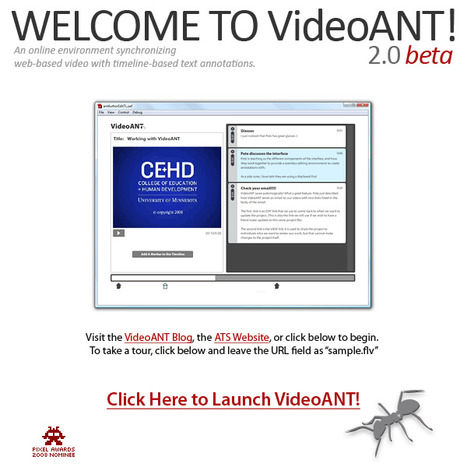
Academic Technology Services... VideoANT is a simple, easy-to-use environment which synchronizes online video with timeline-based text annotations. It is designed to engage learners by supporting interactions between students, instructors, and their videos. The product supports a number of video formats from FLV to MOV. As long as the video is already online (and in the correct format) it can be annotated using the VideoANT interface. In addition, VideoANT supports links to YouTube. A sample video is available if you just want to see how it works.
|
|
Scooped by
Kim Flintoff
May 31, 2012 4:38 AM
|
This is a survey for university-based researchers working in the broad area of education and digital technology/digital media. If your research covers any aspect of education and digital technology/digital media then we would be very grateful if you could complete the following questions. This is an independent study conducted by researchers from the Institute of Education (UK) and Monash University (Australia). Your participation is anonymous and your responses will not be used for any other purpose than the current study. The study aims to map the different types of research taking place in this area, develop a better understanding of people's various use of methods and theory, and make recommendations about future ‘research capacity’ building work. The research team will produce an open access report in the autumn of 2012 summarizing the key findings, as well as a subsequent set of journal articles/conference papers.
|
|
Scooped by
Kim Flintoff
May 29, 2012 10:08 PM
|
TalkMiner aggregates and indexes lecture videos available across the internet. The system processes RSS feeds from a variety of sites to collect lecture videos. The system automatically processes the video to generate metadata describing each talk including the video frames that contain slides, their time offsets, and the text recovered from those frames by optical character recognition.

|
Suggested by
Learning Futures
May 29, 2012 10:38 AM
|
The purpose of this page is to give online teachers usable Icebreakers for synchronous or asynchronous activities. The activities on this page have been developed by Boise State University students in an Advanced Online Teaching Methods Class (EdTech 523). Listed below are links to several different Icebreaker Activities appropriate for all grade levels from Kindergarten up to 12th Grade.
|
|
Scooped by
Kim Flintoff
May 29, 2012 12:03 AM
|
The Collaborative Learning Network... Teamie is a cloud-based social platform that makes learning collaborative & fun, enables educators to engage & teach, and drives performance & behavior. Teamie harnesses the power of social networking to make learning fun, collaborative and engaging. Teamie helps teachers save their time, and reuse their content & resources. Teamie create a safe & secure network for teachers and students to interact and learn.
|
|
Rescooped by
Kim Flintoff
from :: The 4th Era ::
May 28, 2012 11:42 PM
|
By Maria H. Anderson "Mass education is adequate, as long as students are highly motivated to learn and get ahead of their peers. In developing countries, a student who is successful in education will be able to climb the ladder of personal economic prosperity faster than those who are not successful. But in industrialized countries, where prosperity is the norm, an education does not necessarily translate into a significantly higher standard of living. In these countries, there is no longer a large economic incentive to learn, so the motivation to learn must become intrinsic. As we redesign en masse education, we must address learners’ intrinsic motivations, which means that education must circle back to being personal again. "The vision of a modern education built around personalized learning is not new, but it is definitely tantalizing. Neal Stephenson’s novel The Diamond Age (Spectra, 1995) shares a vision of personalized learning in the future via an interactive book that possesses a conversational interface (CI) and “pseudo-intelligence,” a kind of artificial intelligence (AI) that is inferior to human intelligence. It’s likely that we’ll see decent conversational interfaces within the next decade, and certainly applications like Google Voice are moving us much closer to this reality. AI that is capable of directing the learning needs of a human will take much longer, developing in the next 20–50 years, but we can’t wait that long for the technology to catch up with education. The need for personalized learning exists in the here and now. So how does one bridge this vision of the future with the realities of the present? "...A system for personalized learning will not grow from inside formal education. Education is like a field that’s been overplanted with only small patches of fertile soil. Too many stakeholders (parents, unions, administration, faculty, etc.) compete to promote various ideas about how to change, acting like weeds or plagues that choke off plant growth. The fresh and fertile soil of the open Web can foster the quick growth of a personalized learning system. Then, like a good fertilizer, it can be used to replenish the soil of formal education and help us to reach that “Holy Grail” of education: personalized learning for all."
Via Jim Lerman
|
|
Scooped by
Kim Flintoff
May 28, 2012 3:20 AM
|
In his new book What Technology Wants, Kevin Kelly writes, “No transition in technology has affected our species, or the world at large, more than the first... Our new understandings of truth, of learning, of interconnectedness, of networks, of complex systems… are cause for concern when applied to what’s happening in schools today.Certainly, with all the challenges that humanity is facing, our species would do well to maximize our rate of learning. It’s becoming more apparent every day that one of the simplest and most powerful ways of doing this is to increase connectivity among people, their ideas, and the data that their technology is churning out in record quantities. Our minds are products of self-organizing, emergent forces, not products of committees or curriculum boards. Our institutions need to understand this if they are to remain viable. Today, more than ever, as we become better acquainted with the science of complexity, we are starting to see the importance of interconnectivity, the power of diverse ideas, and the innovation that comes from connecting many minds, ideas, sensors, and data. Schools will change. The frustration comes from those who see how today’s technology is being underutilized and hobbled by The Academy. Unfortunately, (for short-term practical reasons) most people still see The Academy’s credential as being more important than the mind’s ability to use existing (and future) technology. That will change as employers can no longer afford to hire credentialed individuals who lack the requisite abilities to adapt quickly through connectedness. The performance levels of people who’ve learned to use connectedness compared to those who haven’t will be too great to ignore. Whereas performance differentials in traditional work do not vary much between individuals, with knowledge work, they can be drastic.

|
Scooped by
Peter Mellow
May 28, 2012 12:37 AM
|
Given the importance of Google Plus and its promising potential as an educational social networking website for educators and teachers, I am adding here in Educational Technology and Mobile Learning another article for teachers to discover more about its hidden secrets.
|
|
Scooped by
Peter Mellow
May 27, 2012 10:23 PM
|
The big trend these days is online learning, online collaboration, and, well, online everything. In fact, self-learning has become an incredibly powerful force thanks to online technology. Udemy has just publsihed an infographic that considers self-learning the new master’s degree.
|
|
Scooped by
Kim Flintoff
May 27, 2012 9:34 PM
|
Education sits at the social/technological nexus of change – primed for dramatic transformative change.
|
|
Rescooped by
Peter Mellow
from Educational Technology News
May 27, 2012 8:21 PM
|
"Have you ever dreamed of experiencing a watershed moment in your field? Moments like the splitting of the atom or the landing of a man on the moon? If you’re an educational leader, buckle up, because your moment is here. Schools are still experiencing the shockwaves of the Internet, a transformative global network that is radically changing how we think about learning and schooling. Moments like these are exhilarating, because our decisions matter so much. They are also terrifying, because we’re under enormous pressure—first, to find the right path; second, to move people in that direction."
Via EDTECH@UTRGV
|
|
Rescooped by
Peter Mellow
from Educational Technology News
May 27, 2012 8:19 PM
|
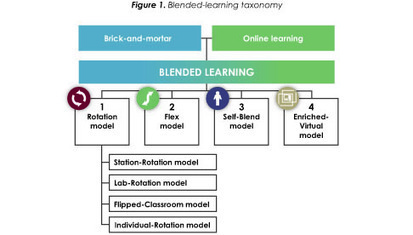
"As blended learning continues to expand across the K-12 sector, definitions are important to help people talk about the new phenomena. This white paper refines our previous work in helping to create a shared language for the emerging field so that innovators can build upon each other’s ideas, rather than talk past each other."
Via EDTECH@UTRGV
|
|
Scooped by
Kim Flintoff
May 25, 2012 9:36 PM
|
Upload, share & View presentations online Slideonline.com lets you upload and share PowerPoint and PDF presentations online, publicly or privately.
|
Welcome to the college education revolution. Big breakthroughs happen when what is suddenly possible meets what is desperately necessary.Thomas Friedman, Come the Revolution,NYT M...
Via Mark Smithers, Vasi Doncheva
|
|
Scooped by
Kim Flintoff
May 31, 2012 4:34 AM
|
The Net Generation encountering e-learning at university Welcome to the the Net Generation Encountering eLearning at University Project (NetGen for short) which is based at the Open University and funded by the Economic and Social Research Council (ESRC). The overall aim of the research is to provide an empirically based understanding of young students, often called the Net Generation or Digital Natives, as they first engage with e-learning in tertiary education. This site provides information on the Net Generation project and can provide you with access to our exciting findings.
|
|
Scooped by
Kim Flintoff
May 29, 2012 9:16 PM
|
VersaHub is the only online platform specifically designed for remote work teams and telecommuters. It allows you to stay connected with the people you work with, and manage work more efficiently from any location. Whether you're working from the office, your home, on the go, or in a coffee shop, you be able to break down the barriers that make remote work more difficult. Free plan available for small groups - very adaptable to education.
|
|
Scooped by
Kim Flintoff
May 29, 2012 12:07 AM
|
Schoology is a learning management system (LMS) and social network that makes it easy to create and share academic content. Schoology offers education without walls With Schoology, educators can do things as simple as posting assignments, quizzes and links to additional resources or as sophisticated as conducting online courses, providing one-on-one remediation, or hosting discussions. Schoology connects students and parents to educators and learning resources anytime, anywhere in a safe, secure online environment.
|
|
Scooped by
Kim Flintoff
May 29, 2012 12:00 AM
|
The learning platform. Simple, elegant course management meets social networking. And it's free. We’re reshaping education for the Internet age. We’ve re-imagined what a class should look like online. We give instructors and students amazingly designed tools to manage their courses – calendaring, file management – and we make it unbelievably easy to interact with one another. We believe that there’s a lot more to class than lecture. Post links, videos, files. Start discussions. Write a blog post. Ask about an assignment. Classes are meant to be social, but they rarely are. We’re changing that. We’ve designed every aspect of the experience, down to the pixel. We forgot what we knew about clunky university software and built something that is completely state of the art.
If you have either attended or facilitated training in a virtual classroom you know that maintaining a high level of interactivity is key to keeping participants engaged. Here are ten ideas for exercises to try in your next virtual classroom...
Via Dr. Susan Bainbridge, Petra Pollum
|
|
Scooped by
Peter Mellow
May 28, 2012 12:38 AM
|
PhDs and postdocs turn to social media to answer their pressing questions. Elizabeth Gibney reports
|
|
Scooped by
Peter Mellow
May 28, 2012 12:37 AM
|
Having spent some time exploring the new social networking platform Google+, communications expert and Webster University media manager Patrick Powers shares his thoughts on how the new service can work for academics and those involved in higher education.
|
|
Scooped by
Peter Mellow
May 27, 2012 10:18 PM
|
What happened to the newspaper and magazine business is about to happen to higher education: a rescrambling around the Web.
|
|
Scooped by
Peter Mellow
May 27, 2012 8:24 PM
|
Another report that essentially finds no significant difference between different modes of learning when variables are ‘properly’ controlled. The value of this study is that it is properly randomized and controlled with a sufficiently large sample population to produce significant results. Unfortunately though it comes up with nothing new – most experienced researchers in the field would have predicted the result.
|
|
Rescooped by
Peter Mellow
from Educational Technology News
May 27, 2012 8:20 PM
|
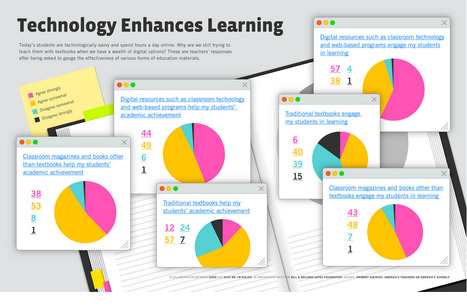
"Today’s students are technologically savvy and spend hours a day online. This infographic from Socrato illustrates teachers’ responses after being asked to gauge the effectiveness of various forms of education materials…. Might the same apply to instructors and employees within corporate/enterprise settings as well?"
Via EDTECH@UTRGV
|
|
Rescooped by
Kim Flintoff
from eLearning
May 26, 2012 10:01 PM
|
|