Your new post is loading...

|
Rescooped by
Peter Mellow
from The Student Voice
January 21, 2023 5:20 PM
|
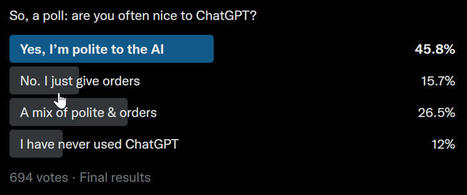
I think most people who are using ChatGPT to help with writing are doing it wrong. I don’t just mean because they using it to cheat on school assignments (don’t do that) or because they don’t check the facts that ChatGPT gives (they might be made up), but because they have the wrong mental model for how to work with the system.
I have mentioned that ChatGPT isn’t Google, and it isn’t Alexa, but it also isn’t a human that you are giving instructions to. It is a machine you are programming with words.
|
|
Rescooped by
Peter Mellow
from Educational Leadership
January 19, 2023 9:03 PM
|
OpenAI’s new chat bot is raising fears of cheating on homework, but its potential as an educational tool outweighs its risks.
|
|
Rescooped by
Peter Mellow
from Educational Leadership
January 19, 2023 9:03 PM
|
With the rise of the popular new chatbot ChatGPT, colleges are restructuring some courses and taking preventive measures.
|
|
Scooped by
Peter Mellow
January 19, 2023 9:02 PM
|
There has been a lot of hype over the last few weeks about students using ChatGPT, a conversational artificial intelligence (AI) that ca
|
|
Scooped by
Peter Mellow
January 14, 2023 4:17 AM
|
Machine learning that generates images and video could find use cases in higher education.
|
|
Scooped by
Peter Mellow
January 12, 2023 5:09 AM
|
An Ode to Online Learning - By ChatGPT
Oh Online Learning, how you've changed the game, Making education accessible to all, without any shame. Gone are the days of brick and mortar schools, With you, anyone can learn, break out of their own fools.
With the click of a button, the world is at our fingertips, Endless knowledge and resources, we no longer have to dip and dip. From coding to cooking, art to science, Online Learning gives us the chance for self-reliance.
No longer limited by location or time, Online Learning allows us to climb the educational climb. Opportunities for growth and advancement, With you, our potential for success is enhanced.
Thank you, Online Learning, for your endless possibilities, For breaking down barriers and creating opportunities. We are grateful for the doors you have opened wide, And the knowledge and skills you have provided.
An ode to Online Learning, a revolutionary way to learn, Empowering us to reach our full potential, and in turn, our own yearn.
|
|
Scooped by
Peter Mellow
January 8, 2023 1:27 AM
|
In this study, a grounded theory approach was used to investigate the process college and university instructors undergo to design and develop online courses. Fourteen instructors who created online courses for four-year colleges and universities were interviewed about their experience designing and developing online courses. Results showed that participants begin the process with objectives and/or with existing course outlines, typically taken from online and face-to-face courses. Next, the instructors structure the course and chunk content. The instructors interviewed rarely use formal instructional design principles, but their design tasks show a striking similarity to those formalized in the ADDIE model. Student feedback (evaluation) motivated the instructors in their development efforts after initial course delivery. The study discusses practical implications and suggests opportunities for future research.
|
|
Scooped by
Peter Mellow
January 4, 2023 7:09 PM
|
As higher education moves into the second wave of Dx — aligning digital efforts with institutional success — here are five key trends to watch.
|
|
Scooped by
Peter Mellow
December 23, 2022 11:40 PM
|
Assisting the Deaf community, helping reading comprehension, supporting endangered languages: is there anything captions can't do?
|
|
Scooped by
Peter Mellow
December 22, 2022 4:29 PM
|
How will higher education react to AI text generators?
|
|
Scooped by
Peter Mellow
December 11, 2022 1:52 AM
|
User needs are at the heart of the Web Content Accessibility Guidelines (WCAG). When you take user needs into account, applying accessibility principles becomes simpler, though not necessarily easier.
|
|
Rescooped by
Peter Mellow
from The Student Voice
December 7, 2022 12:06 AM
|
This week’s newsletter topic was inspired by a question that a participant in one of my online classes asked last week. That question was “can I use the pictures I find on Google Images?”…
Via Yashy Tohsaku, David W. Deeds, Peter Mellow
|
|
Scooped by
Peter Mellow
November 28, 2022 2:30 PM
|
Image descriptions can define photos, graphics, gifs, and video — basically anything containing visual information. Providing descriptions for imagery and video are required as part of WCAG 2.1 (for…
|
|
|
Rescooped by
Peter Mellow
from Educational Leadership
January 19, 2023 9:03 PM
|
The recent release of ChatGPT — a new natural language processor that can write essays, spit out a Haiku, and even produce computer code — has prompted more questions about what this means for the future of society than even it can answer, despite efforts to make it try. Faculty from the Stanford Accelerator for Learning are already thinking about the ways in which ChatGPT and
|
|
Rescooped by
Peter Mellow
from Educational Leadership
January 19, 2023 9:03 PM
|
Education institutions at all levels are increasingly having to figure out how to deal with the rise of clever AI that is easily accessible by students to use in their work.
|
|
Rescooped by
Peter Mellow
from Educational Leadership
January 19, 2023 9:03 PM
|
Artificial intelligence can be a valuable learning tool, if used in the right context. Here are ways to embrace ChatGPT and encourage students to think critically about the content it produces.
|
|
Scooped by
Peter Mellow
January 19, 2023 6:51 PM
|
Analyzing data across the institution to build a true picture of student engagement and using targeted, scripted reporting for meaningful insights has
|
|
Rescooped by
Peter Mellow
from EdTech: The New Normal
January 14, 2023 1:29 AM
|
With every new technology comes along opportunities and threats. In this case the threats are actually not that different to what mor
Via David W. Deeds
|
|
Scooped by
Peter Mellow
January 10, 2023 2:59 AM
|
Video-based learning is widely used today in both formal education and informal learning in a variety of contexts. Videos are especially powerful for transferable skills learning (e.g. communicating, negotiating, collaborating), where contextualization in personal experience and ability to see different perspectives are crucial. With the ubiquity of widely available video content, video-based learning is seen as one of the main strategies to provide engaging learning environments. However, numerous studies show that to learn effectively while watching videos, students need to engage actively with video content. We have developed an active video watching platform (AVW-Space) to facilitate engagement with video content by providing means for constructive learning. The initial studies with AVW-Space on presentation skills show that only students who commented on videos and who rated comments written by their peers have improved their understanding of the target transferable skill. In order to foster deeper engagement, we designed a choice architecture and a set of nudges to encourage students to engage deeper. We conducted two studies investigating the effect of nudges. The results provide evidence that the initial set of implemented nudges is effective: the students who received nudges wrote more comments, used different aspects, and there were more students who wrote comments. The nudges were particularly helpful for undergraduate students who were less experienced in self-regulated learning. Future work includes designing additional nudges to enhance student engagement by improving the quality of comments and by encouraging participation in collaborative activities.
|
|
Scooped by
Peter Mellow
January 4, 2023 7:11 PM
|
Online mentoring is an innovative and cost-efficient way to be more responsive and potentially better serve all students and faculty engaged in teachi
|
|
Scooped by
Peter Mellow
December 27, 2022 5:06 PM
|
Learning from video lectures is becoming a prevalent learning activity in formal and informal settings. However, relatively little research has been carried out on the interactions of learning strategies and social environment in learning from video lectures. The present study addresses this gap by examining whether learner-generated explanations and co-learner presence with or without nonverbal praise independently and interactively affected learning from a self-paced video lecture about infectious diseases. University students were randomized into viewing either the video with instructor-generated explanations or the same video but generating explanations themselves. Outcomes were assessed by the quality of explanations, learning performance, mental effort, attention allocation, and behavioral patterns. Between-group comparisons showed that, in the absence of a peer co-learner, learning performance was similar in both the instructor-generated and learner-generated explanation groups. However, in the presence of a peer, learner-generated explanation facilitated learning performance. Furthermore, learner-generated explanation in the presence of a co-learner also reduced learners’ mental effort and primed more behaviors related to self-regulation and monitoring. The results lead to the following strong recommendation for educational practice when using video lectures: if students learn by generating their own explanations in the presence of a co-learner, they will show better learning performance even though the learning is not necessarily more demanding, and will engage in more behaviors related to explanation adjustment and self-regulation.
|
|
Scooped by
Peter Mellow
December 22, 2022 11:03 PM
|
A digital learning strategy can help institutions reconcile a tradition of high-touch, in-person learning with the opportunities of digital learning.
|
|
Scooped by
Peter Mellow
December 20, 2022 7:14 PM
|
Writing well-researched content containing over 1,200+ words is often a requirement to gain a higher position in Google search results. When trying to score more points with SEO, web writers often forget that it’s not a search engine that reads posts, but a human being.
|
|
Scooped by
Peter Mellow
December 10, 2022 4:05 PM
|
Liquid Syllabus A humanizing element for online courses Sends the cue, “I will be a partner in your learning.” A Liquid Syllabus (Pacansky-Brock, 2021, 2014, 2017) is a humanizing element that ensures students start a course feeling supported by their instructor. It intentionally provides students with what they need to succeed in week one of…
|
|
Scooped by
Peter Mellow
November 28, 2022 2:33 PM
|
The European Framework for the Digital Competence of Educators
|